A newsletter signup form is far more than a simple web element; it stands as the critical conduit between a prospective audience member and a business’s direct communication channel, collecting vital subscriber information and seamlessly integrating it into an email platform for future engagement. For many small businesses, the prevailing approach has often been to implement a basic form and then largely disregard its ongoing performance. This oversight, however, represents a significant missed opportunity, as many forms inadvertently create barriers by demanding excessive information, failing to articulate clear value propositions, and being placed in static, low-visibility locations on a website. These shortcomings collectively translate into three primary points of friction, each capable of deterring a potential subscriber before they ever receive their inaugural email. Addressing these common deficiencies is paramount for any business aiming to cultivate a robust and engaged email list in the competitive digital landscape of 2026.
The Critical Role of Newsletter Signup Forms in Modern Digital Strategy
In an era increasingly defined by data privacy concerns and the gradual deprecation of third-party cookies, the value of first-party data, primarily gathered through email list subscriptions, has surged. Email marketing consistently delivers one of the highest returns on investment (ROI) among digital marketing channels, with industry reports frequently citing figures upwards of $36 for every $1 spent. This enduring efficacy underscores why the newsletter signup form is not merely a utility but a strategic asset. Unlike fleeting social media algorithms or paid advertising campaigns, an email list provides a direct, owned channel of communication, fostering deeper relationships and enabling targeted outreach. Small businesses, in particular, stand to gain immensely by prioritizing the optimization of these forms, transforming them from passive data collection points into dynamic conversion engines. The proper design and placement of a signup form can significantly amplify a business’s reach, build community, and drive sustained growth, serving as a foundational element of any comprehensive digital marketing strategy.
Evolution of Email List Building: A Historical Perspective
The journey of email list building reflects the broader evolution of digital marketing itself. In its nascent stages, around the turn of the millennium, signup forms were often rudimentary, consisting of little more than an email field and a “submit” button, typically relegated to a website’s footer. The primary goal was simply collection, with less emphasis on user experience or conversion psychology. As email marketing matured through the 2000s, businesses began experimenting with more prominent placements, such as sidebars and dedicated “contact us” pages. The rise of content marketing in the 2010s saw a greater focus on offering value in exchange for an email, leading to the proliferation of lead magnets and content upgrades, often paired with more sophisticated, multi-step forms. However, this period also introduced the pitfall of “form fatigue,” where excessive fields led to abandonment.
The mid-2020s ushered in a new era, characterized by a heightened awareness of user privacy, the demand for personalized experiences, and the advent of artificial intelligence (AI) tools. The shift from generic, one-size-fits-all templates to context-aware, benefit-driven forms became imperative. This evolution is driven by consumer expectations for transparency and relevance, compelling businesses to refine their list-building strategies. The article’s publication date of June 1, 2026, positions these insights at a crucial juncture where AI-powered solutions are not just innovative but becoming standard practice, representing the culmination of decades of learning in optimizing the digital handshake between businesses and their audiences.
Decoding the Anatomy of High-Converting Forms: Fields and Friction
The effectiveness of a newsletter signup form hinges significantly on its structural simplicity and the perceived effort required from the user. Every additional field beyond the absolute minimum introduces a degree of “friction,” a psychological barrier that can deter potential subscribers. Marketing analytics consistently demonstrate that reducing the number of input fields directly correlates with increased conversion rates, sometimes by as much as 20-30% for each field removed.
-
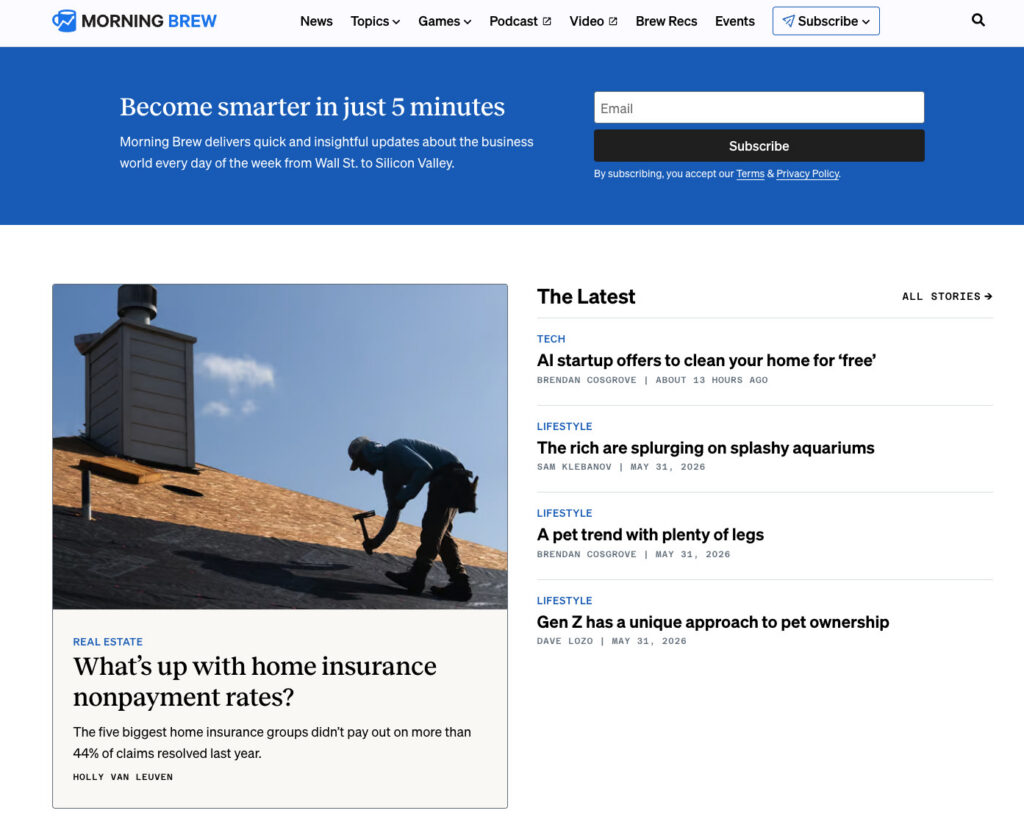
The ‘Less is More’ Principle: At its core, a newsletter signup form requires only two elements: an email address field and a clear call-to-action (CTA) button. This minimalist approach is rooted in the understanding that for most small business newsletters, an email address is the sole piece of information necessary to deliver the intended value. Businesses like “Morning Brew” and “The Hustle,” which have built multi-million dollar empires solely on newsletter subscriptions, exemplify this principle, often presenting just an email field prominently on their homepages. This streamlined design respects the visitor’s time and minimizes cognitive load, making the decision to subscribe effortless.
-
Strategic Personalization: The inclusion of a first name field can be justified, but only under specific circumstances: when a business genuinely intends to leverage this data for personalization within their email content. Addressing subscribers by name, for instance, with “Hey Sean,” rather than a generic “Hey there,” has been shown to modestly increase email open rates by 1-2% and click-through rates by a similar margin. However, if the collected name will not be actively used in personalized greetings or dynamic content, its presence on the form becomes an unnecessary point of friction. The decision to add this field must be a deliberate strategic choice, directly tied to the email content strategy, rather than a default inclusion.
-
Fields to Avoid: Protecting Trust and Efficiency: Certain data fields are almost universally detrimental to newsletter signup conversion rates. Phone numbers, company names, job titles, and physical addresses are typically associated with higher-commitment interactions, such as sales inquiries, whitepaper downloads, or lead generation for complex services. Including these on a simple newsletter form sends a signal that the business is seeking more than just a casual subscription, implying a transactional intent before any value has been delivered. This premature request for sensitive information can erode trust and significantly reduce signups. Unless the data collected serves a direct, immediate, and transparent purpose within the context of the newsletter, it should be omitted to maintain a low-friction, high-trust user experience. The maxim “if you cannot use the data, do not collect it” is a golden rule for effective form design.

Strategic Placement: Maximizing Visibility and Engagement
The visibility of a signup form is as crucial as its design. A perfectly optimized form that remains unseen will yield no subscribers. Strategic placement ensures the form intercepts visitors at opportune moments, maximizing the likelihood of conversion. Data from various A/B tests and marketing studies highlight distinct performance variations across different form locations, with some placements yielding significantly higher conversion rates than others.
-
Above the Fold on Your Homepage: This is premium digital real estate. For businesses where the newsletter is the primary product—like the aforementioned “Morning Brew” or “The Hustle”—placing the signup form prominently “above the fold” (visible without scrolling) on the homepage is non-negotiable. Visitors arrive with the explicit intent to subscribe. For businesses where the newsletter supports a product or service, a homepage form still holds value but must be integrated thoughtfully, complementing the main calls to action without overshadowing them. Conversion rates for above-the-fold forms can range from 1% to 5%, depending on the clarity of the value proposition and overall site design.
-
Persistent Sidebars and Headers: A sidebar signup form, typically on desktop, offers continuous visibility as users navigate content. For blogs or content-heavy sites, a persistent sidebar form keeps the subscription option in view without interrupting the reading flow. When the newsletter aligns with the content being consumed, this placement can be highly effective, often yielding conversion rates between 0.5% and 1.5%. On mobile devices, sidebars frequently collapse below the main content, making it crucial to pair this strategy with other mobile-optimized placements. Similarly, a compact form embedded in the website’s header or top navigation bar provides site-wide visibility, ensuring the subscription option is always accessible, particularly for visitors browsing multiple pages. These are typically minimalist, featuring just an email field and a button.
-
The Power of a Dedicated Landing Page: A standalone page exclusively dedicated to the newsletter allows ample space to articulate its unique value proposition without competing with other website elements. This is especially potent for promoting the newsletter across external channels—social media bios, podcast show notes, guest post bylines, and email signatures. As business strategist Alexandra Franzen, who famously built her audience primarily through email, emphasizes, a newsletter should be an “art project,” so compelling that readers enthusiastically share it. A dedicated signup page should embody this philosophy, selling the experience and intrinsic value rather than just the act of subscribing. These pages, when well-crafted, can achieve conversion rates upwards of 10-20% due to their focused nature.
-
Catching Attention with Exit-Intent Pop-ups: An exit-intent popup is a last-ditch effort to capture a visitor’s attention before they leave the site, triggering when their cursor moves towards the browser’s close or back button. While some find pop-ups intrusive, when implemented judiciously—shown once per session, with a clear close button, and a highly specific, benefit-driven offer—they can be remarkably effective. For instance, “Get weekly email tips for your small business” is far more persuasive than a generic “Subscribe to our newsletter.” Exit-intent pop-ups often achieve conversion rates ranging from 2% to 5%, demonstrating their power as a final engagement opportunity.
-
The Footer: A Safety Net for Engaged Visitors: The website footer serves as a common destination for visitors seeking additional information or contact options after consuming the main content. Placing a newsletter signup form here acts as a “safety net,” capturing individuals who have scrolled through the entire page and demonstrated sufficient interest to explore further. While typically lower-converting than more prominent placements (often around 0.2-0.8%), the footer still serves an important role, ensuring no potential subscriber is overlooked.
Crafting Compelling Copy: The Art of Conversion-Driven Messaging
Beyond placement and field count, the language used on a signup form is a primary determinant of its conversion success. Effective copy addresses three core questions in the visitor’s mind: What will I gain? How frequently will I receive it? And how much effort is required?
-
Beyond ‘Subscribe’: Emphasizing Value: The most common mistake in form copy is defaulting to generic phrases like “Subscribe to our newsletter.” This tells the user what to do but provides no compelling reason to do it. It places the burden on the reader to infer value. Instead, benefit-driven language directly answers the “What’s in it for me?” question. For example, “Get one email per week with strategies to grow your small business” immediately conveys the content, frequency, and relevance. This shift from action-oriented to value-oriented language has been shown to increase signup rates by 15-25% in various A/B tests. The difference is stark: “Subscribe to our newsletter” is a command; “Get our Tuesday email: one tactic to grow your list this week” is a clear promise of specific, timely value.
-
Setting Expectations: The Frequency Contract: One of the most overlooked yet critical elements of signup form copy is setting clear frequency expectations. Explicitly stating “sent every Tuesday,” “twice a month,” or “weekly” creates a transparent contract between the business and the subscriber. This upfront communication significantly reduces post-signup unsubscribes, which often occur when an email arrives unexpectedly or more frequently than anticipated. Subscribers who opt-in with full knowledge of the sending schedule are less likely to feel overwhelmed or “spammed.” This mutual understanding builds trust from the very first interaction, leading to a more engaged and loyal subscriber base, often reducing first-month unsubscribe rates by 5-10%.
-
Action-Oriented Calls-to-Action: The button text is the final prompt before conversion. Generic terms like “Submit” or even “Subscribe” are often less effective than specific, benefit-mirroring calls to action. If the headline promises “Weekly email marketing strategies for small businesses,” the button could reinforce this with “Get weekly strategies” or “Send me the tips.” This makes the button a confirmation of value rather than a mere mechanical action, improving click-through rates by 5-10%. Incorporating social proof, such as “Join 1,200 readers,” can also be highly persuasive, leveraging the psychological principle that people are more likely to follow the actions of others. However, button text should always avoid ambiguity; phrases like “Learn more” or “Get started” are too vague and do not clearly communicate the immediate outcome of clicking.
The Advent of AI in Form Generation: A New Paradigm
For years, the standard advice for creating signup forms involved selecting a template and customizing it with brand colors and logos. The inherent limitation of this approach, however, is that templates are by nature generic, built to serve a broad audience rather than the unique specifics of an individual business. This often forced businesses to retroactively fit their distinct brand voice, content, and audience into a pre-defined structure, leading to forms that felt disconnected or unoptimized.
-
Customization at Scale: AWeber’s AI Signup Form Builder: The landscape is rapidly changing with the introduction of intelligent tools like the AI Signup Form Builder by AWeber, launched around June 2026. This technology represents a significant leap forward, moving beyond static templates to dynamic, context-aware form generation. Instead of starting with a blank canvas or a generic template, users simply describe their newsletter’s purpose and target audience. The AI then analyzes the business’s website, understanding its content, tone, and brand identity, to generate a complete form that is custom-tailored. This includes not only design elements but also benefit-driven copy, optimal field structures, and even suggested placements, all aligned with the business’s unique offerings.
-
Bridging the Gap: From Generic Templates to Tailored Solutions: AWeber’s Chief Product Officer, Chris Vasquez, demonstrated this transformative capability, showcasing how a standard newsletter signup form could be instantly elevated to one that perfectly embodies a brand’s essence, as seen with Keenya Kelly’s website. The AI-generated forms are versatile, embeddable on any page, usable as standalone landing pages, or deployable as exit-intent pop-ups, with the AI guiding placement suggestions. Crucially, each form seamlessly integrates with the subscriber list, ensuring new signups are immediately ready for subsequent email campaigns. This innovation democratizes advanced marketing techniques, making highly optimized, brand-aligned forms accessible even to small businesses without dedicated design or copywriting teams.
Measuring Success: Analytics for Continuous Optimization
The creation of an optimized signup form is merely the initial step; continuous monitoring and analysis of its performance are essential for sustained growth. Data-driven insights reveal what resonates with an audience and where improvements can be made.
-
Conversion Rate by Placement: Identifying Strengths: Tracking the conversion rate for each form placement—e.g., sidebar, footer, dedicated page, pop-up—provides invaluable data. A form embedded in a high-traffic, top-performing blog post might convert at 3%, while a footer form might yield 0.5%. This granular data directs where marketing efforts should be concentrated and which placements require further optimization. Tools like AWeber’s AI Signup Form Builder are designed to automatically track this data, offering businesses a clear overview of their most effective channels. This allows for agile adjustments, reallocating resources to high-performing forms or redesigning underperforming ones.
-
First-Month Unsubscribe Rates: A Barometer of Expectation Management: A high unsubscribe rate within the first 30 days post-signup is a critical indicator that the signup form may be setting incorrect expectations. This mismatch between the promise made on the form (e.g., “weekly tips on small business growth”) and the reality of the delivered content (e.g., daily promotional emails) is a primary driver of early churn. Regularly reviewing the form copy against the actual email content, frequency, and tone is crucial. A well-aligned promise and delivery foster trust and lead to a more engaged, long-term subscriber base. Analyzing these rates helps businesses refine their messaging and ensure transparency, thereby nurturing a healthier email list.
Broader Implications for Small Businesses and the Digital Landscape
The strategic optimization of newsletter signup forms, particularly with the advent of AI-powered builders, carries profound implications for small businesses and the broader digital marketing ecosystem. For small businesses, this shift democratizes access to sophisticated list-building techniques previously requiring significant expertise or resources. It levels the playing field, enabling them to compete more effectively with larger entities by building highly engaged, first-party data lists. This directly translates to improved customer relationships, higher conversion rates on email campaigns, and a more sustainable marketing channel less reliant on fluctuating third-party platforms.

For the digital landscape, the trend towards intelligent, context-aware form generation signifies a broader movement towards hyper-personalization and efficiency in marketing technology. AI’s ability to interpret brand identity and content nuances means that even routine tasks like form creation can now contribute significantly to brand consistency and conversion optimization. This reduces the time and effort marketers spend on setup, allowing them to focus more on content creation and strategy. Ultimately, this evolution promises a future where digital interactions are more intuitive, relevant, and valuable for both businesses and consumers, fostering a more engaging and less intrusive online experience.
Frequently Asked Questions
-
Defining the Newsletter Signup Form: A newsletter signup form is a dedicated web interface, either embedded within a page or presented as a standalone entity, specifically designed to gather visitor information for subscription to a recurring email newsletter. Distinct from general email signup forms that might funnel into automated sequences, product updates, or transactional communications, its singular purpose is to enroll individuals onto a specific newsletter list. This precise focus necessitates that the form’s design, messaging, and data fields are meticulously crafted to align with the explicit content and frequency of the newsletter, ensuring subscribers have accurate expectations.
-
Integrating Forms with Your Website: The process of adding a newsletter signup form to a website has become increasingly streamlined. Using modern tools like AWeber’s AI Signup Form Builder, businesses can describe their newsletter, and the AI will generate a customized form. Once approved, the platform provides an embed code. This code can then be easily pasted into the HTML of any website page. Content management systems such as WordPress, Squarespace, Wix, and similar website builders typically feature a “custom HTML” or “code block” option where this embed code can be inserted, allowing the form to appear seamlessly within the site’s design.
-
Extending Reach to Social Media: To leverage social media platforms for list growth, after creating your signup form in a platform like AWeber, obtain its unique hosted URL. This link can then be strategically placed across various social media touchpoints. Common applications include adding the link to your Facebook page’s action button (e.g., “Sign Up”), integrating it into your Instagram or TikTok bio, or pinning it as a prominent post on platforms like X (formerly Twitter). When clicked, this link directs visitors to your dedicated hosted form, enabling them to subscribe without needing to navigate away from their current browser session.
-
Understanding HTML Integration: While modern form builders automate much of the technical work, understanding HTML integration remains valuable for advanced customization. Platforms like AWeber typically generate a functional HTML version of your form. This code provides a clean, pre-wired structure where the subscription logic is already connected to your email list. Users with HTML proficiency can then directly edit this code to fine-tune styling, modify field labels, adjust the layout, or integrate it into highly customized website environments, all without having to build the backend subscription mechanism from scratch. This flexibility allows for deep brand integration and unique user experiences.
Expert Insight and Future Outlook
Sean Tinney, a content marketer at AWeber with over 15 years of experience collaborating directly with small business owners on email strategy, list building, and automation, emphasizes a pragmatic approach. His focus on “what actually moves the needle for businesses without large marketing teams” underpins the insights shared in this article. Tinney’s work highlights the critical shift from merely collecting emails to strategically building engaged communities through thoughtful form design and placement.
Looking ahead, the ongoing advancements in AI are poised to further revolutionize email marketing. We can anticipate even more predictive capabilities, where AI not only generates forms but also dynamically optimizes their content and placement in real-time based on visitor behavior and historical conversion data. This continuous learning will enable businesses to achieve unprecedented levels of efficiency and personalization in their list-building efforts, ensuring that the newsletter signup form remains a cornerstone of effective digital engagement for years to come.