The e-commerce landscape is in constant flux, driven by rapid technological advancements and evolving consumer expectations. This week’s roundup of new services for online merchants highlights a significant surge in AI-powered solutions, agentic commerce infrastructure, and enhanced payment and logistics capabilities. From optimizing product visibility and streamlining affiliate marketing to fortifying against bots and enabling seamless cross-border transactions, these innovations are poised to reshape how businesses operate and engage with customers in the digital realm.
Key Developments in E-commerce Technology
This installment features a comprehensive overview of recent product releases and service expansions designed to empower e-commerce merchants. These updates span a wide array of critical business functions, including:
- Enhanced Creator and Affiliate Tools: Pinterest’s integration with Amazon storefronts aims to simplify affiliate marketing for content creators.
- Payment Infrastructure Advancements: ACI Worldwide’s role in powering instant payments across Europe and Visa’s exploration of agentic commerce infrastructure with OpenAI signal a future of faster, more integrated financial transactions.
- AI and Agentic Commerce Solutions: A notable trend is the proliferation of AI-driven tools for everything from bot protection and product discovery to subscription management and automated media buying.
- Logistics and Fulfillment Innovations: Amazon’s expansion of its less-than-truckload (LTL) freight offering provides greater flexibility for businesses of all sizes.
- Streamlined Visual Content Creation: New tools are emerging to simplify the creation of compelling product imagery and videos.
Empowering Creators and Affiliates
Pinterest Integrates Amazon Storefront Linking for Creators
Pinterest has introduced a significant enhancement for its creator community by enabling direct linking to Amazon storefronts. This new feature allows creators to tag Amazon products within their pins, with Pinterest automatically applying their Amazon affiliate information. This automation eliminates the manual process of adding affiliate links or IDs, thereby streamlining the monetization process for influencers and content creators on the platform.
Furthermore, creators can now feature a dedicated Amazon storefront directly on their Pinterest profile. This provides users with a more comprehensive view of the products recommended by their favorite creators, fostering a more integrated shopping experience. The move by Pinterest is a strategic effort to deepen its e-commerce capabilities and capitalize on the growing trend of social commerce, where content discovery directly influences purchasing decisions. By simplifying affiliate partnerships, Pinterest aims to incentivize more creators to leverage the platform for product promotion, potentially driving increased sales for Amazon sellers and enriching the discovery experience for Pinners.
Transforming Payment Systems
ACI Worldwide to Power Instant Payments Across Europe with EPI’s Wero Wallet
ACI Worldwide, a prominent global payments platform, has announced its strategic partnership with the European Payments Initiative (EPI) as a technical service provider. This collaboration will see the integration of EPI’s innovative Wero digital wallet solution into ACI’s existing infrastructure. Wero is designed as a pan-European digital wallet that operates on the Single Euro Payments Area (SEPA) instant payment rails.
The Wero wallet aims to facilitate a range of payment activities, including peer-to-peer transfers, online e-commerce transactions, and point-of-sale purchases. For merchants and financial intermediaries across Europe, this integration signifies an opportunity to offer consumers and businesses a unified, instant payment solution. The rollout of Wero is a critical step towards a more harmonized European payments market, addressing the fragmentation that has historically hindered seamless cross-border transactions. The ability to process payments instantly can significantly improve cash flow for businesses and enhance the customer experience by reducing checkout friction. This initiative is expected to accelerate the adoption of real-time payments, a trend that has seen significant growth globally, driven by consumer demand for speed and convenience.
Visa and OpenAI Forge Ahead with Agentic Commerce Infrastructure
Visa, a global leader in digital payments, has announced a groundbreaking collaboration with OpenAI, the artificial intelligence research laboratory, to develop infrastructure for agentic commerce. This partnership signifies a forward-looking approach to integrating artificial intelligence into the fabric of commercial transactions.

Under this agreement, Visa will embed its robust payment capabilities into OpenAI’s AI experiences. This will empower developers and merchants to accept payments initiated by AI agents, a concept that represents a significant shift in how transactions can occur. Visa will provide the foundational global network, advanced payment tokenization, secure authorization processes, agent identification protocols, and comprehensive fraud monitoring infrastructure. These elements are crucial for ensuring the security and reliability of AI-initiated transactions.
Beyond the immediate implications for agentic commerce, Visa and OpenAI also plan to explore further applications. This includes the potential for embedding payment primitives and trusted agent identity signals into developer-focused experiences powered by Codex, OpenAI’s coding agent. This exploration signals a commitment to building a future where AI agents can seamlessly and securely participate in commercial ecosystems, automating complex purchasing processes and unlocking new efficiencies for businesses and consumers alike. The development of agentic commerce infrastructure has the potential to revolutionize online shopping, making it more personalized, efficient, and automated.
Fortifying Against Digital Threats
Kinsta Enhances WordPress Security with Integrated Bot Protection
Kinsta, a leading managed hosting provider for WordPress, has rolled out a comprehensive bot protection feature directly within its MyKinsta dashboard. This proactive security measure puts website owners in greater control of the traffic accessing their sites, offering granular control over who and what can pass through.
The new bot protection system provides four distinct, configurable levels of security: “Block Malicious Traffic,” “Block Automations,” “Challenge Bots,” and “Challenge Everyone.” These presets allow users to tailor their security posture based on their specific needs and threat landscape. Importantly, Kinsta is offering this advanced bot protection as a no-cost addition to all its hosting plans, underscoring the company’s commitment to providing robust security solutions to its clientele without additional financial burden.
In an era where websites are constantly under siege from malicious bots attempting to scrape data, launch denial-of-service attacks, or exploit vulnerabilities, this integrated solution is a critical development. Bot traffic can not only compromise security but also skew analytics, negatively impact user experience, and consume valuable server resources. By providing these customizable protection levels, Kinsta empowers its users to mitigate these risks effectively, ensuring a safer and more reliable online environment for their WordPress websites. The cost-effectiveness and ease of integration make this a particularly attractive offering for small to medium-sized businesses relying on WordPress for their online presence.
Optimizing Logistics and Fulfillment
Amazon Supply Chain Services Expands Less-Than-Truckload (LTL) Freight Offering
Amazon has announced a significant expansion of its Less-Than-Truckload (LTL) freight services across the United States. This enhancement, part of Amazon Supply Chain Services, now allows businesses to ship goods to any destination, including third-party warehouses, distribution centers, and retail partners.
This expansion provides businesses with increased flexibility in their shipping strategies. The LTL service allows shippers to send freight by pallet, utilizing trailer space for partial loads. This is particularly beneficial for businesses that do not have enough volume to fill an entire truck, as it offers a more cost-effective alternative to full truckload shipping. By opening up its extensive logistics network for LTL shipments, Amazon is aiming to capture a larger share of the business-to-business (B2B) freight market, competing with traditional freight carriers.
The move signifies Amazon’s ongoing strategy to leverage its logistical prowess beyond its own e-commerce operations. Offering LTL services to external businesses is a natural extension of its existing capabilities, providing a valuable service to merchants who can benefit from Amazon’s scale, efficiency, and reliability. This can help businesses reduce shipping costs, improve delivery times, and streamline their supply chain operations, ultimately enhancing their competitive edge in the market. The broader availability of LTL services is expected to introduce more competitive pricing and service options within the freight industry.
The Rise of Agentic Commerce and AI Orchestration
Kyndryl Releases AI Orchestration for Business to Accelerate Agent-Driven Transformation

Kyndryl, a leading provider of enterprise technology services, has launched “AI Orchestration for Business.” This new offering is built upon Kyndryl’s existing Agentic AI Framework, which integrates data, events, and AI agents to create intelligent workflows.
According to Kyndryl, AI Orchestration for Business is designed to support agentic workflows across various business operations, including retail store management and broader enterprise functions. Key applications highlighted by Kyndryl include agentic commerce, where AI agents can autonomously manage purchasing processes, supply chain disruption management, enabling proactive responses to unforeseen events, and role-based operational orchestration, ensuring tasks are performed by the most appropriate AI agents.
The introduction of AI orchestration signifies a move towards more sophisticated and autonomous business processes. By combining data insights with AI agent capabilities, businesses can automate complex decision-making and execution across their operations. This has profound implications for efficiency, responsiveness, and adaptability in a rapidly changing market. The framework’s focus on agentic commerce suggests a future where AI agents play a central role in customer interactions and transactions, potentially leading to more personalized and seamless shopping experiences.
Subotiz Launches AI Agent Suite and MCP Server for Subscription Commerce
Subotiz, a platform specializing in subscription commerce, has introduced its AI Agent Suite and MCP (Merchant Control Panel) Server. These new tools are aimed at democratizing the design, management, and scaling of global subscription commerce models for the era of generative AI and Software as a Service (SaaS).
The AI Agent Suite comprises several specialized agents: Collect Agent, Onboard Agent, Merchant Agent, Data Agent, and Email Agent. These components are designed to automate and enhance various aspects of the subscription lifecycle. The MCP Server further empowers users by enabling them to create customer profiles, adjust pricing plans, audit live webhook event logs, inspect refund histories, and retrieve documentation, all through natural language commands.
This launch addresses the growing complexity of subscription businesses, particularly in the context of AI-driven personalization and management. By leveraging natural language processing, Subotiz aims to make sophisticated subscription management accessible to a wider range of users, reducing the technical barrier to entry. The ability to automate key functions and gain insights through simple language commands can significantly improve operational efficiency and allow merchants to focus on strategic growth and customer retention.
ShopAgentic Secures Funding to Build Agentic Commerce Infrastructure
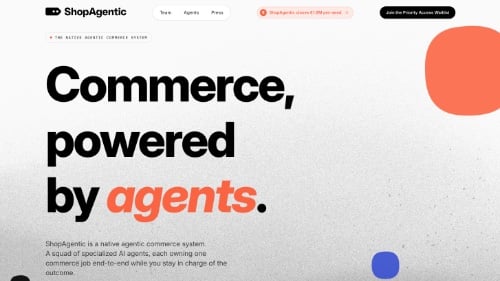
ShopAgentic, a company developing coordinated AI agents for e-commerce automation, has successfully closed a pre-seed funding round, securing €1.9 million (approximately $2.2 million USD). The round was led by May Ventures and Greenfield Capital.
ShopAgentic’s core offering is a system of specialized AI agents designed to automate critical e-commerce functions. These include catalog management, dynamic pricing adjustments, customer service operations, and fulfillment processes. By orchestrating these AI agents, ShopAgentic aims to create a highly efficient and automated e-commerce ecosystem.
The capital raised will be instrumental in accelerating ShopAgentic’s product development, deepening integrations across the broader commerce ecosystem, and expanding its team. This investment underscores the growing market confidence in the potential of agentic commerce to transform online retail by enabling businesses to operate with greater speed, precision, and scalability. The focus on automating fundamental e-commerce processes suggests a future where AI agents handle a significant portion of the operational workload, freeing up human resources for more strategic initiatives.

Athos Commerce Unveils Intelligent Product Discovery Platform
Athos Commerce, a platform dedicated to enhancing product visibility for merchants, has launched its “Commerce Intelligent Discovery” framework. This AI-powered solution aims to connect shoppers with the right products across various shopping channels.
The Commerce Intelligent Discovery framework integrates several key components into a single platform. These include intelligent search capabilities, advanced personalization engines, sophisticated merchandising tools, comprehensive product feed management, and optimization for generative AI engines. The overarching goal of this integrated approach is to help e-commerce brands improve product discoverability, drive higher conversion rates, and deliver superior shopping experiences across both traditional and emerging generative channels.
In an increasingly crowded online marketplace, product discoverability is a paramount challenge for brands. Athos Commerce’s solution tackles this by leveraging AI to understand shopper intent and product attributes more effectively. The integration with generative channels is particularly noteworthy, anticipating the future of shopping where AI assistants may play a more significant role in product discovery and recommendation. By offering a unified platform, Athos Commerce simplifies the complex task of optimizing product visibility and engagement for its clients.
DoorDash Debuts Conversational Search Tool
DoorDash, the popular food delivery and logistics platform, has introduced “Ask DoorDash,” a new conversational search tool integrated into its app. This feature aims to enhance the user experience by allowing for more intuitive and natural language-based product discovery.
With Ask DoorDash, users can initiate searches by tapping an “Ask” button within the search bar. They can then share recipe links, upload photos of cookbooks, or describe the specific items or dining experiences they are looking for. The tool is currently available in select areas for iOS users, focusing on restaurant search and grocery shopping functionalities.
The introduction of conversational search marks a significant step towards making online discovery more human-centric. Instead of relying on precise keywords, users can engage with the app in a more conversational manner, similar to how they might ask a friend for a recommendation. This innovation has the potential to make it easier for consumers to find what they need, especially when their needs are complex or difficult to articulate through traditional search queries. This move by DoorDash reflects a broader industry trend towards utilizing AI to create more personalized and user-friendly interfaces.
Fast Simon Launches AI Personalization for Merchandisers
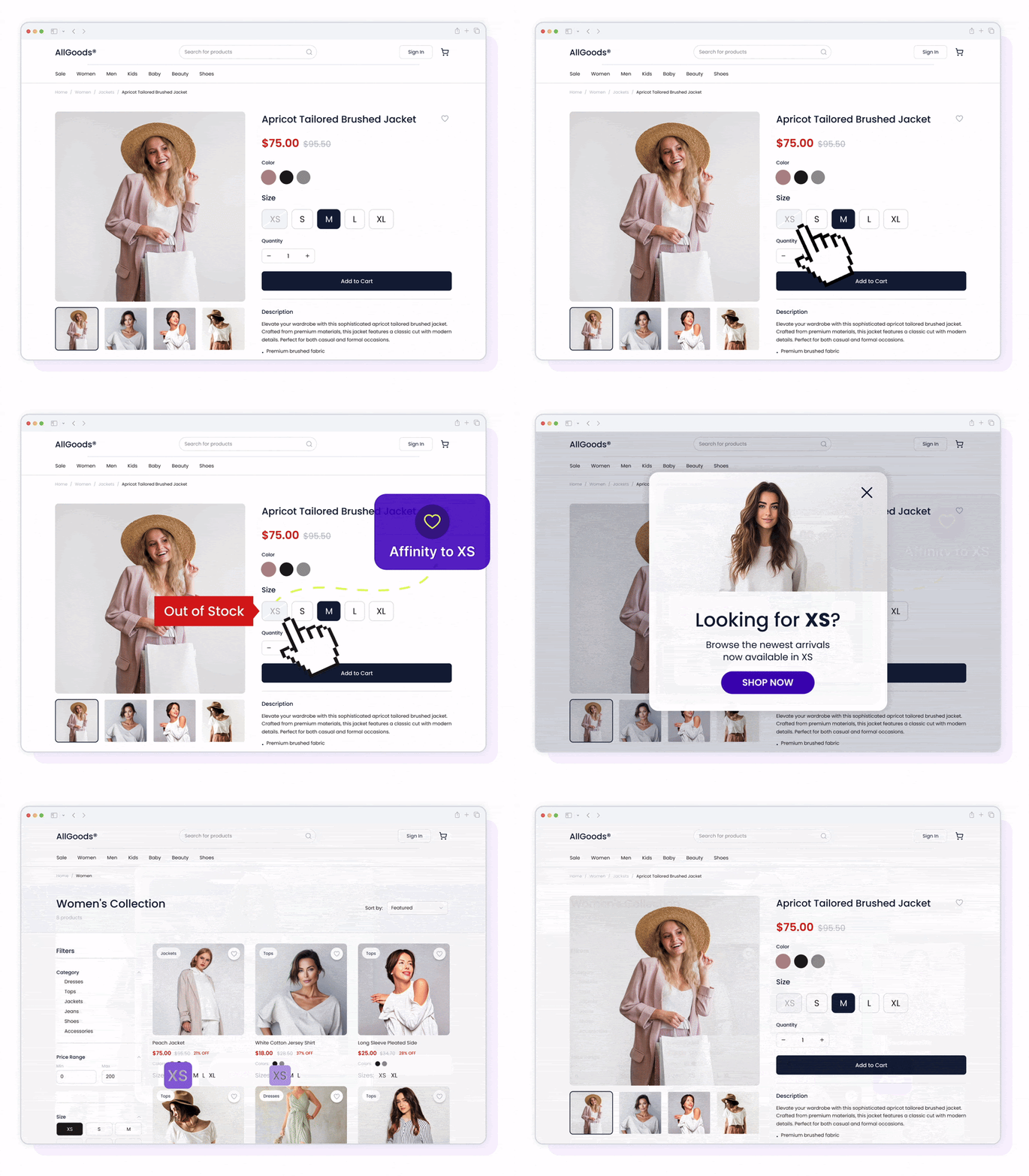
Fast Simon, a platform focused on e-commerce search and merchandising, has unveiled a new AI personalization tool specifically designed for mid-market and enterprise brands operating on Shopify.
This AI-driven tool is engineered to optimize various aspects of a brand’s online presence and sales strategy. Key areas of focus include enhancing brand presentation, refining collection strategies, optimizing product launches, managing promotions more effectively, and improving inventory management. By leveraging AI, Fast Simon aims to provide merchandisers with powerful tools to create more engaging and effective shopping experiences that drive sales.
The introduction of AI personalization tools tailored for merchandisers signifies a growing demand for sophisticated solutions that go beyond basic search functionality. Merchandisers are tasked with curating product assortments, designing promotional campaigns, and ensuring the overall shopping experience is appealing and conversion-oriented. AI personalization can provide data-driven insights and automated adjustments to help them achieve these goals more efficiently and effectively. This can lead to increased customer engagement, higher conversion rates, and improved overall revenue for brands.
LinkedIn Introduces Creator Marketplace and BrandWorks
LinkedIn, the professional networking platform, has launched two new initiatives: Creator Marketplace and BrandWorks. These offerings are designed to enhance collaboration between brands and content creators on the platform, particularly within the business-to-business (B2B) sector.
Creator Marketplace aims to simplify the process for brands to discover credible content creators, initiate collaborations, and amplify both organic and sponsored content. This platform is expected to streamline the influencer marketing process on LinkedIn, making it more efficient for B2B marketers to identify and engage with relevant creators who can reach their target audiences.
BrandWorks, on the other hand, provides hands-on strategy and support to B2B marketers. Its focus is on helping these marketers develop and execute high-performing campaigns. This service acknowledges the unique challenges and opportunities present in B2B marketing, where building relationships and establishing thought leadership are crucial.
The introduction of these features signals LinkedIn’s strategic push to become a more comprehensive platform for B2B marketing and brand building. By facilitating creator collaborations and offering strategic support, LinkedIn is empowering businesses to leverage content marketing and influencer strategies more effectively to achieve their professional and commercial objectives.
Merchantee Secures Funding for Agentic Marketplace Management
Merchantee, a startup focused on agentic marketplace management, has raised €1.8 million (approximately $2.1 million USD) in funding. The round was led by Reflex Capital, with participation from Czech Founders VC and Lighthouse Ventures.
Merchantee’s agentic marketplace platform model is designed to manage data, decision-making, execution, and optimization within online marketplaces. The platform allows sellers to define their own budget and sales limits, which then guide automated discount campaigns, dynamic price adjustments, and participation in promotional activities. This approach empowers sellers to maintain control over their profitability while leveraging AI-driven automation to optimize their performance.
The secured funding will be allocated to expanding Merchantee’s product development efforts and increasing its marketplace integrations. This investment highlights the growing interest in AI-driven solutions that can automate complex marketplace operations and provide sellers with greater control and efficiency. The ability to automatically adjust pricing and promotions based on predefined parameters can lead to improved sales performance and profitability for sellers operating in competitive online marketplaces.
Shopware Launches Payment Acceptance in Partnership with PayPal

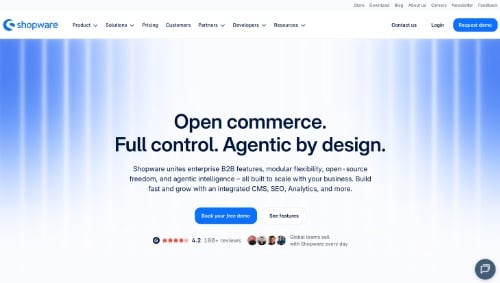
Shopware, an open-source e-commerce platform, has introduced “Shopware Payments,” a new payment acceptance feature developed in collaboration with PayPal. This integration aims to simplify payment processing for Shopware merchants.
Shopware Payments provides merchants with a unified solution to activate and manage a wide range of checkout methods. This includes traditional payment options like credit and debit cards, as well as popular digital wallets, buy-now-pay-later services, and direct PayPal and Venmo transactions. The goal is to offer a seamless and flexible checkout experience for customers, thereby reducing cart abandonment and increasing conversion rates.
The partnership with PayPal is a strategic move to leverage PayPal’s extensive payment network and trusted brand recognition. For Shopware merchants, this integration means easier access to a comprehensive suite of payment options without the need for complex third-party integrations. This move is particularly beneficial for small and medium-sized businesses that may have limited resources for managing multiple payment gateways. By offering a robust and user-friendly payment solution, Shopware is enhancing its platform’s value proposition and supporting its merchants’ growth.
Enhancing Media Buying and Profitability with AI
Triple Whale Launches Moby Automations for E-commerce Campaigns
Triple Whale, an AI-powered optimization system for e-commerce, has launched “Moby Automations.” This suite of tools is designed to automate key aspects of media buying, empowering e-commerce businesses to manage their advertising campaigns more efficiently and effectively.
Moby Automations offers several core functionalities. Users can automate the scaling of winning campaigns by providing Moby with their existing campaign management rules. The system can also manage creative performance at scale by analyzing large libraries of ad creatives to identify and promote top performers. Furthermore, it provides the capability to track campaign results across multiple attribution models, offering a more comprehensive view of advertising effectiveness.
The introduction of Moby Automations by Triple Whale reflects the increasing demand for AI-driven solutions in digital advertising. Media buying can be a complex and time-consuming process, requiring continuous monitoring and adjustments. By automating these tasks, Moby Automations allows advertisers to focus on strategy and creative development, while the AI handles the optimization and execution. This can lead to improved return on ad spend (ROAS), increased campaign efficiency, and better overall performance for e-commerce businesses.
Fractal Launches Cogentiq E-commerce: An AI-Native Profit Engine
Fractal, a developer of AI solutions, has launched “Cogentiq e-commerce.” This AI-native profit engine is designed to help consumer product companies optimize their performance across marketplace and other sales channels.
Cogentiq e-commerce continuously monitors key profit signals, including stock levels, media spend, keyword performance, content effectiveness, and pricing strategies. By analyzing these critical factors, the platform helps ensure that products remain available, discoverable, and are more likely to convert into purchases. Cogentiq currently integrates with Amazon and has plans to expand its capabilities to other platforms in the near future.
The launch of Cogentiq e-commerce highlights the growing trend of AI solutions focused on driving profitability rather than just sales volume. By providing real-time insights and automated adjustments based on profit signals, the platform enables companies to make more informed decisions that directly impact their bottom line. This approach is particularly valuable in the competitive e-commerce landscape, where margins can be thin and efficient management of various operational aspects is crucial for success.
Pollo AI Launches Commerce Studio to Streamline Product Visual Creation
Pollo AI, a creative suite provider, has launched “Commerce Studio,” a new tool aimed at streamlining the creation of product visuals for e-commerce sellers. This platform offers a range of AI-powered solutions designed to enhance product presentation and appeal.
Commerce Studio features several key functionalities. Its video maker transforms standard product images into dynamic clips with motion, close-ups, and professional presentation-ready scenes. The virtual try-on photo feature allows products to be showcased on realistic AI avatars, providing a more engaging visualization for customers. Additionally, the AI product shot generator creates studio-quality and lifestyle product photos with refined composition.
The ability to quickly and cost-effectively generate high-quality product visuals is crucial for e-commerce success. Pollo AI’s Commerce Studio addresses this need by leveraging AI to automate and enhance the visual content creation process. This can significantly reduce the time and resources traditionally required for professional photography and videography, making it more accessible for businesses of all sizes. Enhanced product visuals are known to improve customer engagement, build trust, and ultimately drive higher conversion rates, making this a valuable tool for online retailers.
Conclusion
The flurry of new services and innovations released this week underscores the dynamic and rapidly evolving nature of the e-commerce industry. From the integration of creator economies with major marketplaces like Amazon and Pinterest, to the foundational shifts in payment infrastructure driven by companies like ACI Worldwide and Visa, to the pervasive influence of AI across all facets of online retail, merchants have an unprecedented array of tools at their disposal.
The continued development of agentic commerce, exemplified by initiatives from Kyndryl, ShopAgentic, and Merchantee, points towards a future where AI agents autonomously manage significant aspects of business operations, from marketing and sales to customer service and fulfillment. This promises to unlock new levels of efficiency and scalability.
Simultaneously, the focus on enhancing product discoverability and visual presentation, as seen with Athos Commerce and Pollo AI, addresses core challenges in online retail. The advancements in conversational search by DoorDash and AI-powered personalization by Fast Simon further illustrate the industry’s commitment to creating more intuitive and tailored customer experiences.
As these technologies mature and become more widely adopted, e-commerce merchants who embrace these innovations are likely to gain a significant competitive advantage. The ability to leverage AI for automation, optimization, and enhanced customer engagement will be key to navigating the complexities of the modern digital marketplace and achieving sustainable growth.