The Reuters Institute for the Study of Journalism, a leading global research center dedicated to exploring the future of journalism worldwide, has released its highly anticipated 2026 Digital News Report. This comprehensive annual study offers a panoramic view of the evolving information ecosystem, meticulously detailing how individuals across the globe are consuming news and forming opinions in an increasingly complex digital age. Based on extensive survey data gathered from over 85,000 respondents across 48 diverse regions, the report serves as a critical benchmark, providing invaluable insights into contemporary news consumption patterns and the multifaceted factors that exert influence on public perception. The overriding conclusion drawn from this year’s findings is unequivocal: social media platforms have solidified their position as the primary daily conduit for news, a development with profound implications for journalistic integrity, information dissemination, and democratic discourse.
The Unprecedented Ascendancy of Social Platforms
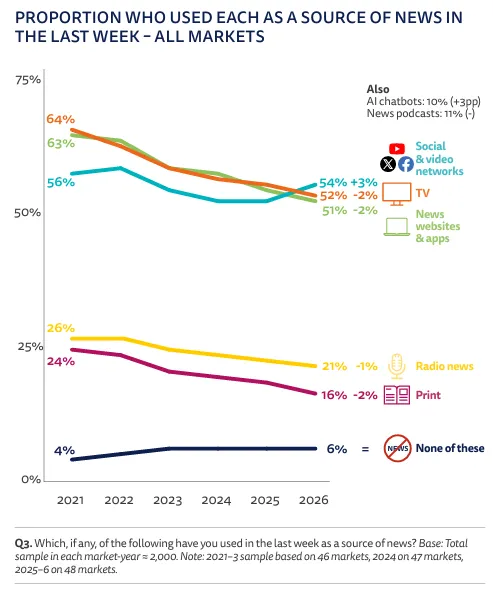
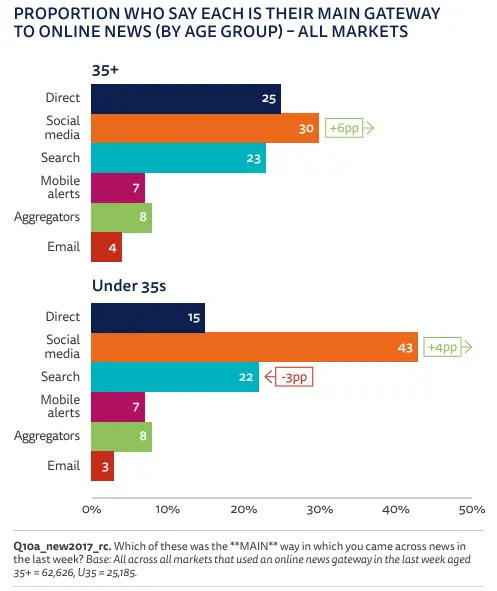
For the first time in the report’s history, social media has unequivocally emerged as the key driving force behind daily news consumption, surpassing established giants like television broadcasters and traditional news websites. The data illustrates a significant paradigm shift, with a growing majority of individuals now relying on discovery within social applications for their informational intake, rather than actively navigating to dedicated news sites or tuning into scheduled broadcasts. This transition reflects not merely a change in platform preference but a fundamental reorientation of how news is encountered, processed, and internalized. The graphical representations within the report starkly demonstrate social platforms’ lead in overall news distribution, underscoring a trend that has been steadily accelerating over the past decade.
This shift is not without its complexities. While offering unparalleled reach and instant dissemination, the dominance of social media also vests significant power in the hands of platform owners and, more importantly, the algorithms that govern content visibility. These algorithms, designed primarily to maximize user engagement and retention, can inadvertently or intentionally be manipulated, leading to a curated news experience that may prioritize sensationalism or user-specific biases over factual accuracy or comprehensive reporting. The very architecture of these platforms, optimized for rapid interaction and emotional resonance, poses an inherent challenge to the nuanced and often slow process of verified journalism.
The Rise of Online Creators: A New Frontier of Influence
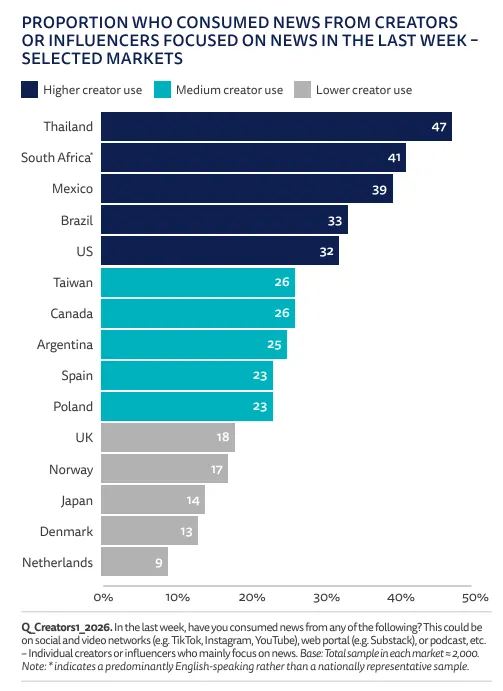
Complementing the overall rise of social media, the 2026 report spotlights another burgeoning phenomenon: the increasing prominence of online creators as influential news sources. Across numerous regions surveyed, individual content creators, ranging from independent journalists and commentators to social media personalities, are steadily gaining traction as trusted voices, often eclipsing established news brands. This trend represents a significant fragmentation of traditional media gatekeeping, as audiences increasingly turn to personalities they perceive as authentic or relatable, rather than institutional entities.
However, this emergent landscape introduces a new set of ethical and practical challenges. Unlike traditional journalists, who are typically bound by professional codes of conduct, editorial oversight, and a mandate for accuracy, online creators are often motivated by different incentives. Their primary drivers frequently include maximizing engagement metrics (likes, shares, comments), cultivating a personal brand, or fulfilling sponsorship obligations. This engagement-first approach can, at times, diverge sharply from the principles of objective reporting, potentially leading to the re-angling of topics, the amplification of unverified claims, or the deliberate omission of inconvenient facts, all in pursuit of audience interest. The report explicitly highlights this concern, noting that such motivations can significantly contribute to the spread of misinformation or, at best, a highly selective presentation of reality.
Algorithmic Governance and the Persistent Misinformation Challenge
The interplay between algorithmic curation and the motivations of online creators forms a potent cocktail that can significantly impact the integrity of the information ecosystem. Social media algorithms are sophisticated systems that learn user preferences and then serve content designed to keep them scrolling and interacting. This mechanism, while effective for engagement, can create “filter bubbles” and “echo chambers” where users are primarily exposed to information that reinforces their existing beliefs, limiting their exposure to diverse perspectives and factual counterpoints. When online creators, driven by engagement, tailor their content to exploit these algorithmic tendencies, the risk of misinformation and biased narratives propagating exponentially increases.
This challenge is further compounded by the sheer volume of content. In a constant battle for attention, accuracy can sometimes be sacrificed for speed or sensationalism. The report implicitly suggests that the current digital environment incentivizes content that is viral rather than verifiable, creating a fertile ground for disinformation campaigns, political polarization, and a general erosion of trust in shared facts. For media analysts, this concentration of news distribution power within engagement-driven social platforms represents a significant vulnerability to the broader information flow and accuracy, making critical media literacy an increasingly vital skill for the public.
Demographic Shifts and Cross-Generational Reliance
A striking finding within the 2026 report is the uniform increase in reliance on social applications for news content across all age groups. While younger demographics have historically been early adopters of new digital trends, this report indicates a broader, cross-generational shift away from other online information sources towards social media platforms. This widespread adoption underscores the pervasive integration of social apps into daily life, transforming them from mere communication tools into primary conduits for staying informed about current events.
Historically, news consumption evolved from print to radio, then television, and subsequently to the internet via websites. Each transition introduced new formats, speeds, and accessibility. The current move towards social media marks another profound shift, one characterized by personalized feeds, interactive content, and often, a blurring of lines between news, opinion, and entertainment. This universal embrace of social media for news suggests that the challenges identified by the Reuters Institute are not confined to specific demographics but are systemic issues affecting the entire population.
Shifting Platform Dynamics: The Rise of Visuals, The Fall of X
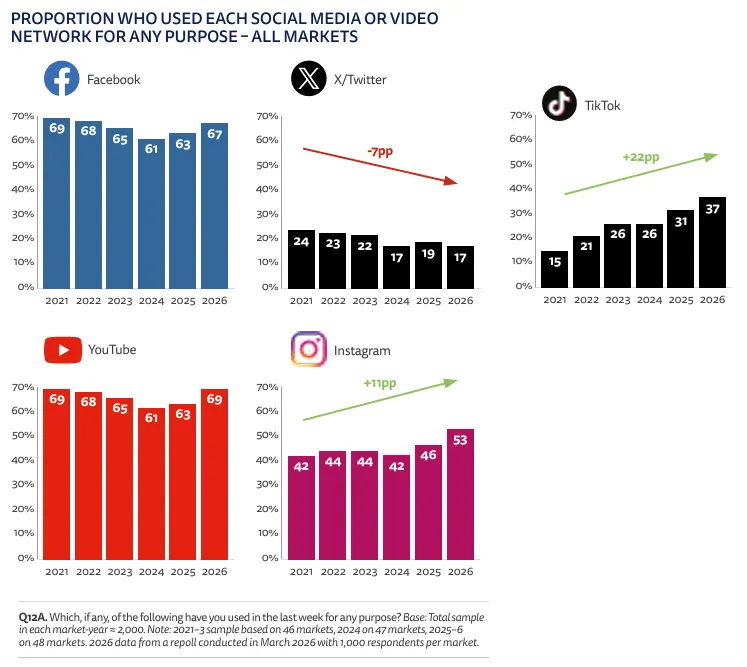
The report delves into specific platform dynamics, revealing significant shifts in influence and user preference. TikTok and Instagram, both highly visual and algorithmically driven platforms, are noted for their accelerating rise in overall news influence. Their short-form video formats and visually rich interfaces cater to evolving consumption habits, particularly among younger audiences, but increasingly across all age groups. These platforms prioritize snackable, engaging content, which can be both an opportunity for accessible news delivery and a challenge for comprehensive reporting.
Conversely, X, formerly Twitter, has experienced a notable decline in news usage. This fragmentation of its audience is directly attributed to the significant changes implemented following Elon Musk’s acquisition of the platform. Musk’s controversial decisions, including alterations to content moderation policies, the introduction of paid verification, and changes to the algorithmic ranking of content, have alienated a substantial portion of its user base and many traditional news organizations. This disruption has led to a noticeable exodus of users seeking alternative platforms for real-time news and public discourse, with Meta’s Threads gaining significant traction as a direct competitor and alternative news hub. The report clearly indicates that the structural and ideological shifts at X have diminished its value as a key platform for breaking news and journalistic dissemination, highlighting the profound impact of platform ownership and policy on the news ecosystem.
The AI Frontier: Chatbots as Emerging News Sources
Perhaps one of the most intriguing and potentially concerning trends identified in the 2026 report is the emergence of artificial intelligence chatbots as a growing source of news. As AI technologies become more sophisticated and widely accessible, a segment of the population is increasingly turning to conversational AI interfaces to get summaries, explanations, and updates on current events. This reliance stems from the perceived efficiency and convenience of AI, which can synthesize vast amounts of information quickly.
However, the report raises a critical alarm regarding this nascent trend. The current generation of AI chatbots is prone to “hallucinations”—generating factually incorrect or entirely fabricated information presented as truth—and often struggles with accurate attribution and contextual understanding. The danger lies in the growing number of people who are now accepting information provided by AI bots as fact, without undertaking the crucial step of verifying that information with independent, reputable outside sources. This uncritical acceptance poses a severe threat to information integrity, potentially accelerating the spread of misinformation and eroding the public’s ability to discern truth from algorithmic fabrication. The report strongly implies that without robust mechanisms for fact-checking and source attribution built into AI systems, and without a significant increase in digital literacy among users, this trend could lead to unprecedented levels of informational chaos.
Expert Analysis and Broader Implications
The findings of the 2026 Reuters Digital News Report have elicited significant discussion among media analysts, policy makers, and journalism ethics advocates. Dr. Evelyn Reed, a prominent media scholar, commented on the report’s release, stating, “The Reuters Institute’s latest report paints a stark picture of an information ecosystem increasingly dominated by platforms whose primary incentive is engagement, not accuracy. This creates a profound vulnerability for democratic societies, where informed citizens are foundational.” She further emphasized, “The rise of individual creators and AI chatbots as news sources, while offering new avenues for information, also introduces unprecedented challenges related to verification, accountability, and the very definition of journalistic ethics.”
Representatives from leading social media platforms, while not directly quoted in the report, typically issue statements emphasizing their ongoing investments in content moderation, fact-checking partnerships, and safety features designed to combat misinformation. However, critics argue that these efforts often fall short, struggling to keep pace with the scale and sophistication of false content, particularly when algorithms are inherently designed to amplify engaging—and often controversial—material. Regulators globally are increasingly scrutinizing platform accountability, with calls for greater algorithmic transparency and stricter penalties for platforms that fail to curb the spread of harmful content.
For traditional news organizations, the report underscores the urgent need for adaptation and innovation. Competing with the algorithmic virality of social media and the personalized allure of online creators requires a renewed focus on unique value propositions: in-depth investigative journalism, verifiable facts, and trusted analysis. The erosion of advertising revenue, largely diverted to social platforms, further exacerbates the challenge for traditional media, pushing many to explore subscription models and diversified revenue streams to sustain their critical public service role.
Ultimately, the 2026 Digital News Report highlights a crucial inflection point in how humanity consumes and processes information. The concentration of news consumption on social media, the influence of unverified creators, and the emerging role of fallible AI chatbots collectively present a formidable challenge to the integrity of public discourse. The implications extend far beyond the media industry, touching upon civic engagement, political stability, and the ability of individuals to make informed decisions. The report serves as a resounding call to action for improved digital literacy, greater platform accountability, and a collective recommitment to the values of accuracy, objectivity, and critical thinking in an ever-evolving digital world. The ongoing battle for truth in the digital age will require vigilance, innovation, and a collaborative effort from all stakeholders to navigate these complex currents and safeguard the foundational principles of an informed society.