The Evolving Digital Footprint: A Historical Context
The evolution of the internet has dramatically reshaped how businesses interact with their audiences. In the early days, a single, static website was often sufficient to establish an online presence. These early digital storefronts primarily served as informational brochures, offering basic details about a company, its services, and contact information. As internet penetration grew and digital marketing matured, the demands on online platforms increased exponentially. The advent of search engines, social media, and sophisticated analytics tools necessitated a more nuanced approach to digital engagement. This evolution paved the way for specialized digital assets, leading to the clear differentiation between the expansive, multi-purpose website and the targeted, conversion-focused landing page. Today, establishing a digital footprint is no longer a luxury but a fundamental requirement for competitive viability, with an estimated 40% of small businesses still lacking an adequate online presence, highlighting a significant opportunity for growth and strategic development.
Defining the Comprehensive Digital Hub: The Website
A website stands as the digital cornerstone of a business, serving as a comprehensive, multi-page platform designed for exploration, education, and brand building. Typically comprising five or more distinct web pages, a standard website often includes essential sections such as a Homepage, About Us, Services/Products, Blog/Resources, and Contact Us. Each of these pages contributes to a holistic narrative, allowing visitors to delve deeply into various aspects of the business at their own pace.
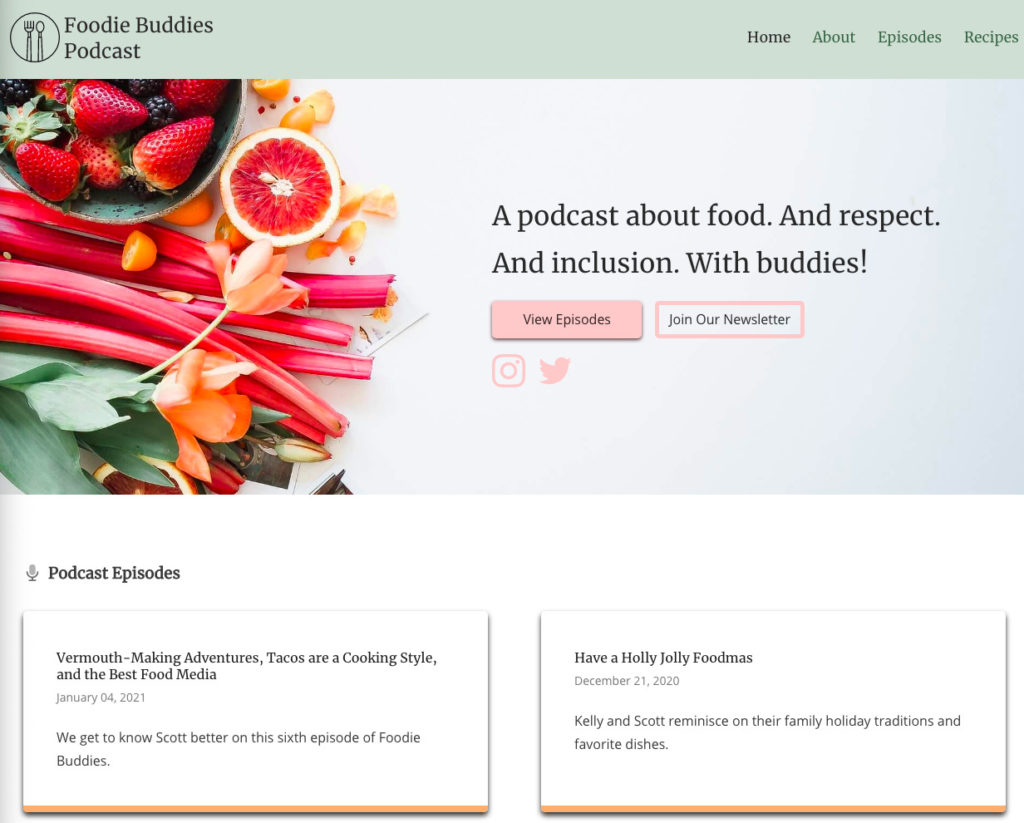
The primary goal of a website is to foster exploration and build familiarity over time. It acts as a central repository for all information pertaining to a business, from its history and values to its full range of offerings, customer testimonials, and thought leadership content. A well-designed website provides a seamless user experience with intuitive navigation menus, allowing visitors to browse, find answers to diverse questions, and develop a comprehensive understanding of the brand. For instance, the website for the “Foodie Buddies” podcast, as observed in industry examples, allows users to navigate effortlessly between sections to learn about the hosts, listen to past episodes, discover recipes, and engage with community forums.
However, this completeness comes with inherent costs and complexities. Developing and maintaining a robust website typically demands a significant investment of time, money, and ongoing resources. Initial development can range from several weeks to months, often requiring the expertise of web designers, developers, and content strategists. Post-launch, regular upkeep, security updates, content creation, and search engine optimization (SEO) are critical to ensure its effectiveness and relevance. The average cost for a professional small business website can range from $2,500 to $10,000, with more complex e-commerce or enterprise solutions potentially costing tens of thousands. This investment is justified by the long-term benefits of brand authority, organic search visibility, and a comprehensive digital presence that can scale with the business.
The Focused Powerhouse: The Landing Page
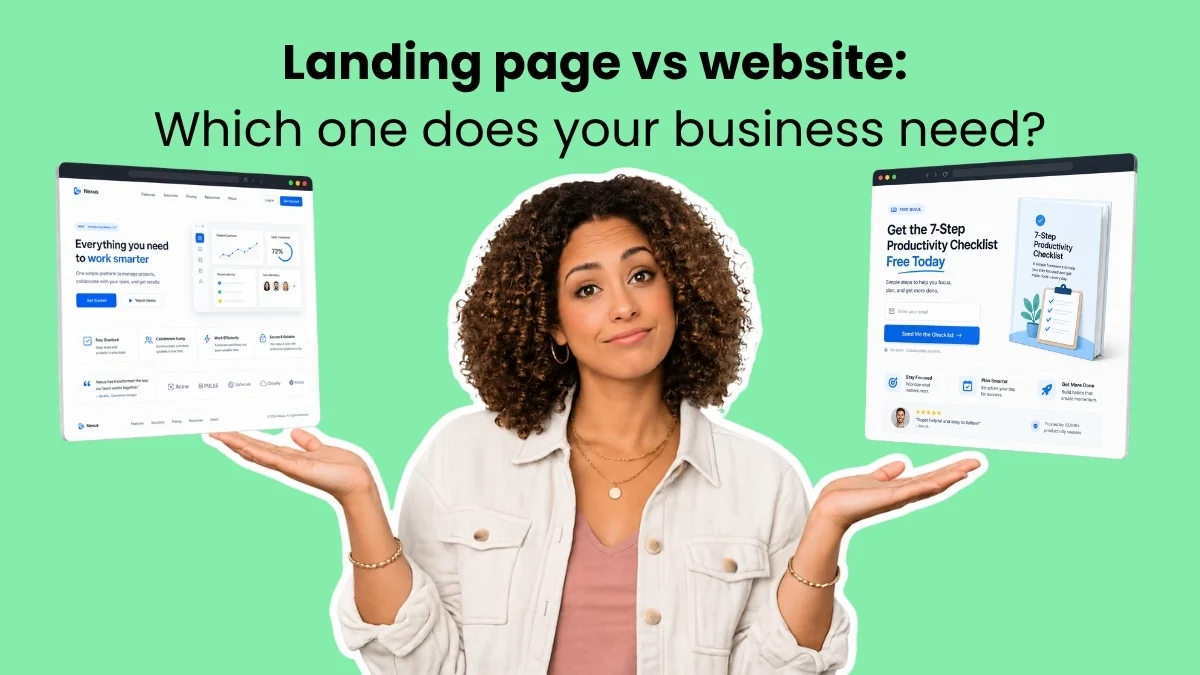
In stark contrast to the expansive nature of a website, a landing page is a singular, standalone web page meticulously crafted with one specific goal and one clear call to action (CTA). Its design is inherently minimalist, featuring limited or no navigation, effectively eliminating distractions that might divert a visitor from the intended action. A visitor “lands” on this page, consumes the concentrated information, and is then prompted to take a predefined action, or leaves.
The strategic objective of a landing page is to drive immediate conversion. Common goals include capturing email sign-ups, promoting a specific product or service, registering attendees for a webinar, offering a free download (lead magnet), or facilitating a direct purchase. Because every element on the page — from the headline and copy to the imagery and CTA button — is aligned to encourage this single action, landing pages consistently demonstrate higher conversion rates compared to general website pages or homepages. Industry benchmarks often show landing pages converting at rates between 5% and 15%, significantly higher than the typical 1-3% conversion rate observed on broader website pages. This efficiency stems from the principle of focus: by removing alternative pathways, the visitor’s attention is entirely channeled towards the desired outcome.
The Foodie Buddies podcast, while having a comprehensive website, also leverages landing pages for specific marketing initiatives. For example, they might use a landing page as a “link directory” in their social media bios, consolidating multiple links to their latest episodes, merchandise store, and newsletter sign-up into a single, mobile-friendly page. Other applications include dedicated pages for seasonal promotions, special offers, or A/B testing different messaging strategies without altering the main website. The speed and cost-effectiveness of creating a landing page are significant advantages; they can often be built and launched within minutes to hours, utilizing drag-and-drop builders often integrated into email marketing or CRM platforms, with hosting and secure connections frequently included in the subscription.
Key Differentiators: A Side-by-Side Analysis
Understanding the core differences is crucial for strategic deployment. While both serve to establish an online presence, their operational mechanics and desired outcomes diverge significantly.
| Feature | Landing Page | Website |
|---|---|---|
| Number of Pages | One | Five or more (often dozens or hundreds) |
| Navigation | None or minimal (e.g., logo to homepage) | Full menu connecting all internal pages |
| Primary Goal | Single, specific action (conversion) | Exploration, education, brand building |
| Calls to Action | One dominant CTA | Multiple CTAs, spread across various pages |
| Time to Launch | Minutes to hours | Days to weeks, potentially months |
| Cost | Low, often included with marketing tools | Higher: hosting, design, development, maintenance |
| Best For | Campaigns, lead generation, specific product sales, A/B testing, immediate results | Established businesses, comprehensive information, long-term SEO, brand authority |
| User Journey | Linear, guided funnel | Non-linear, self-directed exploration |
| SEO Impact | Limited direct long-term SEO; campaign-specific | High potential for long-term organic visibility through content and structure |
The fundamental distinction lies in behavioral intent. A landing page demands a specific action, guiding the visitor through a focused conversion funnel. A website, conversely, invites exploration, allowing visitors to meander and discover information organically. This difference dictates their optimal use cases.
Strategic Application: When to Deploy Each Tool
The choice between a website and a landing page is not always an either/or proposition; rather, it is about understanding when each tool is most effective.
When to Use a Landing Page:
Landing pages are indispensable when the objective is singular and focused. They are the go-to tool for:
- Marketing Campaigns: Driving traffic from paid advertisements (Google Ads, social media ads) to a highly relevant, conversion-optimized page. This ensures ad spend is maximized by minimizing bounce rates and maximizing conversions.
- Lead Generation: Offering a valuable asset (e.g., ebook, whitepaper, free trial, webinar registration) in exchange for contact information, effectively building an email list.
- Product Launches: Creating excitement and facilitating pre-orders or immediate purchases for a new product or service.
- Social Media Marketing: Providing a streamlined pathway for social media followers to access specific content, promotions, or signup forms, often used as a “link-in-bio” solution.
- A/B Testing: Rapidly testing different headlines, images, CTAs, or offers to optimize conversion rates without impacting the main website.
- Startups and New Ideas: Validating market interest for a product or service with minimal upfront investment. A simple landing page can gauge demand before committing to a full-scale website or product development. As industry experts often advise, “Validate your idea with a landing page before you build an empire with a website.”
When to Use a Website:
A comprehensive website becomes essential when a business requires depth, authority, and diverse engagement. It is the appropriate choice for:
- Established Businesses: Showcasing a broad range of products, services, and a rich content library that cannot be contained within a single page.
- Brand Building and Authority: Establishing a credible, professional online presence that reinforces brand identity, values, and trust.
- Long-Term SEO Strategy: Building organic search visibility through a blog, resource center, and well-structured internal linking, attracting passive traffic over time. Studies indicate that businesses with blogs generate 67% more leads than those without.
- Customer Support and FAQs: Providing a central hub for detailed information, troubleshooting, and support resources, reducing direct customer service inquiries.
- E-commerce Stores: Facilitating a multi-product shopping experience with detailed product pages, shopping carts, and secure payment gateways.
- Portfolios and Professional Services: Displaying a diverse body of work, client testimonials, and team profiles that contribute to professional credibility.
The Hybrid Approach: Integrating Websites and Landing Pages
Critically, these two digital assets are not mutually exclusive; in fact, they often work in powerful synergy. A robust website provides the foundational brand presence and organic visibility, while strategically deployed landing pages handle the heavy lifting of conversion for specific campaigns.
Digital marketing strategists consistently recommend sending campaign-specific traffic (e.g., from ads, email promotions, social media posts) directly to dedicated landing pages rather than a general homepage. A homepage, with its numerous navigation options and diverse content, inherently offers too many “exit routes,” diluting the conversion focus. By directing traffic to a landing page, businesses can ensure a consistent message, a clear value proposition, and an unhindered path to conversion, thereby maximizing their return on marketing investment. For example, a business might use its website blog to publish articles that attract organic traffic, then strategically link from those articles to a landing page offering a relevant lead magnet.
Operational Considerations: Time, Cost, and Maintenance
The practical implications of time, cost, and ongoing maintenance are significant factors in deciding which platform to prioritize or invest in.
Time to Market:
- Landing Page: With intuitive drag-and-drop builders, a functional landing page can be designed, populated with content, and published within a matter of hours, sometimes even minutes. This speed is invaluable for agile marketing, allowing businesses to capitalize on trending topics or urgent promotions.
- Website: A comprehensive website requires a more extended development cycle. From planning and wireframing to design, content creation, development, testing, and launch, the process can span several weeks to months, particularly for custom solutions.
Cost Implications:
- Landing Page: The cost of creating and hosting landing pages is generally very low. Many email marketing platforms (like AWeber, as referenced in the original article) include landing page builders, hosting, and SSL certificates as part of their standard subscription plans, which can start from as little as $15-$30 per month. Standalone landing page builders also offer competitive pricing models.
- Website: The financial investment for a website is substantially higher. Initial design and development can range from a few thousand dollars for a basic template-based site to tens of thousands for custom-designed, feature-rich platforms. Ongoing costs include domain registration (typically $10-$20/year), hosting (from $5-$500+/month depending on scale), premium theme/plugin licenses, maintenance, security, and content updates.
Maintenance and Upkeep:
- Landing Page: Requires minimal ongoing maintenance beyond occasional content updates or A/B test adjustments.
- Website: Demands regular attention, including software updates (e.g., WordPress core, plugins, themes), security monitoring, backups, content refreshes, and performance optimization (speed, mobile responsiveness). Neglecting these aspects can lead to security vulnerabilities, performance degradation, and a diminished user experience.
The “Landing Page Only” Model: Viability and Limitations
Can a business truly thrive solely on landing pages without a traditional website? The answer, increasingly, is yes, particularly for certain types of businesses and individuals. Many creators, coaches, freelancers, and solo entrepreneurs successfully operate their entire digital presence through a series of interconnected landing pages.
This model typically involves:
- A lead capture landing page to build an email list.
- Sales pages for digital products, courses, or services.
- A “link-in-bio” page for social media audiences.
- Event registration pages for workshops or webinars.
The success of this approach hinges on the strategic use of email marketing. Landing pages serve as the “front door” to the business, capturing subscriber information. The subsequent communication, education, trust-building, and promotion—functions traditionally performed by a website—are then handled through automated email sequences and regular newsletters. The email list effectively becomes the primary asset, allowing direct and personalized communication with the audience. This strategy is particularly appealing for those seeking to minimize overhead and launch quickly, leveraging integrated platforms that offer landing page builders alongside email marketing capabilities.
However, this model also comes with limitations. Without a comprehensive website, businesses may struggle to build long-term organic search visibility, as landing pages are less effective for broad SEO strategies. Brand authority and comprehensive information about the business might also be harder to convey without a dedicated “About Us” or “Resources” section. While viable for lean operations, businesses aiming for significant scale or requiring a vast content library will eventually find a website indispensable.
Industry Perspectives and Expert Insights
Digital marketing experts widely agree that the optimal strategy involves a judicious combination of both platforms. “For nascent businesses, starting with a powerful landing page to validate market interest and build an initial audience is a low-risk, high-reward strategy,” states Dr. Evelyn Reed, a prominent digital strategy consultant. “As the business matures and its offerings diversify, a comprehensive website becomes critical for establishing authority, housing rich content, and fostering long-term customer relationships.”
Data analytics firm, Digital Insights Group, reported in its Q1 2026 brief that businesses leveraging both a robust website and campaign-specific landing pages experienced an average of 35% higher lead conversion rates compared to those relying solely on one platform. This underscores the power of a synergistic approach, where the website provides the context and credibility, and landing pages drive targeted action.
Future Trends in Digital Presence
Looking ahead, the lines between websites and landing pages may continue to blur with the advent of AI-powered content creation, increasingly sophisticated no-code/low-code builders, and hyper-personalization tools. We can expect even faster deployment times, more dynamic content generation, and more integrated analytics that provide deeper insights into user behavior across both platforms. The emphasis will remain on user experience, conversion optimization, and the ability to adapt swiftly to changing market demands.
In conclusion, the decision between a website and a landing page is a strategic one, dictated by a business’s current stage, goals, resources, and target audience. While a comprehensive website serves as the enduring digital home for a brand, fostering exploration and long-term engagement, a well-crafted landing page acts as a potent, focused tool for driving immediate conversions within specific marketing campaigns. The most effective digital strategies often integrate both, leveraging the strengths of each to build a robust online presence that informs, engages, and converts.