rifanmuazin
The release of Yoast SEO Premium version 27.6.1 marks a pivotal moment for users of the widely adopted WordPress SEO plugin, as it addresses a significant security vulnerability within its Redirect Manager. This update, rolled out to all premium users, specifically targets a flaw that could potentially allow an authenticated user to inject malicious configurations into a site’s .htaccess file. While the potential ramifications of such an exploit range from site crashes to, in the most severe instances, remote code execution (RCE), Yoast has reassured its vast user base that the overwhelming majority of customers are not impacted by this specific vulnerability. This proactive measure underscores Yoast’s commitment to maintaining the integrity and security of its plugins, which are integral to the search engine optimization strategies of millions of websites globally. The fix is crucial for a specific subset of users, particularly those leveraging the .htaccess redirect method within their Yoast SEO Premium, Yoast WooCommerce SEO, or Yoast SEO AI+ installations.
Understanding the Vulnerability: A Deep Dive into .htaccess Injection
The core of the security concern lies in the potential for an authenticated user—meaning someone with legitimate access credentials to the WordPress admin panel, even if with limited privileges—to manipulate the .htaccess file. This manipulation could occur by embedding special, unvalidated characters within a redirect URL or target path managed by the Yoast SEO Premium Redirect Manager. The .htaccess file is a fundamental configuration file used by Apache web servers, which powers a significant portion of the internet’s websites. It allows for decentralized management of server configurations, enabling directives like URL rewriting, access control, error page handling, and, critically, redirects, to be defined on a per-directory basis. Its power, however, is a double-edged sword; any unauthorized or malicious modification can have severe consequences for a website’s functionality and security.
In this particular vulnerability, an attacker, once authenticated, could craft a malicious redirect entry that, when saved through the Yoast Redirect Manager, would inject arbitrary code into the .htaccess file. This type of injection vulnerability is particularly dangerous because it grants the attacker control at the web server level, preceding the execution of PHP scripts and even the WordPress core itself. Depending on the injected code, the outcomes could vary dramatically. At the lower end of the severity spectrum, poorly formed directives could lead to a site crash, rendering the website inaccessible and potentially causing significant downtime and loss of revenue. More alarmingly, in the “most serious cases,” the vulnerability could be leveraged for remote code execution. RCE allows an attacker to run arbitrary commands on the server where the website is hosted, effectively gaining full control over the server’s operating system. This could lead to data theft, defacement of the website, installation of malware, or using the compromised server as a platform for further attacks such as launching denial-of-service attacks against other targets.
Assessing the Risk: Who is Affected?
Despite the severity of potential exploitation, Yoast has provided strong assurances that “the vast majority of users are not impacted.” This low-impact assessment is predicated on a very specific set of conditions that must all be met for a site to be potentially at risk. Site administrators must evaluate their current setup against these three critical criteria:
- Yoast SEO Premium, Yoast WooCommerce SEO, or Yoast SEO AI+ is installed and active: The vulnerability is exclusive to the premium suite of Yoast products that include the Redirect Manager functionality. Users of the free Yoast SEO plugin are not affected, nor are users of premium plugins who have not enabled the Redirect Manager feature.
- The Redirect Manager feature is enabled: While integral to the premium plugins, users have the option to enable or disable specific features within the Yoast SEO dashboard. Only those actively using the Redirect Manager are exposed to the vulnerability’s vector.
- The redirect method is set to
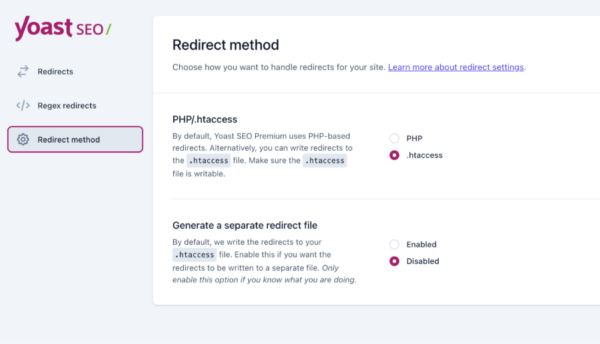
.htaccessmode: This is the most crucial condition and the primary reason for the low impact. The Redirect Manager offers various methods for handling redirects, including using PHP redirects or directly modifying the.htaccessfile. Many hosting environments, particularly shared hosting, might prefer PHP-based redirects due to better performance or security considerations, or server-level configurations managed by the host, thus leaving the.htaccessmode disabled by default or unused by site owners. Yoast clarifies that users can quickly check their configuration by navigating to[www.yoursite.com]/wp-admin/admin.php?page=wpseo_redirects#/redirect-methodwithin their WordPress admin panel. If.htaccessmode is not explicitly enabled, the site is not at risk from this specific vulnerability. This specificity greatly limits the attack surface.
This granular understanding of the affected configuration explains why Yoast could confidently state that the risk is contained to a small subset of its premium user base. The default or common configurations for many users do not involve direct .htaccess manipulation via the plugin, significantly limiting the attack surface. Yoast has further reported that after reviewing a sample of sites using the affected configuration, they found “no evidence of exploitation” and “no known cases of abuse,” suggesting the vulnerability was likely discovered and patched before active exploitation could occur.
Timeline of Discovery and Remediation

While Yoast has not publicly disclosed the exact date of discovery, the swift release of version 27.6.1 suggests a rapid response cycle following either an internal audit or a responsible disclosure from a security researcher. The absence of “evidence of exploitation” or “known cases of abuse” strongly indicates that the vulnerability was identified and patched before it could be actively leveraged by malicious actors in the wild, which is a significant positive for user security.
The typical timeline for addressing such security incidents often involves several key stages:
- Discovery (Pre-release): A vulnerability is identified, either internally through proactive code review, automated security scanning, or externally by a security researcher adhering to responsible disclosure guidelines. Given the nature of the fix and the lack of in-the-wild exploitation, an internal discovery or a private disclosure is most probable.
- Verification (Rapid Response): Yoast’s dedicated security team would have immediately validated the reported vulnerability, confirming its existence, scope, and potential impact on user systems. This phase includes recreating the exploit scenario in a controlled environment.
- Patch Development (Engineering Focus): Engineers would then prioritize the development of a robust fix. This involves not only addressing the immediate flaw but also considering broader defensive strategies to prevent similar issues in the future.
- Quality Assurance and Testing (Rigorous Review): The developed patch undergoes rigorous testing to ensure it effectively mitigates the vulnerability without introducing new bugs, regressions, or breaking existing functionality. This is crucial for a plugin as widely used as Yoast SEO.
- Release (Deployment): The updated version, 27.6.1 in this instance, is then made available to all premium users through the standard WordPress update mechanism.
- Communication (Transparency and Guidance): A security advisory is published to inform users about the vulnerability, its impact, and the necessary steps for remediation. Yoast has indicated that a “full security advisory will be published soon,” providing more in-depth technical details about the flaw and its resolution, which is standard practice for significant security updates.
The rapid turnaround from potential discovery to a patched release, coupled with clear initial communication, is a testament to Yoast’s dedication to its users’ security and maintaining the integrity of its products.
The Technical Solution: Layers of Protection
The patch introduced in Yoast SEO Premium 27.6.1 implements a multi-layered defense strategy to effectively neutralize the .htaccess injection vulnerability. While the original announcement does not detail the specific three layers, standard security practices for mitigating such injection flaws typically involve:
- Robust Input Validation and Sanitization: This is the foundational and first line of defense. Any data submitted by a user, especially through fields that will eventually interact with sensitive server configuration files, must be rigorously validated. This includes checking for expected data types, lengths, and formats. Sanitization involves cleaning or filtering user input to remove any potentially malicious characters or sequences. For instance, special characters like newlines, semicolons, backticks, or directives commonly used in
.htaccessfiles (e.g.,RewriteRule,Options,php_value) would be stripped, escaped, or explicitly disallowed from redirect URLs and targets before being processed. This prevents an attacker from introducing server-side directives disguised as benign input. - Secure Output Encoding/Escaping: When the validated and sanitized data is eventually written to the
.htaccessfile, it must be properly encoded or escaped. This ensures that user-supplied input is treated as literal data rather than executable commands or configuration directives. For example, if a user legitimately inputs a string that contains a character like#(which denotes a comment in.htaccess), proper escaping would prevent it from being interpreted as the start of a comment, thereby preventing an attacker from breaking out of the intended data context and injecting arbitrary directives. This layer specifically prevents the malicious construction of.htaccessdirectives by an authenticated attacker by ensuring that the output context treats all user-provided strings as data, not code. - Context-Aware File Writing and Integrity Checks: Beyond input validation and output encoding, modern security practices for writing to sensitive configuration files often include context-aware writing mechanisms. This might involve generating the
.htaccessfile content in a strictly controlled, templated manner, where only specific, predefined variables can be inserted into designated safe zones. This limits the potential for arbitrary code injection. Furthermore, integrity checks could be performed on the.htaccessfile itself before and after writing. This could involve validating the syntax of the generated file against Apache’s expected syntax, performing a diff to ensure only expected changes occurred, or ensuring that no unexpected directives have been introduced. This layer acts as a final safeguard, preventing the system from writing a malformed or maliciously crafted.htaccessfile that could crash the site or enable RCE, even if preceding layers were somehow bypassed.
These three theoretical layers, when implemented effectively, create a strong and resilient barrier against the type of injection vulnerability identified, ensuring that even if an attacker manages to bypass one layer, subsequent layers provide additional, crucial protection.
Recommendations for Users: What You Should Do
Yoast has issued clear and concise instructions for its users, emphasizing the importance of timely updates for maintaining website security:
- Update Immediately if Affected: For users whose sites meet all three critical criteria (Yoast SEO Premium or a related product active, Redirect Manager enabled, and
.htaccessmode selected), updating to version 27.6.1 is strongly recommended “as soon as possible.” This straightforward action, which can be performed directly from the WordPress plugins screen, typically takes “under two minutes” for a site administrator. Given the potential severity of RCE, prompt action for affected sites is paramount. - General Update for All Users: Even if a site does not meet the specific risk conditions, Yoast advises all premium users to update to 27.6.1. “Keeping your plugins current is always good practice,” the company states, reinforcing a fundamental principle of robust website security. Regular updates not only patch newly discovered security vulnerabilities but also introduce new features, performance improvements, and general bug fixes, contributing to a healthier and more efficient website.
- Verify Your Redirect Method: To definitively ascertain if a site is indeed using the
.htaccessredirect method, administrators are advised to navigate directly to their redirect settings page:[www.yoursite.com]/wp-admin/admin.php?page=wpseo_redirects#/redirect-method. The presence or absence of “.htaccessmode enabled” will be the definitive indicator of potential risk. If it’s not enabled, the site is safe from this particular vulnerability and the update is primarily for general best practice. - Leverage Support: Yoast’s dedicated support team is available to assist users with any questions or concerns regarding the update process or the vulnerability itself. This direct line of communication is vital for users who might be less technically inclined or require specific guidance for their unique hosting environments and website configurations.
Broader Implications for WordPress Security and SEO
This security incident, though contained and promptly addressed, carries broader implications for the WordPress ecosystem and the critical role of SEO plugins in modern web infrastructure.
For the WordPress Ecosystem: WordPress powers over 43% of all websites on the internet, making it an exceptionally attractive target for cyber attackers. The extensive use of plugins, while dramatically enhancing functionality and customization options, also introduces a significant attack surface. This incident highlights the continuous need for robust security practices from all plugin developers, including regular security audits, adherence to secure coding guidelines, and a clear, efficient process for responsible disclosure and patching. It also underscores the importance for users to exercise due diligence when selecting and maintaining plugins, favoring those with a strong security track record, responsive development teams, and transparent communication. The fact that this was an authenticated vulnerability, while still serious, is less critical than an unauthenticated one (which could be exploited by anyone without login credentials), offering some relief. Nevertheless, it reinforces the need for strong password policies, multi-factor authentication, and the principle of least privilege for all WordPress user roles.
For Yoast and Plugin Developers: Yoast’s swift and transparent handling of this vulnerability reinforces its reputation as a responsible and security-conscious developer in the WordPress space. The quick patch, combined with clear communication and user guidance, minimizes potential reputational damage and builds trust with its vast user base. For other plugin developers, this incident serves as a powerful reminder of the constant vigilance required to protect user data and website integrity. Injection vulnerabilities, especially those affecting server configuration files, remain a common and potent threat, necessitating continuous security evaluation throughout the software development lifecycle.
For SEO Professionals and Website Owners: The potential consequences of this vulnerability—site crashes or RCE—could have devastating effects on a website’s search engine rankings and overall online presence. A crashed site results in immediate loss of organic traffic, a negative user experience, and potential penalties from search engines like Google, which prioritize site availability, security, and user experience. Even temporary downtime can lead to significant drops in rankings, which can take considerable effort and time to recover. Remote code execution, on the other hand, could lead to website defacement, the injection of spammy content, or the redirection of visitors to malicious sites, severely harming a site’s SEO authority, brand reputation, and user trust. This incident serves as a stark reminder that technical SEO, which often involves server configurations and redirects, must be handled with utmost care and secured against potential exploits. Regularly updating all software components, including WordPress core, themes, and plugins, is not merely a technical chore but a fundamental and non-negotiable component of a robust and resilient SEO strategy.
The Role of .htaccess in SEO: For many years, the .htaccess file has been an indispensable tool for implementing various SEO best practices on Apache servers, particularly for managing redirects (e.g., 301 for permanent, 302 for temporary). Proper redirect management is crucial for maintaining link equity during site migrations, preventing broken links that degrade user experience, and ensuring a seamless transition for visitors and search engine crawlers when URL structures change. Yoast’s Redirect Manager simplifies this complex process, making it accessible even for users without deep server administration knowledge. The vulnerability highlights that even user-friendly tools that abstract complex server functions must be meticulously secured to prevent their abuse, as the underlying power of files like .htaccess remains significant.
Conclusion
The release of Yoast SEO Premium 27.6.1 is a critical security update that effectively addresses a potentially severe .htaccess injection vulnerability within its Redirect Manager. While the risk profile is narrow, affecting only a specific subset of premium users utilizing the .htaccess redirect method, the potential for remote code execution underscores the importance of this patch. Yoast’s prompt action, transparent communication, and clear guidance for users exemplify responsible software development and commitment to user security. For website administrators and SEO professionals, this incident reinforces the non-negotiable importance of timely plugin updates, diligent security practices, and a clear understanding of their website’s technical configuration to safeguard against evolving cyber threats and maintain a healthy, high-ranking online presence. The upcoming full security advisory is expected to provide even greater detail, further aiding the community in understanding and preventing similar vulnerabilities in the future.