
 rifanmuazin
The discipline of Conversion Rate Optimization (CRO) has evolved from a niche marketing tactic into a core business strategy centered on data-driven decision-making. At the forefront of this evolution is Simbar Dube, a Conversion Research Specialist at Enavi, whose career trajectory illustrates the shifting landscape of digital marketing. In a comprehensive analysis of modern experimentation, Dube outlines how the integration of Artificial Intelligence (AI) and a journalistic approach to data are redefining how brands understand and influence consumer behavior.
The Evolution of a Conversion Specialist
The professional journey of Simbar Dube began in a field seemingly distant from digital analytics: journalism. Transitioning into the CRO space in 2019, Dube joined Invesp, a prominent conversion optimization agency, initially as a Content Editor. His background in investigative storytelling provided a unique foundation for marketing, as both disciplines require an obsession with understanding human motivation and “following the trail” of evidence.
Dube eventually ascended to the role of Head of Marketing at Invesp before moving to Enavi to focus specifically on conversion research. At Enavi, his work centers on deconstructing user journeys to identify points of “intent collapse”—the specific moments where a potential customer decides to abandon a purchase. This transition from broad content creation to granular behavioral diagnosis reflects a broader industry trend where marketers are expected to function as data scientists and behavioral psychologists.

The AI Shift: From Manual Synthesis to Accelerated Insights
The advent of AI has fundamentally altered the workflow of CRO professionals. For years, the primary constraint on high-quality research was time. Practitioners were forced to choose between going “deep” into a single data source or going “wide” across many, often spending days manually synthesizing survey responses, interview transcripts, and session recordings.
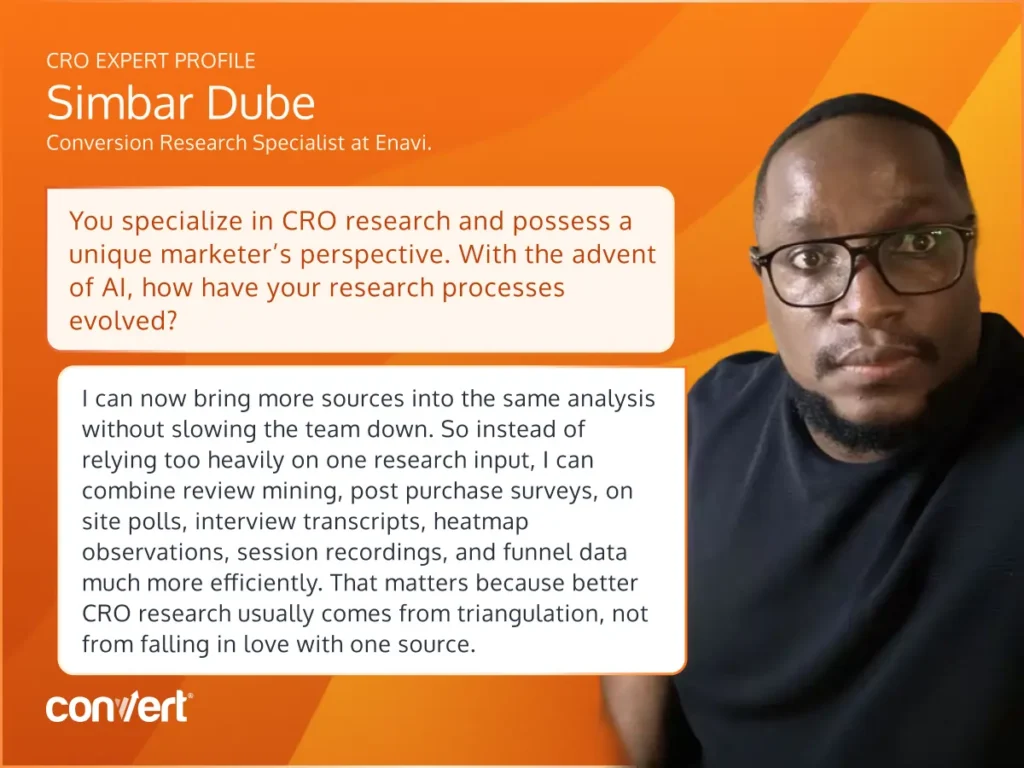
Dube notes that while the fundamental goal—identifying friction in the customer journey—remains unchanged, the speed and breadth of research have increased exponentially. “Before AI, a lot of strong research work was limited by time,” Dube observed. “Now, I can process a much larger volume of customer feedback, cluster recurring objections, and get to a strong first layer of synthesis in hours rather than days.”
This acceleration allows for “triangulation,” a research methodology where multiple data points—such as heatmap observations, post-purchase surveys, and funnel data—are combined to confirm a single hypothesis. According to industry data, companies that utilize more than three data sources for their experimentation hypotheses see a significantly higher win rate in A/B testing. AI enables this level of rigor without slowing down the development cycle.
Limitations of Artificial Intelligence in Strategic Diagnosis
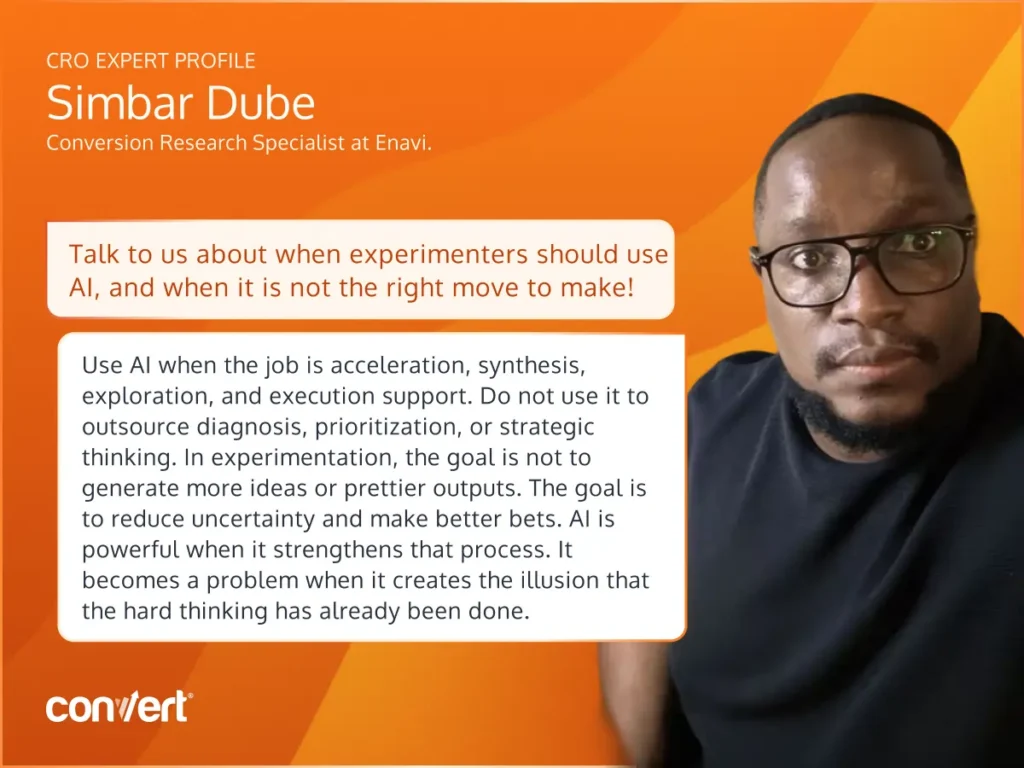
Despite the efficiency gains, Dube maintains a cautious stance on the role of AI in decision-making. He distinguishes between “signal surfacing” and “strategic diagnosis.” While AI is proficient at identifying patterns—such as a recurring complaint in customer reviews—it lacks the business context required to prioritize those findings.

“Just because a model finds repeated complaints does not mean it understands which issue is the actual bottleneck,” Dube stated. The distinction is critical: an AI might highlight a UX glitch that affects 10% of users, but a human specialist might recognize that a less frequent issue is actually impacting the most valuable, high-intent segment of the audience.
In the current landscape, AI is being “baked into” foundational tools like Shopify, which recently introduced apps like SimGym for simulated testing. However, Dube argues that the “hard thinking” of experimentation—deciding what a result means for the business’s bottom line—cannot be outsourced. This perspective is supported by a 2023 report from Forrester, which found that while 70% of marketers use AI for content and data summary, only 20% trust it for strategic roadmap prioritization.
Case Study: Bridging the Gap Between Online Intent and Offline Action
One of the most compelling applications of Dube’s experimentation philosophy involved a retail client seeking to harmonize its online presence with a new physical storefront. The challenge was two-fold: the product required a high level of physical “trust” (customers wanted to see the fit and feel), and the average order value (AOV) was significantly higher for in-store purchases than for online ones.
Rather than running a traditional A/B test on button colors or headlines, Dube and his team treated the problem as a behavioral experiment. They implemented a “Buy Online, Pick Up In Store” (BOPIS) strategy, making it the most prominent option for shoppers located near the physical branch.
The experiment yielded several insights:
- Anxiety Reduction: Highlighting the physical store reduced the “anxiety” of an online purchase, as customers knew they could easily return or exchange the item nearby.
- Channel Value: By driving digital traffic to a physical location, the brand successfully shifted demand into a more profitable channel with higher AOV.
- Measurable Impact: The team tracked pickup orders, foot traffic baseline comparisons, and the overall order value of the local cohort to validate the intervention.
This “omnichannel” approach reflects a growing trend in CRO where the “conversion” is not always a digital transaction but a movement through a complex, multi-touchpoint sales funnel.
B2B Pipeline Recovery and Diagnostic Outreach
Dube’s research also extends into the B2B sector, where “stalled pipelines” represent a significant loss of potential revenue. Traditional marketing responses to stalled deals often involve “nurture” campaigns—generic, automated emails that provide general information.
Applying a CRO mindset, Dube tested a different approach: diagnostic outreach. Instead of generic follow-ups, the team sent prospects a specific diagnosis of what was likely constraining their growth, based on data observed in their funnels. This method moved the needle because it provided the buyer with a reason to think rather than just a reason to click.
“Highly specific diagnostic outreach usually performs better than polished but broad nurture because it gives the buyer a reason to think,” Dube explained. In these experiments, the primary metric shifted from “open rates” to “re-engagement” and “meaningful next conversations.”
Supporting Data and Industry Context
The methodologies discussed by Dube align with broader industry statistics regarding the ROI of experimentation. According to data from Harvard Business Review, companies that foster a culture of experimentation see up to a 30% increase in conversion rates over a two-year period compared to those that rely on “best practices.”
Furthermore, the integration of AI in research synthesis is becoming a competitive necessity. A study by Econsultancy revealed that “highly effective” marketing teams are 2.5 times more likely to use AI for data analysis than their less successful counterparts. However, the same study noted that “human-in-the-loop” systems—where AI provides the data and humans provide the strategy—consistently outperform fully automated systems.
Chronology of Industry Shifts (2019–2024)
The timeline of Dube’s career mirrors the broader shifts in the CRO industry:
- 2019: Dube enters the field at a time when CRO is heavily focused on A/B testing and “best practice” implementation.
- 2020–2021: The pandemic-driven e-commerce boom accelerates the need for deep consumer research as shopping behaviors shift overnight.
- 2022: The rise of Large Language Models (LLMs) begins to change how qualitative data (surveys and interviews) is processed.
- 2023–2024: AI becomes an embedded feature in testing platforms. The focus shifts from “how to test” to “what is worth testing,” emphasizing the importance of research and prioritization.
Broader Impact and Future Implications
The insights shared by Simbar Dube suggest a future where the role of the CRO specialist is increasingly focused on the “Why” rather than the “How.” As AI commoditizes the technical aspects of testing—such as coding variants or summarizing data—the value of a specialist will lie in their ability to understand commercial reality and human psychology.
For businesses, the implication is clear: the goal of experimentation is not to generate more ideas, but to reduce uncertainty. By utilizing AI for acceleration and human expertise for diagnosis, companies can make better “bets” on their growth strategies. The success of Dube’s omnichannel and B2B experiments highlights that the principles of CRO are universal, applying whenever a human decision-maker encounters friction in a journey.
As the industry continues to mature, the “Curiosity. Tested. Proven. Repeat.” mantra cited by Dube will likely remain the standard for organizations looking to navigate an increasingly complex digital economy. The integration of journalism’s investigative rigor with modern AI’s processing power represents the next frontier of conversion research.








