rifanmuazin
Instapage, a prominent leader in the post-click automation industry, has officially announced the launch of AI Collections, a sophisticated tool designed to automate the creation and management of personalized landing pages at scale. This development addresses a long-standing bottleneck in digital marketing: the “personalization gap,” where the theoretical benefits of tailored user experiences are often stymied by the logistical impossibility of manual execution. By leveraging generative artificial intelligence, AI Collections enables marketing teams to produce personalized web environments up to three times faster than traditional manual methods, signaling a significant shift in how brands manage the post-click segment of the customer journey.
The Evolution of Post-Click Automation
The digital advertising landscape has undergone a massive transformation over the last decade. While the “pre-click” phase—consisting of ad targeting, programmatic bidding, and creative optimization—has become highly automated through platforms like Google Ads and Meta, the “post-click” experience has lagged. Historically, marketers have struggled to provide a seamless transition from a specific ad to a relevant landing page.
In the traditional workflow, creating a personalized experience for different audience segments required duplicating pages, manually editing copy for each variation, and managing hundreds of individual URLs. For large-scale campaigns involving hundreds of keywords or diverse demographic targets, this process was not only time-consuming but prone to human error. Consequently, many high-budget campaigns reverted to “generic” landing pages, which typically suffer from lower conversion rates and higher bounce rates. AI Collections aims to solve this by treating landing pages as dynamic templates rather than static files.
Technical Overview: How AI Collections Operates
At the core of AI Collections is a structural shift in how landing pages are built. Rather than managing individual pages, marketers now work within a “Collection” framework. This framework utilizes a centralized content table that functions as a single source of truth for an entire campaign.
The Content Table Methodology
In this new system, each row in the content table represents a unique page within the collection, while each column represents a specific content element—such as headlines, body copy, images, or calls to action. This database-centric approach allows marketing teams to manage dozens or even hundreds of pages from one interface. Instead of opening 50 different editor windows to change a single value, a marketer can update the content table, and those changes propagate across the entire collection.
AI-Driven Placeholder Identification
One of the most labor-intensive aspects of creating dynamic templates is the manual placement of “placeholders”—the markers that tell the system where to insert dynamic text. Instapage has integrated AI to automate this discovery process. The AI analyzes the layout and design of a base page, identifying optimal locations for dynamic content. It then generates placeholders automatically, which users can review, edit, or remove. This eliminates the need for manual coding or complex “if-then” logic mapping that previously required technical expertise.
Generative Content Capabilities
Once the structure is established, the AI takes on the role of a copywriter. By providing the AI with context—such as the target audience, specific messaging goals, and brand voice—marketers can generate publish-ready content for every entry in the table simultaneously. This allows for hyper-granularity; for example, a travel company could generate 200 distinct pages for 200 different destinations in the time it previously took to create two.
Supporting Data: The Impact of Personalization on Conversion
The drive toward automation is supported by significant industry data regarding consumer behavior. According to a recent study by McKinsey & Company, 71% of consumers expect companies to deliver personalized interactions, and 76% get frustrated when this does not happen. Furthermore, companies that excel at personalization generate 40% more revenue from those activities than average players.
In the context of landing pages, “message match”—the alignment between the ad copy and the landing page copy—is a critical factor in Google’s Quality Score. Higher Quality Scores lead to lower Costs Per Click (CPC) and better ad placements. By using AI Collections to ensure that every ad has a perfectly matched landing page, companies can theoretically lower their Customer Acquisition Cost (CAC) while simultaneously increasing their conversion rates (CVR). Instapage’s internal metrics suggest that the 3x increase in production speed allows teams to test more variations, leading to an iterative improvement in ROI that was previously cost-prohibitive.
Integration with Fluid Grid Technology
A common failure point in automated page generation is “layout breakage.” When AI generates a headline that is significantly longer than the original placeholder, it often overlaps with other design elements or pushes content off the screen. To combat this, Instapage has paired AI Collections with its “Fluid Grid” blocks.
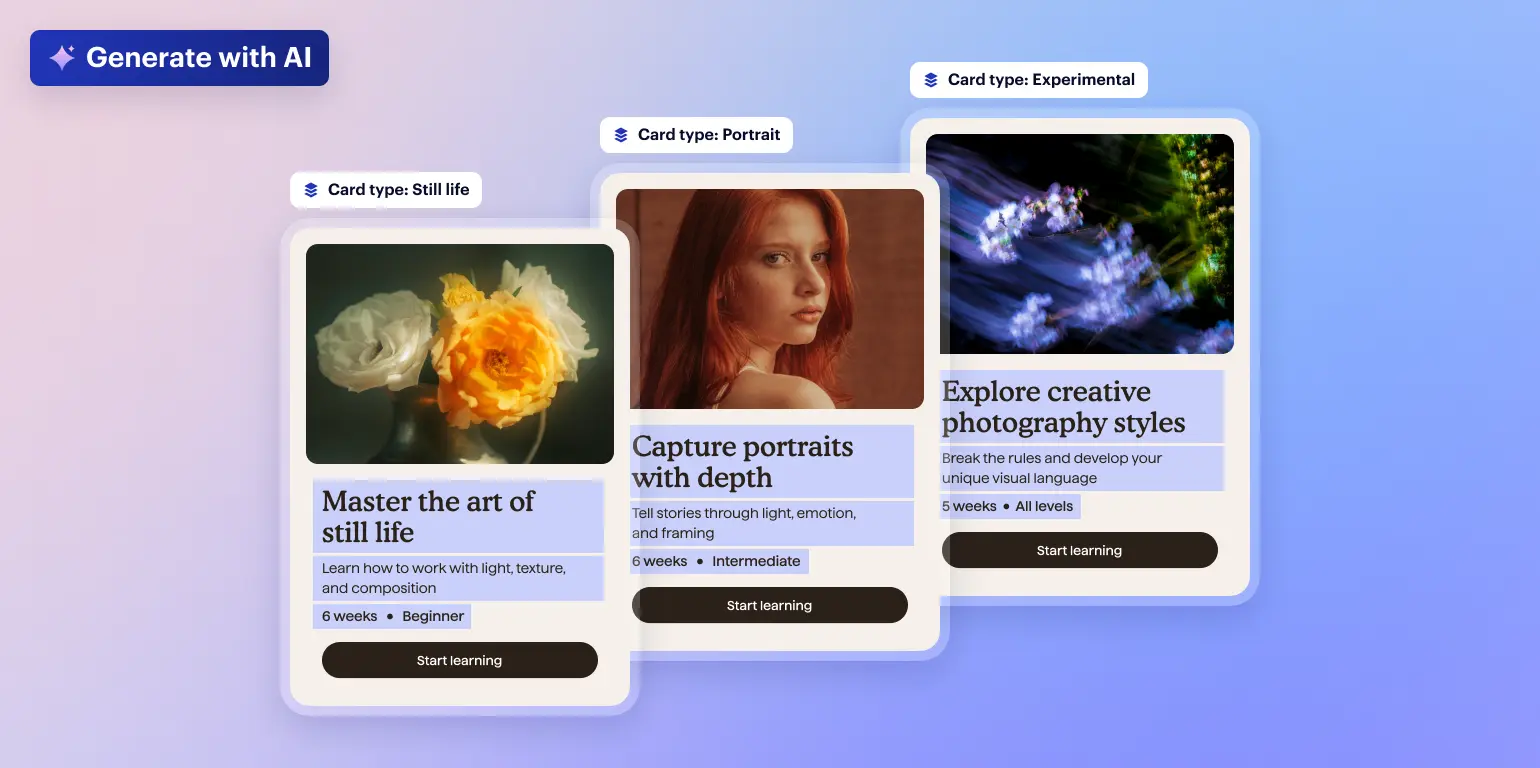
Fluid Grid technology allows the layout to adjust automatically based on the volume of content. If the AI generates a longer paragraph for a specific audience segment, the container blocks and surrounding elements shift dynamically to maintain visual integrity and mobile responsiveness. This “set-it-and-forget-it” approach to design is essential for scaling, as it removes the need for a designer to manually “pixel-push” every generated variation.
Strategic Implications for Marketing Operations
The introduction of AI Collections suggests a shift in the required skill sets for marketing operations (MarOps) teams. The focus is moving away from repetitive manual tasks and toward “prompt engineering” and strategic oversight.
Enhanced Agility
Marketing teams can now respond to market trends or competitor moves in real-time. If a specific keyword suddenly trends, a personalized landing page can be deployed in minutes rather than days. This agility is particularly valuable in industries with high volatility, such as fintech, e-commerce, and SaaS.
Human-in-the-Loop Quality Control
Despite the automation, Instapage emphasizes a “human-in-the-loop” philosophy. The AI provides the heavy lifting of generation, but the marketer retains control over the final output. Users are encouraged to provide detailed prompts and to review the AI-generated content table before hitting “publish.” This ensures that brand safety and tone-of-voice standards are maintained across hundreds of pages.
Industry Reaction and Market Context
While Instapage has not released official statements from third-party partners, the broader MarTech community has reacted to the trend of “generative UI” with cautious optimism. Analysts note that while AI can create content, the strategic “why” behind a campaign still rests with human marketers.
“The bottleneck in digital marketing has moved from the ‘buy’ to the ‘experience,'” says one industry analyst. “Tools like AI Collections are essentially democratizing high-level personalization that was previously only available to enterprise-level companies with massive web development budgets.”
The launch puts Instapage in direct competition with other AI-driven design tools and “headless” CMS providers that are also racing to integrate generative capabilities. However, Instapage’s specific focus on the landing page—a high-intent stage of the funnel—positions it as a specialized tool for performance marketers focused on immediate conversion.
Chronology of Development
The release of AI Collections is the latest in a series of AI-centric updates from Instapage.
- Late 2023: Instapage introduced AI-generated headlines and CTA buttons within its standard editor.
- Early 2024: The company rolled out “AI Experiments,” which automated the A/B testing process by suggesting variations based on historical performance data.
- Current Release: AI Collections marks the move from individual element optimization to full-scale page ecosystem automation.
Broader Impact and Future Outlook
The implications of AI Collections extend beyond mere efficiency. As the cost of creating personalized pages drops toward zero, the barrier to entry for hyper-niche marketing also falls. Small to medium-sized businesses (SMBs) can now compete with larger corporations by providing the same level of tailored user experience without needing a large creative department.
Furthermore, this technology paves the way for “predictive personalization,” where AI might one day not only generate pages based on a marketer’s table but also predict which content variations will perform best for a specific visitor in real-time based on third-party data signals.
In conclusion, AI Collections represents a significant milestone in the maturation of AI in marketing. By shifting the workload from manual duplication to strategic configuration, Instapage is enabling a future where the “generic” landing page may become obsolete. For marketers, the challenge will no longer be how to create a personalized page, but how to best use that capability to build deeper, more relevant connections with their audiences. Instapage is currently offering a 14-day trial of these features, inviting the industry to test the limits of automated personalization.