rifanmuazin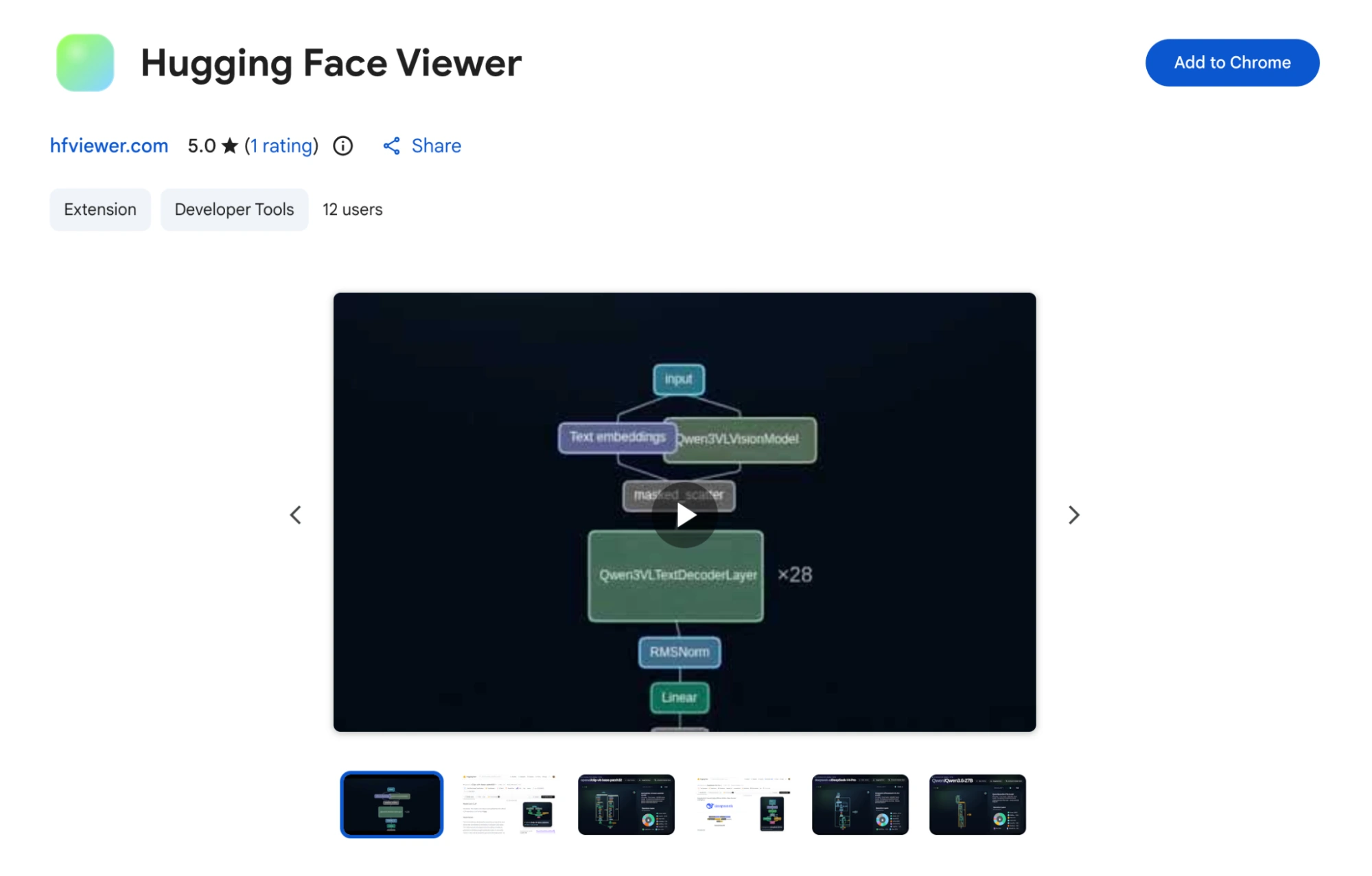
The rapid proliferation of open-source artificial intelligence has transformed the Hugging Face ecosystem into the primary repository for the world’s most advanced machine learning models. As of mid-2024, the platform hosts hundreds of thousands of models, ranging from Large Language Models (LLMs) to specialized vision transformers and multimodal systems. However, as these models grow in sophistication, understanding their internal structural logic has become increasingly difficult for developers and researchers. While model repositories typically provide configuration files and “model cards” that describe a model’s purpose and training data, they often lack an intuitive way to inspect the intricate arrangement of layers, attention mechanisms, and routing logic.
To address this gap in transparency, a new tool known as hfviewer has emerged, offering a streamlined, visual approach to model inspection. By converting abstract configuration data into interactive architectural graphs, hfviewer allows developers to bypass the tedious process of manually reconstructing model layouts from text-based JSON files. This advancement comes at a critical time when architectures like DeepSeek-V4-Pro and other Mixture-of-Experts (MoE) models are pushing the boundaries of modular complexity.
The Challenge of Modern Model Transparency
In the early days of deep learning, architectures like AlexNet or VGG were relatively straightforward, consisting of a linear sequence of convolutional and pooling layers. Today’s state-of-the-art models are vastly more complex. A single LLM may contain dozens of transformer blocks, each comprising multi-head self-attention mechanisms, feed-forward networks, layer normalization, and residual connections. The rise of Mixture-of-Experts (MoE) architectures has added another layer of difficulty, introducing “routers” that dynamically assign tokens to specific “expert” sub-networks.
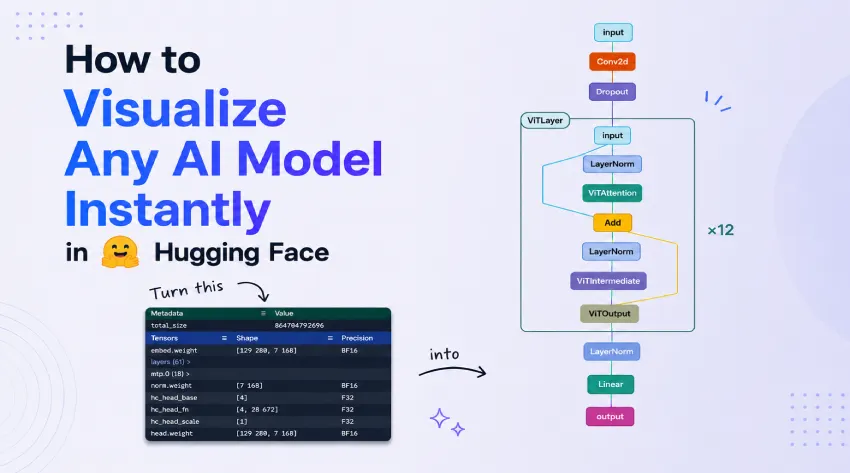
When a developer explores a repository on Hugging Face, they are usually greeted with a config.json file. This file contains the “DNA” of the model—hyperparameters, layer counts, hidden sizes, and activation functions. For a model like DeepSeek-V4-Pro, this configuration can be overwhelming to parse mentally. Errors in interpreting these configurations can lead to significant issues during fine-tuning, quantization, or deployment, as developers may misunderstand how data flows through the system.
The Mechanics of HFviewer: A Simple URL Integration
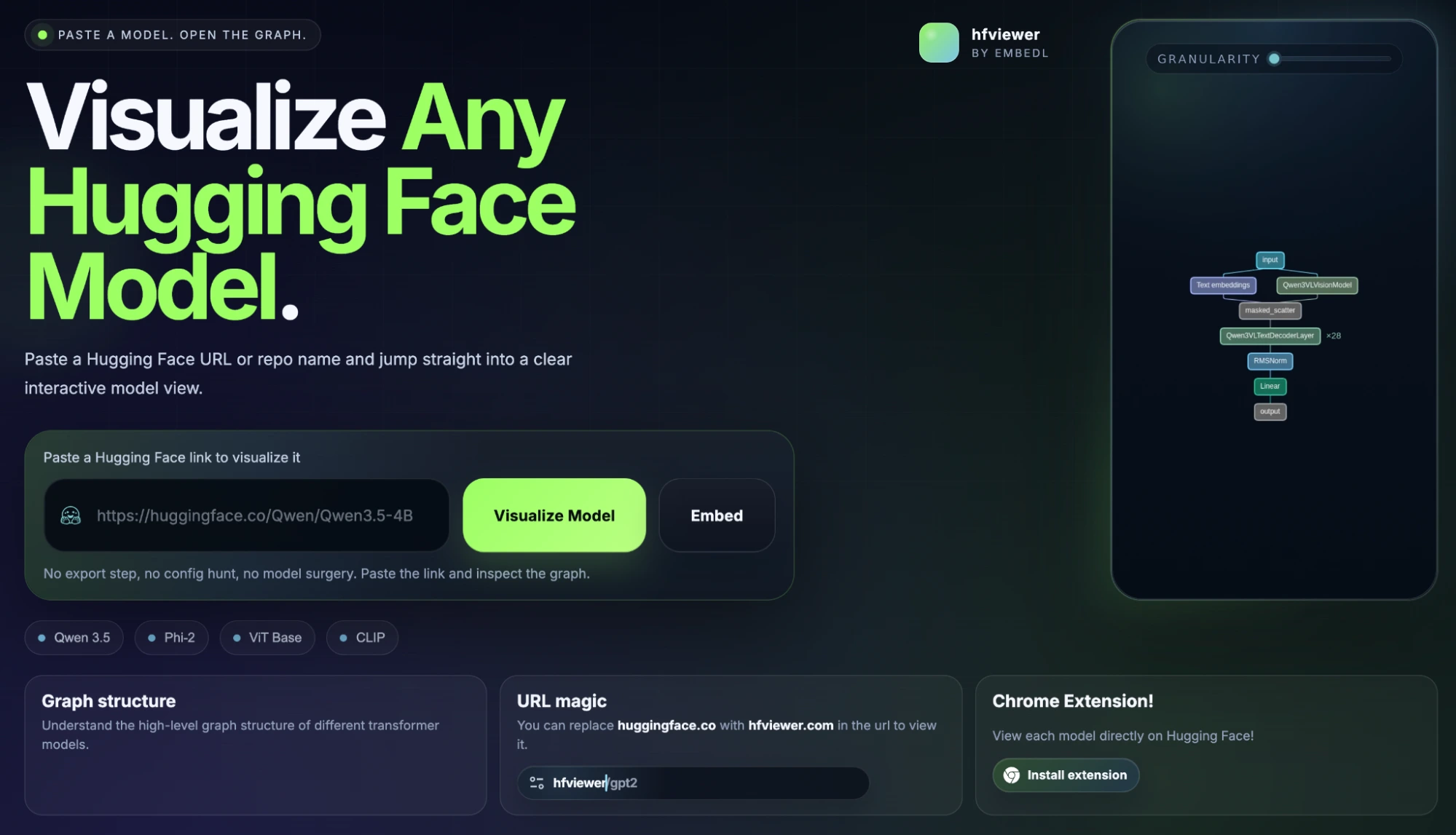
The primary innovation of hfviewer lies in its accessibility. Rather than requiring users to download model weights or install heavy visualization libraries like Netron or TensorBoard locally, hfviewer operates as a lightweight web-based service. The tool utilizes a “URL trick” that allows for instantaneous redirection from a standard Hugging Face model page to a visual representation.
To use the tool, a developer takes a standard Hugging Face URL, such as https://huggingface.co/deepseek-ai/DeepSeek-V4-Pro, and replaces the domain huggingface.co with hfviewer.com. The resulting URL—https://hfviewer.com/deepseek-ai/DeepSeek-V4-Pro—triggers the tool to fetch the model’s configuration metadata and render an interactive graph. This graph displays the hierarchy of the model, allowing users to expand or collapse specific blocks, inspect parameter counts per layer, and trace the connectivity between different components.
Chronology of AI Visualization Tools
The development of hfviewer represents the latest stage in a decade-long effort to make neural networks more interpretable.
- 2014-2016: The TensorBoard Era: Google’s TensorBoard became the standard for visualizing training metrics and static graphs, though it often required significant setup within a TensorFlow environment.
- 2017-2019: The Rise of Netron: As the ONNX (Open Neural Network Exchange) format gained traction, Netron emerged as a popular standalone viewer for saved model files (.onnx, .pb, .h5). However, Netron requires the user to have the actual model file on their local machine.
- 2020-2023: Hugging Face’s Dominance: As the industry shifted toward the Transformers library, the need for “config-first” visualization grew. Developers began writing custom scripts to print model summaries in Python.
- 2024-Present: Web-Native Exploration: Tools like hfviewer represent the “web-native” phase, where visualization is integrated into the browsing experience, requiring zero local computation or file downloads.
Technical Integration and Developer Workflow
Beyond the simple URL redirection, hfviewer has been designed to fit into a variety of developer workflows. For those working within integrated development environments (IDEs) or terminal-heavy setups, the tool supports direct command-line access. By utilizing system-specific “open” commands, developers can trigger a browser-based visualization without leaving their coding environment.
On macOS, the command open https://hfviewer.com/[model-path] serves this purpose, while Linux users utilize xdg-open and Windows users utilize the start command in PowerShell. This functionality is particularly useful during the research phase of a project, where a developer might want to quickly compare the architecture of a Vision Transformer (ViT) with a standard ResNet to determine which is better suited for a specific computer vision task.
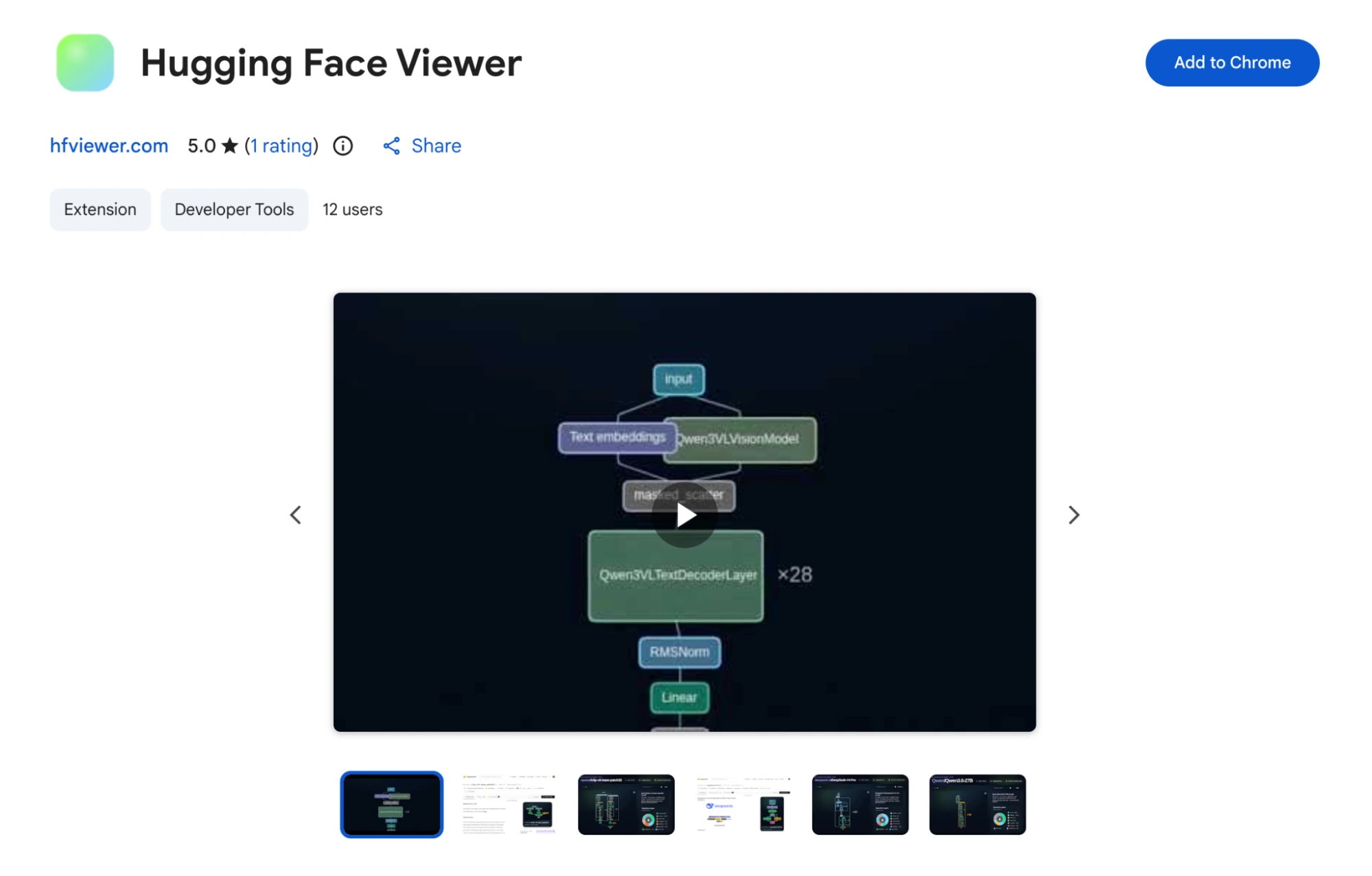
Furthermore, the introduction of the “Hugging Face Viewer” browser extension for Chrome and Chromium-based browsers has further lowered the barrier to entry. The extension adds a dedicated “Visualize” button directly onto the Hugging Face UI, effectively making architecture visualization a native feature of the platform’s ecosystem.
Supporting Data: Why Visualization is Necessary
The necessity for such tools is underscored by the sheer scale of modern AI. Recent data on model growth highlights the following trends:
- Parameter Density: In 2018, BERT-Large featured 340 million parameters. By 2024, models like DeepSeek or Llama-3 have scaled to hundreds of billions of parameters, with some MoE models effectively utilizing trillions of parameters across their expert layers.
- Modular Complexity: Modern models are no longer monolithic. They often combine vision encoders (like CLIP) with language decoders, connected by projection layers. Visualization allows researchers to see exactly where the vision-to-language “bridge” occurs.
- The “Expert” Proliferation: In MoE architectures, the number of experts can range from 8 to over 100. Understanding the routing logic—how the model decides which expert to use for a given input—is nearly impossible without a visual representation of the routing nodes.
Industry experts suggest that as AI moves toward “Agentic” workflows—where models call other models or tools—the ability to visualize the “pipeline” of these interactions will become the next frontier of development.
Broader Implications for the AI Industry
The emergence of hfviewer has implications that extend beyond simple convenience. It touches on three critical areas of the AI industry: education, debugging, and standardization.
Educational Accessibility: For students and junior machine learning engineers, the “black box” nature of AI is a significant hurdle. Visualizing a model helps bridge the gap between mathematical theory (e.g., “how self-attention works”) and structural reality (e.g., “where the attention heads are located in the stack”). By making these structures visible, hfviewer serves as a powerful pedagogical tool.
Optimization and Debugging: When porting a model to edge devices or mobile hardware, developers must often “prune” or “quantize” specific layers. Visualizing the architecture helps identify which layers are most resource-intensive and where data bottlenecks might occur. It allows for a more strategic approach to model optimization.
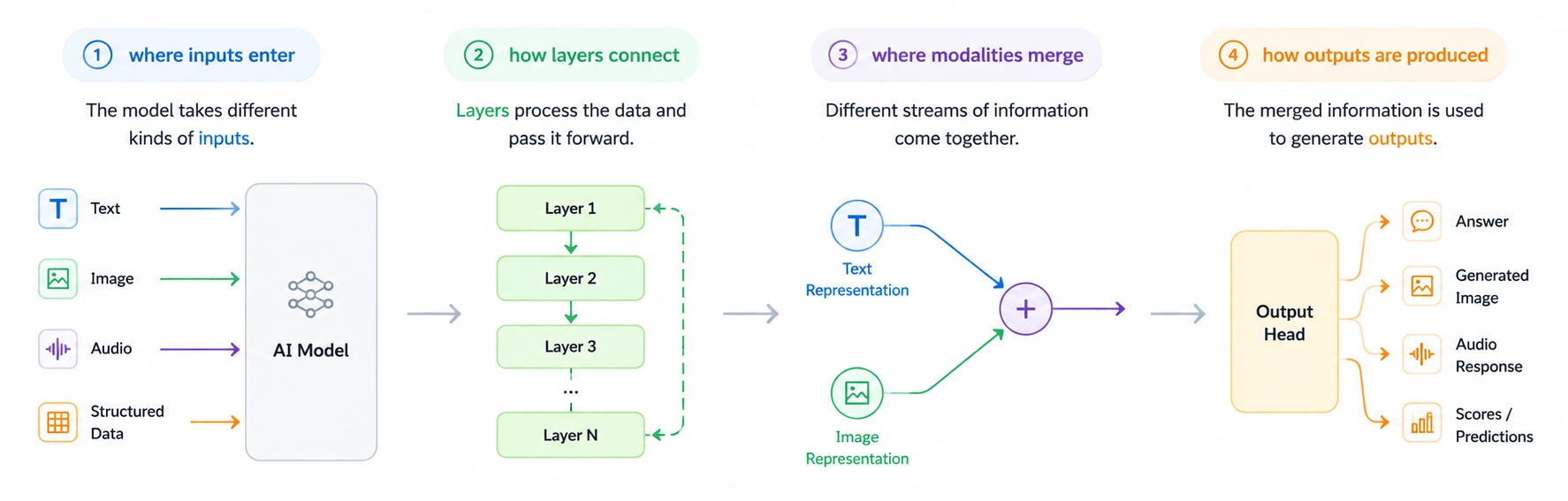
Standardization of Transparency: As regulatory bodies in the US and EU begin to look closer at AI transparency, the ability for companies to clearly explain their model architectures will become a compliance requirement. Tools that provide an objective, standardized view of a model’s “innards” could play a role in technical auditing and safety reviews.
Analysis of the Future Landscape
While hfviewer is a significant step forward, the field of AI visualization is far from settled. Current limitations include the inability to visualize dynamic weights in real-time or to see the specific data activations as they pass through the network (a feat that usually requires running the model on active hardware).
However, the trend is clear: the AI community is moving away from “faith-based” development—where one trusts the code—toward “verification-based” development, where one inspects the structure. As models continue to become more modular and multimodal, the demand for tools that can simplify this complexity will only grow.
The success of hfviewer demonstrates a fundamental truth in the tech industry: sometimes, the most impactful innovations are not the ones that add complexity, but the ones that remove it. By simply changing a URL, developers can now gain a level of insight that previously required hours of manual labor. In the high-stakes race of AI development, that clarity is an invaluable asset.