rifanmuazin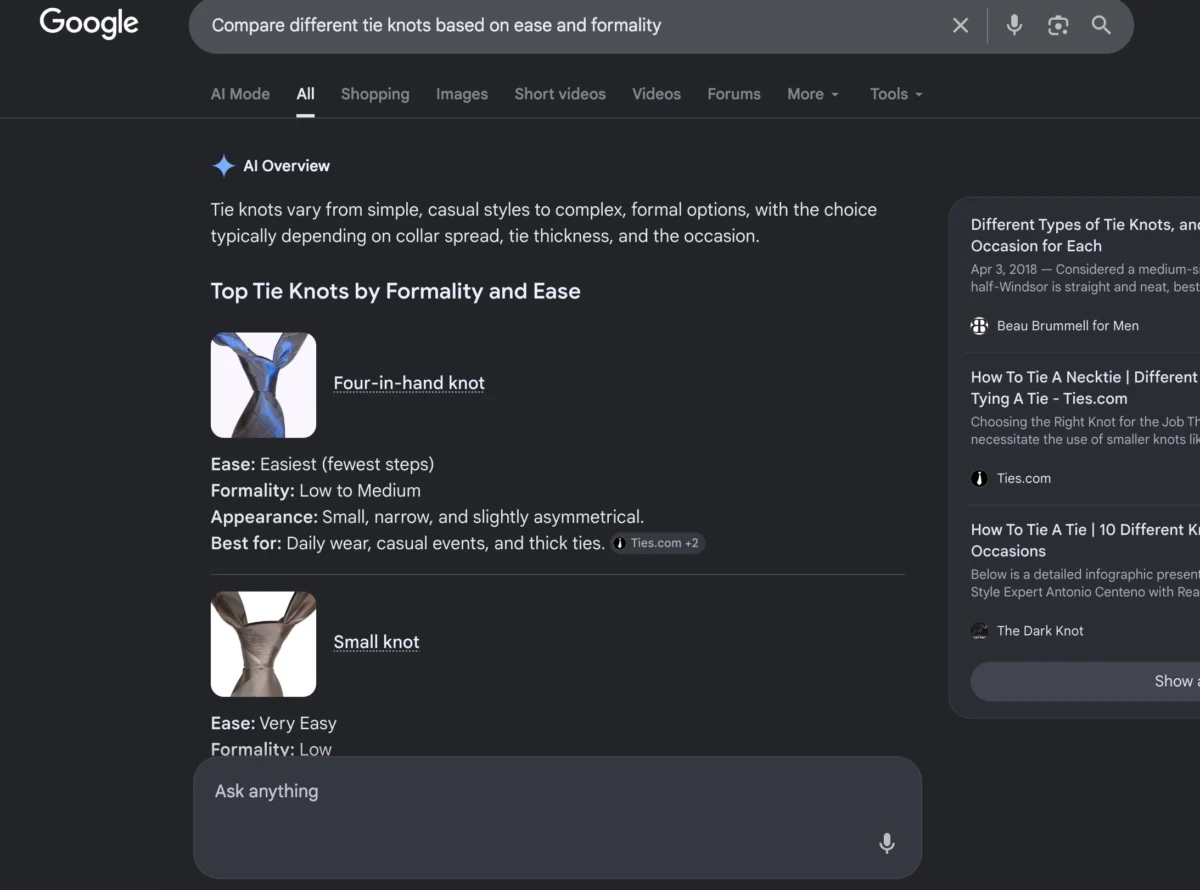
Google is currently in the testing phase of a significant new feature, integrating a distinctive icon into its autocomplete search suggestions that, when clicked, directly expands an AI Overview response. This development, first observed by SEO Observer and shared on X (formerly Twitter), signals a further evolution in how Google aims to deliver information and interact with user queries, particularly those amenable to artificial intelligence-generated summaries. The icon itself features a magnifying glass overlaid with the recognizable Gemini logo, indicating its direct connection to Google’s advanced AI models. When a user types a query into the search bar, and this new suggestion appears, clicking it does not merely refine the search query; instead, it immediately navigates to a Google Search Results Page (SERP) where the AI Overview for the suggested, often longer, query is already fully expanded and prominently displayed at the top.
The Evolution of Google Search and AI Integration
The introduction of this new autocomplete icon marks another milestone in Google’s ongoing efforts to infuse artificial intelligence deeper into its core search experience. For decades, Google Search has been the primary gateway to information online, constantly adapting its algorithms and user interface to provide more relevant and efficient results. Early iterations focused on keyword matching and page ranking, evolving to understand natural language and user intent. The advent of AI and large language models (LLMs) has presented Google with an unprecedented opportunity to transform search from a link-aggregation service into a more direct answer engine.
A Brief Chronology of AI in Google Search:
- Early 2010s: Google began incorporating machine learning more extensively, notably with RankBrain in 2015, to better understand complex and ambiguous queries.
- Late 2010s: BERT (Bidirectional Encoder Representations from Transformers) in 2019 and MUM (Multitask Unified Model) in 2021 further enhanced Google’s ability to process natural language and provide more nuanced answers, particularly for multi-faceted questions.
- 2023: Google started to publicly roll out its "Search Generative Experience" (SGE), later rebranded as AI Overviews, to a limited set of users. This marked a significant shift, as AI-generated summaries began appearing directly on the SERP, aiming to answer queries without requiring users to click through to external websites.
- Google I/O 2024: AI Overviews were officially rolled out to a broader audience in the United States, with plans for global expansion. This move solidified Google’s commitment to an AI-first search future.
- Previous Autocomplete AI Tests: Prior to this specific test, Google had experimented with "AI Mode" suggestions within autocomplete, which would offer to reformulate a user’s query for an AI-enhanced search. However, the current test is distinct in its direct invocation of an expanded AI Overview.
This latest test with the Gemini-branded icon is a logical progression, streamlining the path from user query to AI-generated answer. It moves beyond simply suggesting a modified query and directly offers the AI’s compiled response, potentially saving users several clicks and reducing the cognitive load of navigating search results.
Deep Dive into AI Overviews and Gemini’s Role
AI Overviews are Google’s answer to the growing demand for instant, concise information. Powered by Google’s advanced generative AI models, primarily Gemini, these overviews synthesize information from across the web to provide direct answers to complex questions, summarize topics, or offer step-by-step instructions. The goal is to provide a comprehensive answer directly on the search results page, especially for queries where users might otherwise need to visit multiple websites to gather information.
The Significance of the Gemini Logo:
The inclusion of the Gemini logo on the new autocomplete icon is particularly noteworthy. Gemini is Google’s most powerful and versatile AI model, designed to understand and operate across different modalities—text, code, audio, image, and video. Its integration into this autocomplete feature underscores Google’s confidence in Gemini’s ability to accurately and effectively generate summaries for a wide range of user queries. It also serves as a clear branding exercise, associating the cutting-edge AI capabilities directly with the search experience. This branding helps users understand that the response they are about to receive is not merely a traditional search result but a sophisticated AI-generated synthesis.
The transition from a basic autocomplete suggestion to a direct AI Overview expansion highlights a strategic shift: Google is actively guiding users towards its AI-powered answers. This could be interpreted as an effort to educate users about the capabilities of AI Overviews and to encourage their adoption, ultimately reshaping user expectations for what a search engine can deliver.

Implications for User Experience and Search Behavior
From a user experience perspective, this feature promises greater efficiency. For queries seeking factual information, definitions, summaries, or step-by-step guides, an immediately expanded AI Overview could be a significant time-saver. Instead of sifting through ten blue links, users receive a synthesized answer upfront. This aligns with modern user preferences for instant gratification and streamlined information access.
However, this efficiency comes with potential trade-offs. The "black box" nature of AI-generated answers means users might be less aware of the original sources of information, even if AI Overviews typically include links to the web pages from which they draw their data. The directness of the AI Overview might also reduce critical engagement with diverse perspectives, as the AI synthesizes a single, authoritative response. This could lead to an over-reliance on the AI’s interpretation, potentially impacting users’ ability to critically evaluate information from multiple sources.
Furthermore, this feature could subtly influence user search behavior. By presenting AI-enhanced suggestions that lead to direct answers, Google might encourage users to formulate more complex, conversational, or research-oriented queries that are well-suited for AI Overviews. This would be a departure from the traditional keyword-centric search paradigm, pushing users towards a more natural language interaction with the search engine.
Broader Impact on Search Engine Optimization (SEO)
The implications for Search Engine Optimization (SEO) and the broader digital ecosystem are substantial and multifaceted. For years, the goal of SEO has been to rank high in the "10 blue links" of Google’s organic search results, driving traffic to websites. AI Overviews, and now this direct autocomplete integration, fundamentally alter this dynamic.
Reduced Organic Clicks: If users can get their answers directly from an expanded AI Overview, the need to click through to traditional organic results decreases significantly. This "zero-click search" phenomenon, where users find answers directly on the SERP, is not new but is amplified by AI Overviews. For websites that rely on organic traffic for revenue (through advertising, e-commerce, or lead generation), a reduction in clicks could have a profound impact. Content creators and publishers may see a decline in referral traffic, forcing them to re-evaluate their content strategies and business models.
Shifting Content Strategy: Websites may need to adapt by focusing on content that AI Overviews are less likely to fully satisfy, or by creating content that is explicitly designed to be summarized effectively by AI while still compelling users to visit the full page for deeper insights or unique value. This might involve:
- Niche Expertise: Providing highly specialized or proprietary information that AI struggles to synthesize from general web sources.
- Experiential Content: Focusing on personal experiences, opinions, or interactive tools that AI Overviews cannot replicate.
- Brand Building: Investing in brand recognition and direct traffic channels to reduce reliance on Google.
- Data Structure: Ensuring content is well-structured and uses schema markup to make it easier for AI models to understand and extract key information accurately.
The "Featured Snippet" on Steroids: AI Overviews can be seen as an evolution of Google’s featured snippets, which already provided direct answers and sometimes reduced clicks. The difference is in scale, complexity, and the generative nature of the AI response. This means competition for visibility within the AI Overview itself becomes paramount.
Monetization Challenges for Google: While this feature enhances user experience, it also presents a long-term challenge for Google’s own advertising model. If fewer users click on organic or even paid search results, the traditional pay-per-click (PPC) advertising model might need significant adaptation. Google has indicated that AI Overviews will be integrated with ads, but the precise nature and effectiveness of this integration remain evolving.

Statements and Expert Reactions
While Google has not released an official statement specifically on this autocomplete test, its broader strategy has been articulated in numerous keynotes and press releases. At Google I/O 2024, CEO Sundar Pichai emphasized Google’s commitment to an AI-first future, stating, "We’re already seeing the benefits of AI in Search today. Soon, you’ll see AI Overviews in Search, helping you get the gist of a topic with links to dive deeper." This new autocomplete icon aligns perfectly with that vision, making AI Overviews more accessible and central to the search experience.
Industry analysts and SEO experts have been quick to react to these developments. Barry Schwartz, a prominent voice in the SEO community and editor of Search Engine Roundtable, has extensively covered Google’s AI experiments, consistently highlighting their potential to reshape the digital landscape. Commenting on similar AI integrations, Schwartz has noted the accelerating pace of change and the need for website owners to remain agile.
A hypothetical statement from an AI ethics researcher might caution that while direct AI answers offer convenience, they also place a greater responsibility on the AI system for accuracy and neutrality. "The more Google guides users directly to AI-generated content, the more critical it becomes to ensure that these AI Overviews are robustly fact-checked, free from bias, and transparent about their sources," a hypothetical expert might state. "The convenience must not come at the cost of critical thinking or information diversity."
The Competitive Landscape and Future of Search
Google’s aggressive integration of AI into search is also a response to a rapidly evolving competitive landscape. Microsoft, with its integration of OpenAI’s GPT models into Bing Chat (now Copilot), has been a significant driver in pushing generative AI into search. Other players are also exploring AI-driven search solutions. Google’s move with the Gemini-branded autocomplete icon is a clear statement of intent: to maintain its dominance in search by leading the charge in AI innovation.
The future of search, as envisioned by Google, appears to be increasingly conversational, personalized, and proactive. The current test is a step towards a search engine that not only understands what you’re looking for but also anticipates your needs and provides synthesized answers before you even fully formulate your query or click a link. This transition represents a fundamental shift from a "pull" model, where users actively seek information, to a "push" model, where the search engine intelligently delivers it.
In conclusion, the testing of a new autocomplete icon that directly expands an AI Overview with the Gemini logo is more than just a minor UI tweak; it is a significant indicator of Google’s strategic direction. It underscores the company’s commitment to making AI Overviews a central, rather than supplementary, part of the search experience. While promising enhanced efficiency for users, this evolution presents profound challenges and opportunities for content creators, SEO professionals, and the entire digital publishing industry, signaling a new era in the ongoing transformation of how we access and interact with information online. The coming months will reveal how widely this feature rolls out and its ultimate impact on user behavior and the web ecosystem.