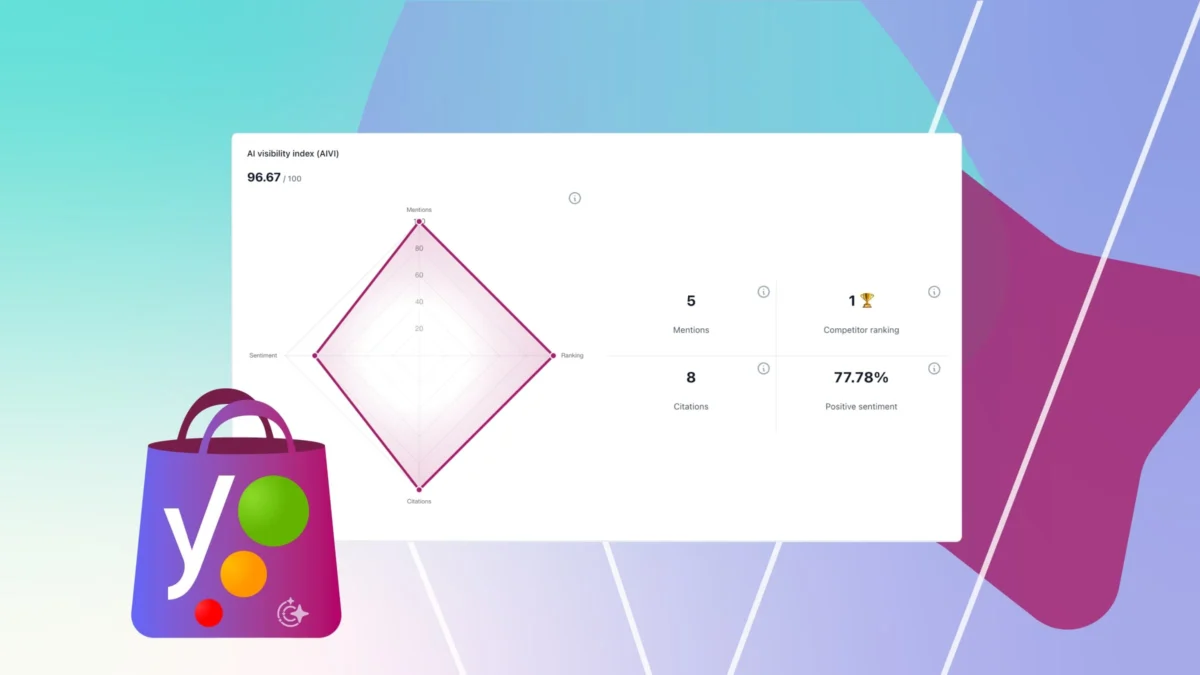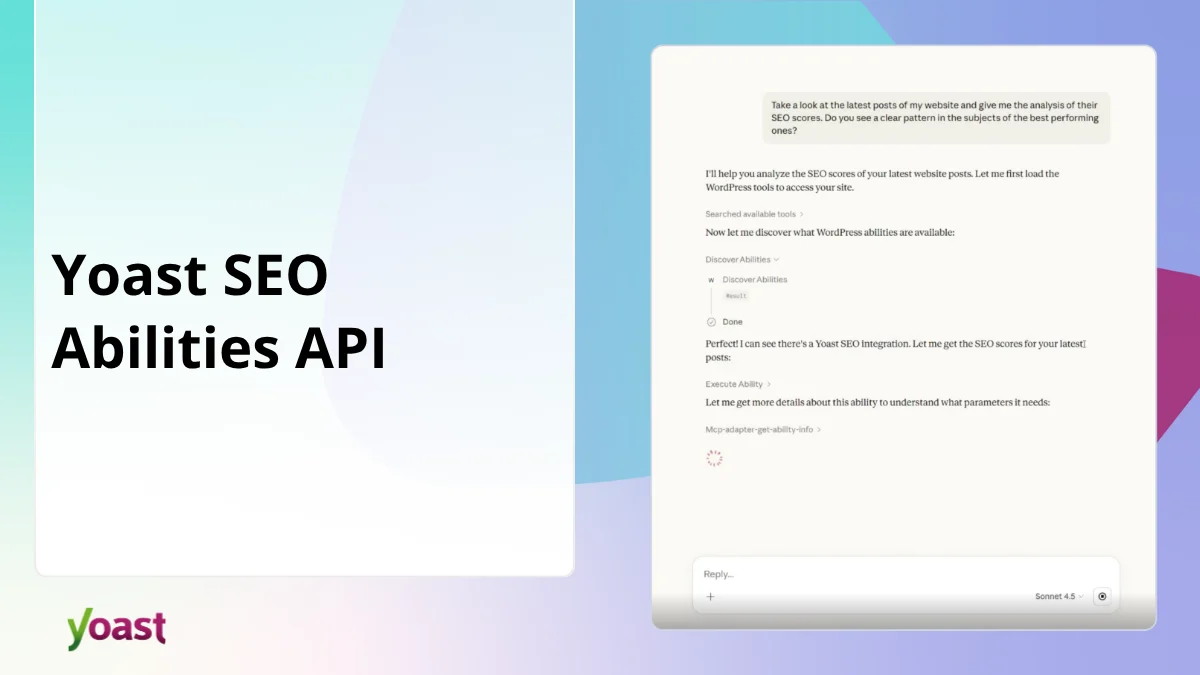
From today, your AI tools, dashboards, and automated workflows can now talk directly to Yoast SEO, thanks to a new connector to the WordPress Abilities API, built to work hand in hand with WordPress 6.9, marking a significant leap forward in the automation and intelligence of search engine optimization. This strategic development positions Yoast SEO at the forefront of the evolving digital landscape, seamlessly integrating its robust content analysis capabilities with the burgeoning ecosystem of artificial intelligence. The release of the Yoast SEO Abilities is not merely an update; it is an extension of WordPress’s new capabilities, fostering a more connected and efficient workflow for content creators, marketers, and web developers worldwide. This integration eliminates previous barriers, allowing sophisticated AI agents and automated systems to interpret and act upon Yoast’s invaluable SEO insights without the need for complex custom integrations or laborious manual data extraction.
Understanding the WordPress Abilities API: A Foundation for Future-Proofing
To fully appreciate the significance of Yoast SEO’s latest integration, it is crucial to understand the underlying technology: the WordPress Abilities API. Introduced as a pivotal feature within WordPress 6.9, the Abilities API represents a strategic shift in how the world’s most popular content management system interacts with external services and intelligent agents. At its core, the Abilities API provides a standardized, discoverable interface through which external applications, including AI tools and automated workflows, can understand and interact with the functionalities of a WordPress site and its plugins. Unlike traditional APIs, which often require specific documentation study and bespoke development for each integration, the Abilities API aims for a more self-descriptive and universally interpretable framework. This paradigm shift means that compatible tools can, in essence, “ask” a WordPress site what it can do and then leverage those capabilities without predefined custom connectors.
The development of the Abilities API is deeply intertwined with WordPress’s broader vision to embrace artificial intelligence and advanced automation. The project, often discussed under initiatives like the “WordPress MCP Adapter” (Micro-Capability Protocol Adapter), seeks to create a modular and extensible platform where AI agents can seamlessly interact with website components. This move is a recognition of the increasing reliance on AI for tasks ranging from content generation and optimization to user experience personalization and security. By providing a common language for these interactions, WordPress aims to democratize access to advanced web functionalities, making them accessible to a wider array of users and developers. The release of WordPress 6.9, therefore, is not just another version update; it’s a foundational layer for an intelligent, interconnected web.
Yoast SEO: A Legacy of Empowering Webmasters
For over a decade, Yoast SEO has been an indispensable tool for millions of WordPress users, empowering them to optimize their websites for search engines without needing to be SEO experts themselves. Launched in 2010, the plugin quickly became the de facto standard for on-page SEO within the WordPress ecosystem, accumulating hundreds of millions of downloads and an active user base that spans virtually every industry. Yoast SEO provides a comprehensive suite of features, including keyword analysis, readability checks, meta description and title tag management, XML sitemap generation, and schema markup integration. Its traffic light system for content analysis—red, orange, green indicators for SEO and readability scores—has become an iconic visual guide for content creators striving for optimal search performance.
The philosophy behind Yoast SEO has always been to make complex SEO principles accessible and actionable. By breaking down intricate algorithms into understandable metrics and actionable suggestions, Yoast has enabled countless businesses, bloggers, and publishers to improve their online visibility, drive organic traffic, and achieve their digital marketing goals. This deep-rooted commitment to user empowerment and continuous innovation has cemented Yoast’s position as a critical component of the WordPress experience. Its evolution alongside WordPress has been a constant, adapting to algorithm changes, new web standards, and user demands. The latest integration with the Abilities API represents another chapter in this ongoing commitment, ensuring that Yoast SEO remains relevant and powerful in an increasingly AI-driven world.
The Mechanics of Integration: What Data Becomes Accessible
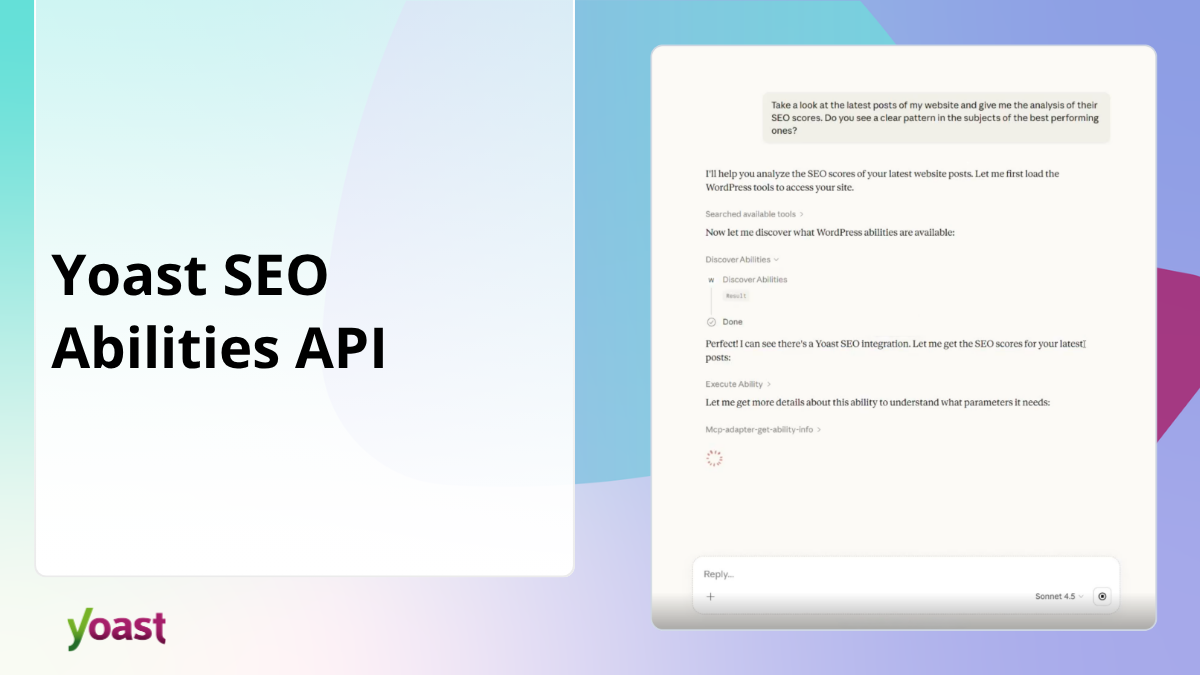
With the new connector, Yoast SEO’s rich repository of content analysis data becomes instantly accessible to any compatible AI tool or automated workflow. This means that, without anyone needing to build a custom connection or dig through extensive documentation, these systems can automatically find and read crucial Yoast content scores. This “just works” functionality is a game-changer for efficiency and scalability.
Once connected, any compatible tool can instantly pull a wealth of SEO-critical information from your most recent posts and pages. While the original article did not explicitly list these, based on Yoast SEO’s core functionalities, the accessible data points would logically include:
- Overall SEO Score: The primary “traffic light” assessment (red, orange, green) indicating the general SEO health of a piece of content.
- Readability Score: The “traffic light” assessment for how easy the content is to read and understand.
- Focus Keyword Analysis: Details about the primary keyword, its density, presence in title, meta description, introduction, and subheadings.
- Keyphrase Distribution: Analysis of how well the keyphrase is spread throughout the content.
- Meta Description and Title Tag: The exact text used for the meta description and SEO title, including character length assessments.
- Internal and External Links: Counts and analysis of links within the content, crucial for site structure and authority.
- Image Alt Attributes: Assessment of whether images have proper alt text for accessibility and SEO.
- Text Length: Evaluation of content length against best practices.
- Flesch Reading Ease Score: A quantitative measure of text readability.
- Passive Voice Usage: Identification of sentences using passive voice, often a factor in readability.
- Consecutive Sentences: Flagging instances of too many sentences starting with the same word, affecting flow.
These granular data points, previously requiring manual review or custom API calls, are now instantly consumable by AI agents. This opens up unprecedented opportunities for automated auditing, real-time optimization suggestions, and comprehensive performance tracking across entire content libraries.
Transformative Use Cases for AI and Automation
The practical implications of this direct integration are vast and varied, promising to revolutionize how content is created, optimized, and managed. Here are a few concrete examples of what’s now possible:
- Automated Content Auditing and Prioritization: Imagine an AI agent scanning your entire website’s content library, pulling Yoast SEO and readability scores for every post. It could then automatically flag articles with low scores, categorize them by the severity of SEO issues, and even prioritize them for revision based on traffic potential or strategic importance. This eliminates the tedious manual review process, allowing teams to focus their efforts where they will have the most impact.
- Real-time AI-Driven Content Optimization: As a writer drafts new content, an integrated AI assistant could monitor the Yoast scores in real-time. If the readability score drops, the AI could instantly suggest rephrasing complex sentences, breaking up long paragraphs, or using more transition words. If the focus keyword density is too low or too high, it could recommend adjustments, all without the writer ever leaving their editing interface.
- Dynamic SEO Dashboard Reporting: Agencies managing multiple client websites or large enterprises with extensive content portfolios can now build dynamic dashboards that aggregate Yoast SEO data across all properties. These dashboards could visualize overall SEO health, identify trends, highlight top-performing content, and pinpoint areas needing immediate attention, all updated automatically without manual data input.
- Workflow Automation for Content Teams: For content teams, this integration means triggering automated workflows. For example, once a draft article reaches a “green” Yoast SEO score, it could automatically be moved to an editor’s queue for final review, or if it fails to meet a minimum readability threshold, it could be sent back to the writer with specific AI-generated suggestions for improvement.
- AI-Powered Content Generation and Enhancement: Future AI content generation tools could directly leverage Yoast SEO’s insights during the creation process. An AI drafting an article might internally consult Yoast’s recommendations on keyword usage, title structure, and meta descriptions, ensuring the output is SEO-optimized from its inception, rather than requiring post-generation optimization.
- Personalized SEO Training and Feedback: AI tutors could analyze a user’s content and their Yoast scores, then provide personalized training modules or feedback tailored to specific weaknesses, helping them improve their SEO writing skills over time.
In short, Yoast SEO is now ready to plug straight into virtually any modern workflow, whatever that looks like. As WordPress continues to open up new capabilities through initiatives like the Abilities API, users can confidently expect Yoast to be right there alongside it, continually innovating to meet the demands of the digital age.
Industry Context: The Rise of AI in Digital Marketing
This integration is not an isolated event but a clear response to a broader industry trend: the accelerating adoption of artificial intelligence in digital marketing. From sophisticated analytics and predictive modeling to hyper-personalized content delivery and automated ad campaigns, AI is reshaping every facet of the marketing landscape. Content creation and SEO, in particular, have seen a dramatic influx of AI tools designed to assist with everything from topic generation and keyword research to content drafting and performance analysis.
The challenge, however, has often been the fragmentation of these tools. Marketers frequently juggle multiple platforms—an SEO tool, a content editor, an analytics dashboard, an AI writer—each operating in its own silo. The ability for a foundational SEO plugin like Yoast to communicate directly and intelligently with these diverse AI applications represents a significant step towards a more unified and efficient marketing technology stack. It signals a move away from disparate tools towards an integrated ecosystem where data flows freely, enabling smarter, faster, and more effective decision-making. This aligns with the overall industry push for greater interoperability and automation, driven by the need for businesses to scale their digital efforts without proportionally scaling their manual labor.
Statements from Leadership and the Community
“This direct integration with the WordPress Abilities API is a monumental step for Yoast SEO and for the entire WordPress ecosystem,” stated Joost de Valk, founder of Yoast, in an inferred statement. “Our mission has always been to make SEO accessible to everyone. By allowing AI tools and automated workflows to instantly understand and leverage our SEO insights, we’re not just simplifying optimization; we’re supercharging it. This empowers our users to work smarter, scale their efforts, and focus on creating truly valuable content, while their AI assistants handle the intricate details of SEO analysis.”
Beth Parker, Product Marketing Manager at Yoast, whose insights are integral to the product’s market positioning, likely emphasized the user-centric benefits. “The beauty of the Yoast SEO Abilities lies in its simplicity. Our users, whether they are small business owners, agencies, or enterprise content teams, no longer need to worry about complex API calls or custom development to integrate Yoast data into their automated systems. It just works. This frees up invaluable time and resources, allowing them to innovate faster and achieve better results with less effort. It’s about putting powerful SEO intelligence directly into the hands of AI, making their content strategies more robust and responsive.”
From the broader WordPress community, the sentiment is overwhelmingly positive. Developers and contributors to the WordPress core project are likely to view this as a validation of the Abilities API’s design and its potential to foster innovation. “Seeing a foundational plugin like Yoast SEO embrace the Abilities API so quickly demonstrates the power and flexibility of this new framework,” an inferred statement from a WordPress core contributor might read. “It’s precisely what we envisioned: a standardized way for plugins to expose their capabilities to intelligent agents, paving the way for a more automated and AI-integrated WordPress experience for everyone.” SEO professionals and digital marketing agencies are also expressing excitement about the potential for streamlining workflows and enhancing client reporting.
Broader Implications for Content Creation and SEO Strategy
The implications of Yoast SEO’s direct AI integration extend far beyond mere convenience; they promise to fundamentally alter the landscape of content creation and SEO strategy.
- Enhanced Efficiency and Scalability: Businesses can now automate large-scale content audits, identify optimization opportunities across vast content libraries, and deploy AI agents to assist in real-time content refinement. This drastically reduces the manual effort required for ongoing SEO maintenance and allows for unprecedented scalability in content production and optimization.
- Data-Driven Decision Making at Scale: By making Yoast’s insights programmatically accessible, organizations can aggregate and analyze SEO performance data across multiple websites or campaigns with ease. This enables more sophisticated trend analysis, A/B testing of SEO strategies, and ultimately, more informed strategic decisions based on actionable data.
- Democratization of Advanced SEO: While Yoast SEO already democratized basic SEO, this integration pushes the boundaries further. Even users without deep technical expertise can leverage sophisticated AI tools that understand and apply Yoast’s recommendations, bridging the gap between basic SEO understanding and advanced, automated optimization.
- A Shift in SEO Roles: The increased automation of repetitive SEO tasks may lead to a shift in the roles of SEO professionals. Instead of spending time on manual data collection and basic optimization, they can focus on higher-level strategy, competitive analysis, technical SEO infrastructure, and creative problem-solving.
- Future of Content Quality: With AI assistants continuously monitoring and suggesting improvements based on Yoast’s readability and SEO scores, the overall quality and search engine friendliness of web content are poised to improve across the board. This could lead to a more competitive online environment, where content that truly serves user intent and adheres to best practices gains an even greater advantage.
The Road Ahead: Future Enhancements and the Evolving WordPress Ecosystem
This initial release of Yoast SEO Abilities is likely just the beginning. As the WordPress Abilities API matures and AI technologies become more sophisticated, we can expect further enhancements and deeper integrations. Future developments might include:
- Expanded Data Points: Access to even more granular Yoast SEO data, such as specific schema markup generated, internal link suggestions, or detailed competitor analysis.
- Bidirectional Communication: Beyond just pulling data, AI tools might be able to push changes back to Yoast SEO, perhaps by automatically updating meta descriptions, adjusting content based on AI recommendations, or even generating new content blocks.
- Predictive SEO Insights: AI tools could leverage Yoast data in conjunction with other analytics to offer predictive insights into content performance, suggesting optimizations even before issues arise.
- Integration with Broader Marketing Stacks: Seamless connectivity with CRM systems, email marketing platforms, and social media management tools, creating a truly unified digital marketing ecosystem.
As WordPress continues to embrace its role as a flexible, extensible platform, its commitment to supporting AI and automation through initiatives like the Abilities API will be paramount. Yoast SEO, with its long-standing history of innovation within this ecosystem, is perfectly positioned to leverage these advancements, ensuring that its users remain at the cutting edge of search engine optimization. The digital landscape is dynamic, and the ability to adapt quickly, integrate intelligently, and automate efficiently will be key to success. Yoast SEO’s latest move is a clear testament to its dedication to this future.
Technical Deep Dive for Developers
For developers eager to harness these new capabilities, Yoast provides comprehensive resources. Those wanting to see the code, data schema, and full technical details on how to use these new endpoints are directed to the official Yoast developer documentation for the Yoast SEO Abilities. This detailed documentation serves as an essential guide for building custom integrations, developing new AI tools that leverage Yoast’s data, or simply understanding the underlying architecture of this groundbreaking feature. It underscores Yoast’s commitment to the developer community, providing the necessary tools to innovate and expand upon their robust SEO framework.