


The modern digital enterprise operates within a paradox of abundance; while businesses have access to more consumer data than ever before, they are increasingly starved for the clarity required to act upon it. This gap between data collection and confident execution is creating a "fragmentation tax" that costs organizations significantly in lost revenue and operational efficiency. To address these systemic coordination failures, Wingify has announced a strategic unification of its core assets, VWO and AB Tasty, into a single, connected suite designed to bridge the chasm between insight and action.
By combining two of the most mature and widely adopted platforms in the experimentation and personalization sectors, Wingify is positioning itself as the primary solution for organizations struggling with disconnected point solutions. The integration marks a significant shift in the Digital Experience Optimization (DXO) market, moving away from fragmented tools that require manual data stitching and toward a holistic ecosystem where data, audiences, and success metrics are shared universally across teams.
The Structural Cost of Coordination Failure
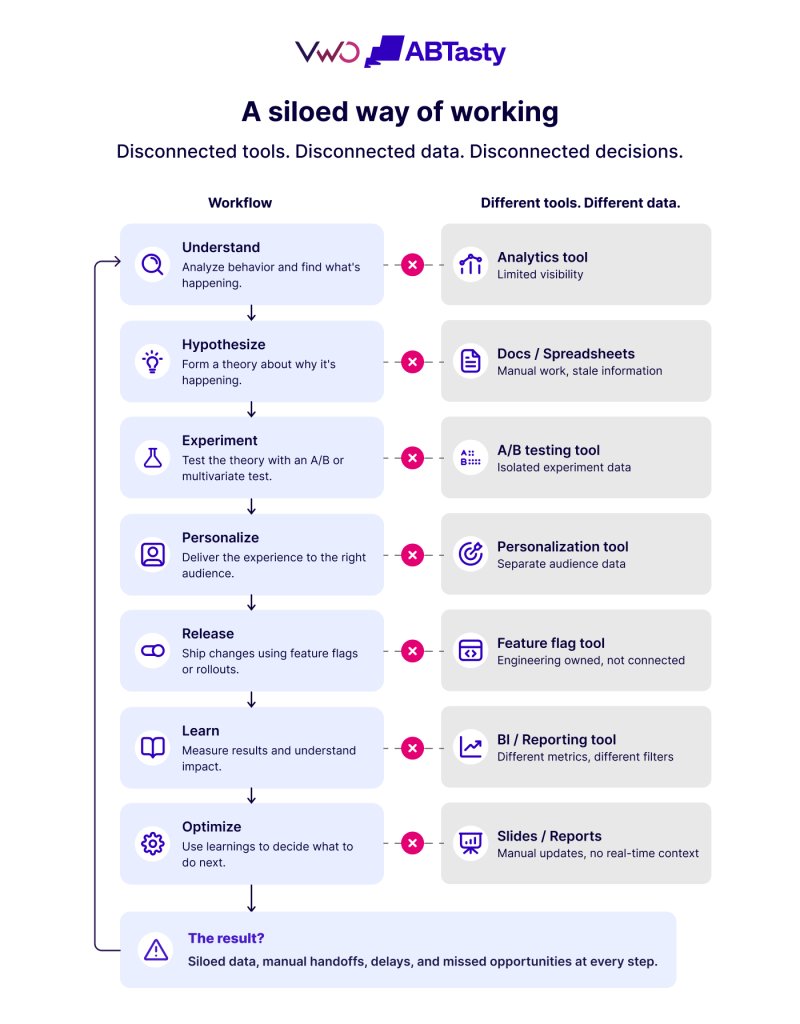
The primary challenge facing digital teams today is not a lack of tools, but rather the failure of those tools to communicate. Most optimization strategies are currently built upon a patchwork of solutions that do not share a common definition of success. Marketing teams may run experiments to increase conversion, while product teams ship features to improve retention, yet these efforts often happen in isolation.
When data does not travel seamlessly across an organization, decision-making slows down. Each "handoff" between tools—from an analytics platform to an experimentation tool, or from a personalization engine to a feature management system—introduces interpretation errors. By the time a data-backed hypothesis is translated into a live customer experience, the market window or consumer trend it was designed to capture may have already passed.
Furthermore, the lack of a unified audience definition leads to "audience drift." For example, a segment defined as "returning customers who abandoned a cart" might be calculated differently across four separate tools. When experimentation teams see one set of figures and personalization teams see another, the result is an endless cycle of data reconciliation rather than active optimization. This conflict in metrics undermines the confidence of stakeholders and stalls the momentum of growth initiatives.
A Unified Foundation for Business Outcomes
The core value proposition of the new Wingify suite is structural connectivity. When experimentation, personalization, feature delivery, customer insights, and analytics share a singular data layer, the output of one stage of optimization becomes the immediate, automated input for the next. This creates a continuous loop that replaces the traditional, stop-and-start nature of digital marketing.
The process begins with a unified "Understand" phase, where behavioral insights—such as heatmaps showing friction in a checkout flow—automatically inform a hypothesis. This hypothesis is then transitioned into an experiment without the need for manual data migration. Once a winning variant is identified, the system can automatically transform that variant into a personalized experience for the specific customer segment that responded most favorably.
This seamless chain—Understand, Hypothesize, Experiment, Personalize, Release, Learn, and Optimize—allows for compounding improvements. In a fragmented environment, the chain is broken at every handoff. Wingify’s integrated approach ensures that the chain remains intact, drawing upon VWO’s decade of expertise in behavioral insight and AB Tasty’s advanced capabilities in AI-driven targeting and segmentation.
Wandz: The Intelligence Layer of the Connected Suite
A critical component of this unified strategy is the introduction of "Wandz," Wingify’s embedded AI layer. Unlike general-purpose AI tools that require users to manually export and import context, Wandz operates directly within the experimentation and personalization workflows. It serves as the intelligence engine that maintains the momentum of the optimization loop.
The limitations of external AI tools in a business context are well-documented. While a general AI can assist in brainstorming, it lacks access to a company’s live experiments, historical test results, and specific audience segments. Wandz addresses this by utilizing the shared context of the Wingify suite to provide relevant, data-grounded assistance.
The business value of an embedded AI layer manifests in several key areas:
- Rapid Hypothesis Generation: Rather than growth teams spending days analyzing data to justify a test, Wandz can surface hypotheses based on real-time behavioral patterns and historical performance in a matter of minutes.
- Error Mitigation: Before a campaign or experiment goes live, the AI reviews configurations, audience targeting, and traffic splits to flag potential errors. This prevents the costly mistake of running misconfigured tests for weeks before detection.
- Instant Data Interpretation: Teams can query the AI using natural language to understand complex results, such as how a specific campaign performed across different devices for first-time visitors, receiving immediate answers derived from actual data.
- Natural Language Execution: The AI Editor allows teams to modify campaigns through text instructions, significantly reducing the time-to-live for new digital experiences.
Addressing the Governance and Security Patchwork
Beyond performance metrics, the unification of VWO and AB Tasty addresses the growing burden of governance. For global organizations operating across multiple regions and brands, managing a "patchwork" of optimization tools creates a significant security risk. Every tool that operates on a separate permission model represents an additional attack surface and an administrative overhead.
In a fragmented setup, audit trails are often incomplete or scattered across different platforms, making compliance with data privacy regulations like GDPR or CCPA increasingly difficult. Wingify’s unified suite provides a single permission model and a consolidated audit trail. This transparency ensures that security and compliance are built into the optimization process rather than being treated as an afterthought. The reduction in governing overhead represents a tangible return on investment (ROI) that is often overlooked in the evaluation of individual point solutions.
Market Context and the Evolution of DXO
The consolidation of VWO and AB Tasty under the Wingify banner reflects a broader trend in the MarTech (Marketing Technology) industry. After years of "tool proliferation," where specialized startups filled every niche of the marketing stack, the market is now entering a phase of rationalization. Enterprise clients are increasingly fatigued by the complexity of managing dozens of vendors and are seeking integrated platforms that offer "all-in-one" capabilities without sacrificing the depth of functionality.
Historically, VWO was a pioneer in the A/B testing space, democratizing access to experimentation for mid-market and enterprise firms. AB Tasty, meanwhile, established a strong foothold in the European and North American markets by focusing on sophisticated personalization and AI-driven experience delivery. By merging these two philosophies, Wingify is positioning itself to compete directly with legacy giants like Adobe and Optimizely, offering a more agile and integrated alternative for the modern digital team.
Implications for Digital Strategy
The move toward a unified suite suggests that the future of competitive advantage in the digital space will not be determined by who has the most data, but by who can cycle through the optimization loop the fastest. In a landscape where consumer preferences change rapidly, the ability to turn an insight into a live, personalized feature in hours rather than weeks is a significant differentiator.
Industry analysts suggest that this integration will likely force other players in the experimentation space to accelerate their own partnership or acquisition strategies. For end-users, the benefit is clear: a reduction in "manual stitching" and a refocusing of human talent on strategy and creativity rather than data plumbing.
As organizations look toward the next fiscal year, the business case for a unified Digital Experience Optimization suite becomes more compelling. By removing the technical and organizational friction that slows down optimization, Wingify’s combined suite allows businesses to treat every customer interaction as a learning opportunity, leading to a more responsive and ultimately more profitable digital presence. The integration of VWO and AB Tasty is not merely a technical update; it is a fundamental reimagining of how digital teams should work in a data-saturated world.







