

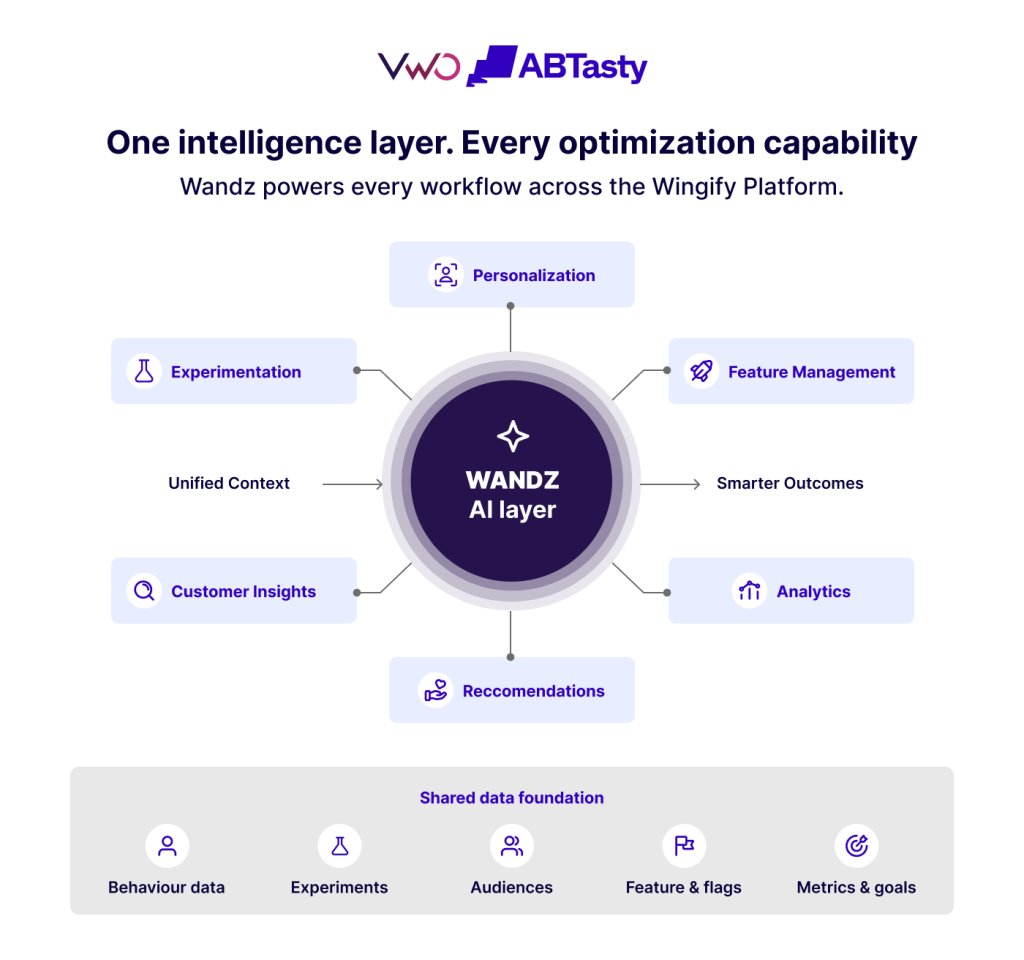
The global digital experience optimization landscape has reached a pivotal juncture with the introduction of Wandz, an embedded artificial intelligence layer developed by Wingify. As an integrated intelligence framework, Wandz is designed to operate directly within the critical workflows of experimentation, personalization, feature management, commerce, and customer insight across both the VWO and AB Tasty platforms. Unlike general-purpose AI tools that exist as external destinations, Wandz functions as a native component of the optimization suite, possessing immediate access to experiment data, audience segments, performance metrics, and granular behavioral insights. This native integration allows the system to analyze, recommend, and execute complex changes without requiring the manual exportation of data or the extensive re-contextualization often necessary when using third-party AI models.
The Evolution of Intelligence in Optimization Workflows
For the past decade, digital growth teams have relied on a fragmented ecosystem of tools to improve user experience and conversion rates. The recent surge in generative AI, led by platforms such as OpenAI’s ChatGPT, Anthropic’s Claude, and Google’s Gemini, has provided teams with powerful capabilities for brainstorming, copywriting, and code generation. However, the application of these general-purpose models to conversion rate optimization (CRO) has been hindered by a significant "context gap."
Effective optimization requires deep familiarity with the specific environment of a website or application. When a product manager asks why a conversion rate has dropped on a specific landing page, a useful answer depends on data that resides exclusively within a testing and personalization suite. This includes ongoing experiments, traffic split configurations, the specific attributes of an audience segment, and qualitative data from heatmaps or session recordings.
Until now, the standard workflow involved a high-friction "round trip": exporting data into CSV files, pasting them into an AI chat window, writing elaborate prompts to provide context, and then manually translating the AI’s suggestions back into the testing platform. Wingify’s Wandz aims to eliminate this friction by embedding the intelligence directly into the screens where the work occurs.
A Unified Intelligence Layer: The Convergence of VWO and AB Tasty
Wandz represents the culmination of a strategic technological convergence following Wingify’s integration of VWO and AB Tasty. Previously, each platform offered its own AI-assisted features—VWO through its "Copilot" tool and AB Tasty through its "Evi" assistant. Wandz unifies these capabilities into a single, cohesive intelligence layer that spans the entire combined suite.
This unified approach ensures continuity across the optimization lifecycle. An insight discovered during a qualitative review of a heatmap can immediately inform a hypothesis for a new A/B test. That test, in turn, can define an audience segment for a personalization campaign, which eventually guides the logic for a feature rollout. Because Wandz sits beneath all these modules, the underlying data and context remain consistent throughout the handoff process, preventing the loss of information that typically occurs when moving between disparate tools.
Agentic Capabilities and the Shift from Recommendation to Execution
A defining characteristic of Wandz is its transition from a passive recommendation engine to an agentic AI assistant. While traditional AI tools often stop at providing a suggestion, Wandz is engineered to execute multi-step tasks end-to-end. This "agentic" behavior means the AI can draft an entire experiment, build complex audience segments, review technical configurations, and interpret results in plain language.
Crucially, Wandz maintains a "human-in-the-loop" architecture. While it handles the mechanical and repetitive aspects of the workflow, it pauses at critical junctures to seek human approval, judgment, or sign-off. This distinction is vital for enterprise teams where accountability and precision are paramount. By doing the work rather than just describing it, Wandz addresses the primary bottleneck in digital optimization: the manual labor of implementation.
Detailed Functional Applications Across the Wingify Suite
The impact of Wandz is felt across five primary domains of the Wingify ecosystem, each benefiting from the AI’s ability to process real-time data within the platform’s native environment.
1. Experimentation and Hypothesis Generation
In the experimentation phase, Wandz replaces the "blank slate" problem with data-driven drafting. By analyzing historical performance, the AI generates hypotheses that are grounded in actual user behavior. It can define variations, select primary and secondary metrics, and suggest the optimal audience for a test. Once a test is concluded, Wandz provides a plain-language summary of the results, identifying not just "what" happened, but suggesting "what next" based on the statistical significance of the data.
2. Personalization and Audience Segmentation
Personalization often fails due to the complexity of manual segmentation. Wandz identifies patterns in visitor behavior that may not be immediately apparent to human analysts. It can automatically group users based on intent, friction points, or purchasing power, and then suggest tailored experience variations for those specific segments. This compresses the analytical cycle from days to minutes.
3. Feature Management and Risk Mitigation
For engineering and product teams, Wandz serves as a safety layer for feature flags and rollouts. It reviews configurations before they go live, flagging potential errors in targeting rules or traffic allocation. During a progressive rollout, the AI monitors signals to determine if a feature is performing as expected, advising teams whether to accelerate the release, pause it, or trigger a "kill switch" based on pre-defined risk profiles.
4. Qualitative Customer Insights
One of the most time-consuming tasks in UX research is the review of session recordings and heatmaps. Wandz performs the initial triage, identifying sessions that contain significant friction or unusual behavior. It summarizes patterns across thousands of heatmaps, connecting qualitative findings to quantitative data to provide a holistic view of the user journey.
5. Advanced Analytics and Reporting
Wandz simplifies data democratization by allowing stakeholders to ask questions about performance in natural language. Instead of building custom reports, a user can ask, "Why did mobile checkout conversion drop yesterday?" Wandz then cross-references segments, campaigns, and technical metrics to provide a summarized answer that is ready for presentation to executive leadership.
Comparative Analysis: Wandz vs. General-Purpose AI
The strategic value of Wandz lies in its specialization. While Large Language Models (LLMs) like GPT-4 possess vast general knowledge, they lack the specific "memory" of a company’s experimentation history.
| Feature | General-Purpose AI (ChatGPT/Claude) | Wandz (Embedded AI) |
|---|---|---|
| Knowledge Base | Generic global data | Specific experimentation & optimization context |
| Data Access | Requires manual upload/copy-paste | Real-time connection to suite data |
| Context | Zero knowledge of active campaigns | Full access to live experiments and history |
| Actionability | Suggests ideas in text | Builds and configures work in-platform |
| Workflow | Separate tab/application | Integrated into the active workspace |
Impact on Multi-Disciplinary Teams
The deployment of Wandz affects various roles within a modern digital organization. Product managers utilize the tool to prioritize experiments based on potential impact and resource availability. Marketers leverage it to scale personalized journeys that would otherwise be too complex to manage manually. Growth teams find value in the speed at which hypotheses can be generated and tested.
Engineers benefit from the automated sanity checks on feature rollouts, reducing the likelihood of production errors. Finally, e-commerce teams use the integrated insights to identify checkout friction in real-time, directly connecting behavioral changes to revenue outcomes.
Security, Governance, and Enterprise Readiness
In an era of increasing data privacy regulation, the implementation of AI within enterprise software requires rigorous guardrails. Wingify has emphasized that Wandz is built with the same security protocols that govern the rest of its suite. All AI-assisted actions are governed by role-based permissions, ensuring that only authorized users can approve and launch changes.
Furthermore, the system maintains comprehensive audit logs, allowing organizations to track which changes were suggested by AI and who provided the final approval. This level of transparency is essential for compliance with global standards such as GDPR and SOC2. The AI operates on the data already collected within the suite, ensuring that no unauthorized data sharing occurs with external model providers.
The Broader Implications for the SaaS Industry
The launch of Wandz signals a broader shift in the Software-as-a-Service (SaaS) industry from "AI-enabled" to "AI-native." As organizations move away from fragmented toolsets, the value of an integrated intelligence layer becomes a competitive differentiator. By reducing the time-to-insight and the time-to-execution, Wandz enables a more agile approach to digital optimization.
Industry analysts suggest that the "intelligence layer" will soon become a standard requirement for enterprise platforms. The ability of Wandz to unify the capabilities of VWO and AB Tasty under a single AI framework positions Wingify as a leader in this transition, offering a glimpse into a future where the software does not just provide the tools for work, but actively participates in the work itself.
As digital landscapes become increasingly complex and user expectations continue to rise, the ability to optimize at scale—without a corresponding increase in manual labor—will be the hallmark of successful digital brands. Wandz provides the infrastructure for this scale, transforming the way teams interact with data and execute their growth strategies.







