

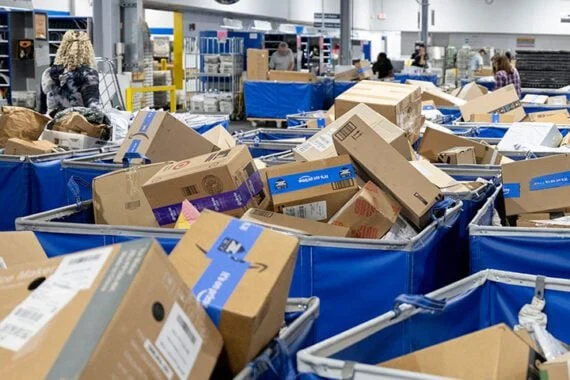
The United States Postal Service (USPS), grappling with an ongoing liquidity crisis, is strategically signaling a shift in its operational philosophy. Facing persistent financial headwinds, the quasi-governmental agency is poised to implement further parcel price increases, even if such a move leads to a reduction in overall package volume. This calculated approach underscores a departure from a long-held reliance on volume growth, as the USPS now prioritizes revenue generation to stabilize its precarious financial standing.
A Calculated Pivot: Revenue Maximization Over Volume
Postmaster General and CEO David Steiner articulated this strategic recalibration during the USPS Board of Governors open session on August 7, 2026. "The results this quarter show the strong leverage that pricing can have on results, and pricing is one lever that we have to use now to grow revenue," Steiner stated, emphasizing the critical role of pricing adjustments in the current fiscal environment. This sentiment reflects a pragmatic recognition that in the face of financial strain, the immediate imperative is to bolster incoming funds, even at the potential cost of market share in certain segments.
The USPS’s third-quarter fiscal year 2026 financial report, ending June 30, provided a stark illustration of this emerging trend. The agency reported operating revenue of $19.9 billion, a 6.1% increase compared to the same period in the previous year. While this represents positive growth, the net loss for the quarter narrowed to $2.5 billion from $3.1 billion, indicating that while revenue is up, the agency is still operating at a significant deficit.
Within this broader financial picture, the shipping and packages segment painted a particularly revealing narrative. This sector generated $8.25 billion in revenue during the quarter, an increase of $588 million, or 7.7%, year-over-year. However, this revenue surge was achieved despite a notable decline in package volume, which fell by 55 million pieces, or 3.4%. This dichotomy—more revenue from fewer packages—is precisely what Postmaster General Steiner highlighted as evidence of the effectiveness of their pricing strategy.
The report attributed this revenue growth in the parcel sector to several factors, including the continued expansion of the Ground Advantage service and a temporary transportation-related price increase implemented in April for specific parcel services. These relatively higher prices are demonstrably compensating for the diminishing volume, a trend that Steiner believes is not only sustainable but necessary.
"All of the statistics and results show that we have yet to cross the point that we should be changing our pricing strategy, and that we have more price [increases] to take in the marketplace. It would be financially irresponsible of us not to do so," Steiner declared. This firm stance suggests that further price adjustments for parcel services are highly probable, signaling a significant shift in how the USPS approaches its competitive landscape.
This pricing-driven revenue enhancement is not confined to the parcel sector. Even in market segments where the USPS holds a de facto monopoly, such as First-Class Mail delivery, similar trends are emerging. First-Class Mail revenue saw a 4.3% increase during the quarter, even as its volume experienced a 3.5% decline. This reinforces the overarching strategy: extract greater value from each unit of service delivered.
Navigating Regulatory Constraints and Market Realities
The USPS operates under a unique regulatory framework that significantly impacts its pricing flexibility. While its monopoly on certain mail products limits how aggressively it can raise prices, the agency possesses considerably more latitude than its for-profit competitors in the logistics industry. This quasi-governmental status grants it a degree of protection and a distinct competitive advantage in setting rates for essential postal services.

Postmaster General Steiner drew parallels between the USPS’s pricing approach and that of private sector entities in industries like airlines and grocery stores. In these sectors, businesses routinely adjust prices based on supply and demand dynamics to optimize financial returns, rather than solely focusing on maximizing the sheer volume of goods or services sold. "Thus far, applying those basic principles has favored raising prices even though there has been a modest decrease in volumes," Steiner observed, explicitly equating the USPS’s current strategy with that of private industry operating under different market rules. This analogy suggests a deliberate move towards a more market-driven and profit-oriented pricing model, even within the constraints of its public service mandate.
The Evolving Role of E-commerce and the USPS
For many years, the burgeoning volume of e-commerce packages was widely perceived as the USPS’s primary lifeline, a critical avenue to offset the persistent decline in First-Class Mail volume and its associated revenue. This perception was shared by many merchants who viewed the Postal Service as an attractive and cost-effective carrier, particularly for lightweight residential shipments and deliveries to remote areas where private carriers often impose surcharges. The logic was simple: packages filled existing delivery routes and infrastructure that the USPS was legally obligated to maintain, making their inclusion a seemingly low-cost, high-volume opportunity. The ubiquity of post offices, even in the smallest towns, reinforced this notion.
However, Postmaster General Steiner’s recent pronouncements challenge this long-standing assumption. He argues that maximizing parcel volume, or even mail volume, is not necessarily synonymous with maximizing revenue. The data from the June 30 quarter strongly supports this assertion. The USPS successfully generated $588 million more revenue from its parcel services while handling 55 million fewer packages. From the Postal Service’s perspective, this was a decidedly favorable trade-off, creating a new incentive structure that could significantly impact e-commerce shippers.
While the USPS still requires package volume to sustain its operations, its latest financial performance indicates that it no longer necessarily needs more packages at any price. If the agency can achieve greater revenue with a reduced package count, Postmaster General Steiner has made it clear which outcome he prioritizes. This shift in perspective does not inherently diminish the attractiveness of services like Ground Advantage for e-commerce merchants, but it does signal a potential evolution in how the Postal Service structures its offerings and pricing. Merchants may need to adapt to a future where cost-effectiveness might be balanced against the volume of shipments they can entrust to the USPS.
An Unsustainable Business Model and the Call for Congressional Action
Beyond the immediate pricing strategies, Postmaster General Steiner also underscored the deeply rooted structural issues plaguing the Postal Service. He asserted that even with enhanced price-setting authority and revenue growth, these measures alone cannot rectify a fundamentally unsustainable business model.
"As things stand, the Postal Service is expected to be self-sustaining while, at the same time, fulfilling mandates that are inherently unsustainable and do not cover their costs," Steiner stated, highlighting a critical disconnect between its operational obligations and its financial capacity. He further emphasized the urgent need to address the long-standing imbalance between costs and revenue, a problem that has persisted for 17 years. "We need to fix the business model that has produced the 17-year-long imbalance in costs and revenue—and that is going to require Congressional involvement."
This call for legislative intervention points to the systemic challenges that transcend day-to-day operational decisions. The USPS operates under a complex web of legislative mandates, including universal service obligations and pre-funding of retiree health benefits, which have historically placed significant financial burdens on the agency. Without a comprehensive legislative overhaul, critics argue, the USPS will remain on a trajectory of financial instability, regardless of its pricing strategies.
In the interim, e-commerce merchants are being advised to prepare for continued price increases in postal package rates. The lead-up to the holiday peak season, a period of traditionally high shipping volume, is often a prime time for carriers to adjust their pricing. Given the USPS’s current financial imperatives and its stated strategy of prioritizing revenue over volume, it is highly probable that parcel rates will continue to climb, potentially impacting the cost of goods and shipping options for consumers.
The implications of this strategic shift are multifaceted. For businesses heavily reliant on USPS for last-mile delivery, particularly small and medium-sized enterprises, the rising costs could necessitate a re-evaluation of their shipping strategies. This might involve exploring alternative carriers, absorbing increased costs, or passing them on to consumers, potentially affecting purchasing decisions. The USPS’s embrace of a more market-driven pricing model, while potentially beneficial for its financial health in the short term, could reshape the competitive landscape of the parcel delivery industry and alter the cost dynamics for millions of e-commerce transactions. The path forward for the USPS appears to be one of calculated financial adjustments, coupled with a persistent plea for systemic reform from its legislative overseers.








