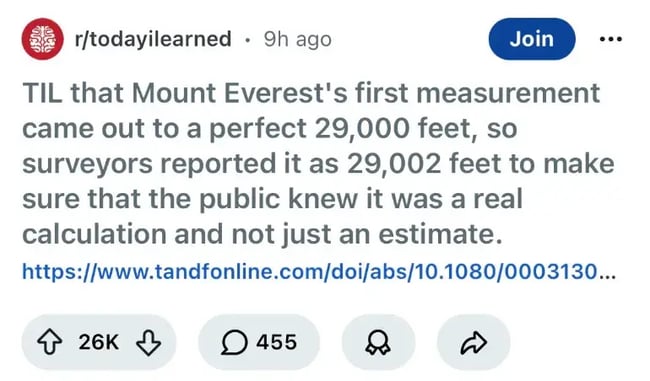
The first recorded measurement of Mount Everest, a monumental feat of 19th-century surveying, yielded an elevation of 29,000 feet. However, when the British Royal Geographical Society announced this figure in 1856, they opted for a slightly different number: 29,002 feet. This seemingly minor adjustment, adding just two feet to a colossal measurement, was a deliberate psychological maneuver rooted in the understanding that perfectly rounded numbers often appear less credible. This historical anecdote, far from being an isolated quirk, illustrates a profound principle of human psychology that continues to influence our perceptions, decisions, and interactions in profound ways. Decades of subsequent research in social psychology have repeatedly validated the instinct of those early surveyors, demonstrating that precise, non-rounded figures are consistently perceived as more believable, more accurate, and ultimately, more persuasive. This phenomenon, often termed the "precision effect" or linked to the "pique technique," reveals a fundamental aspect of human cognition: we are inherently skeptical of simplicity when complexity is expected, and precision signals a greater degree of care, expertise, and truth.
Historical Precedent: The Everest Enigma
The saga of Mount Everest’s initial measurement is deeply intertwined with the Great Trigonometrical Survey of India, an ambitious and monumental undertaking by the British East India Company, which later continued under the British Raj. Initiated in 1802 and lasting for over 70 years, the survey aimed to accurately map the entire Indian subcontinent, a task of immense scientific and strategic importance. It involved legions of surveyors, engineers, and scientists battling harsh terrain, extreme weather, and formidable logistical challenges across thousands of miles. The project was led by figures like William Lambton and, most famously, Sir George Everest, after whom the world’s highest peak was named.
It was under the superintendence of Sir Andrew Waugh, Everest’s successor, that the peak initially known as "Peak XV" was identified as the highest in the world. The measurements were primarily carried out by Radhanath Sikdar, a brilliant Indian mathematician and chief computer of the survey, who painstakingly calculated the height from six different observations taken from distances of up to 100 miles. These measurements, completed in 1852, accounted for various factors such as atmospheric refraction, curvature of the earth, and instrument errors. Sikdar’s meticulous calculations, after four years of complex work, ultimately arrived at a mean height of precisely 29,000 feet.
However, Waugh, acutely aware of the human tendency to distrust figures that seem "too perfect," instructed that the official declaration be 29,002 feet. His reasoning, though not explicitly recorded in detail, is widely inferred: a rounded number like 29,000 could easily be dismissed as an estimate or an approximation, rather than the product of painstaking scientific measurement. By adding a seemingly arbitrary "2," Waugh aimed to convey a sense of meticulous accuracy and genuine calculation, thereby enhancing the credibility of the claim. This decision was a masterstroke in public relations and scientific communication, ensuring that the unprecedented finding would be accepted without undue skepticism. The announcement of 29,002 feet captivated the world, solidifying the peak’s status as the "roof of the world" and lending an air of unimpeachable scientific rigor to the British survey. This figure remained the accepted height for many decades until more advanced technologies and re-surveys led to updated measurements, such as the 8,848 meters (29,029 feet) established in 1955 and the most recent 8,848.86 meters (29,031.7 feet) jointly announced by Nepal and China in 2020. Yet, the initial act of rounding up by two feet serves as a potent historical illustration of the enduring psychological impact of precision.
Unpacking the Pique Technique: Monetary Compliance

The intuitive wisdom of the Everest surveyors found robust scientific validation more than a century later through rigorous psychological research. One of the foundational studies exploring this phenomenon is the 1994 research published in the Journal of Applied Social Psychology by Michael D. Santos, Craig Leve, and Anthony R. Pratkanis from the University of California, Santa Cruz. Their work delved into what they termed the "pique technique," a social influence strategy designed to disrupt "mindless refusal" by presenting an unusual or strange request.
Mindless refusal is a common human behavior where individuals automatically decline a request without fully processing it, often due to cognitive overload, habitual responses, or a general desire to avoid engagement. Think of ignoring a panhandler or a charity collector; the brain defaults to a "no" to conserve mental energy. The pique technique aims to interrupt this automatic response, forcing the target to momentarily pause, process the unusual request, and thus become more amenable to compliance.
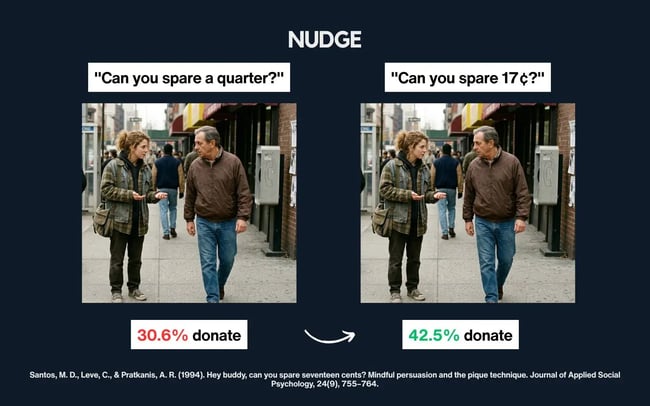
In their seminal experiment, Santos, Leve, and Pratkanis enlisted three female actors to approach 289 adults in public settings over several days, asking for spare change. The crucial variable was how the request was phrased. One group of passersby was asked a general question: "Can you spare a quarter (or any change)?" This represented the control condition, designed to elicit a typical response to a common request for money. The experimental group, however, received a more specific and unusual request: "Can you spare 17¢ (or 37¢)?" The researchers hypothesized that these odd, precise amounts would disrupt the automatic "no" response, compelling individuals to think about the request rather than reflexively rejecting it.
The results were striking. The group asked for a specific, unusual amount (17¢ or 37¢) demonstrated significantly higher rates of compliance compared to those asked for a general amount. The specific request forced individuals to consider why such an exact amount was needed, breaking their cognitive routine and engaging them more deeply. This momentary cognitive disruption, rather than leading to confusion or irritation, often translated into a greater likelihood of agreeing to the request. The study provided compelling empirical evidence that precision, even in trivial monetary requests, could significantly enhance persuasive power by overcoming the default mechanisms of refusal.
Beyond Money: Time and Non-Monetary Requests
Nineteen years after the groundbreaking work of Santos, Leve, and Pratkanis, the robustness and applicability of the pique technique were re-examined and extended by Professor Nicolas Guéguen, a prominent researcher in behavioral sciences at the University of Southern Brittany in France. Published in 2015, Guéguen’s study aimed to determine if the power of specific requests extended beyond monetary donations to non-monetary solicitations, specifically requests for time. This extension was critical for understanding the broader psychological principles at play and their potential utility in diverse contexts.
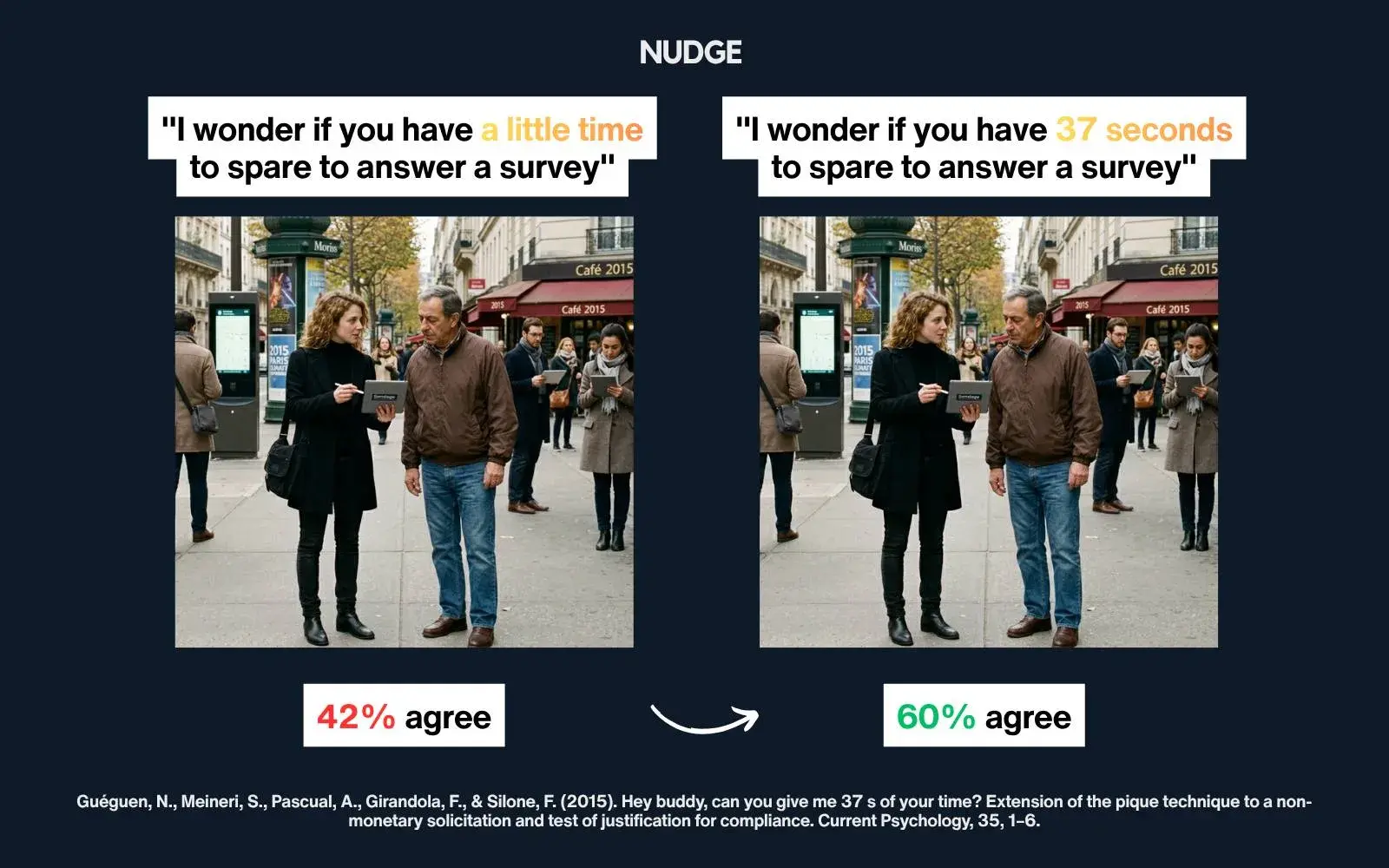
For this experiment, Guéguen and his team recruited four female actors, all dressed identically in black to minimize any confounding variables related to appearance, to approach 300 passersby (an equal number of men and women). The participants were asked to complete a survey, but again, the phrasing of the request varied. Half of the passersby (150 individuals) were asked a general question: “I wonder if you have a little time to spare to answer a survey.” This served as the control condition, a common and somewhat vague request for engagement. The other half (150 individuals) were presented with a highly specific request: “I wonder if you have 37 seconds to spare to answer a survey.” The choice of "37 seconds" was intentionally precise and unusual, mirroring the "17¢" or "37¢" from the earlier monetary study.

The findings from Guéguen’s study further cemented the power of the pique technique. In the control group, where individuals were asked for "a little time," only 63 out of 150 agreed to participate in the survey, representing a compliance rate of 42%. However, in the experimental group, where the request was for "37 seconds," a remarkable 90 out of 150 individuals agreed, pushing the compliance rate up to 60%. This represented a substantial boost in compliance of 42.9% due to the specific nature of the request.
The results clearly demonstrated that the principle holds true not just for money, but also for time and other non-monetary resources. The specificity of "37 seconds" likely achieved several effects. Firstly, it disrupted the typical, vague mental calculation people might make when asked for "a little time," which often leads to an overestimation of the commitment required. Secondly, it conveyed a sense of the requestor having carefully considered and quantified the exact time needed, implying a level of preparation and respect for the individual’s time. This perception of precision made the request seem more legitimate and less open-ended, thus reducing perceived risk and increasing willingness to comply.
The Art of Negotiation: Precise Offers in Practice
The impact of precise numbers extends significantly into the realm of negotiation, where initial offers and counter-offers play a critical role in shaping outcomes. A 2013 paper published in the Journal of Experimental Social Psychology by four researchers meticulously explored the effect of precise offers on negotiation dynamics. This study provided compelling evidence that the level of specificity in an initial offer can profoundly influence the subsequent bargaining process and the final agreed-upon price.
The researchers conducted a series of experiments, one of which involved hundreds of participants engaging in a hypothetical negotiation for the sale of a second-hand car. The participants were divided into groups, with buyers instructed to initiate the negotiation with different types of offers. Half of the buyers were told to open with a rounded price, specifically $2,000. This served as a baseline, representing a common, easy-to-process, and somewhat generic opening bid. The other half of the buyers were instructed to use a precise, non-rounded price point. These precise offers were either $1,865 or $2,135. The specific amounts were chosen to be close to the rounded figure but distinct enough to appear deliberate and calculated.
The primary objective of the researchers was to ascertain whether these more specific starting prices would influence the sellers’ counter-offers and, ultimately, the final negotiated price. The hypothesis was that precise initial offers would anchor the negotiation more effectively and lead to smaller adjustments from the sellers, signaling a perception that the precise offer was more justified and less arbitrary.
The findings strongly supported their hypothesis. When buyers initiated the negotiation with a precise asking price (e.g., $1,865 or $2,135), sellers responded with significantly smaller counter-offers and more modest adjustments compared to when the opening bid was a rounded $2,000. This suggests that the precise numbers made the initial offer seem more carefully considered, better informed, and therefore more defensible. Sellers perceived these specific figures as being based on a deeper assessment of value, leaving less room for aggressive haggling. Consequently, using precise numbers in the opening bid led to higher final selling prices for the buyers.
This study highlights the interplay between the precision effect and the anchoring bias. Anchoring bias is a cognitive bias where individuals tend to rely heavily on the first piece of information offered (the "anchor") when making decisions. A precise anchor, unlike a rounded one, appears to be a "stronger" anchor. It conveys an impression of confidence, detailed knowledge, and a lack of willingness to deviate significantly. This makes the precise offer more difficult for the counterparty to dismiss outright, compelling them to adjust their own expectations and offers within a narrower range around that specific anchor.
The Psychology Behind the Precision Effect
The consistent findings across these diverse studies point to several underlying psychological mechanisms that explain why precise numbers are more believable and persuasive than rounded ones:
- Disruption of Mindless Processing (Pique Technique): As seen in the donation and survey studies, precise, unusual numbers interrupt automatic cognitive shortcuts. When confronted with "17 cents" or "37 seconds," the brain pauses, rather than defaulting to a "no." This momentary break in routine forces conscious thought, making individuals more open to the request.
- Perceived Effort and Expertise: A precise number often implies that significant effort, calculation, or measurement has gone into arriving at that figure. Whether it’s the 29,002 feet of Everest, the 17 cents requested, or a $1,865 car price, specificity suggests a meticulous process, deep knowledge, or careful consideration. This perceived effort translates into a higher level of credibility and expertise on the part of the communicator. Rounded numbers, conversely, can seem lazy, estimated, or even fabricated.
- Reduced Ambiguity and Increased Legitimacy: Specific numbers leave less room for interpretation or doubt. "A little time" is vague and subjective, allowing the recipient to imagine a large, inconvenient commitment. "37 seconds" is concrete and finite, making the commitment seem manageable and clearly defined. This reduction in ambiguity enhances the legitimacy of the request or claim. It implies that the requestor has a genuine, quantified need, making it harder to dismiss as arbitrary.
- Signal of Honesty and Transparency: In many contexts, precision can be interpreted as a signal of honesty and transparency. If someone is willing to provide an exact figure, it suggests they have nothing to hide and are confident in their data. This fosters trust, which is a critical component of persuasion and compliance.
- Cognitive Fluency vs. Disruption: While cognitive fluency (ease of processing) is often desirable, in certain persuasive contexts, a slight disruption can be beneficial. Rounded numbers are cognitively fluent, but this ease can lead to them being overlooked or dismissed. Precise numbers, while requiring a fraction more processing, actively engage the recipient’s attention and thought processes, making the message more impactful.
Broader Implications for Business and Communication
The consistent evidence for the precision effect has profound implications across various fields, particularly in business, marketing, sales, and public communication. Understanding and leveraging this psychological principle can significantly enhance effectiveness in persuasion and trust-building.
- Pricing Strategies: The most direct application is in pricing. Instead of pricing a product at $20, consider $19.97 or $19.89. While "charm pricing" (ending in .99) is a related concept, the precision effect suggests that even non-traditional cents amounts can be more effective than perfectly rounded figures. This conveys a sense that the price has been carefully calculated based on value, rather than simply rounded up for convenience.
- Sales and Marketing Messaging: When presenting benefits or statistics, precision can make claims more compelling. Instead of saying "save a lot of money," specify "save 17.3% on your monthly energy bill." Rather than "our product lasts a long time," state "our product has an average lifespan of 7.2 years." Specific metrics lend weight and credibility to marketing claims, differentiating them from vague, unsubstantiated promises.
- Fundraising and Charitable Appeals: Charities can benefit by asking for precise donation amounts. Instead of "please donate generously," a request like "your $37 donation can provide 15 meals to those in need" is more likely to elicit a positive response. The specific amount, coupled with a clear outcome, makes the request concrete and the impact tangible.
- Negotiation and Deals: As demonstrated by the car sales study, initiating negotiations with precise figures can lead to more favorable outcomes. Whether it’s a salary negotiation (e.g., asking for $78,500 instead of $75,000) or a real estate deal, a precise opening offer anchors the discussion more effectively and signals confidence in one’s valuation.
- Data Reporting and Public Relations: Companies reporting financial results, market research, or impact metrics should lean into precision. Stating "our customer satisfaction increased by 14.7%" is more convincing than "customer satisfaction significantly improved." Precise data fosters trust with investors, stakeholders, and the public, conveying a commitment to accuracy and transparency.
- Call-to-Actions (CTAs): Even in digital marketing, precise numbers can enhance CTAs. Instead of "Join our community," consider "Join 13,456 satisfied members today." This leverages social proof while adding a layer of credible specificity.
- Time Management and Productivity: In internal communications, when assigning tasks or requesting time, being specific can improve compliance and efficiency. Asking for "15 minutes to discuss" rather than "a quick chat" sets clear expectations and respects colleagues’ time, making them more likely to agree.
Challenges and Considerations
While the precision effect is powerful, it is not without nuance. Over-precision in situations where it’s clearly unnecessary or impossible to achieve can backfire, making the communicator seem pedantic or even deceptive if the precision is perceived as fabricated. For instance, claiming a product boosts mood by "17.437%" might be seen as absurdly specific and untrustworthy if the underlying science isn’t equally precise. The key lies in strategic application where precision is perceived as justifiable and indicative of genuine effort or measurement.
Furthermore, the context of the communication matters. In some rapid-fire, low-engagement environments, overly complex numbers might slow down processing without yielding a significant benefit. The goal is to disrupt mindless refusal and signal credibility, not to overwhelm.
Conclusion
From the majestic peaks of the Himalayas to the everyday transactions of commerce, the power of precise numbers is a consistently observed and scientifically validated phenomenon. The initial measurement of Mount Everest, deliberately adjusted to 29,002 feet, was an early, intuitive recognition of this psychological truth. Modern research has since formalized this insight, demonstrating that specific figures disrupt cognitive shortcuts, signal effort and expertise, reduce ambiguity, and ultimately foster greater trust and compliance.
In an increasingly data-driven world, where information overload can lead to skepticism and "mindless refusal," the strategic use of precise numbers offers a potent tool for effective communication. Marketers, negotiators, fundraisers, and communicators across all sectors can leverage this principle to enhance the credibility of their claims, increase engagement, and drive desired outcomes. The lesson from Everest endures: in the quest for influence, clarity and exactitude often speak louder than elegant simplicity. To truly earn trust and persuade an audience, sometimes, it’s those extra two feet—or 17 cents, or 37 seconds—that make all the difference.