

In the fiercely competitive arena of digital marketing, an impeccably crafted email campaign—featuring razor-sharp copy, stunning visuals, and compelling calls to action—is often seen as the zenith of strategic outreach. Yet, the stark reality is that the brilliance of such a campaign is entirely negated if its destination remains perpetually out of reach: the recipient’s inbox. This critical, often overlooked dimension of email marketing success is governed by a robust, behind-the-scenes system known as email infrastructure. Far from a glamorous topic, its meticulous construction and ongoing maintenance are frequently the decisive factor separating a campaign that generates tangible results from one that vanishes into the digital ether, lost to spam folders or simply undelivered.
At its most fundamental, email infrastructure is the intricate technical framework that orchestrates the sending, routing, and ultimate delivery of every email. This encompasses a complex array of components, including the designated sending domain, the dedicated servers responsible for message transmission, the essential security protocols that authenticate sender legitimacy, and the sophisticated tools employed for continuous monitoring and performance analysis. Without a meticulously engineered foundation here, even the most captivating and conversion-focused email risks becoming a digital whisper unheard.
The Imperative of Deliverability: A Shifting Landscape
The landscape of email deliverability has undergone a profound transformation over the past two decades. What began as a relatively open communication channel quickly became saturated with unsolicited commercial messages, giving rise to the pervasive problem of "spam." This proliferation necessitated a drastic evolution in how mailbox providers (MBPs) like Google, Yahoo, and Microsoft manage incoming mail. Their primary objective became the protection of their users from unwanted or malicious content, leading to the development of increasingly sophisticated anti-spam filters, reputation algorithms, and strict authentication mandates.
Initially, email authentication protocols were considered "best practice"—recommendations for senders aiming for optimal inbox placement. However, this perception has irrevocably shifted. Today, authentication is a non-negotiable requirement, particularly for bulk senders. Major MBPs have tightened their enforcement significantly, driven by a dual imperative: to combat the persistent threat of phishing and spoofing, and to ensure a cleaner, more trustworthy email ecosystem for their users. The consequences of neglecting these protocols are severe: emails are no longer merely "underperforming"; they are increasingly subject to outright blocking, jeopardizing entire marketing initiatives and potentially damaging brand reputation.
The evolution of these systems has created a dynamic environment where sender reputation is paramount. Every email sent contributes to a sender’s cumulative reputation score, a complex metric derived from factors such as spam complaint rates, bounce rates, engagement levels (opens, clicks), and adherence to technical standards. A positive reputation ensures smooth passage to the inbox, while a tarnished one can lead to throttling, spam folder placement, or outright rejection. This necessitates a proactive, strategic approach to email infrastructure, beginning with foundational choices and extending to continuous monitoring and adaptation.
Key Pillars of Robust Email Infrastructure
Building a resilient email infrastructure is a multi-faceted process that demands careful planning, technical precision, and unwavering vigilance. The following pillars form the bedrock of successful email deliverability in the modern digital age:
1. Strategic ESP Selection: The Program’s Foundation
The Email Service Provider (ESP) serves as the technological engine powering an entire email program. The selection of an ESP is not merely a vendor decision; it’s a strategic investment that can determine the long-term viability and success of email marketing efforts. A misstep here can be incredibly costly, leading to persistent deliverability issues, stunted growth, and wasted resources.
When evaluating an ESP, organizations must look beyond superficial features and delve into critical aspects that directly impact deliverability and scalability. Key considerations include:
- Deliverability Track Record: Investigate the ESP’s historical deliverability rates and their relationships with major mailbox providers. Do they actively engage with MBPs to resolve issues and stay abreast of policy changes?
- Scalability and Performance: Can the ESP accommodate current and future sending volumes without compromising performance? Does it offer options for shared or dedicated IP addresses, and what are the implications of each for reputation management? Shared IPs are cost-effective but tie your reputation to other senders, while dedicated IPs offer more control but require careful warming and management.
- Support and Expertise: Does the ESP offer robust customer support, particularly for deliverability-related challenges? Access to experienced deliverability specialists can be invaluable in troubleshooting and optimizing performance.
- Feature Set: Beyond basic sending, consider features like advanced segmentation, A/B testing, automation workflows, robust analytics, and integration capabilities with CRM or other marketing platforms.
- Compliance Tools: Does the ESP provide tools to aid compliance with regulations such as GDPR, CAN-SPAM, and CCPA, including easy unsubscribe mechanisms and consent management?
- Pricing Structure: Understand the pricing model (per email, per subscriber, tier-based) and ensure it aligns with budget and growth projections.
A comprehensive due diligence process, including detailed questions about their infrastructure, deliverability practices, and client success stories, is paramount before committing to any platform. A recent industry report indicated that ESPs with strong deliverability teams and proactive reputation management strategies consistently outperform those that do not prioritize these aspects, often resulting in 10-15% higher inbox placement rates for their clients.
2. Establishing a Dedicated Sending Domain: Safeguarding Brand Reputation
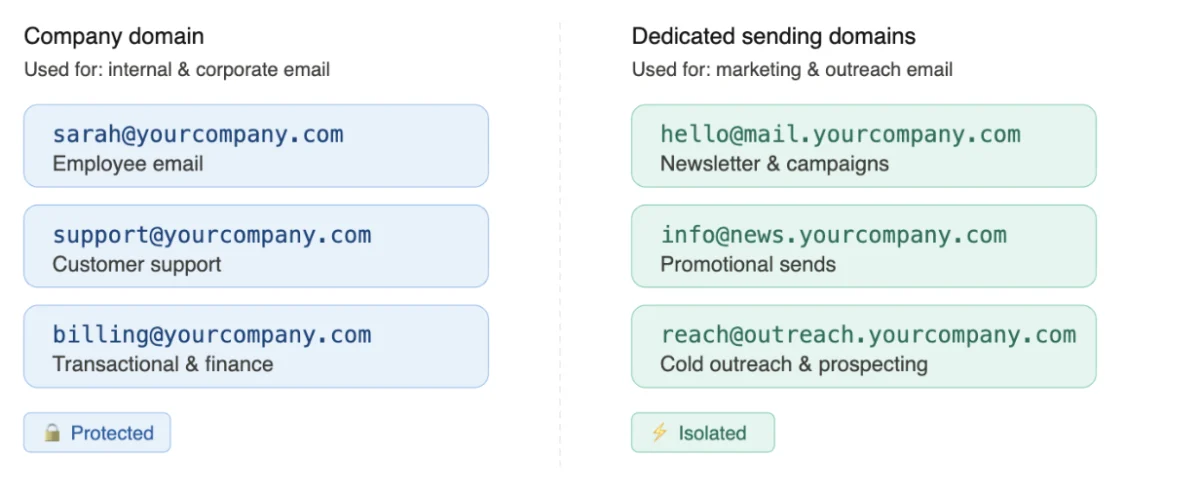
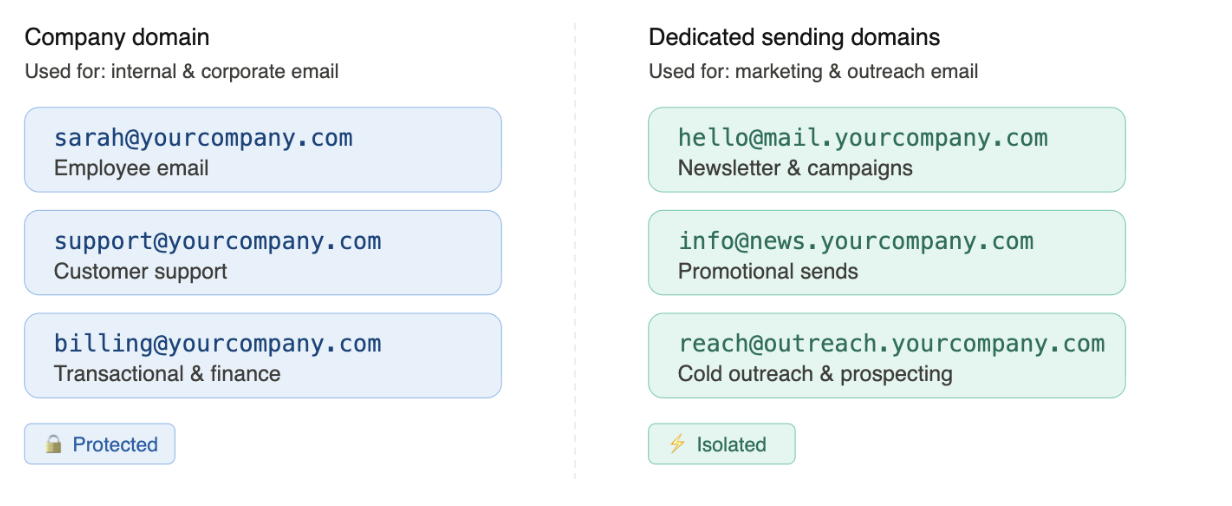
One of the most crucial foundational steps in establishing robust email infrastructure is the separation of marketing email traffic from primary corporate communications. Sending marketing emails from the main company domain carries significant risks. If something goes awry—such as a sudden spike in spam complaints, an accidental blocklisting, or a phishing attempt using your domain—the negative impact could drag down the reputation of the domain your entire business relies upon for essential corporate email, website hosting, and other critical functions.
Instead, the recommended practice is to establish a dedicated domain or a specific subdomain exclusively for marketing outreach. For instance, if the main company domain is yourcompany.com, it should be reserved strictly for business-critical communications. Marketing sends could then originate from marketing.yourcompany.com, news.yourcompany.com, or even an entirely separate, branded domain like yourcompany-updates.com.
This strategy offers several distinct advantages:
- Reputation Isolation: It creates a clear demarcation, isolating the reputation of your marketing emails from your core business domain. Any deliverability issues encountered by your marketing sends will not negatively impact your corporate email deliverability.
- Controlled Environment: A dedicated domain provides a clean slate to build a sender reputation from scratch, allowing for controlled warming processes and meticulous management.
- Brand Consistency (with control): While separate, these domains can still be branded to maintain a consistent corporate identity, ensuring recipients recognize the sender.
- Risk Mitigation: In the unfortunate event of a blocklisting, only the dedicated marketing domain is affected, allowing business operations to continue uninterrupted.
Industry data suggests that companies separating their transactional and marketing email streams, often through dedicated subdomains, experience an average of 5% higher inbox placement for both categories due to clearer sender identity and distinct reputation management.
3. Mastering Email Authentication Protocols: The New Mandate
As previously noted, email authentication has transitioned from a recommendation to an absolute requirement. The mandates from major mailbox providers, particularly Google and Yahoo, for bulk senders underscore this shift. These mandates, which became increasingly stringent in early 2024, require specific authentication protocols to be correctly configured. Failure to comply does not merely result in diminished performance; it leads to emails being actively rejected or routed directly to spam folders, rendering campaigns ineffective.
These protocols are designed to verify the sender’s identity and ensure that the email has not been forged or tampered with in transit. Typically, an organization’s IT team or domain administrator is responsible for configuring these critical DNS records. The three primary protocols are:
- Sender Policy Framework (SPF): SPF allows a domain owner to specify which mail servers are authorized to send email on behalf of their domain. It’s a DNS TXT record that lists the IP addresses or hostnames of authorized sending servers. When a mailbox provider receives an email, it checks the SPF record of the sender’s domain to verify if the sending server’s IP address is on the authorized list. If not, it raises a red flag, indicating potential spoofing.
- DomainKeys Identified Mail (DKIM): DKIM adds a digital signature to outgoing emails, allowing the recipient’s server to verify that the email was indeed sent by the domain owner and that its content hasn’t been altered during transit. This signature is generated using a private key by the sender’s mail server and verified using a public key published in the sender’s DNS records. DKIM provides a strong layer of integrity and authenticity.
- DMARC (Domain-based Message Authentication, Reporting & Conformance): DMARC builds upon SPF and DKIM, providing a framework that instructs receiving mail servers on how to handle emails that fail SPF or DKIM authentication. More importantly, it provides reporting capabilities, allowing senders to receive aggregated feedback on how their emails are being authenticated and processed by various mailbox providers. A DMARC policy can be set to "none" (monitor only), "quarantine" (send to spam), or "reject" (block entirely). For bulk senders, a DMARC policy set to
p=quarantineorp=rejectis increasingly mandatory. This protocol is crucial for brand protection, preventing phishing attacks that spoof your domain.
The correct implementation of SPF, DKIM, and DMARC is complex and requires precision. Errors in configuration can paradoxically lead to legitimate emails being rejected. The industry-wide adoption of these standards, reinforced by the 2024 mandates from Google and Yahoo, means that neglecting them is no longer an option for serious email marketers. Companies that fully implement DMARC at an enforced policy (quarantine or reject) often see a significant reduction in spoofing attempts against their domain, enhancing brand trust and security.
4. The Art of Domain Warm-up: Building Trust Incrementally
A brand-new sending domain or IP address begins with no established reputation with mailbox providers. Attempting to send a large volume of emails immediately after setup is a critical error that almost guarantees immediate flagging as spam. Instead, a methodical and patient "domain warm-up" process is essential to gradually build trust and establish a positive sender reputation.
The warm-up process is akin to introducing yourself to a community: you start small, engage positively, and slowly expand your interactions. A solid warm-up approach typically involves:
- Starting Small: Begin with a very limited volume, perhaps 500-1,000 emails per day, in the initial few days.
- Targeting Engaged Contacts: Crucially, these initial sends should be directed only to your most engaged and responsive contacts—subscribers who have recently opened or clicked your emails, or who have explicitly opted in and are expecting communication. This generates positive engagement signals, which are vital for reputation building.
- Gradual Volume Increase: Every few days (typically 2-3), slowly increase the sending volume, roughly doubling it, provided that key metrics remain healthy.
- Vigilant Monitoring: Continuously monitor bounce rates, spam complaint rates, and open/click rates. If any of these metrics spike negatively, it’s a clear signal to pull back, reduce volume, and reassess before attempting to increase again.
- Segmenting by Mailbox Provider: For very large lists, some senders segment their warm-up by major mailbox provider (e.g., sending specific volumes to Gmail, Yahoo, Microsoft users) to ensure balanced reputation building across different platforms.
This process is not a quick fix; it typically takes several weeks, sometimes even months, to establish a robust and trustworthy sender reputation, especially for large sending volumes. Patience during this phase is paramount, as the sender reputation built through a careful warm-up forms the foundational trust upon which all subsequent email marketing success rests. Rushing this process can lead to long-term deliverability penalties that are difficult and time-consuming to reverse. Studies show that domains that undergo a structured warm-up period of 4-6 weeks achieve 15-20% higher inbox placement rates within the first three months compared to those that skip this crucial step.
5. Proactive Deliverability Monitoring: Vigilance is Key
A common misconception among senders is that an email reported as "delivered" by their ESP has successfully reached the recipient’s inbox. The reality is far more nuanced. As highlighted by Validity’s 2024 Email Deliverability Benchmark report, a significant portion—approximately 1 in 7—of legitimate, permission-based marketing emails never actually reach the primary inbox, often landing in spam folders or being blocked entirely, despite being technically "delivered" to the mailbox provider’s gateway.
This underscores why active, continuous deliverability monitoring is not merely advisable but absolutely essential. It involves tracking a comprehensive set of metrics and utilizing specialized tools to gain insight into how mailbox providers perceive your sending reputation.
Key metrics and tools for proactive monitoring include:
- Spam Complaint Rate: This is arguably the most critical metric. Keep it well below 0.3%, with an ideal target of 0.1% or less. High complaint rates are a direct signal of low sender quality and will quickly degrade your reputation.
- Bounce Rates: Differentiate between "hard bounces" (permanent delivery failures, e.g., invalid address) and "soft bounces" (temporary failures, e.g., full inbox). Regularly clean your list to remove hard bounces.
- Blocklisting Status: Monitor major blocklists (e.g., Spamhaus, Barracuda) to ensure your sending IPs or domains are not listed. Blocklistings can severely impact deliverability.
- Engagement Metrics: While open rates have become less reliable due to Apple’s Mail Privacy Protection, click-through rates and conversion rates remain vital indicators of content relevance and audience engagement, both of which positively influence sender reputation.
- Mailbox Provider Feedback Loops (FBLs): Sign up for free FBLs offered by major providers like Google Postmaster Tools, Microsoft SNDS (Smart Network Data Services), and Yahoo Sender Hub. These invaluable tools provide direct insights into how these dominant inbox providers view your sending reputation, including spam complaint data, delivery errors, and DMARC reports. They offer a critical window into the actual inbox placement, not just gateway acceptance.
- Third-Party Deliverability Tools: Consider investing in specialized deliverability platforms that offer seed list testing (to see where your emails land across various inbox providers), inbox placement tracking, blocklist monitoring, and more granular analytics.
The insights gleaned from these monitoring efforts are crucial for informed decision-making. If deliverability drops, these tools help diagnose the problem, allowing for swift corrective action, such as adjusting sending volumes, refining list segmentation, or addressing content issues. The ongoing nature of this monitoring acknowledges that inbox algorithms are dynamic and require continuous adaptation.
The Broader Impact: Business Implications and ROI
While setting up and maintaining robust email infrastructure may not possess the immediate gratification of designing a visually stunning email, its importance cannot be overstated. It is the invisible force that underpins every successful email marketing endeavor. The increasing stringency of authentication requirements, the sophistication of inbox algorithms, and the ever-present threat of spam mean that the gap between senders who strategically invest in their infrastructure and those who neglect it is widening at an accelerated pace.
The business implications of strong deliverability are profound:
- Enhanced ROI: Emails that consistently reach the inbox have a higher probability of being opened, clicked, and converted, directly translating to improved campaign ROI. Conversely, poor deliverability means marketing budget is effectively wasted on emails that never reach their intended audience.
- Stronger Brand Reputation: Consistent inbox placement builds trust and credibility with subscribers, reinforcing brand loyalty. Being consistently routed to the spam folder erodes trust and can damage brand perception.
- Improved Customer Experience: Subscribers expect to receive the emails they’ve opted into. Reliable delivery ensures a seamless and positive customer experience, fostering engagement and satisfaction.
- Competitive Advantage: In a crowded digital marketplace, companies that master deliverability gain a significant edge, ensuring their messages cut through the noise while competitors’ emails languish in obscurity.
- Data Accuracy and Insights: Reliable deliverability ensures that performance metrics (open rates, click rates) are more accurate, providing better data for optimizing future campaigns.
In conclusion, the journey to email marketing success begins not with dazzling creativity, but with a meticulously constructed and continuously optimized email infrastructure. By selecting the right ESP, establishing dedicated sending domains, rigorously configuring authentication protocols, patiently warming up new sending assets, and diligently monitoring deliverability metrics, organizations can lay a formidable foundation. This strategic investment ensures that their carefully crafted messages consistently reach their intended audience, fostering engagement, driving conversions, and ultimately, delivering measurable business results in an increasingly complex digital environment. For businesses seeking to navigate the technical intricacies and optimize their email deliverability, specialized services offered by industry experts can provide invaluable support, auditing setups, configuring protocols, and maintaining crucial deliverability pathways.








