A shift in focus from traditional growth metrics like increasing headcount and marketing expenditure towards operational leanness and strategic tax management is revealing a more potent pathway to enhanced profitability for e-commerce businesses. This approach, often overlooked in favor of aggressive scaling tactics, is proving to be a significant differentiator between struggling enterprises and those achieving robust financial health. Research and anecdotal evidence suggest that optimizing internal operations and proactively managing tax liabilities can yield more substantial and sustainable profit margins than solely focusing on revenue growth or marketing prowess.
The conventional wisdom in business growth often dictates that to scale, one must increase investment in personnel and marketing campaigns. However, a compelling case study from a hypothetical e-commerce store owner illustrates a counter-narrative. This owner, previously managing 35 employees with solid revenue but persistently tight profit margins and high stress levels, implemented a radical operational overhaul. By embracing a remote work model, outsourcing fulfillment to a third-party logistics (3PL) provider, and transitioning from full-time employees to a leaner team of one core employee supported by eight independent contractors, the business experienced a dramatic transformation. The result was a significant surge in profitability and a substantial reduction in stress, directly challenging the assumption that business growth necessitates a proportional increase in employee numbers.

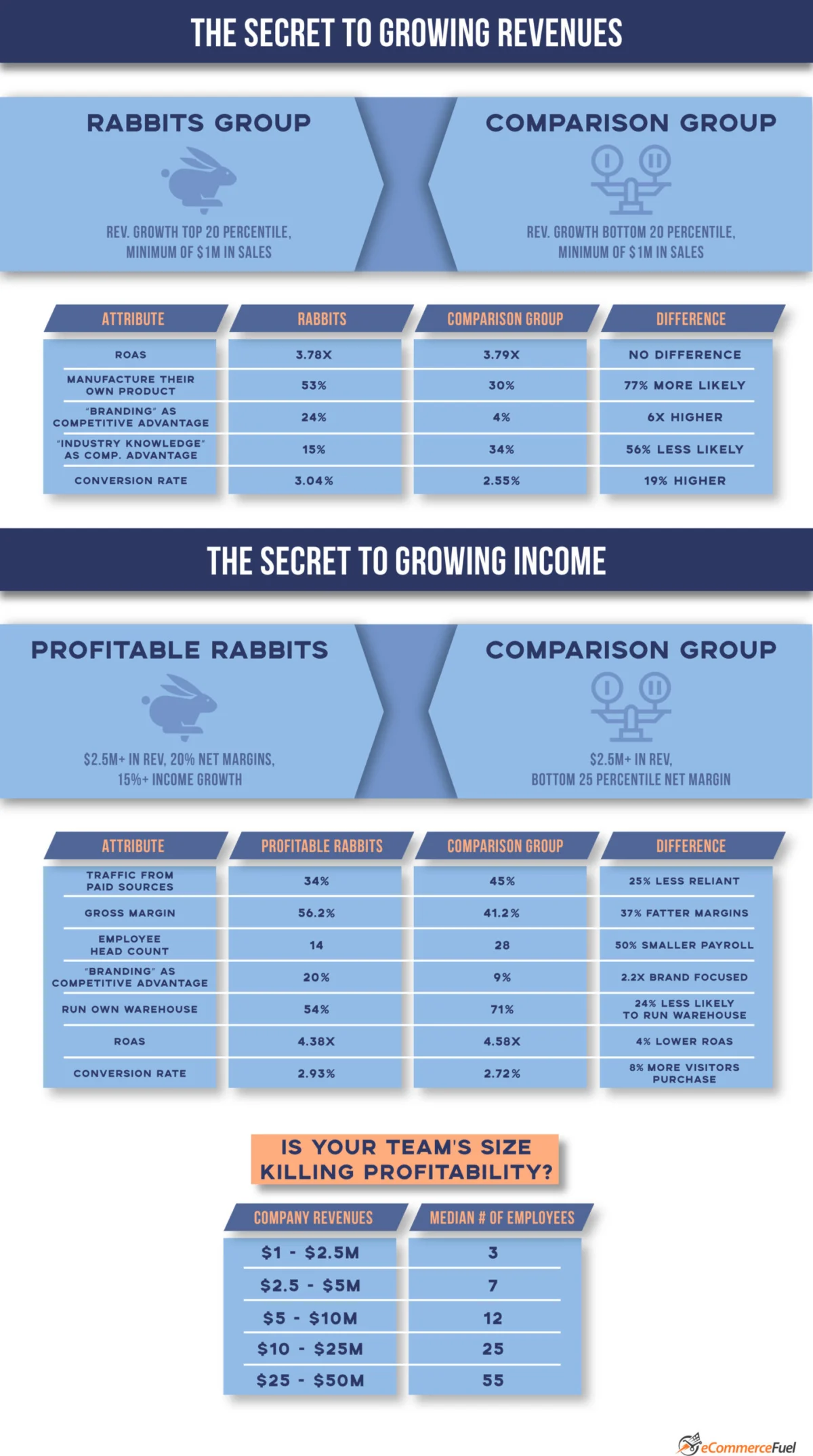
This narrative is not an isolated incident but reflects broader trends observed within the e-commerce landscape. A comprehensive analysis of hundreds of e-commerce businesses, aiming to identify the key drivers of profitability, revealed surprising insights. Contrary to expectations that superior marketing strategies would be the primary differentiator, the research indicated negligible differences in Return on Ad Spend (ROAS) between top-performing and struggling stores. The true demarcation line lay not in marketing cleverness but in operational efficiency. Businesses achieving peak profitability were found to have, on average, half the payroll expenses of their less successful counterparts. Furthermore, they were 25% more likely to outsource warehouse operations and 25% less reliant on paid traffic, highlighting the potent impact of operational leanness. This suggests that a strategic focus on optimizing existing resources and outsourcing non-core functions can consistently outperform aggressive marketing initiatives in driving profitability.
Redefining "Lean" Beyond Workforce Reduction
The concept of "staying lean" is frequently misinterpreted as synonymous with layoffs. However, the principle extends far beyond headcount. Overhead costs manifest in numerous insidious ways within a business. These can include maintaining expensive office spaces that are underutilized, particularly in the post-pandemic era of remote work; paying for extensive warehouse facilities when a 3PL could manage fulfillment more cost-effectively and efficiently; and accumulating a series of recurring, often forgotten, SaaS subscriptions that contribute to a silent drain on financial resources.
A crucial filter for identifying areas of potential cost reduction lies in discerning what constitutes the absolute core of a brand’s unique value proposition. For instance, if a brand’s competitive advantage is deeply rooted in its unique product design, retaining in-house design talent would be strategically sound. Conversely, if the act of packing boxes and managing logistics is not a core competency or a source of differentiation, outsourcing these functions to specialized providers becomes a more logical and financially prudent decision. Profitable e-commerce leaders are not merely slashing expenses indiscriminately; they are engaging in a deliberate and intentional allocation of resources, prioritizing investments that directly contribute to their brand’s competitive edge and divest from those that do not.

The Imperative of Proactive, Difficult Conversations
The trajectory of success in any entrepreneurial venture is often directly correlated with an individual’s willingness to engage in and navigate challenging conversations. Many business owners tend to postpone these critical discussions until circumstances force their hand, such as during economic downturns, periods of acute cash flow scarcity, or when declining profitability reaches an existential threat level.
However, the e-commerce entrepreneurs who consistently achieve superior profit margins are distinguished by their proactive approach to these uncomfortable dialogues. They initiate these conversations preemptively, long before they are compelled by external pressures. This involves a critical self-assessment: questioning the necessity of certain roles or hires that may have been made out of perceived busyness rather than strategic need. It requires scrutinizing expenses for tools and software, distinguishing between essential operational requirements and expenditures driven by habit. Most importantly, it necessitates posing the hypothetical but crucial question: "What would we cut if we were forced to reduce our expenditure by 25% tomorrow?" The willingness to then implement some of these identified cuts, not out of crisis but from a place of intentional strategic planning, is a hallmark of these high-performing businesses.
The Second Unsexy Lever: Strategic Tax Optimization
While marketing and operational efficiency often dominate strategic discussions, the realm of tax management represents a similarly potent, yet frequently overlooked, lever for enhancing profitability. Many business owners tend to view taxes as a fixed, unavoidable cost – a percentage of income that must be paid regardless of strategic planning. However, astute entrepreneurs are discovering that by being deliberate and proactive, they can significantly reduce their tax burden without resorting to illicit practices or complex offshore schemes.

Consider a comparative analysis of two hypothetical store owners, both operating businesses generating $2.5 million in revenue and $250,000 in profit, with identical salaries and family situations (married with three children).
Owner A, representing a typical approach, might pay approximately $75,000 in annual taxes.
Owner B, however, adopts a strategy focused on maximizing after-tax outcomes and pays significantly less, potentially around $21,000 annually. This substantial difference of approximately $54,000 is achieved through several intentional, legal strategies, assuming a marginal tax rate of roughly 30%:

- Profit Sharing Contributions: Owner B contributes $45,000 into retirement accounts via profit sharing, exceeding standard 401(k) limits. This yields an estimated tax saving of $13,500.
- Donations of Appreciated Stock: When making charitable donations, Owner B utilizes stock that has increased in value rather than cash. This strategy allows them to avoid capital gains tax on the appreciation while still receiving a full tax deduction for the fair market value of the stock, resulting in savings of approximately $3,500.
- Maximized Health Savings Account (HSA): Owner B contributes the maximum allowable family limit of $8,500 to their HSA. This account offers triple tax advantages (tax-deductible contributions, tax-free growth, and tax-free withdrawals for qualified medical expenses), leading to an estimated saving of $2,550.
- Paying Children for Work: Owner B employs their three children for legitimate work within the business, paying each $7,000 annually. These payments are deductible for Owner B and, crucially, the children can invest these earnings in Roth IRAs, allowing for tax-free growth over decades. This strategy generates an estimated saving of $6,300.
- Donations of Inventory: Owner B identifies $60,000 worth of slow-moving or obsolete inventory. Instead of liquidating it at a significant loss, they donate it to a qualified charity, claiming a deduction at fair market value. This is a highly underutilized strategy in e-commerce and can result in substantial tax savings, estimated at $18,000.
The cumulative effect of these deliberate actions is a remarkable reduction in the overall tax liability, demonstrating that what is often perceived as a fixed cost can, in fact, be strategically managed to significantly boost net profits.
The Hidden Nature of Tax Optimization
The reason these tax optimization opportunities are frequently missed by many business owners is the fragmented nature of tax reporting and management. Personal tax returns, business filings, brokerage statements, and payroll tax reports are often handled in disparate systems. This lack of a consolidated view prevents business owners from grasping their total tax outlay and identifying potential areas for reduction. A "decent" accountant may ensure accurate filing but often lacks the proactive advisory role needed to identify these nuanced savings. They process information provided by the client rather than proactively suggesting innovative strategies tailored to the business’s unique circumstances.
A Simple Gauge for CPA Effectiveness
A straightforward method for assessing the proactivity of one’s Certified Public Accountant (CPA) is to consider the frequency with which they initiate contact with actionable ideas. If the last interaction with a CPA was solely in response to a question posed by the business owner or the accurate filing of returns, it may indicate a passive rather than an advisory relationship. While such accountants may be competent in basic compliance, their approach can inadvertently cost businesses substantial sums in missed opportunities. The significant financial disparities, such as the $54,000 difference illustrated between Owner A and Owner B, are not the result of complex financial wizardry but of intentional, strategic planning. If a CPA is not consistently bringing forward innovative strategies, it may be time to seek out a professional who operates with a more proactive and advisory mindset.

Conclusion: Harnessing Ignored Levers for Profitability
Marketing metrics like ROAS, Customer Acquisition Cost (CAC), and Lifetime Value (LTV) dominate industry discourse and business owner attention. These are undoubtedly important aspects of running a successful e-commerce operation. However, the entrepreneurs who consistently achieve superior profitability are often those who have mastered two less glamorous, but profoundly impactful, levers: operational leaness and strategic tax management. By cultivating leaner operational structures, including optimizing workforce models and outsourcing non-core functions, and by proactively engaging in tax planning to minimize liabilities, businesses can significantly increase the amount of revenue they retain. In many cases, optimizing what a business already earns proves to be a more direct and sustainable route to enhanced profitability than solely focusing on generating more revenue through increased marketing spend. The true path to e-commerce success may lie not just in attracting more customers, but in intelligently managing the financial architecture of the business itself.