


Referral marketing is a powerful customer acquisition strategy that transforms satisfied customers into brand advocates. By formalizing the organic process of word-of-mouth, businesses can create trackable programs that reward existing customers for introducing new clientele. These initiatives typically involve unique referral links or codes, clearly defined rewards, and measurable conversion data, making them a sophisticated approach to growth. Research consistently shows that referred customers are not only more valuable over their lifetime but also contribute significantly to further acquisition. A study by the University of Pennsylvania’s Wharton School found that referred customers are approximately 16% more valuable throughout their customer lifecycle compared to those acquired through other channels.
For over 15 years, demand marketing professionals have observed the efficacy and pitfalls of referral programs. While a select few have achieved remarkable success, compounding growth and becoming a cornerstone of customer acquisition, many others fade into obscurity, buried in inactive settings pages. This comprehensive guide delves into the critical elements that distinguish successful referral campaigns from those that falter, offering insights gleaned from extensive market observation.
Why Referral Marketing Works: The Pillars of Success
Referral marketing thrives on three fundamental, measurable reasons, underpinned by robust data and psychological principles.
Firstly, referred customers exhibit a greater propensity to not only spend more but also to recruit more customers themselves. A 2024 study published in the Journal of Marketing Research revealed that referred customers generate between 31% and 57% more referrals than customers acquired through other channels. The study also highlighted a significant oversight by many firms: ignoring these downstream referrals can lead to an undervaluation of each individual referral by 20% to 36%. This cascading effect amplifies the return on investment for referral programs.
Secondly, the cost of acquiring referred customers is significantly lower. Vendor benchmarks consistently indicate a customer acquisition cost (CAC) that is typically 25-50% lower for referred customers compared to those acquired through paid channels. This cost-efficiency is a major draw for businesses seeking to optimize their marketing spend.

Thirdly, and perhaps most crucially, the trust transfer inherent in a personal recommendation is far more potent than any advertising creative. When a customer endorses a brand to a friend, it carries an intrinsic weight and authenticity that paid advertisements struggle to replicate. This trust is built on a foundation of shared experience and credibility, making the referral a highly persuasive form of marketing.
The Economics of Referrals: Quantifiable Value
The economic benefits of referral marketing are substantial and well-documented. The aforementioned Journal of Marketing study, which tracked nearly 10,000 customers of a German bank over six years, found that referred customers exhibited a contribution margin approximately 25% higher in the first year and a 16% higher lifetime value across the entire study period, even after controlling for demographic factors.
While vendor blogs often cite CAC reduction figures between 25-50%, it’s important to approach these numbers with a degree of practitioner heuristic. These are typically vendor-aggregated statistics with methodologies that are rarely published, leading to the recycling of similar figures across various platforms without primary research backing. Consequently, there isn’t a universally accepted, peer-reviewed figure for referral CAC reduction in the same way there is for referred-customer value. Businesses are therefore encouraged to model their own referral CAC using tools like the ROI calculator provided, which allows for benchmarking and optimization against real business data.
The Psychology of Referrals: Harnessing Human Connection
The psychological underpinnings of referral marketing are as important as its economic advantages. The principle of reciprocity, famously outlined by Robert Cialdini in "Influence: The Psychology of Persuasion," plays a key role. When a program offers a reward to both the referrer and the referred, it creates a sense of fairness and mutual benefit, making existing customers more inclined to participate. This is why double-sided referral programs consistently outperform single-sided ones in empirical tests.
Furthermore, recommendations from trusted individuals remain the most influential form of advertising. A 2021 Nielsen study on Trust in Advertising found that 88% of global respondents trust recommendations from people they know more than any other advertising channel. This inherent trust is the bedrock upon which successful referral programs are built.
Referral Marketing ROI Calculator
To help businesses assess the potential impact of a referral program, a specialized ROI calculator can be instrumental. This tool allows users to input key business metrics such as average order value or lifetime value, current blended CAC, expected participation rate, shares per participant, share-to-conversion rate, reward structure, and platform costs. By inputting these figures, businesses can project new customer acquisition, calculate referral CAC, estimate payback periods, and understand the overall ROI multiple of a referral program. It’s crucial to remember that these calculators often provide a conservative floor, as they may not fully account for the typically higher retention and spending of referred customers.
Distinguishing Referral Marketing from Similar Channels
It’s common for referral marketing to be confused with other customer acquisition channels like word-of-mouth, affiliate marketing, and influencer marketing. However, these channels possess distinct incentive structures, require different software solutions, and carry different regulatory obligations, particularly concerning FTC disclosures.
- Word-of-Mouth: This is an organic, untracked form of promotion where customers share their positive experiences without direct incentive. While invaluable, it’s difficult to engineer directly.
- Referral Marketing: This involves existing customers sharing unique links or codes with their network, typically on a one-to-one basis, and receiving a defined reward upon successful conversion. It is a formalized and tracked version of word-of-mouth.
- Affiliate Marketing: This model pays third-party publishers, such as bloggers, deal sites, or content creators, a commission for driving traffic and sales through unique tracking links. The relationship is transactional and often focused on broad reach.
- Influencer Marketing: This involves paying creators with established audiences to promote a brand or product, typically through sponsored content. The focus is on content creation and reach, with compensation often a flat fee plus potential commissions.
Understanding these distinctions is vital for setting appropriate budgets, selecting the right technology, and ensuring compliance with legal requirements.
Channel Comparison Table
| Channel | Who Refers | Reward Structure | Best For |
|---|---|---|---|
| Organic Word-of-Mouth | Anyone, unprompted | None. Untracked. | Brands customers genuinely love; impossible to engineer directly. |
| Referral Marketing | Existing customers, 1:1 share | Two-sided cash, credit, discount, or gift per conversion. Tracked. | Lowering blended CAC post-product-market fit; high-ROI new-customer channel. |
| Affiliate Marketing | Third-party publishers | Commission per conversion (typically 5-30% of order value). | Scaling reach beyond customer base; works alongside referral. |
| Influencer Marketing | Paid creators with their own audiences | Flat fee + optional commission. Content-led. | Awareness and brand lift; higher reach per campaign than direct ROI. |
For most small to medium-sized businesses (SMBs), running both a referral program and an affiliate program, managed as separate initiatives with distinct budgets, is often the most effective strategy. Organic word-of-mouth then acts as the underlying, unmanaged foundation supporting both.
The choice of which tactic to prioritize is heavily dependent on the specific niche and the ideal customer profile. Identifying which channel is most likely to influence target customers and understanding the associated economics is paramount.
Exploring the Spectrum of Referral Program Designs
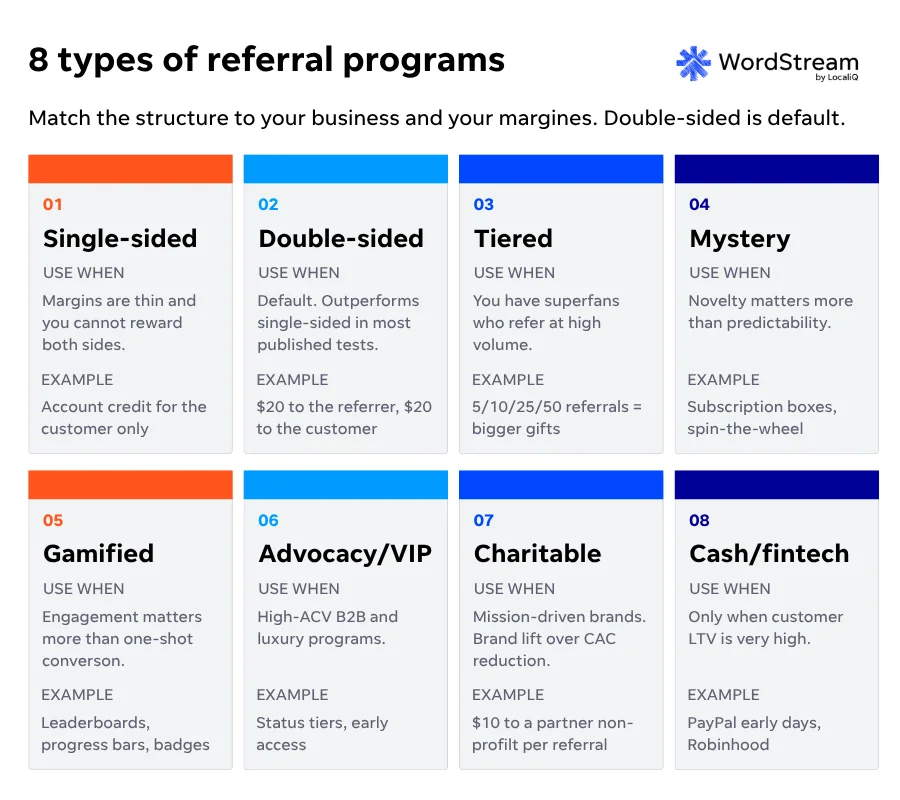
Referral marketing encompasses a variety of structures, each designed to address specific business constraints and customer motivations. The eight common types include:
- Single-Sided: Rewards only the referrer for bringing in a new customer.
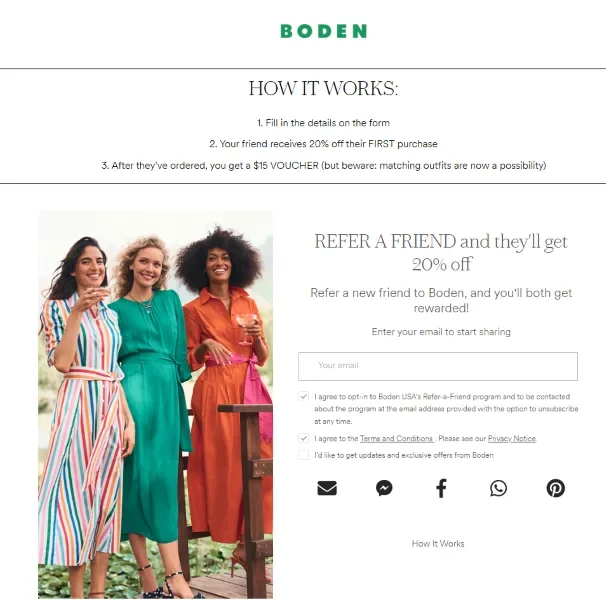
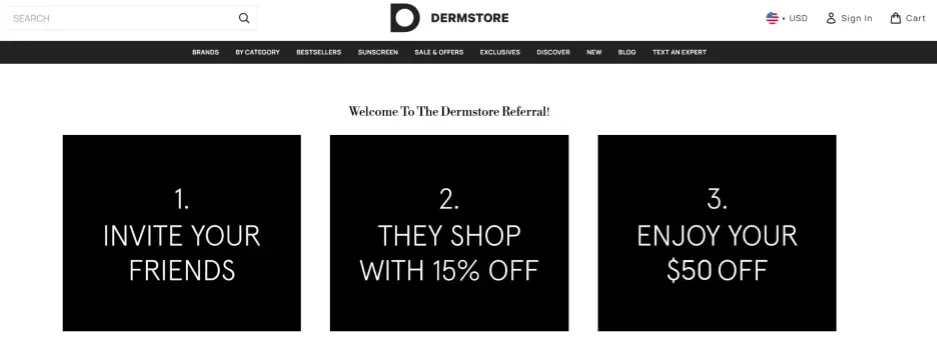
- Double-Sided: Offers incentives to both the referrer and the referred customer, often a cornerstone of successful programs.
- Tiered or Milestone: Rewards escalate as the referrer achieves certain referral targets or milestones.
- Mystery: Offers an element of surprise with randomized rewards, adding an engaging gamified aspect.
- Gamified: Incorporates game-like elements such as badges, leaderboards, and points to boost engagement.
- Advocacy or VIP: Focuses on rewarding loyal customers with exclusive benefits, status, or early access, fostering a sense of community and privilege.
- Charitable: Donates a portion of the reward to a chosen charity, appealing to socially conscious customers.
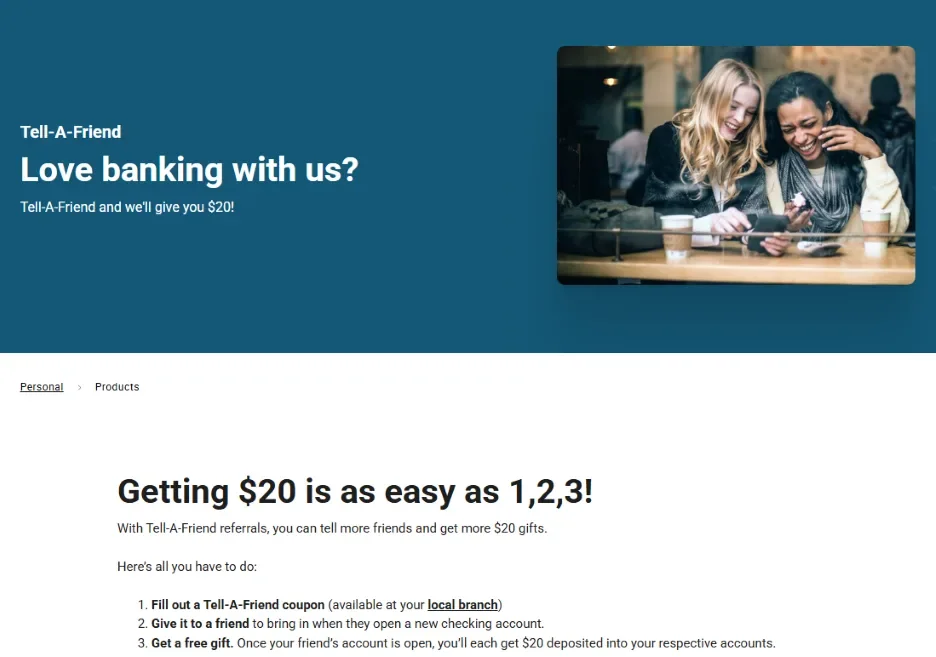
- Cash: Offers direct monetary rewards, often used in high-lifetime-value (LTV) industries like fintech.
While double-sided programs are frequently the default choice due to their proven effectiveness, each structure serves a purpose. For instance, a tiered program can motivate a small segment of highly engaged customers to make a significant number of referrals, driving substantial growth.
Illustrative Referral Program Mechanics
Examining successful referral programs provides actionable insights into effective design. Companies like Dropbox, for example, offered additional cloud storage as a reward, directly tying the incentive to the product’s core utility rather than a cash discount. This mechanic is powerful because it reinforces the value proposition and encourages deeper product engagement. The lesson here is to align rewards with the primary value metric of your product or service.
PayPal, in its nascent stages, utilized substantial cash payouts to both parties. This strategy was viable due to the exceptionally high LTV of its early customers, where the acquisition cost was justified by long-term revenue potential. This underscores the importance of LTV in determining reward feasibility.
Tesla has employed milestone rewards, often incorporating status and exclusivity as prizes, such as a Model X for top referrers. This approach taps into the aspirational desires of customers who already feel a strong connection to the brand, demonstrating that rewards should resonate with existing brand sentiment.
Robinhood’s pre-launch strategy leveraged referrals to build a waitlist, allowing referrers to jump the queue. This highlights referral marketing’s potential as a pre-launch growth engine, generating buzz and early adoption.
Airbnb’s program, offering cash credits and robust re-engagement campaigns for dormant referrers, emphasizes the critical role of ongoing promotion. Many users may only refer one or two people initially; sustained engagement through email loops can significantly boost referral activity.
Casper, the mattress company, strategically surfaced its refer-a-friend offer at the peak of customer satisfaction – immediately post-purchase. This timing capitalizes on the positive emotional state of a new customer, maximizing the likelihood of a referral.
Subscription services like Hims & Hers integrate referral discounts directly into their recurring billing structure, creating a powerful multiplier effect. The ongoing customer relationship inherent in subscriptions naturally leads to higher referral rates.
Harry’s, the DTC grooming brand, utilized pre-launch milestone tiers, offering progressively larger rewards for increased referral numbers. This strategy effectively addresses the common challenge of most users referring few or no friends, while incentivizing a dedicated segment to drive significant growth.
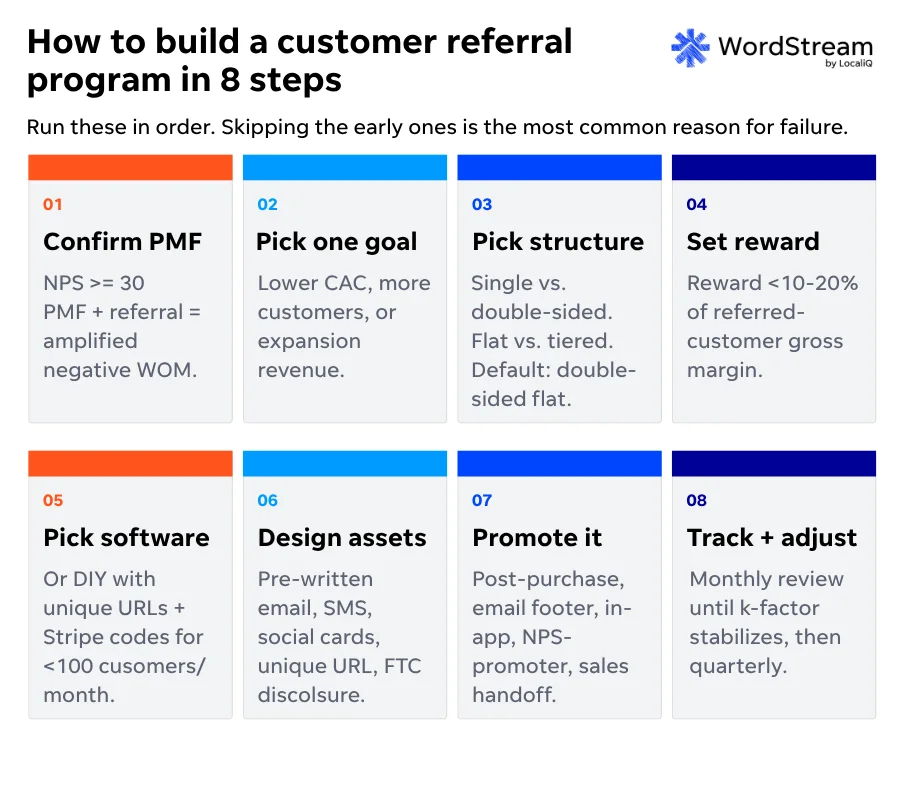
Building a Customer Referral Program: An 8-Step Framework
Creating a successful customer referral program requires a structured approach. The following eight steps provide a roadmap for implementation:
- Confirm Product-Market Fit and NPS: Before launching, ensure your product has strong market fit and generates positive Net Promoter Score (NPS) signals. Referral programs amplify existing sentiment, so a happy customer base is foundational.
- Define a Primary Goal: Identify a single, clear objective for your program. This could be lowering customer acquisition cost (CAC), acquiring a specific number of new customers, or driving expansion revenue within existing accounts.
- Choose Program Structure: Decide between a single-sided or double-sided program based on your goals and customer psychology. Double-sided programs generally yield better results.
- Set Rewards Based on LTV: Calculate the Customer Lifetime Value (LTV) of a referred customer to determine appropriate reward levels. Rewards should typically not exceed 10-20% of the referred customer’s gross margin.
- Select Software or DIY: Choose referral marketing software that integrates with your existing tech stack or opt for a do-it-yourself approach using unique URL parameters and CRM tools.
- Design Share Assets and Disclosures: Create compelling sharing content, including personalized messages and graphics. Crucially, ensure all assets include clear and conspicuous FTC-compliant disclosures.
- Promote Strategically: Surface the referral program at high-trust moments in the customer journey, such as post-purchase, in order confirmation emails, shipping notifications, in-app widgets, and NPS promoter follow-ups.
- Review and Optimize Monthly: Regularly monitor program performance against key metrics, analyze what’s working, and make iterative improvements to maximize effectiveness.
Promoting Your Referral Program for Maximum Impact
A successful referral program launch is merely the first step; ongoing promotion is crucial for sustained growth. The most effective placements for surfacing referral asks occur when customers feel most positive about your brand. These include:
- Post-Purchase Confirmation: Immediately after a customer completes a purchase, their satisfaction is high.
- Order Confirmation Emails: Reinforce the positive experience and introduce the referral opportunity.
- Shipping Notifications: As anticipation builds for a product’s arrival, customers are often receptive.
- In-App Widgets: Seamlessly integrate referral prompts within your application or website.
- NPS Promoter Follow-up: Engage with customers who have provided a high NPS score, as they are your most enthusiastic advocates.
- Customer Support Resolution Emails: After a positive support interaction, customers may be inclined to share their good experience.
- Quarterly Dedicated Campaigns: Run targeted campaigns to re-engage customers and remind them of the referral program.
- Sales Rep Outreach (B2B): For B2B clients, sales representatives can personally invite satisfied customers to participate.
The overarching principle is to ask for referrals at high-trust moments in the customer journey, ensuring the ask feels natural and beneficial.
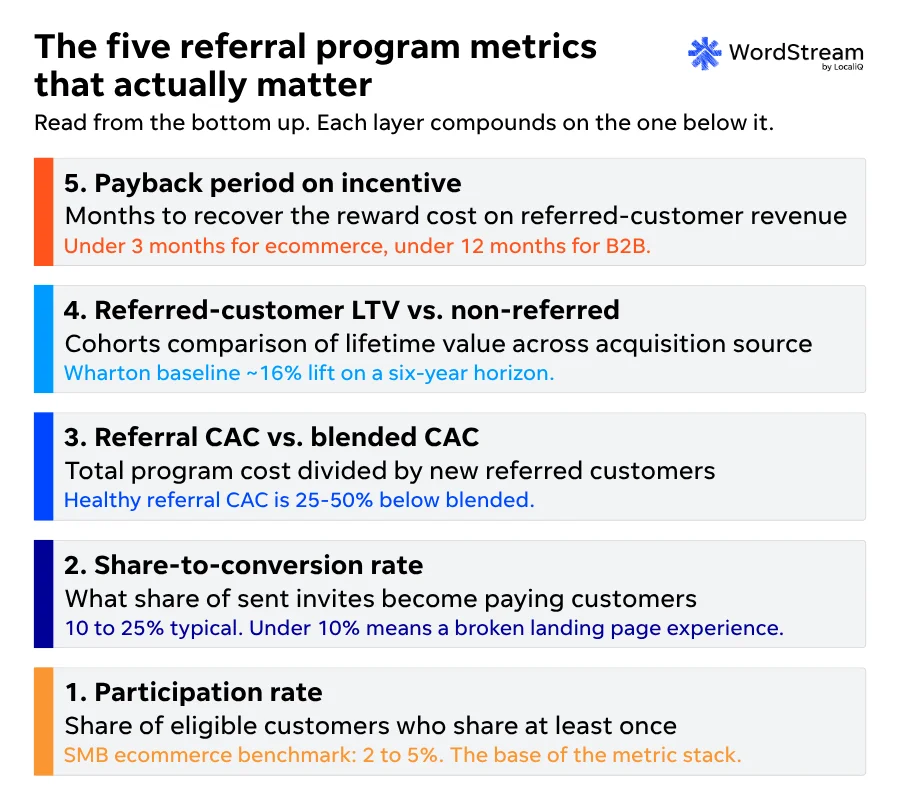
Referral Program Metrics That Drive Success
To effectively manage and optimize a referral program, tracking key performance indicators (KPIs) is essential. The five most critical metrics are:
- Participation Rate: The percentage of eligible customers who share their referral link or code at least once.
- Share-to-Conversion Rate: The percentage of shares that ultimately result in a new customer acquisition.
- Referral Customer Acquisition Cost (CAC) vs. Blended CAC: Comparing the cost of acquiring referred customers to the average CAC across all channels.
- Referred Customer Lifetime Value (LTV) vs. Non-Referred LTV: Analyzing the long-term value generated by referred customers compared to others.
- Payback Period on Incentive Spend: The time it takes for the revenue generated by referred customers to recoup the cost of referral incentives.
For programs specifically aiming for viral growth, tracking the K-factor (or viral coefficient) is also important. This metric, calculated as invites per user multiplied by the conversion rate of invited users, indicates whether a program is compounding (K > 1) or simply additive (K < 1). Most profitable programs operate with a K-factor between 0.1 and 0.5.
Referral Marketing Software for SMBs in 2026
The landscape of referral marketing software is diverse, with options catering to various business sizes and platforms. The "best" software is subjective and depends on a company’s specific needs, existing tech stack, and scale.
For Shopify e-commerce businesses, popular choices include ReferralCandy, Yotpo, and Smile.io. For general SMBs or those preferring no-code solutions, Referral Rock, Referral Factory, and Friendbuy offer user-friendly interfaces. B2B SaaS companies might consider Cello or GrowSurf. For enterprise-level operations, platforms like Extole, Buyapowa, Mention Me, or Annex Cloud provide robust features.
For businesses with fewer than 100 new customers per month, a DIY approach using unique URLs, coupon codes managed through platforms like Stripe, and integrated CRM capabilities may suffice. The key is to define your program structure and goals first, then evaluate software based on how well it supports those requirements, rather than letting vendor demos dictate strategy.
When Referral Marketing Falls Short
Despite its potential, referral marketing is not a universal solution. It can fail to deliver results in specific scenarios:
- Lack of Product-Market Fit: Launching a referral program before achieving product-market fit is akin to amplifying negative sentiment. If customers are unhappy, a referral program will only accelerate the spread of dissatisfaction.
- One-Time Purchases: For products or services that are typically purchased only once, the incentive for the referrer to promote may diminish over time, though referee-side rewards can still be effective.
- Heavily Regulated Industries: In sectors like financial advisory, healthcare, or legal services, stringent regulations can prohibit or severely restrict referral programs without extensive legal review. The cost and complexity of compliance may outweigh the program’s benefits.
- Extremely Low Current CAC: If a business already has a very low CAC and a rapid payback period (under a month), the overhead and incentive costs of a referral program might not offer a compelling ROI.
- Poorly Designed Program Mechanics: An unattractive reward structure, a cumbersome user experience, or a lack of clear promotion can doom a program from the start.
In all these cases, the program’s operational overhead exceeds the tangible gains. The most significant strategic error is initiating a referral program before confirming a positive Net Promoter Score (NPS). A referral program acts as an amplifier; it is essential to ensure the message being amplified is positive.
FTC Disclosure and Legal Considerations: Maintaining Compliance
The Federal Trade Commission’s (FTC) Endorsement Guides mandate clear and conspicuous disclosure of any material connection between a brand and an endorser. This includes referral rewards, whether they are cash, credit, discounts, free products, or even status. The 2023 update to these guides explicitly extended this requirement to pre-written share copy provided to customers, and 2024 enforcement actions have significantly increased civil penalties for violations, reaching five figures per instance. Misrepresenting a paid referral as an organic recommendation constitutes non-compliance.
The Material Connection Rule in Plain English
At its core, the material connection rule means that if a customer recommends your product and receives something in return, they must disclose that relationship. This disclosure must be:
- Clear: Use plain language that is easily understood, avoiding legal jargon.
- Conspicuous: The disclosure must be readily visible, not hidden behind expandable text or in a font size significantly smaller than surrounding copy.
- Consistent: The disclosure must accompany every endorsement, not just be made once during signup.
For referral programs, this translates to ensuring that any share copy provided to referrers, whether pre-written or generated, includes a clear statement about the reward.
Special Rules for Regulated Industries
Certain industries, including healthcare, financial services, and any services targeting children under 13 (due to COPPA regulations), have additional federal and state-specific rules that layer on top of the FTC’s baseline requirements. Launching referral programs in these verticals without consulting legal counsel is strongly advised against.
This information is not a substitute for legal advice. Businesses should consult the FTC’s Endorsement Guides directly and seek professional legal counsel for programs tailored to their specific circumstances.
Frequently Asked Questions About Referral Marketing
What is referral marketing in simple terms?
Referral marketing is a customer acquisition strategy where businesses reward existing customers for referring new customers. It formalizes word-of-mouth into a trackable system with unique links, defined rewards, and measurable results, turning organic recommendations into a managed growth channel.

What is the difference between referral marketing and affiliate marketing?
Referral marketing focuses on existing customers making one-to-one personal recommendations, typically rewarded per conversion. Affiliate marketing involves paying third-party publishers (bloggers, content creators) a commission for driving traffic and sales through public links. They target different audiences and have distinct reward structures and software needs.
What are the main types of referral programs?
The primary types include single-sided, double-sided, tiered/milestone, mystery, gamified, advocacy/VIP, charitable, and cash-based programs. Double-sided programs are generally the most effective.
How do you build a customer referral program step-by-step?
- Confirm product-market fit and positive NPS.
- Define a single primary goal (e.g., lower CAC).
- Choose a single or double-sided structure.
- Set rewards based on LTV.
- Select software or a DIY approach.
- Design share assets with clear disclosures.
- Promote at high-trust customer touchpoints.
- Review and optimize monthly.
What metrics should I track for a referral program?
Key metrics include participation rate, share-to-conversion rate, referral CAC vs. blended CAC, referred customer LTV vs. non-referred LTV, and payback period on incentives. The K-factor is important if aiming for viral growth.
What is the best referral marketing software in 2026?
The best software depends on your platform (e.g., Shopify, custom site), scale, and business type (B2C vs. B2B). Popular options include ReferralCandy, Yotpo, Smile.io, Referral Rock, GrowSurf, Extole, and Buyapowa. For smaller businesses, a DIY approach may be sufficient.
Do I have to disclose referral relationships under FTC rules?
Yes. The FTC’s Endorsement Guides require clear and conspicuous disclosure of any material connection, including referral rewards, every time an endorsement appears. This applies to pre-written share copy provided by the brand. Penalties for violations can be significant.
When does referral marketing not work?
It typically fails when there’s a lack of product-market fit, for one-time purchase products, in highly regulated industries without legal review, or when current CAC is already exceptionally low and payback periods are very short.
What’s the difference between B2B and B2C referral programs?
While the core strategy is similar, B2C programs often feature short cycles, low-friction, two-sided cash/credit rewards, and in-app/post-purchase placements. B2B programs tend to have longer sales cycles, multi-stage rewards tied to pipeline progression, CRM attribution, and sales involvement for high-value deals. Adapting a B2C model directly to B2B can be a common pitfall. For mid-market and enterprise B2B, referral programs often evolve into more complex partner programs.
Conclusion: Making Referral Marketing Work for Your Business
Referral marketing is not a passive strategy; it demands consistent effort in launching, managing, tracking, and refining the program. However, with a well-defined plan, it can become a highly effective engine for low-cost customer acquisition. The key to success lies in tailoring the referral program to your specific business, objectives, and ideal customer profile. When aligned correctly, referral marketing delivers dependable and sustainable growth.
For businesses seeking to amplify their marketing efforts and achieve their growth objectives, exploring comprehensive digital marketing solutions can be a valuable next step.









