admin
admin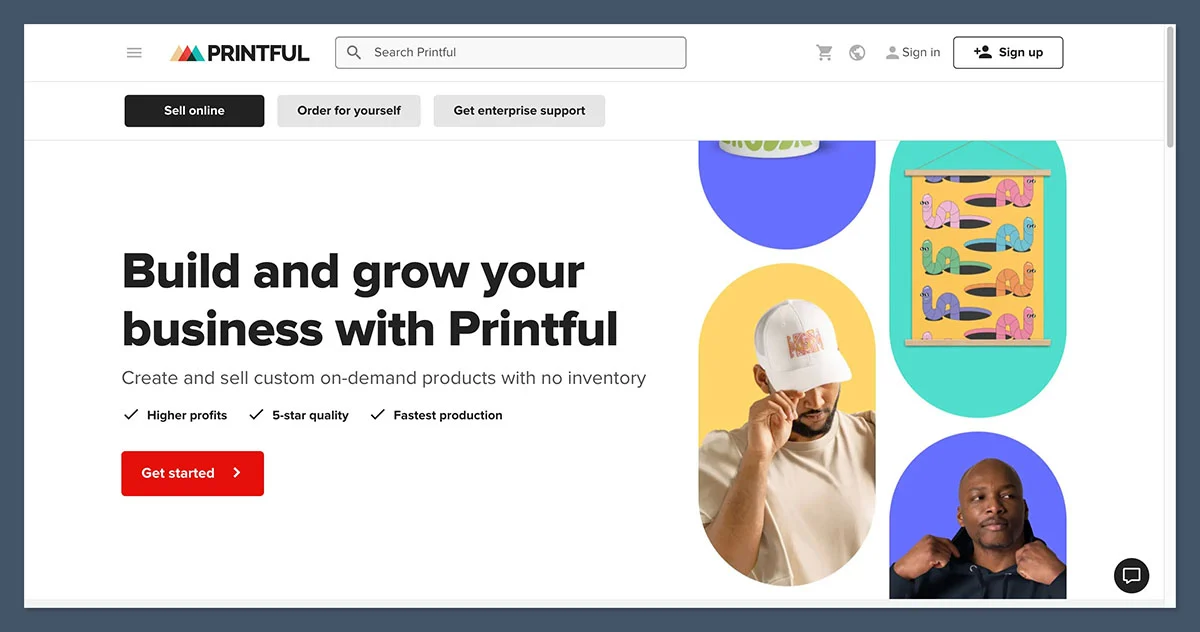
With an intensive research and testing period spanning over 150 hours and involving ten leading print-on-demand (POD) platforms, a comprehensive analysis has been conducted to identify the premier options for influencers and creators aiming to launch or scale their merchandise lines in 2026. The evolving landscape of influencer marketing and consumer purchasing habits, particularly the rise of integrated social commerce and AI-driven discovery, necessitates a strategic approach to merchandise. This guide delves into the key features, pricing structures, and inherent trade-offs of the top-rated POD platforms, empowering creators to select the ideal solution for their audience and strategic objectives.
The surge in influencer-led merchandise sales is a testament to the deepening creator economy. As fans seek to express their connection to their favorite online personalities, branded merchandise has transitioned from a mere promotional tool to a significant revenue stream and a vital component of brand identity. In 2026, the integration of platforms like TikTok Shop, the emergence of AI-powered search storefronts, and the increasing demand for global fulfillment capabilities have become critical factors influencing the success of these ventures. This report has been updated to reflect these dynamic shifts, offering actionable insights for creators navigating this competitive market.
POD Platform Comparison Table: A Snapshot of Top Contenders
To provide a clear overview, the following table outlines the key attributes of the top print-on-demand platforms, enabling a side-by-side comparison to align with specific merchandise goals:
| Platform | Best For | Starting Price | Storefront Integrations | Branding Options | Product Catalog |
|---|---|---|---|---|---|
| Printful | Brand-first merch stores | Free (Growth plan from ~$24.99/mo) | Shopify, Etsy, WooCommerce, Wix, Squarespace, BigCommerce, Amazon | Custom neck tags, inside labels, branded packaging, pack-ins | 350+ products |
| Printify | Margins and variety | Free (Premium from $29.99/mo) | Shopify, Etsy, WooCommerce, Wix, BigCommerce | Limited (provider-dependent) | 900-1,000+ products |
| Spring | YouTube and social creators | Free | YouTube merch shelf, TikTok, Instagram, native storefront | Basic | 200+ products |
| MyDesigns | High-volume automation | From $19.99/mo | Etsy, Shopify, TikTok Shop | AI-assisted mockups | Provider-dependent |
| Merch by Amazon | Amazon-centric audiences | Free (approval required) | Amazon only | Minimal | Limited apparel categories |
1. Printful: The Benchmark for Brand-First Merch Stores
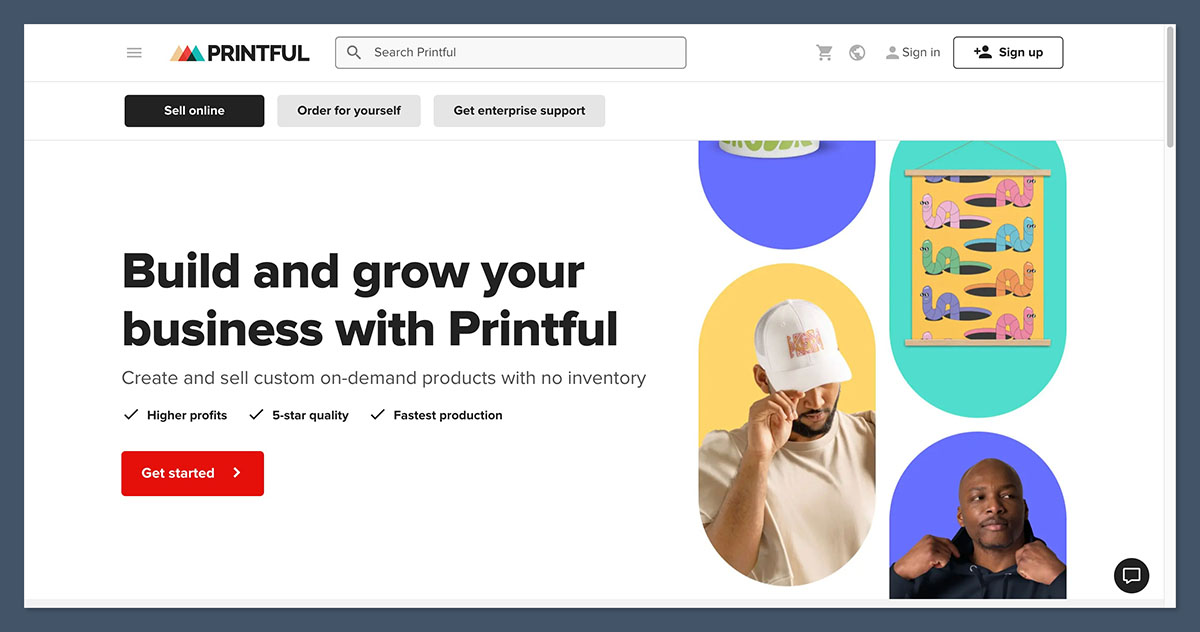
For influencers who aspire to cultivate a distinct brand identity rather than simply operating as a marketplace seller, Printful stands out as the premier recommendation. Its robust branding options, including custom inside labels, tailored neck tags, and personalized packaging with optional pack-ins, ensure that the creator’s brand remains at the forefront of the customer experience. This focus on brand immersion is crucial for building long-term loyalty and recognition.
During testing, Printful’s integration with Shopify proved to be a seamless and well-documented process. The platform consistently receives high marks for product quality, particularly in its embroidery and direct-to-garment (DTG) printing capabilities. This emphasis on quality is paramount for creators whose personal brands are associated with a specific standard of excellence.
Printful’s Growth plan, which includes priority processing and volume discounts, can effectively become free for stores achieving approximately $12,000 in annual sales. This tiered pricing structure is particularly beneficial for mid-tier influencers who are actively expanding their merchandise operations and seeking cost efficiencies as their sales volume increases.
The true differentiator for influencer merchandise through Printful lies in its white-label shipping experience. From the shipping label to the interior of the garment, every touchpoint reinforces the creator’s brand. This level of control is invaluable for influencers focused on establishing a direct-to-consumer (DTC) presence, transforming merchandise from a transactional offering into an integral extension of their brand narrative.
Printful’s Cost Structure:
Printful operates on a freemium model. The base product cost is charged per item sold, with no upfront monthly fees for the basic plan. However, optional paid plans, such as the "Growth" plan starting at approximately $24.99 per month, offer enhanced features like volume discounts and priority fulfillment, which can be a strategic investment for scaling businesses.
Who Should Choose Printful?
- Creators prioritizing brand integrity and a premium customer experience.
- Influencers seeking extensive customization options for their merchandise.
- Those with an established audience that values quality and cohesive branding.
- Businesses looking for deep integrations with major e-commerce platforms like Shopify and Etsy.
Who Might Look Elsewhere?
- Creators on an extremely tight budget with no immediate plans for significant sales volume.
- Those prioritizing the absolute lowest per-item cost over branding control.
Why Printful in 2026?
In an increasingly discerning market, Printful empowers creators to deliver merchandise that feels deliberate and high-quality. Its combination of superior product quality, comprehensive branding control, and reliable fulfillment provides a solid foundation for any influencer viewing merchandise as a core brand extension. The enhanced mobile application in 2026 further simplifies order management for creators juggling content creation, community engagement, and product launches, a common challenge in the fast-paced digital landscape.
2. Printify: Maximizing Margins and Product Variety
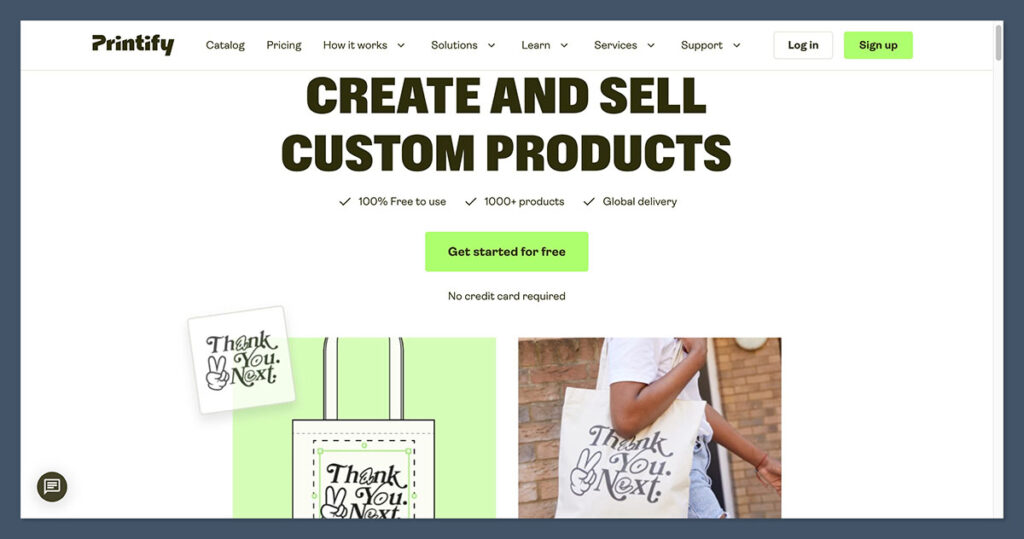
Printify emerges as the leading choice for influencers who aim to maximize profit margins, experiment with a wide array of designs, and execute frequent product drops. Its unique print-provider marketplace model allows creators to select suppliers based on geographical location, pricing, and customer ratings, offering granular control over both cost and delivery timelines for each product.
With a catalog boasting over 900 to 1,000 products, Printify significantly surpasses other platforms in terms of variety. This extensive selection spans apparel, accessories, home goods, and even specialized categories such as pet products and custom supplements, catering to a diverse range of creator niches and audience interests.
The inherent trade-off with Printify is the need for greater diligence in supplier curation. Unlike the uniform quality assurance provided by a single fulfillment partner like Printful, Printify’s product quality is contingent on the chosen print provider. It is strongly advised for creators to order samples from multiple providers before committing to a product line to ensure consistency and meet brand standards.
Printify’s Cost Structure:
Printify offers a free basic plan, making it accessible for creators to start without initial investment. For those seeking enhanced features, such as premium design tools and expanded product selection, the "Premium" plan is available starting at $29.99 per month, offering a discount on product prices.
Who Should Choose Printify?
- Creators focused on optimizing profit margins through competitive pricing.
- Those who desire a vast selection of product types to test and offer.
- Influencers who are comfortable managing multiple suppliers and quality control.
- Businesses looking for localized fulfillment options across different regions.
Who Might Look Elsewhere?
- Creators who prioritize a completely hands-off approach to quality control.
- Those who find managing multiple supplier relationships overly complex.
Why Printify in 2026?
For influencers treating merchandise as an experimental channel to test slogans, designs, and product types, Printify’s combination of low base prices and an expansive catalog makes it an exceptionally efficient platform for rapid iteration. The provider marketplace also facilitates localized fulfillment, enabling US orders to be routed to US-based printers and European orders to European facilities without requiring a platform switch. Printify’s deep integration within the Shopify ecosystem, supported by hundreds of thousands of merchants, ensures a mature and robust user experience.
3. Spring (Teespring): The Fast Track for YouTube and Social Creators
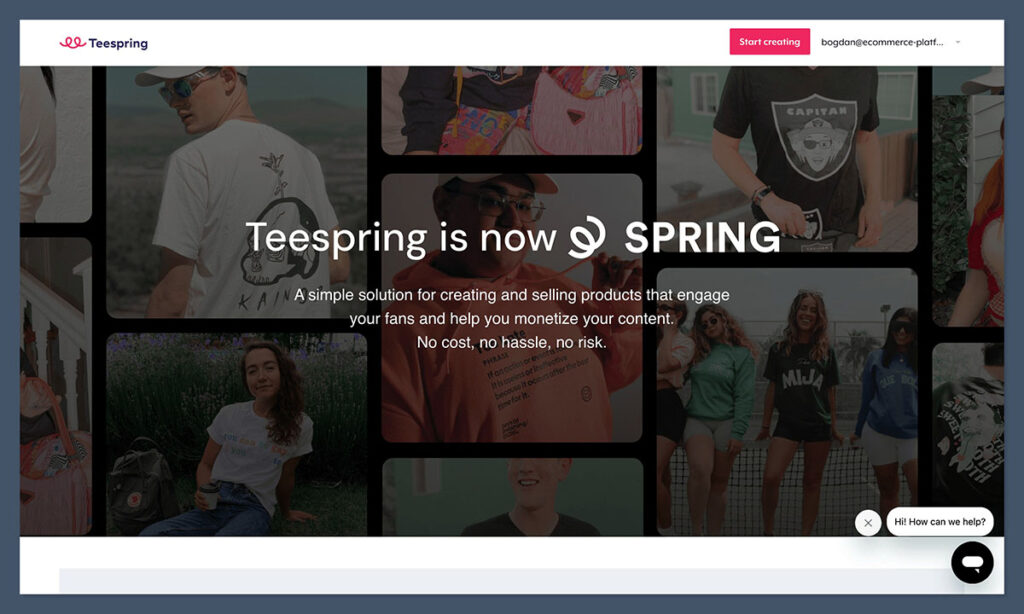
For creators aiming to introduce merchandise to their audience with minimal delay and without the immediate need to establish a separate e-commerce store or incur upfront costs, Spring presents the most direct pathway from concept to live product. Its native integration with YouTube’s merchandise shelf allows creators to prominently display products directly beneath their videos and on their channel pages, a powerful conversion tool for creators with highly engaged subscriber bases.
While Spring’s strength lies in its speed and simplicity, this also represents its core limitation: it is optimized for rapid deployment rather than the development of a distinct, stand-alone brand. Custom neck tags and branded packaging are not standard offerings, and creators have less visibility into customer data compared to a more robust setup like Shopify integrated with a fulfillment partner.
For creators who are exploring the viability of merchandise with their audience, Spring effectively removes numerous barriers to entry. However, for those who have already validated demand and are looking to elevate their merchandise strategy, Spring can serve effectively as a supplementary channel alongside a dedicated, brand-owned store.
Spring’s Cost Structure:
Spring operates entirely on a no-upfront-cost model. Creators upload designs, select products, and set their prices. Spring handles production, fulfillment, and customer service, taking a base cost for each item sold and allowing creators to set their own profit margin above that.
Who Should Choose Spring?
- YouTube creators seeking seamless integration with their channel’s merch shelf.
- Social media influencers looking for a quick and easy way to launch merch.
- Creators testing merchandise demand with minimal financial risk.
- Those prioritizing ease of use and speed to market.
Who Might Look Elsewhere?
- Creators focused on building a strong, independent brand identity with custom packaging.
- Businesses requiring deep analytics and customer data ownership.
Why Spring in 2026?
The direct integration with platforms like YouTube is a significant advantage for Spring. It places merchandise precisely where the target audience spends their time, minimizing friction in the purchasing process. In 2026, with shorter attention spans and audiences fragmented across multiple channels, this frictionless commerce is invaluable. Spring’s support for TikTok and Instagram integrations further solidifies its position as a multi-channel option for social-first creators who are not yet ready to manage a full e-commerce infrastructure.
4. MyDesigns: Streamlining High-Volume Automation
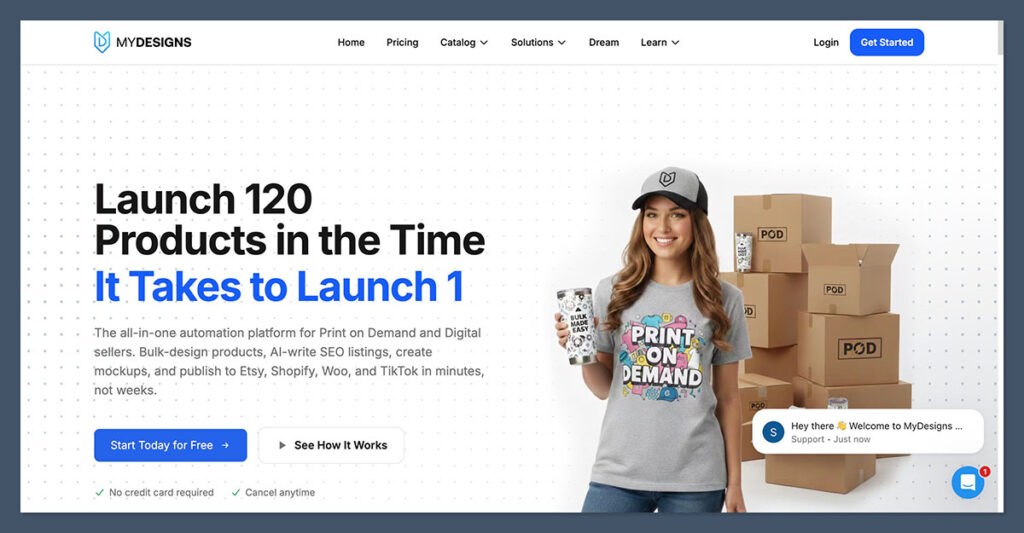
MyDesigns is specifically engineered for a more sophisticated tier of influencer merchandise operations: those characterized by high volume, extensive automation, and often managed by a dedicated team or agency rather than the creator alone. Its bulk publishing capabilities allow for the simultaneous upload of up to approximately 120 products, supported by AI-assisted design workflows and thousands of automated mockup generations, significantly reducing manual labor.
This platform is ideally suited for agencies managing merchandise for multiple creators or for individual creators who aggressively test design variations, colorways, and slogans across platforms like Etsy, Shopify, and TikTok Shop. MyDesigns’ robust tooling for Etsy integration, in particular, makes it a compelling choice for creators whose audiences are accustomed to purchasing through the Etsy marketplace.
MyDesigns’ Cost Structure:
MyDesigns offers tiered pricing plans, starting from $19.99 per month. These plans unlock features such as unlimited product listings, advanced design tools, and bulk publishing capabilities, catering to the needs of growing and high-volume businesses.
Who Should Choose MyDesigns?
- Agencies managing merchandise for multiple influencers.
- High-volume creators with a continuous stream of new designs.
- Businesses that leverage automation to streamline operations.
- Creators focused on multi-marketplace distribution, especially Etsy and Shopify.
Who Might Look Elsewhere?
- Solo creators just starting out with a small number of designs.
- Those who prefer a simpler, less automated workflow.
Why MyDesigns in 2026?
The influencer merchandise sector is maturing, with many creators now viewing it as a significant revenue stream managed with the same rigor as any established e-commerce business. MyDesigns caters directly to this evolved segment. Its bulk workflows, AI-powered design tools, and multi-marketplace publishing capabilities enable efficient, scaled merchandise operations without requiring an extensive team, aligning with the 2026 trend of creators diversifying income streams and competing for consumer attention across numerous channels.
5. Merch by Amazon: Leveraging Amazon’s Vast Reach
Merch by Amazon provides creators with direct access to Amazon’s immense organic traffic and its highly efficient Prime shipping network, a substantial advantage if a creator’s audience predominantly shops on the platform. There are no upfront costs associated with using Merch by Amazon, and Amazon assumes responsibility for production, shipping, and customer service, simplifying the operational burden for creators.
The primary trade-off with Merch by Amazon is the significant compromise on brand identity. Merchandise is listed within Amazon’s marketplace, adhering to its design standards, and creators have limited ability to cultivate a direct relationship with their customers. However, for influencers who already generate substantial affiliate revenue through Amazon or whose audiences habitually default to Amazon for purchases, it serves as a natural and effective secondary channel. As a primary strategy for brand building, its limitations become more apparent.
Merch by Amazon’s Cost Structure:
Merch by Amazon is free to use, with Amazon handling all production and fulfillment costs. Creators earn a royalty for each item sold, with the royalty amount determined by the selling price minus Amazon’s base product cost.
Who Should Choose Merch by Amazon?
- Creators whose audience is heavily concentrated on Amazon.
- Influencers who want to leverage Amazon’s vast customer base and Prime shipping.
- Those looking for a low-risk, supplementary revenue stream.
- Creators who prioritize reach over brand control on their merchandise.
Who Might Look Elsewhere?
- Creators focused on building a distinct, independent brand experience.
- Those who want direct customer relationships and data.
Why Merch by Amazon in 2026?
Amazon’s search traffic remains formidable, and the speed of Prime shipping sets a high bar for customer expectations that most POD fulfillment services struggle to match. In 2026, with two-day delivery often considered the baseline, a Merch by Amazon presence offers a logistical advantage. It functions most effectively as a complementary channel, capturing the segment of an audience that defaults to Amazon for all their purchasing needs.
Overall Winner and Strategic Considerations
For influencers who view merchandise as a strategic component of brand building, Printful remains the most robust option. Printify, conversely, is the superior choice for creators prioritizing profit margins and product experimentation. For those just embarking on their merchandise journey, Spring offers the most accessible entry point.
How to Choose the Right POD Platform for Your Merch
Selecting the appropriate print-on-demand platform is intrinsically linked to an influencer’s current stage of growth, audience expectations, and desired level of brand control. Identifying personal priorities and understanding the trade-offs inherent in each platform is paramount.
Key Factors for Consideration:
- Brand Control and Identity: The ability to implement custom labels, packaging, and inserts significantly impacts the perceived value and authenticity of merchandise. White-label fulfillment, as offered by Printful and Printify, provides greater brand control compared to marketplace-integrated tools like Spring and Merch by Amazon, which prioritize convenience.
- Product Catalog and Niche Fit: The platform’s product offerings must align with audience preferences. While basic apparel is widely available, niche creators in areas like gaming, pet care, or fitness may find Printify’s extensive catalog or specialized providers more suitable.
- Margins vs. Quality: Lower base costs, often found with Printify and specific regional providers, can increase per-unit profit but may introduce variability in product quality. Higher base costs, as seen with Printful, can mitigate refund risks and support premium pricing when backed by a strong brand.
- Geographic Reach and Shipping: The geographical distribution of an influencer’s audience is a critical factor. For a primarily US-based following, a US-centric provider suffices. However, for a global fanbase, platforms with distributed fulfillment networks are essential to minimize shipping costs and delivery times.
- Technology Stack and Integrations: Shopify continues to be the dominant e-commerce hub for creator merchandise, with Printify and Printful offering the most mature integrations. The increasing importance of TikTok Shop and Etsy syncing for short-form content commerce cannot be overstated.
- Scalability: The platform’s capacity to grow alongside the creator’s business is vital. Creators managing hundreds of SKUs across multiple marketplaces will have different needs than those launching their first few products. MyDesigns and Printify are built for scale, whereas Spring and Merch by Amazon are better suited as initial or supplementary channels.
Our Testing Methodology: A Deep Dive into POD Platforms
The evaluation process involved a rigorous assessment of ten leading POD platforms, accumulating over 150 hours of research and testing across 85 distinct criteria. The methodology prioritized six core categories, each weighted to reflect their significance for influencer merchandise sellers:
| Category | Weight | Assessment Criteria |
|---|---|---|
| Product Quality & Fulfilment | 30% | Print consistency, fulfillment speed, shipping reliability, global coverage |
| Branding & Customization | 20% | Custom labels, packaging options, white-label shipping, brand presentation |
| Integrations & Tech Stack | 20% | Storefront compatibility (Shopify, Etsy, etc.), social integrations, API quality |
| Pricing & Margins | 15% | Base product costs, shipping prices, monthly fees, profit margin potential |
| Ease of Use | 10% | Onboarding, product creation workflow, order management, dashboard clarity |
| Catalog & Scalability | 5% | Product variety, niche categories, bulk tools, multi-store support |
Direct testing of each platform’s product creation workflow and storefront integrations was conducted, including the ordering of physical samples to evaluate print quality and packaging. This hands-on approach ensured a comprehensive understanding of the user experience and product output.
Key Takeaways for Influencer Merch Success
- Brand Integration is Paramount: In 2026, generic merchandise is increasingly overlooked. Prioritizing platforms that allow for deep brand customization (like Printful) is crucial for building authentic connections.
- TikTok Shop and Social Commerce Integration is Evolving: Platforms offering seamless integration with emerging social commerce channels (like Spring and MyDesigns) provide a significant advantage for creators leveraging short-form content.
- Global Fulfillment is No Longer Optional: Audiences are global. Creators must consider platforms with distributed fulfillment networks to cater to international fans effectively and affordably.
- Automation is Key for Scale: As businesses grow, automation tools (MyDesigns) become essential for managing high volumes and multiple SKUs efficiently.
- Data Ownership Matters: While marketplace platforms offer reach, owning the customer relationship and data (via Shopify with Printful/Printify) is vital for long-term brand strategy and retention.
Final Verdict: The Strategic Choice for Creator Merchandise
Based on extensive research and testing, Printful stands out as the premier option for influencers who view merchandise as a fundamental element of their brand-building strategy. Its unparalleled combination of product quality, sophisticated branding tools, and deep integration capabilities provides the most comprehensive package for creating a professional, brand-owned merchandise experience.
However, the optimal platform is ultimately dictated by individual creator profiles and business objectives. For those uncertain about where to begin, a pragmatic approach involves initiating with a low-friction platform like Spring to validate market demand. Once demand is confirmed, migrating to a more robust, brand-owned stack, such as Shopify integrated with Printful or Printify, becomes a logical next step.
The most common pitfall observed among influencers is over-investing in infrastructure before establishing proven demand. A recommended strategy is to commence with a simplified setup, test design appeal, and then strategically scale into a premium solution as sales metrics justify the investment.
Frequently Asked Questions (FAQ)
What is the best POD site for influencer merch?
Printful is our top recommendation due to its exceptional balance of print quality, branding control, and integration options, enabling creators to establish a strong, independent brand presence.
Can I start selling merch with no upfront cost?
Yes, all five featured platforms allow creators to begin selling without upfront inventory investment, as products are produced on demand. Spring and Merch by Amazon have no associated monthly fees, while Printful and Printify offer robust free plans with optional paid upgrades for advanced features.
Which POD platform offers the best margins for creators?
Printify typically provides the most favorable margins, thanks to its print-provider marketplace that facilitates competitive pricing. However, this necessitates careful supplier selection and quality assurance.
Do I need a Shopify store to sell merch?
No, platforms like Spring and Merch by Amazon offer integrated storefronts or marketplace listings, eliminating the need for a separate e-commerce site. For comprehensive brand control, customer data management, and advanced sales funnels, a Shopify store integrated with Printful or Printify is the recommended configuration for serious merchandise operations.
What is the best POD platform for TikTok creators?
For TikTok creators, both Spring and MyDesigns offer TikTok Shop integrations. Spring is more suitable for beginners, while MyDesigns caters to high-volume creators utilizing short-form content commerce and managing multiple product tests.
Can I use multiple POD platforms simultaneously?
Absolutely. Many successful creator merchandise businesses leverage a hybrid approach, for instance, using Printful for their primary Shopify store while also utilizing Merch by Amazon for Amazon traffic and Spring for YouTube’s merch shelf. The key is to master one platform before expanding.