
 rifanmuazin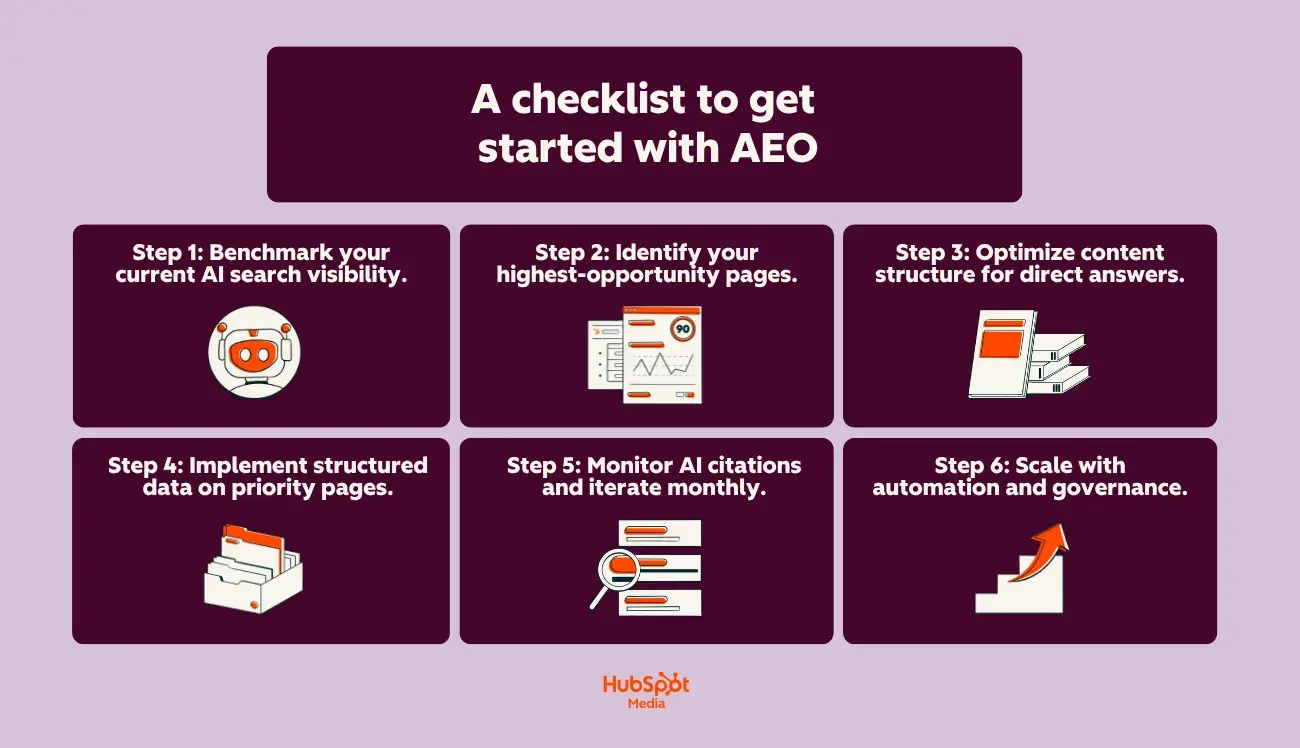
The benefits of Answer Engine Optimization (AEO) have transcended theoretical discussions, evolving into demonstrably measurable outcomes for marketing leaders navigating the rapidly changing digital landscape. As artificial intelligence (AI)-powered search engines such as ChatGPT, Google AI Overviews, and Perplexity AI assume an increasingly dominant role in how consumers and businesses discover brands, the strategic importance of AEO has escalated. Early adopters, those investing proactively in optimizing content for AI-driven results, are now reporting tangible returns in conversion quality, pipeline influence, and long-term brand authority. This shift marks a pivotal moment in digital marketing, demanding a re-evaluation of established SEO paradigms and a strategic pivot towards content designed for direct AI consumption.
The Evolution of Search: From Links to Answers
For decades, Search Engine Optimization (SEO) focused primarily on securing high rankings in lists of "blue links" on traditional search engine results pages (SERPs). The objective was to drive clicks to websites, where users would then find their answers. However, the advent of generative AI has fundamentally reshaped this dynamic. AI-powered search engines are designed to synthesize information from various sources and present direct, concise answers to user queries, often without requiring a click to an external website. This phenomenon, frequently referred to as "zero-click searches," means that brands must now aim to be the source of the answer, rather than merely a link to the answer.
Answer Engine Optimization (AEO) is the specialized practice of structuring and presenting digital content in a manner that allows AI systems to easily extract, understand, and cite a brand’s information as a definitive response to user inquiries. Unlike traditional SEO, which prioritizes keywords and backlinks to improve page rankings, AEO centers on entity recognition, semantic clarity, and the provision of authoritative, well-structured answers. This includes optimizing for factual accuracy, clear topic definitions, and the explicit linking of related entities within content. The rise of AI overviews and conversational search interfaces has compressed the customer journey, making direct citations within AI responses an invaluable touchpoint for brand exposure and authority building.
The timeline of this transformation has been remarkably swift. While AI capabilities have been evolving for years, the widespread public introduction of large language models (LLMs) like OpenAI’s ChatGPT in late 2022 catalyzed a rapid acceleration. Google swiftly responded with its Search Generative Experience (SGE), now known as AI Overviews, integrating generative AI directly into its core search product. Concurrently, other AI-first search platforms like Perplexity AI emerged, further diversifying the landscape of AI-powered information retrieval. This rapid technological deployment has created an urgent need for marketers to adapt, with industry analysts suggesting that companies failing to integrate AEO into their strategies risk significant competitive disadvantages.
Tangible Benefits of Answer Engine Optimization
The strategic advantages of AEO extend far beyond mere visibility; they translate directly into key performance indicators (KPIs) that growth and enterprise marketing teams prioritize. These benefits create compounding advantages, rewarding early and consistent investment.
-
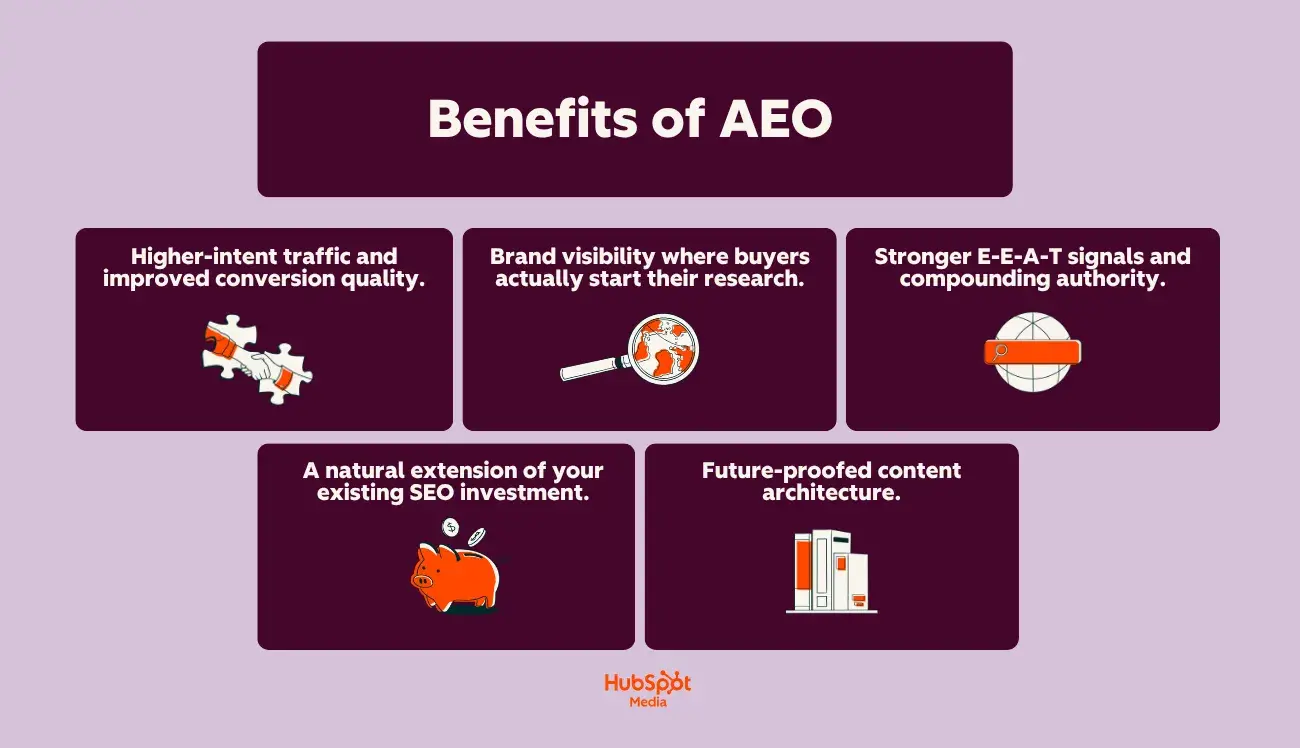
Higher-Intent Traffic and Improved Conversion Quality: Users who click through from an AI-generated citation are often pre-qualified. They have already encountered the brand’s content presented as an authoritative answer, signifying a deeper level of engagement and trust. This results in traffic with significantly higher intent, leading to improved conversion rates, shorter sales cycles, and a reduced cost per acquisition. Data from early adopters, including insights from HubSpot’s 2026 State of Marketing Report, indicate that while overall web traffic from search may see a shift due to AI answers (49% of marketers agree), 58% report that AI referral traffic boasts much higher intent. This suggests a qualitative improvement in leads generated through AEO.
-
Maximized Brand Visibility at the Moment of Discovery: In an era where buyers increasingly obtain answers directly from AI, being cited within these responses ensures brand visibility at the critical juncture of intent formation. Instead of navigating a list of links, users encounter a brand’s expertise directly, positioning it as a credible solution provider even before they visit a website. This direct exposure in AI overviews, conversational interfaces, and intelligent assistants is invaluable, especially as studies show a growing percentage of search queries are resolved without a click to an external domain.
-
Strengthened E-E-A-T and Compounding Authority: AEO inherently reinforces a brand’s E-E-A-T (Experience, Expertise, Authoritativeness, Trustworthiness) signals. The optimization work itself—defining entities, implementing structured data, and producing clear, well-sourced answers—is precisely what both traditional and AI-powered search engines reward. Each piece of answer-optimized content contributes to a brand’s entity profile, increasing the likelihood of future citations across various AI platforms. This consistent reinforcement builds a durable form of authority, making it progressively easier for a brand to earn visibility and trust over time.
-
Measurable Performance with Purpose-Built Tools: A significant challenge in traditional SEO has been the precise measurement of ROI, particularly as ranking factors became more complex. Legacy rank trackers were not designed for AI citations. However, the landscape of AEO tools is rapidly maturing. Platforms like HubSpot’s AEO Grader and its associated product, HubSpot AEO, provide concrete metrics for AI visibility and performance. These tools offer baseline scores, identify content gaps, and provide prioritized recommendations, allowing marketers to tie AEO efforts directly to measurable business outcomes, moving beyond intuition to data-driven strategy.

-
A Natural Extension of Existing SEO Investments: AEO is not a replacement for traditional SEO but rather an amplification layer. The foundational work in SEO—like building topical authority, creating high-quality content, and establishing a robust backlink profile—serves as an excellent springboard for AEO. High-ranking pages, already deemed authoritative by traditional search engines, are prime candidates for AEO optimization. The structured data implemented for AI citation eligibility often simultaneously enhances traditional rich results, and existing topic clusters provide the semantic relationships that LLMs require. This synergy allows teams to integrate AEO incrementally, leveraging existing content programs rather than rebuilding from scratch.
-
Future-Proofed Content Architecture: Investing in AEO means developing a content architecture that is resilient and adaptable to future technological shifts. Structured data, entity optimization, and semantic clarity are foundational not only for today’s AI search engines but also for emerging technologies like voice search, multimodal AI, agent-driven commerce, and advanced zero-click interfaces. By building content around clear facts, defined entities, and explicit relationships, brands are creating a robust information infrastructure that can scale across any future retrieval system, securing their relevance for the next decade of digital interaction.
Overcoming Common AEO Implementation Challenges
Despite the clear advantages, many growth and enterprise marketing teams encounter persistent challenges when attempting to scale AEO beyond initial experimentation. These blockers, while common, are not insurmountable.
-
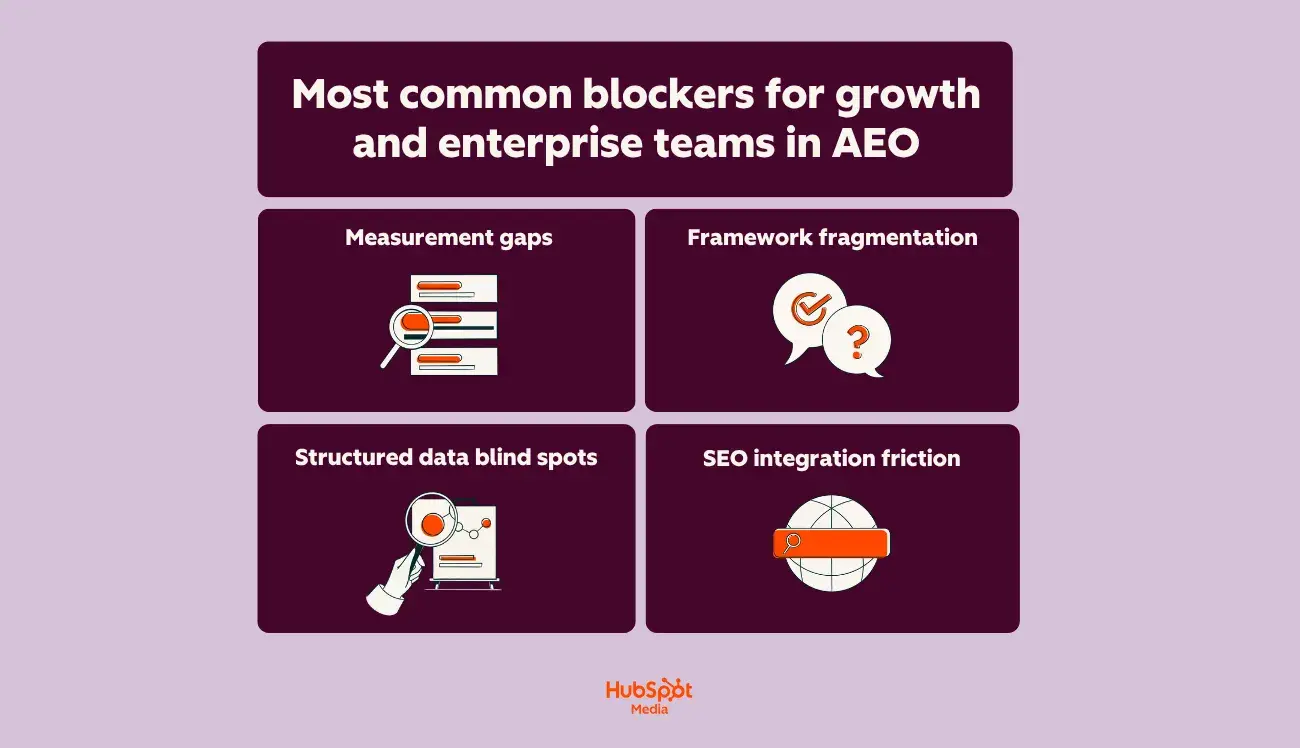
Unclear ROI Measurement: The primary hurdle remains the inability of legacy tools to track AI citations effectively. Without clear data, justifying budget and demonstrating impact to leadership is difficult.
- Solution: Implement purpose-built AEO measurement tools like HubSpot’s AEO Grader, which provides a comprehensive assessment of AI visibility and performance, offering a baseline, gap analysis, and actionable recommendations. This enables rigorous reporting on AI citation presence.
-
Lack of Standardized Frameworks: Many teams approach AEO ad hoc, leading to inconsistent efforts that don’t scale.
- Solution: Develop a repeatable AEO content workflow. This involves defining specific steps for identifying high-opportunity content, optimizing its structure for direct answers, implementing structured data, and establishing a regular monitoring and iteration cycle. Tools like AirOps can automate content audits to streamline this process.
-
Integration Friction with Existing SEO Strategies: AEO’s distinct focus on direct answers and entity clarity can make it seem separate from traditional SEO, leading to concerns about duplicated effort or cannibalization.
- Solution: Position AEO as a complementary layer to SEO. Prioritize optimizing high-ranking, authoritative pages first, as they already possess strong signals for LLMs. Emphasize how structured data for AI citations also enhances traditional rich results, reinforcing existing investments.
-
Technical Hurdles with Structured Data: Implementing schema markup across a large content library can seem technically daunting for marketing teams lacking developer resources.
- Solution: Begin with high-impact, low-effort schema types like FAQPage, HowTo, and Q&A markup. Many CMS platforms offer plugins, and content management systems like HubSpot’s Content Hub provide native support for structured data, simplifying implementation.
-
Lack of Leadership Buy-in: Without a clear understanding of AEO’s strategic importance, securing necessary resources can be challenging.
- Solution: Frame AEO in terms of business outcomes that leadership already tracks: market share, competitive advantage, pipeline generation, and risk mitigation. Highlight the danger of competitors gaining authority in AI search. Use tools like the AEO Grader to provide a clear benchmark and demonstrate progress linked to these key metrics.
-
Ambiguity Regarding AI Search Engine Behavior: The differing retrieval behaviors of various LLMs (ChatGPT, Google AI Overviews, Perplexity) can create confusion about where to focus optimization efforts.
- Solution: Optimize for shared fundamentals rather than platform-specific quirks. All major AI answer engines reward clarity, well-structured content, explicit entity definitions, and authoritative sourcing. Focusing on these core signals ensures broad applicability and influence across the evolving AI search ecosystem.
A Strategic Checklist for AEO Implementation
For marketing teams ready to embark on or accelerate their AEO journey, a structured approach is essential. The following checklist provides a repeatable, tool-supported workflow designed to yield measurable results within a typical 30-to-90-day timeframe.
-
Benchmark Current AI Search Visibility: Begin by establishing a clear baseline. Utilize tools like HubSpot’s AEO Grader to assess your brand’s presence in AI-generated answers, identify existing citations, and pinpoint critical content gaps. This initial assessment provides a quantifiable starting point against which all subsequent optimizations can be measured.
-
Identify High-Opportunity Content: Not all content requires immediate AEO optimization. Prioritize pages that already possess strong topical authority and organic traffic. Focus on content that addresses question-based queries or provides informational answers, as these are most likely to be leveraged by AI. Conduct a content audit to identify key entities and ensure accurate, unambiguous definitions.
-
Optimize Content Structure for Direct Answers: AI systems extract information most efficiently from clearly structured content. For priority pages, ensure that introductory paragraphs provide concise, direct answers, use clear headings (H2, H3) to define distinct topics, and incorporate bulleted or numbered lists for easy scannability. Explicitly state entity relationships to aid AI comprehension.
-
Implement Structured Data: This is a crucial step for enabling AI systems to extract and cite information. Focus on high-impact schema types such as FAQPage, HowTo, and Q&A markup. Many CMS platforms and content hubs (e.g., HubSpot’s Content Hub) offer native support or plugins that simplify this process, reducing the need for extensive developer intervention.
-
Monitor AI Citations and Iterate Monthly: AEO is an ongoing process. Establish a robust monitoring system to track which pages are earning AI citations, the specific queries that trigger them, and competitive landscape. Regularly review results, re-run AEO assessments quarterly, and use this feedback to prioritize the next cycle of content optimization. Tools like Perplexity AI can serve as a testing surface to observe how your content is summarized and cited.
-
Scale with Automation and Governance: As initial successes emerge, focus on scaling AEO efforts efficiently. Leverage automation tools like AirOps for programmatic content audits, bulk schema generation, and AI-assisted optimization recommendations across your entire content library. Establish clear governance policies to maintain content quality, consistency, and compliance across teams.
The Future of Brand Authority in AI Search
The benefits of AEO are no longer a future-facing concept; they are a present-day reality for marketing leaders seeking to build defensible brand authority in an increasingly AI-driven search landscape. While the initial investment in tools and workflow adjustments may seem significant, the compounding advantages—from higher-intent traffic and improved conversions to strengthened E-E-A-T and future-proofed content—underscore its strategic imperative.
The competitive advantage will increasingly belong to brands that treat AEO not as an experimental side project, but as a core operational capability. These are the organizations that are actively measuring their AI search visibility, implementing structured optimization processes, and iterating based on real-world data. As AI systems continue to handle a larger share of the discovery journey, the foundations built today through AEO will determine which brands emerge as the authoritative voices of tomorrow. The time for observation has passed; the era of active Answer Engine Optimization has arrived.









