


The fundamental disconnect between sales and marketing departments has shifted from a secondary organizational friction to a primary barrier to revenue growth, according to a comprehensive new study of 500 go-to-market (GTM) professionals. While 87% of small and medium-sized business (SMB) leaders acknowledge that tighter alignment between these two functions is the single most effective lever for improving performance, only 56% of organizations currently describe their teams as "highly aligned." This gap highlights a persistent struggle within the corporate landscape: the transition from theoretical strategy to operational reality.
As the economic environment of 2026 demands higher efficiency and lower customer acquisition costs, the cost of this misalignment is becoming increasingly visible. Organizations are finding that "qualified" leads generated by marketing are frequently met with skepticism by sales teams, while marketing campaigns often deploy messaging that sales representatives are neither familiar with nor equipped to support. This lack of cohesion creates a pipeline that appears healthy in CRM dashboards but fails to convert into closed revenue at the expected rates.
The Perception Gap: A View from the C-Suite vs. the Frontlines
One of the most striking revelations in the recent data is the disparity in how alignment is perceived across different levels of the corporate hierarchy. According to the report, 69% of executives believe their sales and marketing teams are strongly aligned. However, this optimism is not shared by those responsible for day-to-day execution; only 47% of non-executive staff agree with that assessment.

This "perception gap" suggests that leadership often mistakes a busy meeting schedule for true operational alignment. Executives tend to see alignment through the lens of strategy decks and high-level quarterly goals. In contrast, frontline workers experience misalignment through the granular realities of broken data handoffs, inconsistent lead scoring, and communication silos.
The data further indicates a functional split in perception. Approximately 62% of sales professionals feel a sense of alignment, compared to just 53% of their counterparts in marketing. This suggests that marketing teams often feel the burden of misalignment more acutely, particularly when they are tasked with generating volume without receiving the necessary feedback loops from the sales floor to improve quality.
The Operational Cost of Disjointed Go-To-Market Strategies
Misalignment is frequently dismissed as a "culture problem" or a matter of personality clashes, but the data paints a picture of significant operational and financial loss. When GTM teams operate in silos, the consequences manifest in several critical areas:
- Employee Frustration and Turnover: Topping the list of consequences is employee frustration, cited by 29% of respondents. High turnover in sales and marketing departments is often a direct result of the friction caused by conflicting goals and unclear expectations.
- Delayed Lead Follow-Up: Approximately 28% of teams report that poor alignment leads to significant delays in following up with prospects. In a competitive market where the "speed to lead" is a primary determinant of conversion, these delays directly translate into lost revenue.
- Duplicated Effort and Budget Waste: Without a shared roadmap, teams often find themselves creating redundant content or chasing the same leads through different channels, leading to a 19% increase in duplicated work and inefficient use of marketing budgets.
- Stalled Sales Cycles: Roughly 20% of professionals report that misalignment causes deals to stall in the pipeline. This occurs when the expectations set during the marketing phase do not match the reality presented during the sales process, leading to a loss of prospect trust.
The Tech Stack Paradox: Tool Bloat vs. Adoption
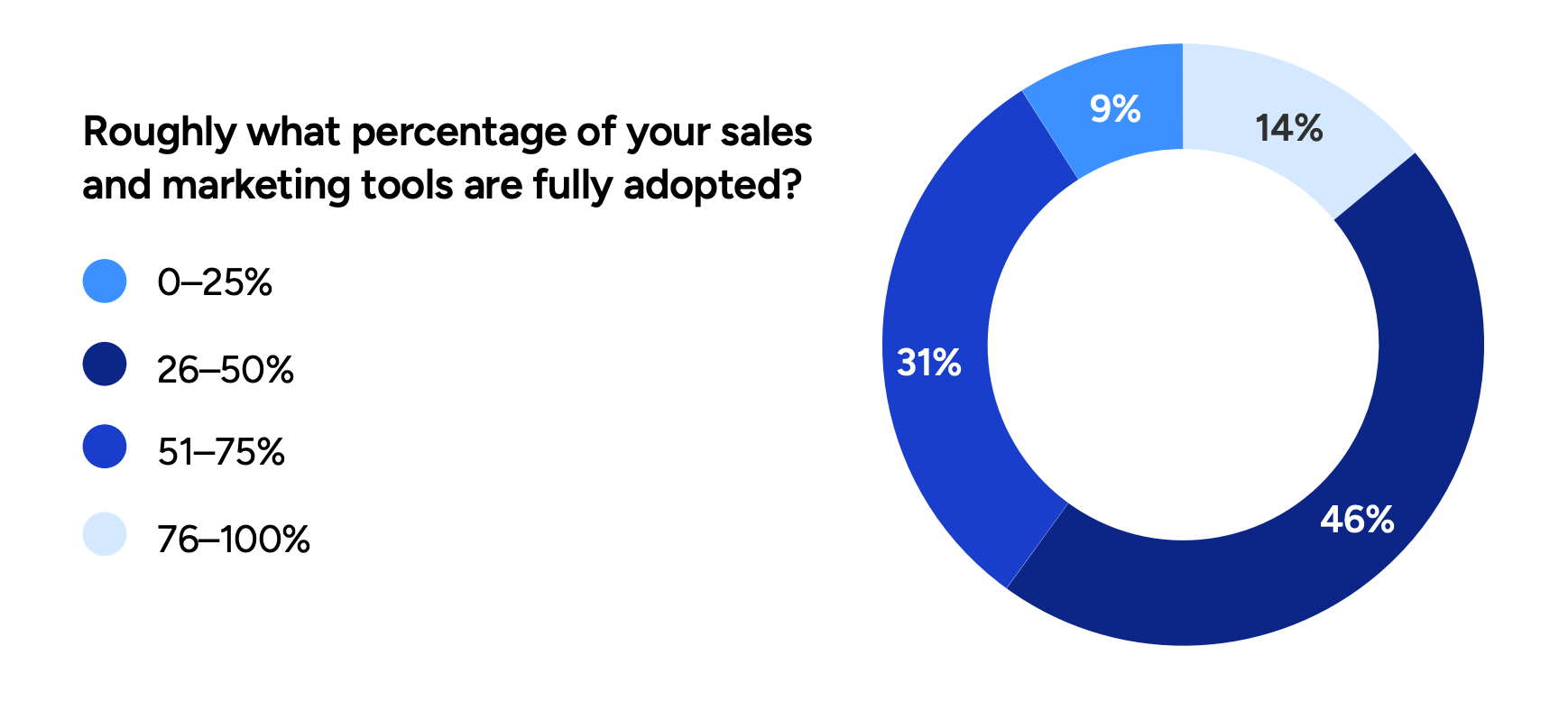
In an attempt to solve alignment issues, many organizations have turned to technology. However, the 2026 report suggests that this has created a new set of problems. Currently, 56% of GTM professionals admit that "tool bloat" is a significant issue within their organizations. Even more concerning is the lack of utilization; 60% of teams report using less than half of the tools available in their current technology stack.

The data shows that 14% of organizations utilize only 0% to 25% of their software capabilities, while 46% utilize between 26% and 50%. This suggests that companies are "buying" their way into alignment rather than "building" the processes required to make the tools effective. Unused or under-utilized tools do more than waste budget; they generate fragmented data silos. When marketing automation platforms are not fully integrated with the CRM, or when sales teams use separate spreadsheets to track their pipeline, the "source of truth" disappears.
Conversely, the study found that teams with "leaner" stacks—those who focused on a few highly integrated tools—reported significantly better outcomes. Organizations that consolidated their technology were twice as likely to rate their lead quality as "excellent" compared to those with sprawling, unmanaged stacks.
The Root Causes of Misalignment in 2026
To address the problem, the report categorized the root causes of misalignment into four distinct pillars:
- Operational (53%): These are issues related to how work actually gets done, including broken handoff processes and lack of shared workflows.
- Goal and Incentive (43%): This occurs when marketing is compensated based on lead volume (MQLs) while sales is compensated solely on closed revenue. This creates a structural incentive for marketing to prioritize quantity over quality.
- Cultural (40%): A lack of trust or a "blame culture" between departments often prevents the open communication necessary for refinement.
- Structural (34%): This refers to the organizational chart itself, where reporting lines do not encourage cross-functional collaboration.
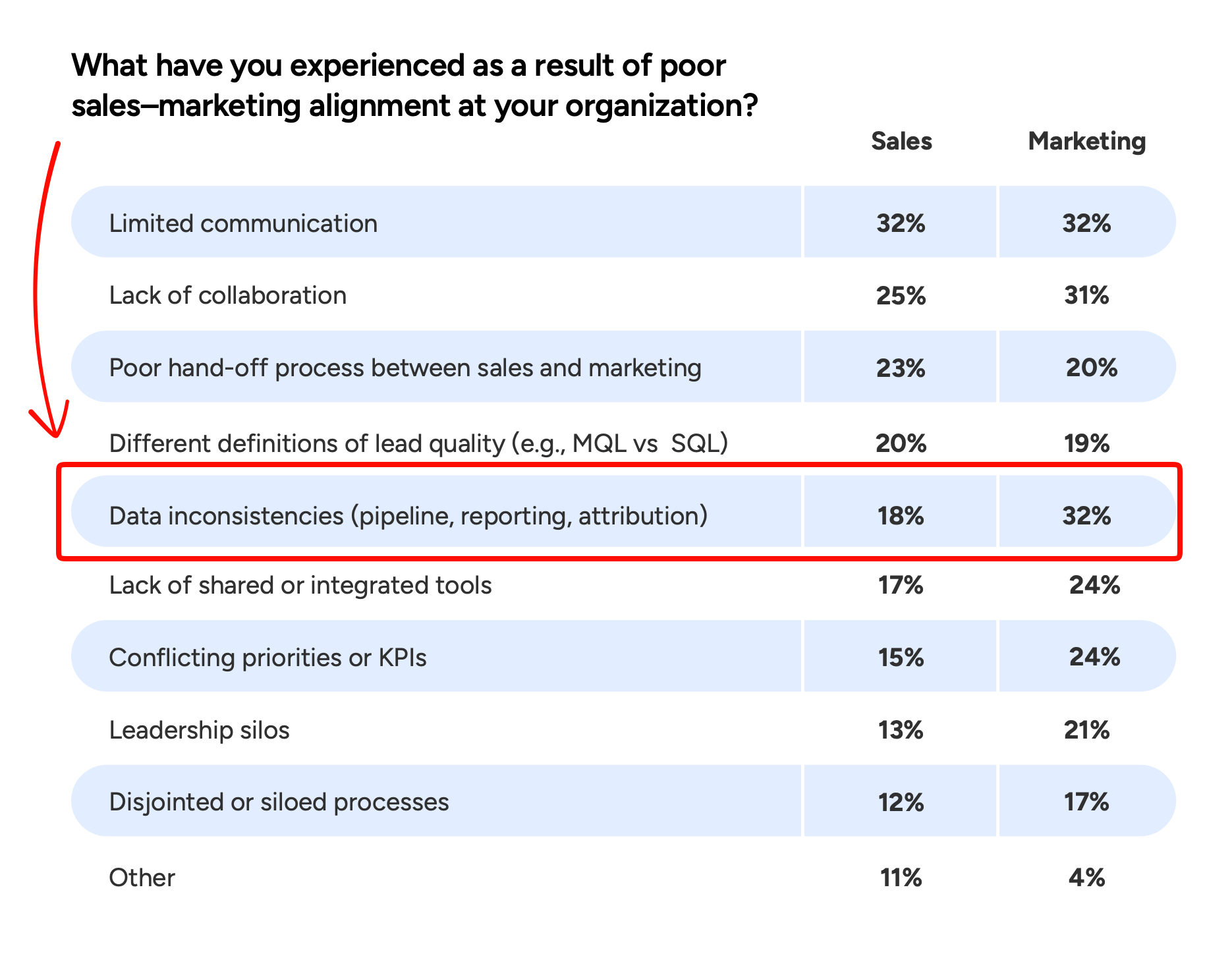
Data inconsistency remains a primary barrier, especially for marketing teams. The report found that 32% of marketers cite data discrepancies as a major obstacle, compared to 18% of sales professionals. This suggests that marketing is often flying blind, unable to accurately attribute revenue to specific campaigns because the data feedback loop from the sales department is broken or non-existent.
The Path to High Alignment: What Top Performers Do Differently
The 56% of organizations that successfully achieved high alignment share several common characteristics that differentiate them from their peers. These "top performers" have moved beyond simply increasing the frequency of meetings and have instead focused on the underlying operating model.
Unified Data Architecture
Aligned teams are 3.5 times more likely to have strong cross-functional data sharing (59% vs. 16%). In these organizations, the CRM, marketing automation, and analytics platforms are not just connected; they operate on a shared set of definitions. When everyone agrees on what constitutes a "qualified lead" and how a "conversion" is measured, the friction of reporting disappears.
Shared Buyer Personas and Messaging
A common failure point in the buyer’s journey is the "message gap"—where a marketing campaign promises one solution and the sales call focuses on another. Aligned teams report significantly lower messaging inconsistencies (17% vs. 28%). They achieve this by involving sales in the creation of buyer personas and allowing marketing to listen to sales calls to understand real-world objections and language.
Formal Service Level Agreements (SLAs)
The most successful teams treat the relationship between sales and marketing as a formal contract. An effective SLA defines exactly what marketing will deliver, the specific data points required for a lead to be considered "sales-ready," and the timeline within which sales must follow up. By codifying these expectations, organizations eliminate the ambiguity that leads to departmental finger-pointing.
Future Outlook and Strategic Implications
As organizations look toward the remainder of 2026 and into 2027, the focus is shifting toward consolidation and intelligence. Approximately 44% of GTM teams have identified data integration and AI-driven insights as their top priorities for the coming year. The goal is to move from reactive alignment—fixing problems after they occur—to predictive alignment, where AI can identify gaps in the pipeline or inconsistencies in messaging before they impact revenue.
Furthermore, 24% of teams are prioritizing the optimization of the "handoff surface," specifically through landing page testing and improved lead routing technology. The realization is that the moment a prospect moves from a marketing asset to a sales interaction is the most fragile point in the customer journey.
In conclusion, sales and marketing alignment in 2026 is no longer a "nice-to-have" cultural goal but a fundamental requirement for survival in an increasingly efficient market. The data from the Unbounce report serves as a stark reminder that while technology can facilitate the process, true alignment is built on a foundation of shared data, common incentives, and a unified view of the customer. Organizations that continue to rely on "meeting cadence" without addressing the underlying "operating model" will likely find themselves struggling with rising costs and stagnant growth, while their aligned competitors capture the lion’s share of the market.







