Asep Darmawan
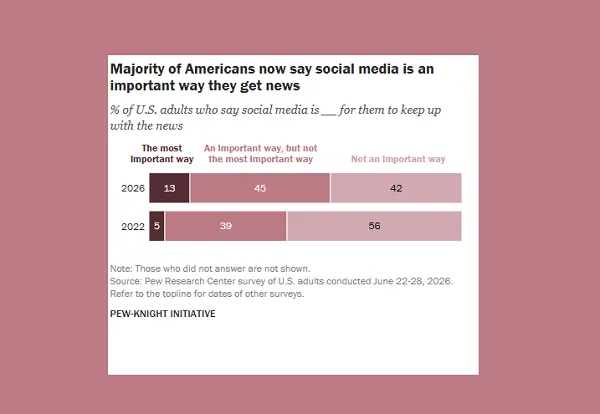
A groundbreaking report published by Pew Research on October 23, 2023, reveals a significant transformation in how Americans consume news, indicating that more than half of the U.S. adult population now views social media as a crucial conduit for news and information. This finding, derived from a comprehensive survey of over 3,500 U.S. adults conducted in June 2023, underscores the profound and escalating influence of social media platforms on the national information ecosystem and their pivotal role in shaping public discourse and informing the voting populace on critical events.
The Ascent of Social Media in News Consumption
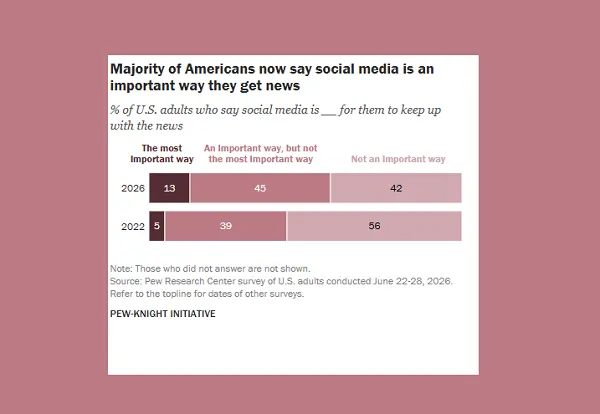
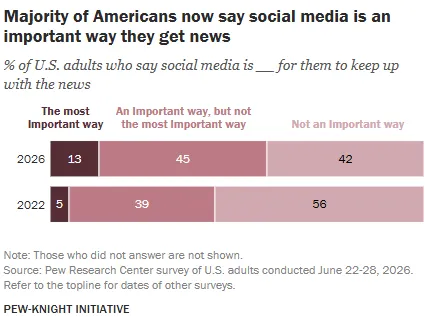
The Pew Research Center’s data highlights a stark upward trend, with 58% of Americans identifying social media as an important connector to current events. More strikingly, 13% of these individuals consider social applications to be their most important source of information. When extrapolated to the total U.S. adult population, estimated by the Annie E. Casey Foundation at approximately 270 million, this suggests that an estimated 35 million American adults now primarily depend on social media to stay informed.
This represents a substantial surge compared to Pew Research’s previous findings. In a similar report from 2022, only 43% of U.S. adults reported social media as an important news source, with a mere 5% designating it as their primary resource. The dramatic increase—a 15-percentage-point jump in overall importance and an 8-percentage-point rise in primary reliance within just one year—illustrates an accelerating shift away from traditional media channels towards a digitally native, algorithm-driven information landscape.
The trajectory of social media’s role in news dissemination has been steep since the early 2010s. Initially perceived as supplementary platforms for sharing personal updates and connecting with friends, these networks gradually evolved into powerful aggregators and distributors of news content. Early studies from the mid-2010s already showed a growing segment of the population, particularly younger demographics, turning to platforms like Facebook and Twitter for news headlines. This trend was fueled by the convenience of integrated news feeds, the immediacy of real-time updates, and the ability to engage directly with content and share it within personal networks. The COVID-19 pandemic further solidified this reliance, as people sought instant updates and community connections during a period of global crisis, inadvertently deepening their dependence on social platforms for critical information.
The Double-Edged Sword: Influence, Moderation, and Misinformation
The growing reliance on social platforms for news inevitably amplifies their power to shape media narratives, a power directly correlated with each platform’s unique content policies and moderation strategies. This immense influence has, for some time, been a focal point of intense debate, particularly concerning issues of free speech, censorship, and the proliferation of misinformation.
Chronology of the Content Moderation Debate:
- 2016-2020: Early Scrutiny and Platform Accountability: Following the 2016 U.S. presidential election and revelations of foreign interference campaigns, social media platforms faced unprecedented scrutiny over their role in spreading disinformation. Companies like Facebook and Twitter began to invest heavily in content moderation teams, AI-driven detection systems, and partnerships with fact-checking organizations. This period marked the beginning of platforms taking a more active, albeit often criticized, role in policing content.
- 2022: Elon Musk’s Acquisition of Twitter (now X): In October 2022, Elon Musk completed his acquisition of Twitter, rebranding it as X. A central tenet of his stated motivation was to restore "free speech" on the platform, which he argued had been stifled by previous management’s alleged interference with democracy and manipulation of content visibility. Musk’s takeover initiated a period of significant policy changes, including the reinstatement of previously banned accounts and a more lenient approach to content moderation, sparking both praise from free speech advocates and alarm from those concerned about the potential surge in hate speech and misinformation.
- Late 2022 – Present: The "Censorship Industrial Complex" Narrative: Concurrent with Musk’s acquisition, a narrative began to coalesce around what some observers and political figures termed the "censorship industrial complex." This concept posits the existence of a loosely organized network of activists, government agencies, academic institutions, and non-governmental organizations that allegedly collaborate to police online behavior, sway public discourse through crackdowns on speech, and limit the amplification of certain viewpoints within social media apps. Proponents of this theory argue that these efforts represent an undue suppression of diverse opinions and a threat to democratic principles.
- December 2023: U.S. State Department Actions: In a significant development, the U.S. State Department announced actions in December 2023 aimed at combating what it described as a "global censorship industrial complex." While not directly naming individuals or organizations, the announcement outlined efforts to counter those who, it claimed, had led organized campaigns "to coerce American platforms to censor, demonetize, and suppress American viewpoints they oppose." This official government acknowledgment underscored the seriousness with which some policymakers viewed these alleged activities and highlighted the complex interplay between government, platforms, and public discourse.
- Ongoing Debate: The core tension persists: how can platforms uphold principles of free expression while simultaneously mitigating the spread of harmful misinformation, hate speech, and foreign influence operations? The stakes are particularly high given the platforms’ current role as primary news sources for millions.
Platform Policies: A Shifting Stance
Initially, many social media platforms leaned towards a hands-off approach, viewing themselves as neutral conduits for information. However, the sheer volume of content, coupled with instances of real-world harm stemming from online discourse, forced a re-evaluation. The challenge lies in establishing equitable rules for acceptable speech, a task made more complex by differing cultural norms, legal frameworks, and political ideologies globally. The question of who should make these critical calls—platforms, governments, or users themselves—remains hotly contested.
A prime example of this evolving, and often contradictory, stance comes from Meta, the parent company of Facebook and Instagram. Mark Zuckerberg, Meta’s founder, has articulated differing philosophies on content moderation over time, reflecting the immense pressures and complexities inherent in governing global digital spaces.
In a notable post from 2021, Zuckerberg outlined a critical observation about social networks: "One of the biggest issues social networks face is that, when left unchecked, people will engage disproportionately with more sensationalist and provocative content. This is not a new phenomenon. It is widespread on cable news today and has been a staple of tabloids for more than a century. At scale it can undermine the quality of public discourse and lead to polarization." In this statement, Zuckerberg acknowledged the inherent algorithmic tendency to boost content that drives engagement, irrespective of its factual accuracy or societal benefit, and expressed concern about its corrosive effect on public discourse and social cohesion. He implicitly suggested a need for platforms to intervene to counter this tendency and address the weaponization of misinformation.
However, in a significant shift articulated in January 2024 (assuming the original article’s 2025 date was a typo for 2024, given the October 2023 publication date of the Pew report), Zuckerberg announced Meta’s move away from extensive fact-checking on certain topics, arguing for an obligation to "allow more speech" and facilitate greater discussion on "borderline topics." As a direct consequence, Meta relaxed some of its rules that had previously restricted discussion on controversial subjects, including immigration and gender identity. This policy pivot implies a greater emphasis on free expression, even if it entails allowing more content that could be considered "sensationalist and provocative."
This change in perspective raises significant questions. By Zuckerberg’s own logic from 2021, such a shift could lead to increased polarization and potential harm. It suggests a strategic re-prioritization, perhaps driven by a desire to avoid accusations of censorship, reduce the operational burden of content moderation, or cater to a segment of the user base that champions unfettered speech. Whatever the motivation, the move signals a potentially more permissive environment on Meta’s platforms, at a time when they are becoming even more critical sources of news and information for millions.
Broader Societal and Democratic Implications
The increasing reliance on social media for news has profound implications beyond platform policy.
- Impact on Public Discourse and Critical Thinking: While social media offers diverse perspectives and rapid information sharing, it also often presents information in decontextualized snippets, frequently devoid of journalistic rigor. The fast-paced, emotionally charged environment can hinder critical thinking, encouraging superficial engagement rather than deep analysis. The prevalence of echo chambers and filter bubbles, where individuals are primarily exposed to information reinforcing their existing beliefs, further exacerbates polarization and diminishes opportunities for nuanced understanding.
- Challenges for Traditional Journalism: Legacy media organizations face immense pressure to adapt. They contend with dwindling advertising revenues, the need to compete with free, user-generated content, and the challenge of maintaining trust in a fragmented media landscape often hostile to traditional journalistic gatekeepers. Many are forced to engage with social media to reach audiences, often diluting their own brand and content in the process.
- Media Literacy Education: The imperative for robust media literacy education has never been greater. Equipping individuals with the skills to critically evaluate information sources, identify misinformation, and understand algorithmic biases is crucial for navigating the complex digital information environment responsibly.
- Foreign Influence and Information Warfare: The open nature of social media platforms makes them prime targets for state-sponsored disinformation campaigns and foreign interference. Bad actors can leverage these platforms to sow discord, influence elections, and destabilize geopolitical situations, often exploiting the very mechanisms designed to promote engagement.
- Erosion of Trust: The constant barrage of conflicting narratives, combined with the perception of biased content moderation, has contributed to a broader erosion of trust in both social media platforms and traditional news outlets. This trust deficit poses a significant threat to informed public debate and democratic processes.
The Regulatory Landscape and Future Outlook
The debate over social media’s role in news and its governance is far from settled. Governments worldwide are grappling with how to regulate these powerful entities without impinging on fundamental rights. Discussions range from mandating greater transparency in content moderation and algorithmic design to exploring legal frameworks for platform liability concerning harmful content.
As artificial intelligence (AI) becomes increasingly sophisticated, its role in generating and moderating content will introduce new layers of complexity. AI-generated news, deepfakes, and hyper-realistic synthetic media could further blur the lines between reality and fabrication, challenging human discernment and necessitating advanced verification techniques. The emergence of metaverses and other immersive digital environments could also transform how news is consumed, creating new frontiers for both information dissemination and potential manipulation.
In conclusion, the Pew Research report unequivocally confirms social media’s ascension as a dominant news source, marking a pivotal moment in the evolution of information consumption. This shift, while offering unparalleled access and immediacy, simultaneously thrusts platforms into the unenviable position of de facto arbiters of truth and discourse. The ongoing tension between fostering open expression and combating misinformation, exemplified by the policy shifts of major platforms like Meta, underscores a critical juncture for society. How these platforms navigate these challenges, and how societies adapt to this new information paradigm, will profoundly shape public understanding, democratic health, and the very fabric of global communication for decades to come.


 Lina Irawan

 Asro