The landscape of commerce is on the precipice of another profound transformation, moving beyond the borderless, internet-driven experiences of traditional e-commerce into the era of agentic commerce. This nascent model leverages advanced artificial intelligence (AI) to empower autonomous agents to discover, compare, and even complete purchases on behalf of consumers, fundamentally reshaping the buying journey. What began with localized physical stores evolved into sprawling digital marketplaces, and is now poised to become an ecosystem where AI agents act as intelligent shopping proxies, understanding user intent, evaluating options, and executing transactions with unprecedented efficiency.
The Evolution of Commerce: From Marketplaces to AI-Driven Autonomy
Commerce has continually reinvented itself. For millennia, trade was confined to physical locations, from bustling bazaars to brick-and-mortar shops. The late 20th century heralded the advent of electronic commerce, breaking geographical barriers and introducing online catalogs, shopping carts, and digital payments. Platforms like Amazon and eBay democratized retail, making products from around the globe accessible with a few clicks. The subsequent rise of mobile commerce further integrated shopping into daily life, allowing transactions from anywhere, at any time. Each shift brought new conveniences, but the core interaction remained: the human shopper actively navigating, researching, and deciding.
The current wave, agentic commerce, is a direct byproduct of the rapid advancements in artificial intelligence, particularly in large language models (LLMs) and autonomous AI agents. These technologies have moved beyond mere information retrieval or recommendation engines. Modern AI agents are increasingly capable of complex reasoning, multi-step task execution, and interaction with external systems, making the concept of a “digital shopping proxy” a tangible reality. This paradigm shift suggests a future where consumers delegate significant portions of their shopping journey to intelligent systems, freeing up time and potentially optimizing purchasing outcomes.
Understanding Agentic Commerce: A Digital Shopping Proxy

At its core, agentic commerce represents a model where AI agents function as decision-makers and executors for customers. Instead of manually sifting through endless product pages, comparing options across various websites, applying filters, and completing checkout processes, users can delegate these tasks to AI agents. These agents operate based on predefined intent, preferences, constraints, and buying goals established by the user.
As Alex Moss, an expert in the field, explained in the SEO Unplugged podcast, agentic commerce envisions a deeply integrated experience: “I could literally say into the into a phone to my agent, go and buy me some new shoes with that jacket I bought last week, and that’s it. And it would go away. It would do the research. And of course, you can have a say in an approval in terms of part of the journey.” This anecdote highlights the key distinction: while traditional AI tools might offer recommendations or information, agentic AI actively executes tasks. Humans define the intent or goal, while AI agents perform the heavy lifting, yet users retain ultimate control over the final decision.
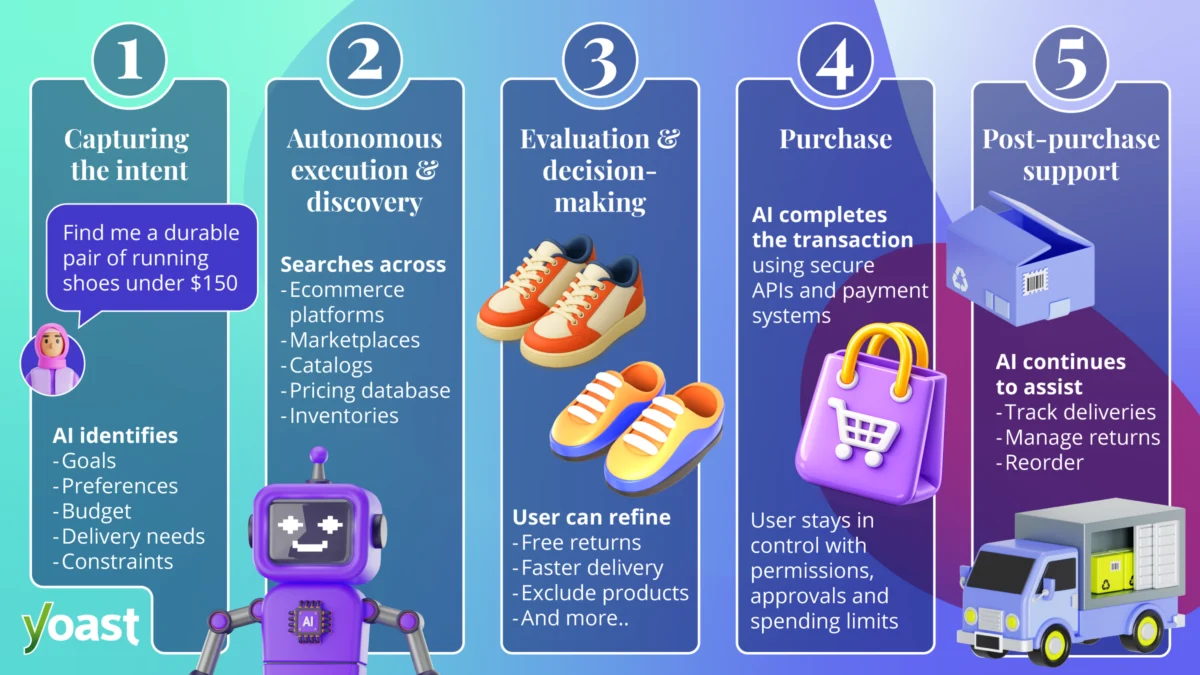
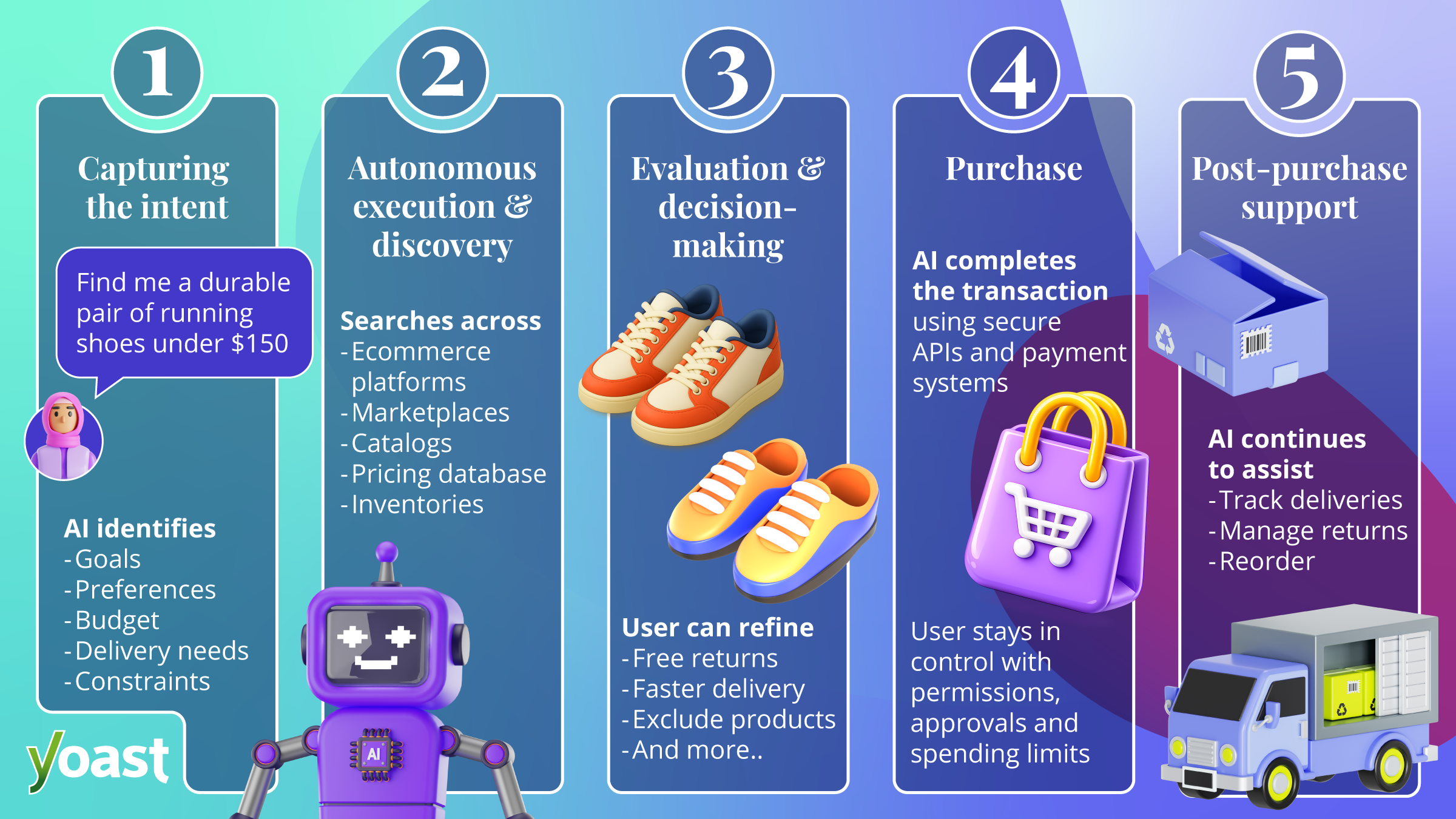
The typical workflow of agentic commerce unfolds in a series of interconnected steps:
-
Capturing the Intent: The journey begins with the user expressing a need or goal in a conversational manner. This is far more nuanced than keyword searches. An agent might be tasked with finding “sustainable running shoes under $150 that are good for high arches” or “a reliable washing machine with a large capacity and a good energy rating for delivery next week.” The AI agent’s initial focus is to understand all parameters, asking clarifying questions if the request is too broad.
-
Autonomous Instruction Execution and Brand Discovery: Once the intent is clear, the AI agent springs into action. It doesn’t just search one platform; it simultaneously scans multiple e-commerce sites, online marketplaces, product catalogs, review aggregators, pricing databases, and inventory systems. This changes traditional product discovery dramatically. Brands with meticulously structured product data, accurate inventory information, transparent pricing, and machine-readable content are inherently more discoverable and favorably evaluated by AI agents.
-
Evaluation and Decision-Making: After gathering a comprehensive set of options, the AI agent evaluates products against the user’s criteria. This involves analyzing factors such as price, features, customer reviews, brand reputation, sustainability credentials, warranty, delivery speed, and return policies. The agent can then present a reasoned explanation of why certain products are superior matches, rather than just a list. Users can further refine this process by adding conditions like “prioritize products with a 4.5-star rating or higher” or “find the lowest price even if delivery takes an extra day,” creating a continuous feedback loop.

-
Purchase: With user approval or predefined rules, the AI agent proceeds to complete the transaction. Utilizing APIs, commerce protocols, and secure payment systems, the agent can add items to carts, apply eligible discounts, authenticate payments, and finalize purchases. This process can be instantaneous or conditional, such as waiting for a price drop or specific stock availability. Crucially, user control is maintained through permissions, spending limits, and approval settings.
-
Post-Purchase Support: The agent’s role extends beyond the checkout. It can track order status, manage returns, initiate warranty claims, facilitate customer support interactions, or even monitor product performance (e.g., for smart appliances) and recommend maintenance or reorder consumables. This transforms shopping into an ongoing, intelligent service rather than a series of isolated transactions.
The Impetus for Change: Consumer Readiness and Market Projections
The shift towards agentic commerce is not merely a theoretical possibility; it is driven by observable changes in consumer behavior and robust industry forecasts. Consumers are already integrating AI into their shopping journeys, and their expectations are evolving rapidly.
According to a McKinsey & Company report, more than 70% of AI-powered search users are asking top-of-the-funnel questions about categories, brands, products, or services. Furthermore, nearly 50% of consumers currently use AI-powered search experiences. This indicates a significant pivot: consumers are moving beyond simple keyword searches and are increasingly seeking AI systems to guide their decisions. The same study projects that businesses could see 20–50% of their traffic shift away from traditional search experiences over time, underscoring the urgency for brands to adapt their discoverability strategies.
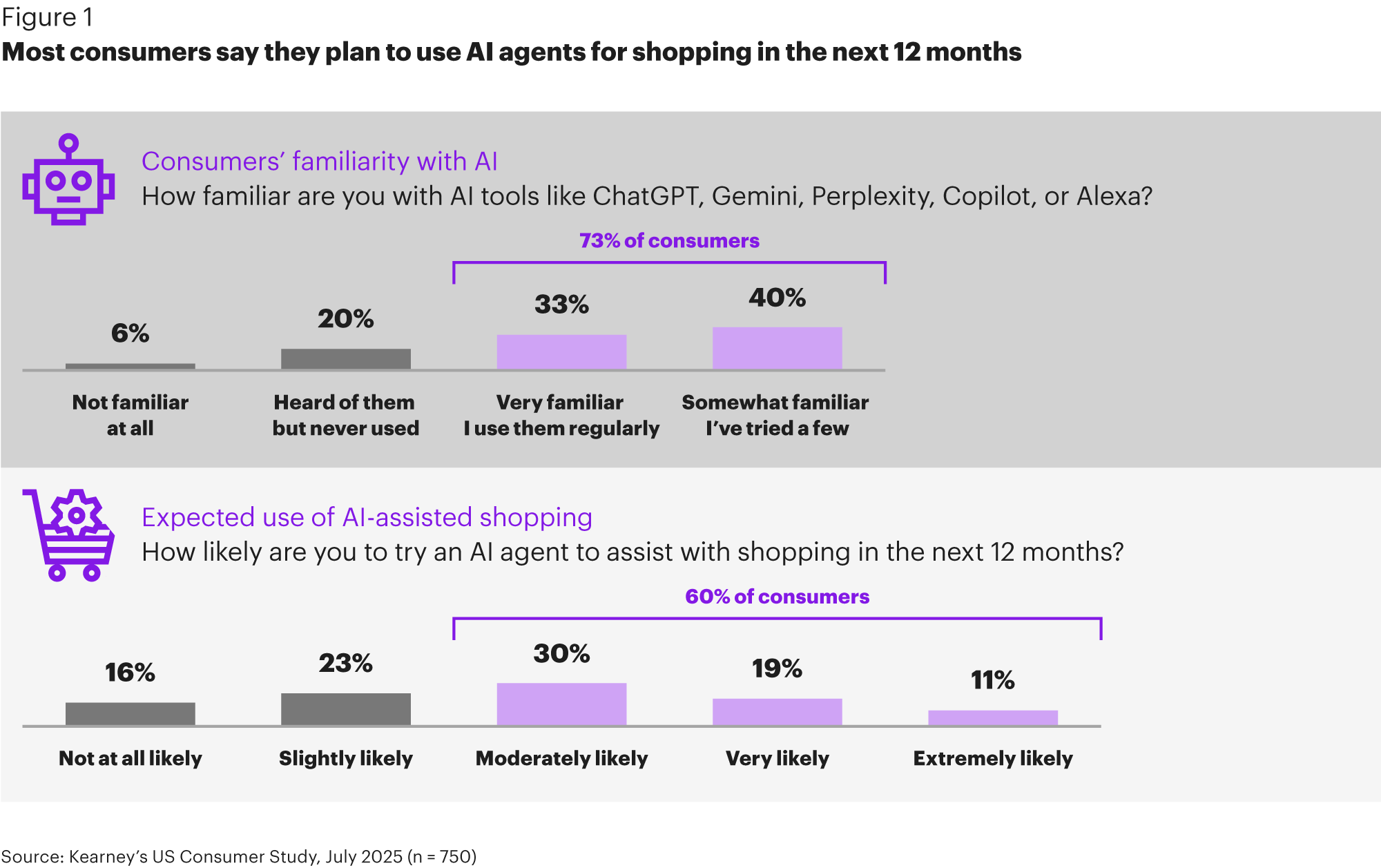
Consumer interest in AI-assisted shopping is not just a trend but a burgeoning expectation. The 2025 Kearney report, “Agentic Commerce: From Brand Loyalty to Bot Logic,” revealed that over 60% of shoppers anticipate using agentic AI by 2026. This report highlights a major behavioral shift where convenience, speed, competitive pricing, and trust are increasingly prioritized over traditional platform or brand loyalty. Instead of browsing individual retailer apps, shoppers envision relying on AI agents to compare products across diverse platforms, evaluate reviews, identify optimal deals, and complete purchases more efficiently. This fundamentally alters the competitive landscape, shifting it from retailer-versus-retailer to a battle for dominance within AI-driven discovery ecosystems.
Industry analysts are also predicting explosive growth. Another McKinsey report suggests that agentic commerce could fundamentally reshape the shopping experience, unlocking significant economic opportunities. Based on growing AI adoption and increasing merchant readiness, the report estimates that by 2030, the US B2C retail market alone could see an orchestrated revenue opportunity ranging from $900 billion to $1 trillion. Globally, this opportunity could expand to between $3 trillion and $5 trillion. These figures underscore the immense potential and the compelling business case for investing in agentic commerce infrastructure and strategies.
Building the Infrastructure: Key Protocols and Partnerships
The realization of agentic commerce is not solely dependent on advanced AI models but also on a foundational ecosystem of protocols, frameworks, APIs, and secure payment systems. These technologies enable AI agents to interact with digital commerce platforms securely and efficiently, transforming recommendations into actionable transactions.
A pivotal concept enabling agentic AI generally is the Model Context Protocol (MCP), which provides a standardized communication layer for AI models to connect with external systems, tools, and databases. For agentic commerce specifically, similar, more specialized protocols are emerging to handle the unique complexities of shopping ecosystems, such as understanding product information, communicating with merchants, comparing inventory, and securely completing transactions.
Agentic Commerce Protocol (ACP) by Stripe and OpenAI:
One of the most significant developments is the Agentic Commerce Protocol (ACP), an open standard introduced by Stripe in collaboration with OpenAI. ACP aims to facilitate more natural interactions between AI agents and e-commerce systems, creating a standardized framework for product discovery, checkout, and payment execution. It provides the necessary infrastructure for AI agents to move beyond merely recommending products to actually completing secure purchases on behalf of users.
Early real-world implementations are already emerging. For instance, ChatGPT users in the United States can now purchase products directly from Etsy merchants within the chat interface, leveraging Stripe-powered checkout. Shopify integrations are also anticipated. This signals a critical shift: AI-enabled transactions are now happening inside conversational interfaces, rather than merely redirecting users to external websites. ACP’s open-standard approach is crucial, as it fosters broader adoption by developers, merchants, and e-commerce platforms, laying the groundwork for scalable AI-driven shopping experiences.
Universal Commerce Protocol (UCP) by Google:
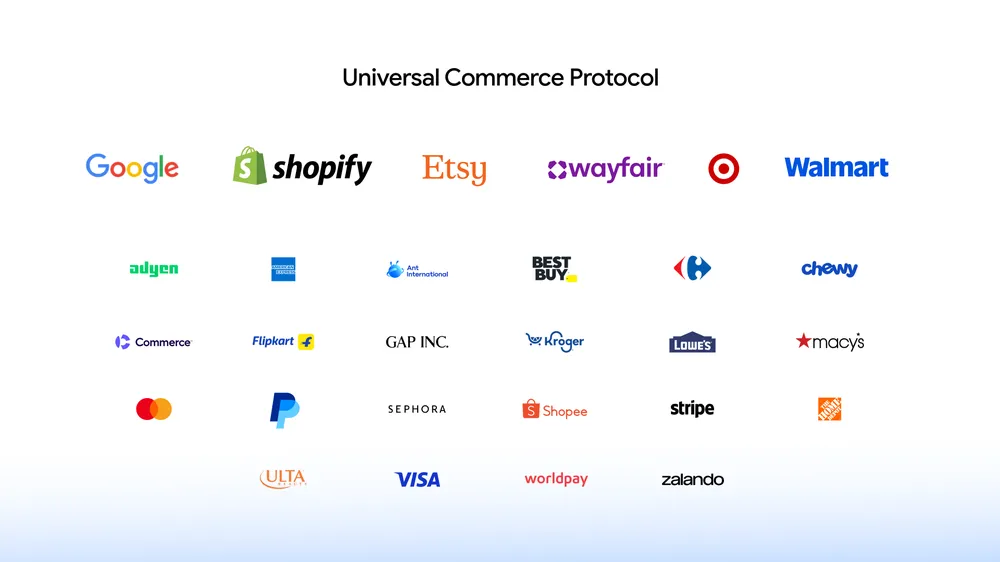
As the number of AI agents in the shopping journey grows, the challenge of seamless communication between thousands of retailers, marketplaces, and payment providers becomes paramount. Google’s Universal Commerce Protocol (UCP) aims to solve this by creating a common language for agentic commerce. UCP is an open standard designed to provide a shared framework for efficient communication throughout the entire shopping journey, rather than requiring custom integrations for every AI agent and commerce platform.
UCP’s broad scope is particularly notable, supporting the full commerce lifecycle, including product discovery, inventory checks, order placement, fulfillment tracking, and returns management. It is also designed for interoperability with other emerging AI standards such as Agent2Agent (A2A), Agent Payments Protocol (AP2), and the Model Context Protocol (MCP), allowing businesses to adopt agentic commerce without overhauling existing systems. Google co-developed UCP with major commerce companies like Shopify, Etsy, Wayfair, Target, and Walmart, and it has received support from financial giants including Mastercard, Visa, Stripe, and American Express. This broad industry backing underscores UCP’s potential to become foundational infrastructure for a truly scalable agentic commerce ecosystem.
Mastercard Agent Pay: Securing the Transaction:
While ACP and UCP focus on communication and interoperability, Mastercard Agent Pay addresses one of the most critical aspects of agentic commerce: secure payment execution and trust. As AI agents gain the ability to make purchasing decisions, they need a secure, verifiable method to complete transactions. Mastercard Agent Pay provides this infrastructure, allowing AI agents to execute payments within user-defined permissions, authentication requirements, and spending controls. It prioritizes verified, traceable, and authorized payment flows, preventing AI systems from having unrestricted access to payment credentials.
A significant development is its integration with PayPal’s wallet infrastructure, allowing AI agents to securely complete transactions for PayPal users while upholding the robust security and trust mechanisms consumers expect from digital payments. This partnership is crucial for moving agentic commerce from experimental environments to widespread, real-world adoption across a vast ecosystem of merchants and consumers.
Together, ACP, UCP, and Agent Pay are constructing the essential foundation for agentic commerce. ACP enables AI agents to interact with merchants and complete purchases, UCP creates a common language for agents, retailers, and platforms to operate at scale, and Agent Pay provides the critical trust layer for secure, authorized payments, collectively bringing AI-driven shopping closer to reality.
Implications for the Future of Retail and Marketing

The advent of agentic commerce carries profound implications for consumers, businesses, and the broader retail ecosystem.
For consumers, the promise is unprecedented convenience and hyper-personalization. AI agents can drastically reduce research time, ensure optimal pricing, and automate routine purchases, freeing up mental bandwidth. However, this convenience comes with potential concerns regarding data privacy, the extent of control over purchasing decisions, and the potential loss of serendipitous discovery that browsing can offer. Trust in AI systems, especially with financial transactions, will be paramount.
For businesses and brands, the shift demands a fundamental re-evaluation of strategies:
- SEO and Discoverability: Traditional keyword-based SEO will likely evolve into “agent optimization.” Brands must prioritize meticulously structured product data, comprehensive product feeds, and machine-readable content to ensure their offerings are discoverable and favorably evaluated by AI agents. Semantic clarity and detailed attributes will outweigh keyword stuffing.
- Marketing and Branding: Influencing AI agents will become a new frontier. Marketing efforts may need to focus more on building strong brand reputation, accumulating authentic customer reviews, demonstrating ethical practices, and ensuring product quality, rather than solely relying on advertising spend to capture human attention. Brands will need to build trust not just with consumers, but with the AI agents making decisions on their behalf.
- Customer Relationships: Agentic commerce could disintermediate the direct relationship between brands and customers. Brands must strategize how to maintain engagement and loyalty when an AI agent is the primary interface.
- Operational Efficiency: Automation extends beyond purchasing. AI agents can streamline supply chain management, monitor inventory levels, and automatically reorder supplies, leading to significant operational efficiencies.
- Investment: Businesses will need to invest in new technological infrastructure, data management systems, and AI-ready commerce experiences to remain competitive.
The competitive landscape will also transform. The focus will shift from platform loyalty to “bot logic,” where the AI agent’s criteria dictate purchasing decisions. New gatekeepers, primarily the developers of leading AI agents and protocols, will emerge, influencing discoverability and market access.
Navigating the Challenges: Trust, Ethics, and Adoption
Despite the rapid technological advancements, widespread adoption of agentic commerce is far from guaranteed and faces significant hurdles.
- Trust and Security: Consumers’ comfort with delegating purchasing authority to AI agents, especially concerning sensitive financial information, remains a major challenge. Robust fraud prevention measures, secure payment gateways, and transparent security protocols are essential.
- AI Bias: Ensuring that AI agents do not perpetuate or amplify biases present in their training data or algorithms is critical. Biased recommendations could lead to discriminatory purchasing patterns or limit consumer choice.
- Data Privacy: The collection, storage, and utilization of vast amounts of personal and purchasing data by AI agents and underlying platforms raise significant privacy concerns. Clear regulations and ethical guidelines are needed to protect consumer information.
- Regulatory Frameworks: Existing commerce regulations may not adequately cover the complexities of agentic commerce. New legal and ethical frameworks will be required to address issues of accountability, liability, and consumer protection in an AI-driven purchasing environment.
- Economic Impact: The automation inherent in agentic commerce could lead to job displacement in customer service, sales, and retail roles, necessitating strategies for workforce adaptation and retraining.
- Ethical Considerations: Questions arise regarding responsibility if an AI agent makes an unsatisfactory or ethically questionable purchase. Who is accountable—the user, the AI developer, the platform, or the merchant?
- Value Proposition: Ultimately, the long-term success of agentic commerce hinges on whether it genuinely solves real problems for consumers and merchants, rather than simply adding another layer of complexity or facilitating excessive consumption.
Agentic commerce represents a significant and potentially inevitable direction for digital shopping. While the foundational technologies and protocols are rapidly falling into place, its journey to widespread adoption will be defined by how effectively these complex challenges—spanning trust, ethics, security, and economic impact—are addressed. The future of retail is being redefined, and AI agents are poised to be central to this new era, demanding a proactive and thoughtful approach from all stakeholders.