A common misconception in the world of e-commerce is that scaling a business invariably requires a proportional increase in headcount and marketing expenditure. However, a closer examination of highly profitable online stores reveals a different paradigm. Instead of focusing solely on aggressive marketing campaigns and expanding payrolls, the most successful businesses are prioritizing operational leanness and strategic tax planning. This approach not only drives higher profits but also significantly reduces the stress associated with managing a growing enterprise.
The Reinvention of an E-commerce Business: A Case Study in Strategic Efficiency
One compelling illustration of this principle comes from the experience of a local e-commerce store owner. For years, this individual managed a team of 35 employees. While the business consistently generated solid revenue, profitability remained a persistent challenge. The owner described the situation as being under constant stress, with the demands of managing a large team consuming significant time and energy, often overshadowing the core business operations.
In a decisive move to address these challenges, the owner implemented a series of strategic changes. This involved transitioning to a remote work model, outsourcing fulfillment operations to a third-party logistics (3PL) provider, and restructuring the workforce by replacing many full-time employees with freelancers and independent contractors. The outcome of these decisions was a dramatic shift in the business’s operational and financial landscape. Today, the business operates with a lean core team of just one full-time employee, supported by eight contractors. This leaner structure has not only led to unprecedented profit margins but has also resulted in a substantial reduction in the owner’s stress levels.

This anecdote challenges the conventional wisdom that business growth is directly correlated with increased staffing and larger marketing budgets. It suggests that alternative strategies can unlock greater financial success and operational efficiency. This is not an isolated incident; data from broader industry analysis supports this observation.
Empirical Data: The Operational Leanness Advantage
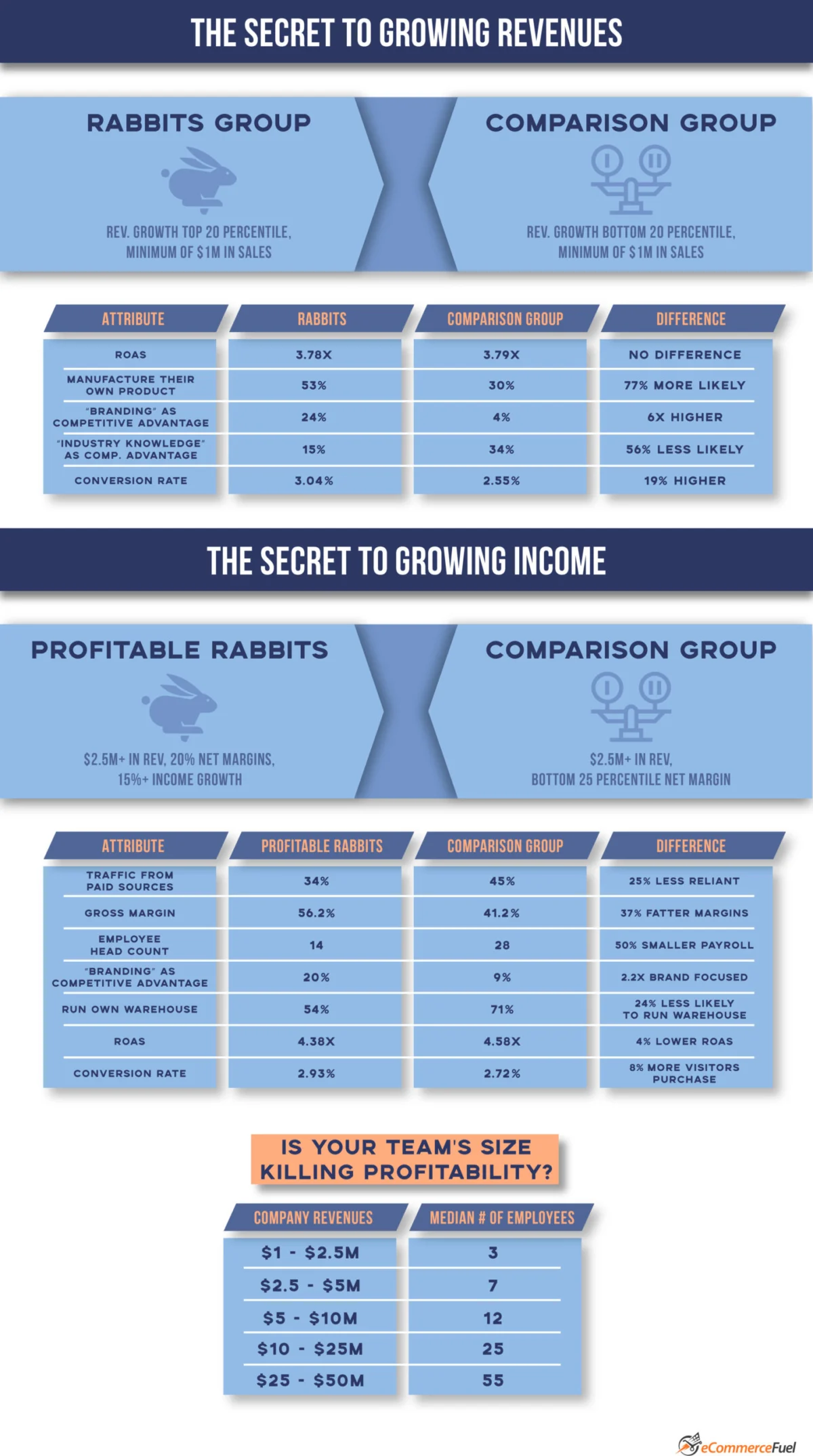
A comprehensive study analyzing hundreds of e-commerce businesses sought to identify the key differentiators between highly profitable and struggling operations. The initial expectation was that superior marketing strategies would be the primary driver of success. However, the research yielded a surprising conclusion: the difference in Return on Ad Spend (ROAS) between top-performing and bottom-performing stores was negligible. Businesses that were excelling in profitability were not necessarily outperforming competitors in areas like Facebook advertising or search engine optimization (SEO).
Instead, the study pinpointed two critical factors that consistently separated the most profitable businesses:
- Reduced Payroll Costs: Top performers maintained payrolls that were, on average, half the size of their less profitable counterparts. This indicates a strategic emphasis on optimizing labor costs.
- Outsourcing and Reduced Reliance on Paid Traffic: Businesses achieving higher profitability were 25% more likely to outsource their warehouse operations, suggesting a preference for specialized third-party services. Furthermore, they demonstrated a 25% lower reliance on paid advertising channels.
This data strongly suggests that operational leanness, characterized by efficient resource allocation and a strategic approach to outsourcing, consistently outweighs marketing prowess in driving profitability. The emphasis shifts from “more” to “smarter.”

The Multifaceted Nature of “Lean” Operations
The concept of maintaining a “lean” operation extends far beyond simply reducing headcount. It encompasses a critical evaluation of all overheads and a deliberate effort to eliminate unnecessary expenses. This can include:
- Re-evaluating Office Space: The necessity of large, physical office spaces, especially in the post-pandemic era where remote work has become more prevalent, needs to be questioned. Maintaining underutilized office facilities can represent a significant and avoidable cost.
- Optimizing Fulfillment: Utilizing a third-party logistics (3PL) provider can often be more cost-effective and efficient than managing in-house warehouse operations. 3PLs can leverage economies of scale, specialized technology, and experienced personnel to handle fulfillment, shipping, and inventory management.
- Auditing Software Subscriptions: Recurring SaaS subscriptions, even seemingly small ones, can accumulate into substantial monthly expenses. Regular audits are crucial to identify and cancel services that are no longer essential or are underutilized.
A key filter for evaluating operational costs is to determine what constitutes the core competency of a brand. If a business’s unique selling proposition lies in its product design, then retaining in-house design talent might be a strategic priority. However, if operational functions like packing boxes are not a competitive advantage, outsourcing these tasks to specialists can free up resources and improve efficiency. Profitable businesses are not cutting costs indiscriminately; they are making intentional decisions about where to allocate their resources to maximize impact.
The Imperative of Proactive “Hard Conversations”
A fundamental aspect of achieving sustained business success, as often noted by business leaders, is the willingness to engage in difficult conversations. Many entrepreneurs tend to postpone these crucial discussions until they are compelled by circumstances such as economic downturns, cash flow crises, or significant drops in profitability.

However, highly profitable businesses proactively address these issues. They engage in regular self-assessment, asking critical questions such as:
- Necessity of Roles: Is a particular position truly essential for the business’s core functions, or was it created out of a perceived need during a period of busyness?
- Value of Tools and Services: Are current software subscriptions and tools being utilized out of necessity or simply out of habit?
- Contingency Planning: What would be the immediate impact of a 25% reduction in expenses, and which areas would be prioritized for cuts if absolutely necessary?
By posing these questions and acting on the insights gained, these owners make intentional adjustments to their operations, not as a reaction to crisis, but as a proactive strategy for sustained financial health.
The Underrated Power of Tax Efficiency
Beyond operational costs, the strategic management of taxes represents another significant, yet often overlooked, lever for enhancing profitability. While many business owners view taxes as a fixed cost, a closer examination reveals substantial opportunities for optimization through intentional planning.
Consider two hypothetical e-commerce owners, each generating $2.5 million in revenue with $250,000 in profit, and facing similar personal financial circumstances. Owner A pays approximately $75,000 in annual taxes, while Owner B, through deliberate tax planning, reduces their tax liability to $21,000. This significant difference, amounting to over $54,000 annually, is achieved not through illicit means, but by strategically leveraging available tax-saving mechanisms.

Key Tax Optimization Strategies:
- Profit Sharing Contributions: By contributing a substantial amount, such as $45,000, into retirement accounts through profit-sharing plans, Owner B can significantly reduce their taxable income. Assuming a marginal tax rate of 30%, this alone could yield savings of approximately $13,500.
- Donations of Appreciated Stock: Instead of donating cash to charities, donating stock that has appreciated in value allows the owner to avoid capital gains tax on the appreciation while still receiving a full deduction for the fair market value of the stock. This can result in savings of around $3,500.
- Maximizing Health Savings Accounts (HSAs): Contributing the maximum allowable amount to an HSA ($8,500 for a family in many jurisdictions) offers triple tax advantages: tax-deductible contributions, tax-free growth, and tax-free withdrawals for qualified medical expenses. This strategy can save approximately $2,550 in taxes.
- Paying Children for Real Work: Employing children in legitimate roles within the business and compensating them with a reasonable salary (e.g., $7,000 each for three children) provides a tax deduction for the business. Furthermore, the children can invest these earnings in Roth IRAs, allowing for tax-free growth over decades. This strategy can result in savings of approximately $6,300.
- Donating Excess Inventory: Rather than liquidating slow-moving or old inventory at a loss, donating it to qualified charities allows for a tax deduction at its fair market value. For instance, donating $60,000 worth of inventory could lead to tax savings of around $18,000, representing a highly effective, yet often underutilized, strategy in e-commerce.
These examples illustrate that with strategic intent, significant reductions in tax liabilities are achievable, directly bolstering net profitability.
The Invisible Nature of Tax Optimization Opportunities
The primary reason many business owners miss these tax optimization opportunities is the fragmented nature of tax information. Personal returns, business filings, brokerage statements, and payroll reports are often managed separately, preventing a holistic view of overall tax liabilities. Without a consolidated dashboard or a proactive approach to tax planning, business owners may not fully grasp their total tax expenditure, nor consider avenues for reduction.
A “Fine” Accountant vs. a Strategic Tax Advisor

A simple yet effective test to assess the value of a Certified Public Accountant (CPA) is to consider when they last proactively offered a new tax-saving idea. A “fine” accountant accurately processes returns and answers questions. However, a truly valuable tax advisor will reach out proactively, analyze the client’s specific situation, and suggest strategies to optimize financial outcomes. The $54,000 difference between Owner A and Owner B is not the result of complex financial maneuvers, but rather the product of intentional, proactive planning. If a CPA is not consistently bringing forward new ideas, it may be time to seek a more strategic partner.
The Two Overlooked Levers for Profitability
In the e-commerce landscape, marketing metrics such as ROAS, Customer Acquisition Cost (CAC), and Lifetime Value (LTV) dominate discussions and strategic focus. While effective marketing is undoubtedly important, the data suggests that the most profitable businesses are leveraging two less-discussed, yet equally impactful, levers: operational leanness and tax efficiency. By optimizing their internal operations, reducing unnecessary overhead, and strategically managing their tax obligations, these businesses ensure that a larger portion of their earned revenue remains as profit. This fundamental approach to retaining earnings is often a more potent driver of financial success than solely focusing on acquiring new revenue through increased marketing spend.
For e-commerce entrepreneurs seeking to build more resilient and profitable businesses, a shift in focus from solely aggressive customer acquisition to meticulous operational management and strategic financial planning is paramount. These “unsexy” but highly effective strategies offer a clearer path to sustained profitability and reduced operational stress.
For those interested in further insights into building leaner, more profitable e-commerce operations, regular updates from a community of successful seven- and eight-figure business owners are available. Staying connected with such resources can provide ongoing strategies and best practices for navigating the complexities of the e-commerce market.