A paradigm shift is occurring within the e-commerce landscape, challenging long-held assumptions about business growth and profitability. While the conventional wisdom often dictates that scaling revenue necessitates a corresponding increase in headcount and operational complexity, a growing body of evidence and anecdotal experience suggests a different, leaner approach can yield superior financial results and reduced entrepreneurial stress. This shift prioritizes operational efficiency and strategic resource allocation over sheer scale, impacting how businesses manage their teams, overhead, and financial obligations.
The traditional narrative of business expansion is deeply ingrained: more sales equal more staff, more inventory, and more physical infrastructure. This often leads to a cascading effect where managing a larger workforce becomes a significant undertaking in itself, diverting valuable time and energy from core business objectives. For many e-commerce entrepreneurs, this scenario has become a familiar source of stress, even when revenue figures appear healthy. The constant pressure of managing a substantial payroll, coordinating logistics, and overseeing day-to-day operations can overshadow the very profitability the business aims to achieve.
Consider the case of a seasoned e-commerce store owner who, for years, operated with a team of 35 employees. While the business enjoyed solid revenue streams, profitability remained persistently tighter than desired, a common predicament for businesses of this size. The sheer managerial burden of overseeing such a large team proved to be a significant drain, effectively creating a second full-time job atop the primary responsibilities of running the business. This situation is not unique; many e-commerce businesses find themselves in a similar predicament, where the growth in team size begins to outpace the growth in efficiency and profit margins.
Faced with this persistent challenge, this particular store owner made a series of decisive strategic adjustments. The business transitioned to a remote operational model, significantly reducing the need for physical office space and associated overhead. Simultaneously, they engaged a third-party logistics (3PL) provider to manage warehousing and fulfillment operations. Perhaps the most impactful change was the strategic restructuring of their workforce. The majority of full-time employees were replaced by a carefully curated team of freelancers and independent contractors. This allowed for greater flexibility, access to specialized skills on demand, and a more variable cost structure.
The results of these strategic pivots have been transformative. The business now operates with a core team of just one full-time employee, supported by a network of eight skilled contractors. This leaner structure has not only drastically reduced overhead but has also led to unprecedented profit margins and a significant decrease in the owner’s stress levels. This anecdote, while specific, reflects a broader trend observed across numerous e-commerce ventures that are re-evaluating their growth strategies.

What the Research Actually Shows
A deeper dive into the operational and financial data of successful e-commerce businesses reveals a compelling pattern that contradicts the "more is more" growth model. An extensive analysis of hundreds of e-commerce businesses, focused on identifying the key differentiators between highly profitable and struggling operations, yielded surprising insights. While many might assume superior marketing prowess or aggressive advertising spend to be the primary drivers of profitability, the research indicates otherwise.
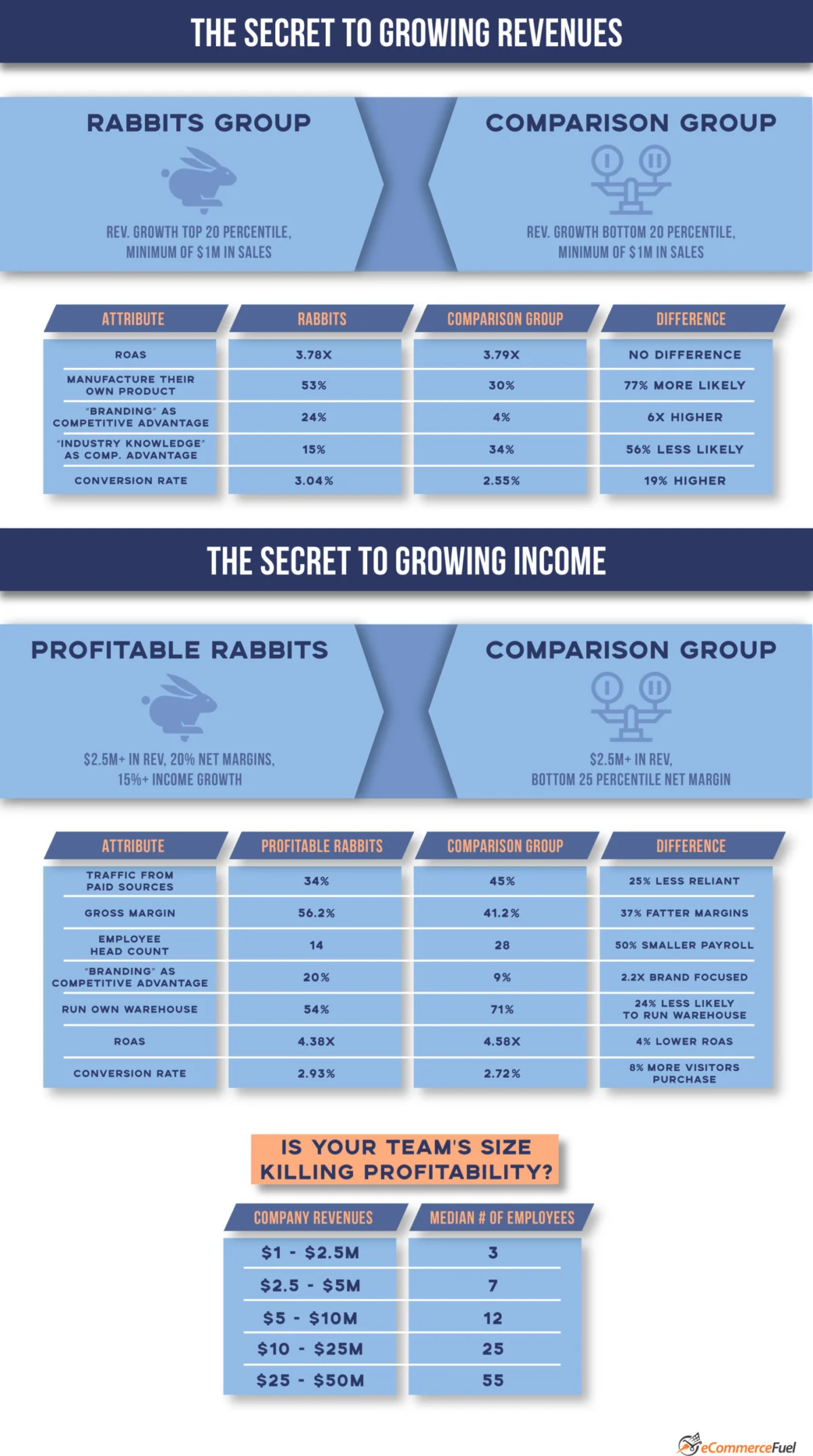
The study found that the difference in Return on Ad Spend (ROAS) between top-performing and bottom-performing stores was negligible. Similarly, businesses that were excelling in profitability were not necessarily masters of Facebook advertising or SEO. This suggests that while effective marketing is crucial for customer acquisition, it is not the sole determinant of financial success. The true secret sauce for sustained profitability appears to lie in operational efficiency and astute financial management.
The data from this comprehensive study highlighted several critical factors separating the most profitable e-commerce businesses:
- Reduced Payroll: Top performers exhibited payroll costs that were, on average, half that of their less profitable counterparts. This indicates a deliberate strategy to optimize labor expenses.
- Outsourced Operations: A significant 25% higher likelihood of outsourcing warehouse operations was observed among top performers. This points to the recognition that specialized third-party providers can often execute logistics more efficiently and cost-effectively than in-house teams.
- Lower Reliance on Paid Traffic: Profitable businesses were 25% less reliant on paid advertising channels. This suggests a greater emphasis on organic growth, customer retention, and leveraging existing customer bases, which tend to have lower customer acquisition costs.
The overarching conclusion from this research is that "operational leanness consistently beats marketing cleverness" when it comes to achieving sustainable profitability. This assertion underscores the importance of meticulously managing expenses and optimizing internal processes as a primary driver of financial success. As this data is refreshed for upcoming reports, participation from store owners is encouraged to further validate these emergent patterns.
Lean Means More Than Headcount

The concept of "staying lean" is often misinterpreted as simply implementing layoffs or drastic cost-cutting measures. However, true operational leanness extends far beyond managing personnel numbers. It encompasses a holistic review of all business expenditures and the strategic elimination of inefficiencies across the entire organization.
Overhead costs can manifest in myriad forms. This can include maintaining expensive office spaces that are no longer necessary in a remote or hybrid work environment, or retaining underutilized warehouse facilities when a 3PL could offer a more cost-effective and scalable solution for fulfillment. Furthermore, the proliferation of Software as a Service (SaaS) subscriptions, often auto-renewing without regular review, can accumulate into significant, often forgotten, monthly expenses. Fifty dollars here, two hundred dollars there, can quickly add up, eroding profitability without providing commensurate value.
A critical filter for evaluating overhead is to identify what is genuinely core to a brand’s unique value proposition. If a company’s competitive advantage lies in its distinctive product design, retaining in-house design talent might be a strategic imperative. However, if the act of packing boxes is not a differentiator, then operating an in-house fulfillment center may be an unnecessary and costly endeavor. The most successful store owners are not cutting costs indiscriminately; they are making intentional decisions about where to allocate resources, focusing on activities that directly contribute to their brand’s success and delegating or eliminating those that do not.
The Uncomfortable Truth About Hard Conversations
A profound principle often cited in personal and professional development is that one’s success is ultimately measured by the number of difficult conversations they are willing to engage in. In the business world, these conversations are frequently deferred until external pressures—such as an economic downturn, a liquidity crisis, or a precipitous drop in profitability—force them into the spotlight.
However, entrepreneurs who consistently achieve high levels of profitability tend to proactively initiate these challenging discussions. They engage in critical self-assessment before a crisis emerges. This involves asking pointed questions: "Do we truly need this position, or was it a hire made out of a perceived need for busyness?" "Are we paying for this software out of necessity, or has it become a mere habit?" "If we were forced to cut 25% of our expenses tomorrow, what would be the first to go?"

By confronting these questions head-on and making deliberate adjustments based on the answers, these business leaders are not reacting to trouble; they are strategically optimizing their operations to ensure sustained success and resilience. This proactive approach to expense management and resource allocation is a hallmark of highly profitable e-commerce businesses.
The Second Unsexy Lever: Tax Optimization
Beyond operational efficiency, another critical but often overlooked area for enhancing profitability is tax optimization. Many entrepreneurs, like the initial store owner in our example, tend to view taxes as a fixed cost—a percentage of income that must be paid regardless of strategy. However, this perspective overlooks the significant opportunities available for legally reducing tax liabilities.
Savvy business owners are not engaging in illicit practices; rather, they are being deliberate and proactive in their tax planning. They understand that by strategically structuring their finances and leveraging available tax incentives, they can retain a substantially larger portion of their earnings. The difference can be staggering, as illustrated by a comparative analysis of two hypothetical store owners with identical business profiles.
A Tale of Two Owners: A Comparative Analysis
Consider two e-commerce entrepreneurs, Owner A and Owner B, both generating $2.5 million in revenue with $250,000 in profit annually. Both owners draw the same salary and have similar family situations, being married with three children. The divergence in their financial outcomes, however, is stark when examining their tax liabilities.

Owner A, operating with a standard tax approach, pays approximately $75,000 in annual taxes. In contrast, Owner B, who has adopted a proactive tax optimization strategy, pays only $21,000 in taxes. This significant difference of $54,000 per year stems from Owner B’s intentional application of various tax-saving mechanisms, assuming a roughly 30% marginal tax rate.
Owner B’s strategies include:
- Profit Sharing Contributions: By contributing $45,000 to retirement accounts through profit sharing, exceeding standard 401(k) limits, Owner B realizes approximately $13,500 in tax savings. This strategy not only defers current tax liability but also builds long-term wealth.
- Appreciated Stock Donations: When making charitable donations, Owner B donates stock that has increased in value rather than cash. This allows them to avoid capital gains tax on the appreciation while still receiving a full deduction for the stock’s fair market value. This strategy can yield savings of around $3,500 annually.
- Maximized Health Savings Account (HSA): By contributing the maximum family limit of $8,500 to an HSA, Owner B utilizes a triple-tax-advantaged account (tax-deductible contributions, tax-free growth, and tax-free withdrawals for qualified medical expenses). This translates to approximately $2,550 in tax savings.
- Paying Children for Real Work: Owner B employs their three children, who perform genuine tasks within the business, paying each $7,000 annually. These payments are deductible for Owner B, and the children can invest these earnings in Roth IRAs, allowing for decades of tax-free growth. This strategy can save Owner B approximately $6,300 in taxes.
- Inventory Donations: For $60,000 worth of slow-moving inventory, Owner B chose to donate it to a charity rather than liquidate it at a loss. By taking a deduction at fair market value, this significantly underutilized strategy in e-commerce can generate savings of around $18,000.
The cumulative impact of these intentional tax planning strategies results in an annual tax savings of approximately $54,000 for Owner B, drastically increasing their after-tax profits compared to Owner A.
Why This Stays Invisible
The primary reason most store owners overlook these substantial tax-saving opportunities is the fragmented nature of tax information. Personal returns, business filings, brokerage statements, and payroll tax reports are often handled by different entities or exist in disparate systems. This lack of a consolidated view prevents owners from seeing their total tax burden and, consequently, from asking if they could be paying less.
Owner A in the example is not unintelligent; they simply have not had the comprehensive overview or the proactive guidance to identify these opportunities. While they may have a competent accountant who ensures accurate filing, these "fine" accountants typically process information rather than proactively offering strategic tax-saving ideas.

A Simple Test for Your CPA
A straightforward method to assess the value of one’s tax professional is to ask a simple question: "When was the last time your CPA proactively approached you with a new tax-saving idea?" The distinction is crucial: not answering a question posed by the owner, nor merely filing returns accurately, but reaching out independently with a suggestion based on the owner’s specific situation.
If the answer is difficult to recall or is a definitive "never," it may indicate that while the accountant is competent in basic compliance, they are not providing the strategic foresight that can lead to significant financial gains. The $54,000 difference between Owner A and Owner B is not the result of complex financial engineering but rather of intentionality and proactive tax planning. If a CPA is not consistently bringing forward innovative strategies, it might be time to seek out a professional who does.
Two Levers Most People Ignore
In the e-commerce world, marketing metrics like ROAS, CAC, and LTV dominate conversations and strategies. These are the widely discussed, heavily tracked, and intensely pursued metrics. However, the entrepreneurs who truly excel in profitability are often focusing on two less glamorous but equally impactful levers: operational leanness and tax optimization.
By streamlining operations, optimizing workforce structure, and judiciously managing overhead, businesses can significantly improve their bottom line. Concurrently, by adopting a proactive approach to tax planning, they can retain a much larger portion of the profits they diligently earn. While enhancing marketing efforts is undoubtedly beneficial, the fundamental principle for achieving sustainable financial success often lies not in making more money, but in keeping more of what is already earned. This strategic focus on efficiency and intelligent financial management represents a powerful, yet often overlooked, pathway to true e-commerce profitability.