rifanmuazin
For decades, the media plan has served as the cornerstone of marketing strategy, a singular document that distills complex campaigns into a clear, actionable roadmap. Typically presented as a one-page overview, it meticulously outlines channels on one side and budget allocations across the year on the other. This tangible artifact is the go-to when executives inquire about financial deployments, fostering rigor, making explicit trade-offs, and ensuring team alignment. Yet, when the same level of strategic clarity is sought from organic marketing teams, the response often falls silent. This is not a critique of SEO professionals, but rather a reflection of a historical paradigm shift. For much of search engine optimization’s existence, it was a discipline focused on a single asset: the brand’s website, optimized for a single dominant engine, Google. The channel was narrow, the surface area clear, and the strategy manageable within a single team.
However, that era has definitively concluded. The landscape shaping how artificial intelligence models perceive and represent brands has expanded dramatically, reaching far beyond a company’s owned website. Platforms like Reddit, YouTube, review aggregators, third-party editorial content, and influencer coverage are now critical inputs into the comprehensive picture AI systems construct around a brand. Each of these sources possesses distinct dynamics, ownership structures, and relationship nuances with a brand. Furthermore, their relative importance can fluctuate significantly based on the brand itself, its industry vertical, and the specific Large Language Model (LLM) being utilized. The current reality for most brands is that this multifaceted portfolio is being managed without a cohesive, overarching plan.
The fundamental issue lies in the persistent structural disconnect within most organic marketing teams, which remain largely unequipped for this new reality. Despite the seismic shift in information dissemination and AI reliance, organic programs often continue to operate through a series of fragmented activities. These may include a standalone content calendar, a separate keyword roadmap, and perhaps a digital PR initiative running in isolation. This siloed approach fails to acknowledge the interconnected nature of modern brand perception in the AI era.
Enter the Organic Media Mix (OMM).
Defining the Organic Media Mix
The Organic Media Mix (OMM) is a strategic framework designed to guide the allocation of effort, resources, and budget across a spectrum of organic channels. Its core principle is to align these investments with the actual sources that AI systems are referencing within a brand’s category and, crucially, where a brand possesses a realistic opportunity to influence those citations. The tangible output of this framework is a concise, one-page strategic overview. This document serves to identify prioritized organic channels for a given period, articulates explicit trade-offs in resource allocation, fosters alignment among cross-functional teams, and provides leadership with a transparent view of organic investment destinations and their anticipated outcomes.
A critical understanding for any organization embarking on OMM development is that no two mixes will be identical. The differences are not superficial; the strategic mix for a consumer packaged goods (CPG) brand will inherently differ from that of a B2B technology firm. Even within a single brand, the optimal mix can vary depending on the specific AI model being analyzed. This variability underscores the need for a data-driven, bespoke approach.
Step 1: The Crucial Citation Report
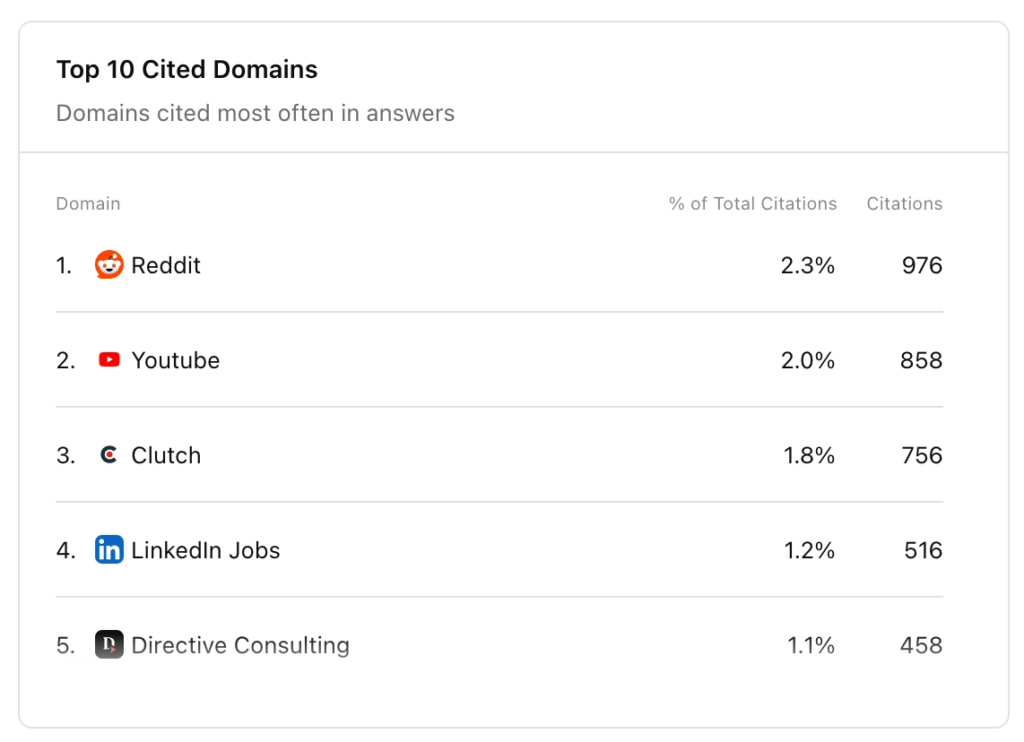
The foundational step in constructing an OMM is the generation of a comprehensive citations report. This report meticulously details the sources from which AI models derive their answers within a specific category. When a user poses a query relevant to a brand—whether it pertains to product information, comparisons, or recommendations—the report identifies which sources the AI references. Does it cite the brand’s own website, a discussion on Reddit, an article from a reputable tech publication, or a video review on YouTube?

A wide array of AI visibility platforms, including but not limited to Profound, seoClarity, and AirOps, are capable of generating this essential data. The process typically involves the following key stages:
- Defining Scope: Identifying the specific category, relevant keywords, and competitor set for analysis.
- Querying AI Models: Submitting a defined set of user queries to various AI models (e.g., ChatGPT, Google’s AI Overviews, Perplexity AI).
- Source Extraction: Analyzing the AI model’s responses to identify and log every external source cited.
- Aggregation and Categorization: Compiling the data to reveal the frequency and prominence of each source.
The result is a clear map of where authority currently resides within a category, not based on assumptions or aspirations, but on the empirical data of where AI models actually direct their inquiries about a brand and its competitors.
The Surprising Revelations of Citation Reports
The findings from citation reports can be profoundly surprising, and these revelations are uniquely tailored to each brand and its market. For instance, in one analyzed category, Reddit did not even appear within the top 100 cited sources. In stark contrast, for another brand, Reddit constituted a substantial 21% of all citations, making it three times larger than the second most frequently cited individual domain. This data highlights that the relevance of a platform like Reddit is not a universal truth but an empirical question that can only be answered through rigorous data analysis.
The variation across different AI models introduces another critical layer of complexity. For one brand under examination, Reddit accounted for a significant 23% of citations within ChatGPT responses. However, in Google’s AI Overviews, its contribution dwindled to a mere 3%. This disparity underscores a crucial point: a strategy built solely on the data from one platform will inevitably miss how a substantial segment of potential customers are actually conducting their searches. Consequently, the OMM cannot be a static, one-size-fits-all document. It must be firmly grounded in specific citation data, reflecting the diverse AI models that a brand’s target audience actively utilizes.
Step 2: Scoring Channels Across Key Dimensions
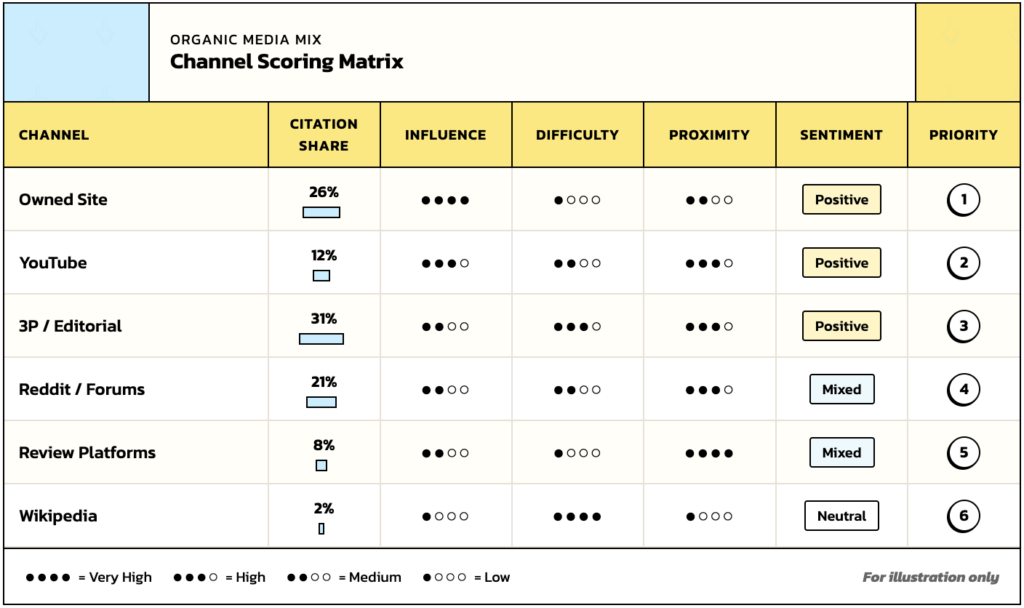
While raw citation volume indicates what is happening, it does not inherently dictate where investment should be directed. To establish a strategic investment rationale, each organic channel must be evaluated across four critical dimensions:
-
Degree of Influence: This dimension assesses the level of control a brand has over the content that appears on a particular surface. At one extreme lies the brand’s owned website, where content is created, published, and updated autonomously. At the other extreme is a platform like Wikipedia, where editorial control is largely external. Channels such as Reddit, review sites, and digital PR fall somewhere in between, requiring varying degrees of negotiation, outreach, and relationship management. While high-influence channels are not always the highest priority, all else being equal, they offer greater agility for implementing changes and achieving faster results.
-
Difficulty of Implementation: This metric evaluates the resources and complexity involved in executing strategies on a given channel. Some channels may necessitate only a single team and a straightforward content calendar. Others, however, can demand significant developer resources, intricate agency relationships, lengthy legal review processes, or extensive editorial cycles. Scoring the difficulty of implementation is crucial for realistically sequencing the execution roadmap and managing internal expectations.
-
Prompt Commercial Proximity: Not all citations carry equal strategic weight. A citation generated from a general query like "what is protein powder?" holds significantly less commercial value than one derived from a more specific and purchase-intent-driven prompt such as "what’s the best high-protein supplement for endurance athletes over 40?" The closer a query is to a potential buying decision, the more valuable the resulting citation becomes. Scoring the brand’s relevant prompt set and weighting citations from high purchase proximity prompts more heavily in the analysis is therefore essential.
-
Sentiment: A mere mention is not inherently a success if it is negative. Favorable citations, particularly those originating from trusted third-party sources, carry substantially more weight than neutral or critical mentions. Each citation source should be scored based on the sentiment it consistently delivers, and this factor must be integrated into investment decisions. A forum thread that unfavorably cites a brand within a highly visible context represents an active liability, not a neutral data point, and requires strategic consideration.
Step 3: Constructing the Organic Media Mix
With the citation report thoroughly analyzed and the channel scores in hand, the Organic Media Mix can now be effectively constructed. Consider a hypothetical scenario for a consumer health brand. Prior to conducting a detailed citation analysis, the marketing team operated under the assumption that their owned content was the primary driver of visibility and had allocated resources accordingly. The data, however, revealed a dramatically different picture.
Anonymized Example: Consumer Health Brand (Illustrative)
- Initial Assumption: Significant investment in owned website content, with minimal structured effort in third-party editorial or community platforms.
- Citation Report Finding: Third-party editorial content emerged as the single largest driver of AI citations within the category. This content also demonstrated high commercial proximity and consistently positive sentiment.
- Strategic Shift: The brand had historically approached digital PR primarily as a brand awareness initiative, not as a critical component of AI visibility. The OMM reframed this perspective, revealing a significant untapped opportunity. This recalibration led to a substantial reallocation of budget towards strengthening digital PR efforts, directly influencing where AI models sourced information about the brand. The OMM illuminated that while the brand had been focusing on building its own house, the most impactful recognition was coming from trusted external sources, and there was a clear opportunity to amplify this.
This example illustrates how the OMM can uncover critical insights that challenge pre-existing assumptions and unlock strategic budget reallocations by focusing on the actual drivers of AI perception.
Step 4: Assigning Resources, Teams, and Ownership
The strategic value of the OMM is only realized when it actively drives concrete decisions. Specifically, it must provide clear answers to three fundamental questions:
-
Who does what? Achieving effective AI visibility is not an SEO-only discipline; it is a comprehensive marketing team sport. Executing an OMM necessitates the involvement of various specialists. SEO practitioners are vital for optimizing owned content and technical infrastructure. PR and communications teams are essential for securing digital PR and editorial coverage. Social media teams play a key role in organic social engagement and community building. Depending on the brand and its strategy, influencer or affiliate marketing leads might also be crucial for driving video content and third-party advocacy. The OMM serves as the central document that compels cross-functional teams to engage in a dialogue about ownership and responsibilities.
-
What is the budget? While the OMM focuses on organic efforts, it’s imperative to recognize that organic marketing is not without cost. Content production, outreach initiatives, PR agency retainers, community management tools, and influencer partnerships all incur expenses. Moreover, the invaluable time and focused attention of the marketing team represent a significant investment. The OMM makes these costs explicit and directly links them to expected citation outcomes, mirroring the way a paid media plan ties expenditures to impression and conversion targets. This financial transparency is crucial for justifying organic investments to stakeholders.
-
What is the sequencing? It is rarely feasible to execute all strategic initiatives simultaneously. The OMM, leveraging the difficulty scores and citation gap analysis, facilitates the creation of a prioritized roadmap. This involves addressing high-priority, low-difficulty items first, while concurrently planning for long-lead infrastructure investments. This phased approach ensures efficient resource utilization and maximizes the impact of early wins.
Bridging the Gap Between Organic and Paid Media
One of the most underutilized applications of the OMM is its capacity to connect organic intelligence with paid media investment decisions. For instance, if a brand’s citation report highlights a Reddit thread that is heavily referenced by AI and consistently features positive brand mentions, this represents more than just an organic signal. It signifies a tangible paid media opportunity. The question then becomes: can the paid social team strategically place targeted advertisements within that specific thread or adjacent communities to amplify the existing positive content?
The reverse logic also holds true. If a paid media campaign successfully generates awareness around a particular use case, the organic marketing team should proactively develop citation coverage for the same queries. This ensures that the brand appears across multiple trusted sources, rather than being confined solely to its own website. This type of cross-functional collaboration, where insights from one channel inform strategies in another, is often invisible without a unified data framework. Historically, paid and organic marketing efforts have operated in silos. The OMM provides a shared language and a common data foundation that makes bridging these disciplines practical and effective.
The Missing Document for Modern CMOs
In the current marketing landscape, many AI visibility strategies are still being driven by assertions that lack empirical grounding—relying on what worked in traditional SEO or on subjective "vibes." The Organic Media Mix directly addresses this deficiency. It initiates with hard data, specifically a brand’s citation report analyzed across the most relevant AI models. It then systematically weights various channels against criteria that demonstrably drive real-world outcomes, including influence, implementation difficulty, commercial proximity, and sentiment. The culmination is a structured framework for allocating resources, assigning ownership, and prioritizing strategic initiatives.
Crucially, a brand’s OMM will be unique, reflecting its specific market dynamics, channel mix, AI model variations, and sentiment landscape. This inherent specificity is the core advantage. Generic organic strategies often contribute to a brand’s invisibility in AI-mediated search. Conversely, a data-driven, tailored approach is what unlocks competitive advantage.
If a Chief Marketing Officer (CMO) can present a board with a comprehensive media plan detailing the deployment of every paid dollar, they should equally be able to present an OMM that clearly articulates the strategic allocation of every organic resource. This level of transparency and strategic foresight is no longer a luxury but a necessity in the evolving digital ecosystem.
Brainlabs specializes in developing bespoke Organic Media Mix strategies for brands navigating the complexities of AI visibility. If you seek to gain a profound understanding of where your category citations originate and where your strategic investments should be focused, we encourage you to connect with us.