The digital landscape is undergoing a profound transformation, driven primarily by advancements in Artificial Intelligence. This shift was the central theme of Yoast’s May 2026 SEO Update, where industry experts Carolyn Shelby and Alex Moss delved into Google’s latest AI-driven changes, the pervasive impact of AI on content creation, and the critical understanding that simply publishing more content is not only insufficient but potentially detrimental. Their discussion highlighted a seismic shift from traditional search engine optimization to a new paradigm centered on AI-driven discovery and interaction, underscoring the urgent need for publishers and businesses to adapt their strategies.
Google’s Preferred Sources Initiative: Empowering User Choice and Publisher Stability
One of the significant developments discussed was Google’s release of a new guide on preferred sources in Google Search for web publishers. This initiative empowers users to explicitly signal their preference for specific news outlets or content creators, a move with substantial implications for the publishing industry. In an increasingly fragmented media environment, where trust and loyalty are paramount, this feature offers a direct mechanism for users to curate their information feeds, thereby boosting visibility for their chosen sources.
The rationale behind this initiative appears multifaceted. From Google’s perspective, it aligns with a broader strategy to enhance user experience by providing more personalized and trusted results, potentially combating the spread of misinformation by elevating user-verified sources. For publishers, particularly those heavily reliant on programmatic ad revenue derived from search traffic, this feature presents a crucial opportunity to stabilize and potentially increase impressions from loyal readers. Industry data from Q1 2026 indicated a continued decline in referral traffic from general search for many news outlets, making direct audience engagement and preference signals more valuable than ever.
The implications are clear: publishers must actively encourage their loyal readership to utilize this feature. This means not only producing high-quality, authoritative content but also engaging directly with their audience to foster brand loyalty and prompt the explicit signaling of preferences. For businesses, understanding the dynamics of preferred sources extends beyond news; it suggests a future where brand affinity could translate into direct visibility within AI-driven search environments, making brand building and community engagement vital SEO components.
Universal Checkout Protocol (UCP) Expands for AI Agents: The Future of Seamless E-commerce
Google’s push for the Universal Checkout Protocol (UCP) as an open standard represents a monumental leap in AI-driven commerce. UCP is designed to allow AI agents to complete purchases on behalf of users, effectively streamlining the transaction process and integrating it directly into AI interactions. Shopify’s early integration of UCP is a testament to its potential, enabling seamless transactions directly from search results or AI assistant interactions without requiring users to navigate to a merchant’s website.
This development is deeply rooted in Google’s vision for ambient computing and an “AI-first” world, where technology seamlessly assists users in their daily lives. As AI assistants become more sophisticated, their ability to perform complex tasks, including e-commerce transactions, becomes a key differentiator. Market projections for AI-driven commerce indicate a rapid expansion, with voice commerce alone expected to exceed $50 billion by 2027. UCP addresses a critical bottleneck by providing a standardized, secure method for these AI agents to interact with merchant systems.
For e-commerce sites, the “why it matters” is existential. Failure to integrate with UCP could result in a significant loss of conversions as users increasingly rely on AI agents for purchasing decisions. The traditional e-commerce funnel, which relies on website visits and manual navigation, is being disrupted. Businesses need to prioritize UCP compatibility, which involves not only technical integration but also a re-evaluation of how product information, pricing, and checkout flows are presented and optimized for AI agents. This necessitates a shift in focus from website conversion rate optimization to “AI agent conversion optimization,” ensuring that product data is structured, transparent, and easily digestible by autonomous systems.
Search Indexing vs. Grounding Indexing: A Critical Distinction for Content Visibility
Bing’s recent clarification on the distinction between traditional search indexing (for human users) and grounding indexing (for AI agents) illuminates a crucial technical nuance with significant SEO implications. Traditional search indexing, which involves crawlers processing content, including JavaScript-rendered elements and hidden text, aims to present comprehensive results to human users. Grounding indexing, however, operates differently. It occurs at “inference time,” meaning AI models scrape and process visible text directly from web pages to inform their responses, often without fully executing JavaScript or interacting with hidden elements like accordions or tabs.
This distinction is vital because it implies that content strategically hidden for user experience (e.g., in expandable sections, carousels, or behind clicks) may be fully indexed by traditional search engines but remain largely invisible to AI agents. A recent study by SEO researchers in Q4 2025 demonstrated that a significant percentage of AI-generated summaries and responses failed to incorporate information located in collapsed sections, even when that content was indexed by Google and Bing.
The actionable takeaway is a fundamental re-evaluation of content architecture. While user experience remains paramount, content creators must ensure that critical information intended for AI consumption is immediately visible on the page. This means prioritizing core answers, key data, and authoritative statements within the main body of the content. For websites that heavily utilize dynamic content and interactive elements, a careful audit is necessary to determine what information might be “lost” in the AI grounding process. Optimizing for grounding indexing requires a shift towards directness and clarity, ensuring that the most valuable content is readily available for AI models to scrape and synthesize.
Google Drops FAQ Rich Results (Again): A Shifting Landscape for Structured Data

Google’s decision to cease supporting FAQ rich results in search, with limited exceptions for specific sites like medical or government pages, marks another iteration in its evolving approach to SERP features. This isn’t the first time Google has adjusted its stance on rich results, having previously refined or removed various snippets to improve user experience and reduce clutter on the search results page. The perceived overuse and sometimes abuse of FAQ schema, leading to repetitive and unhelpful snippets, likely contributed to this change.
While FAQ rich snippets offered a direct pathway to enhanced visibility on the SERP, their deprecation doesn’t render FAQ schema entirely useless. Industry experts suggest that structured data, including FAQ schema, may still play a crucial role in “grounding” AI responses or informing future search features that rely on a deeper understanding of content structure. Data from early 2026 showed a significant drop in FAQ rich result appearances across general search queries immediately following Google’s announcement, prompting many websites to adjust their content strategies.
For businesses that heavily relied on FAQ rich snippets for visibility, the strategy must adapt. Instead of focusing on direct SERP visibility for FAQs, content creators should now leverage structured data to enhance the overall understanding of their content by AI models. This means ensuring that FAQs are well-written, genuinely answer user questions, and are integrated logically within content. The emphasis shifts from “getting a rich snippet” to “providing clear, structured information that AI can easily process and use.” This might involve repurposing FAQ content into dedicated sections within articles, or utilizing other forms of structured data that remain supported and valuable.
The Decline of the “Ultimate Guide” and Commodity Content: A Call for Authenticity
Rand Fishkin’s recent research, highlighting the dwindling effectiveness of long-form “ultimate guides” and low-value listicles, underscores a critical paradigm shift in content marketing. For years, the conventional wisdom in SEO dictated that longer content, covering a topic exhaustively, would rank higher. However, as AI models become adept at synthesizing answers directly, the need for users to wade through verbose, generic content diminishes. Google and AI systems are increasingly favoring authoritative, structured, and differentiated content that offers unique insights and genuine expertise.
The era of “commodity content” – easily replicable, often AI-generated without human oversight, and lacking a distinct voice – is rapidly fading. Google’s quality guidelines, particularly its emphasis on E-E-A-T (Experience, Expertise, Authoritativeness, Trustworthiness), are more critical than ever. Data from content performance analyses in late 2025 indicated a clear decline in engagement and ranking potential for overly generalized, keyword-stuffed “ultimate guides” compared to niche, expert-driven content.
The actionable takeaway is a fundamental re-evaluation of content strategy. Publishing generic, high-volume content is no longer a viable SEO strategy; it can even backfire by signaling low quality to Google’s algorithms. Instead, businesses must invest in creating truly unique, authoritative content that showcases genuine expertise. This means focusing on original research, unique perspectives, case studies, and content informed by real-world experience. The goal is to produce content that AI models cannot simply synthesize but must instead reference due to its inherent value and distinct contribution to a topic.
Gemini Intelligence Expands on Android: The AI-First Mobile Experience
Google’s deep integration of Gemini Intelligence into the Android ecosystem represents a significant leap towards an AI-first mobile experience. This expansion enables proactive AI features, such as booking appointments, making purchases, and responding to complex queries directly from search results or device interfaces. This profound shift moves users away from traditional websites, allowing them to complete tasks within Google’s AI environment, thereby impacting website traffic and traditional ad revenue models.
This move is a natural progression from Google Assistant and reflects Google’s strategic vision for ambient computing, where AI anticipates user needs and facilitates actions seamlessly. Projections suggest that by 2028, a substantial portion of mobile interactions will be mediated by AI agents like Gemini, further reducing direct website visits for many informational and transactional queries. The “zero-click search” phenomenon, where users find answers directly on the SERP without clicking through, is now evolving into “zero-website interaction,” where tasks are completed entirely within the AI ecosystem.
For publishers and businesses, the “why it matters” is paramount. They must adapt to AI-driven discovery rather than relying solely on website visits. This necessitates optimizing content and data to be easily consumable and actionable by Gemini and other AI agents. Businesses need to ensure their services are discoverable and actionable within the Gemini interface, which could involve integrating with Google Business Profile, optimizing for structured data that feeds into AI knowledge graphs, and exploring new API-driven service models. The focus shifts from driving traffic to a website to ensuring a presence within the AI user journey.
Google’s AI Optimization Guide: Navigating Ethical and Effective AI Content Creation
Google’s release of a comprehensive guide on optimizing for generative AI features provides critical insights into its expectations for AI-assisted content. The guide explicitly advises against practices such as automatically generating large volumes of content without human review, creating content primarily for SEO manipulation, and producing low-quality, repetitive, or unoriginal AI-generated text. This directive aligns with Google’s longstanding commitment to quality and its ongoing efforts to combat spam, which has intensified with the proliferation of generative AI tools.
The “why it matters” is twofold. First, it clarifies Google’s stance on AI-generated content, pushing creators towards responsible and ethical use. Content generated purely for SEO without human input is at high risk of penalization. Second, it highlights a crucial distinction: while Google aims to reduce spam and inefficiency in its own AI-driven search results, other AI models, such as Perplexity AI and Claude, may still benefit from structured data and comprehensive, well-organized content, even if it’s AI-assisted.
The actionable takeaway is a nuanced approach to AI in content creation. Businesses should embrace AI as a powerful tool for research, outlining, and drafting, but human oversight, editing, and value addition remain indispensable. This means using AI to generate ideas, structure content, and refine language, but ensuring that the final output reflects genuine expertise, a unique voice, and provides substantial value to the reader. Avoiding the pitfalls outlined by Google requires a commitment to quality over quantity, with AI serving as an assistant to human creativity and insight, not a replacement.
Conde Nast’s Strategic Shift: A Bellwether for Publishers
Conde Nast, the venerable publisher of iconic brands like Vogue and The New Yorker, has reportedly advised stakeholders to “plan as if programmatic ad revenue from search traffic will decline to zero.” This stark declaration, coming from a major player in the publishing world, serves as a powerful indicator of the broader industry’s anxieties and strategic recalibrations in the face of AI-driven search. It reflects a growing recognition that traditional revenue streams tied to page views from organic search are increasingly vulnerable.
This statement is not an isolated incident but part of a wider trend. For years, publishers have grappled with the dominance of platform companies like Google and Facebook, which mediate access to audiences and capture a significant share of digital advertising revenue. The rise of AI, which promises to answer queries directly without sending users to external websites, only exacerbates this challenge. Data from various media groups in Q1 2026 showed continued pressure on programmatic ad yields, prompting a renewed focus on direct-to-consumer models.
The implications are profound for the entire publishing industry. Publishers must aggressively diversify their revenue streams beyond programmatic ads. This includes accelerating investment in subscription models, membership programs, direct advertising sales, branded content partnerships, e-commerce ventures, and live events. The focus must shift from maximizing page views to cultivating deep, direct relationships with audiences who are willing to pay for premium, exclusive, or highly differentiated content. It is a strategic pivot towards building a loyal community that values the brand irrespective of how they discover its content.
Google I/O 2026: AI Agents, Personalization, and Unified Commerce Define the Future
Google I/O 2026 served as a comprehensive unveiling of Google’s AI-first future, cementing the trends and predictions discussed throughout the Yoast update. Key takeaways from Sundar Pichai’s keynote highlighted:
- AI Agents Everywhere: The vision of highly capable, personalized AI agents that proactively assist users across all digital touchpoints, from managing schedules to making purchases. Project Astra, Google’s multimodal AI assistant, was a central feature, demonstrating its ability to understand and interact with the world through various senses.
- Deep Personalization: AI-driven experiences tailored precisely to individual user preferences, habits, and contexts, moving beyond generic search results to hyper-relevant suggestions and actions.
- Unified Commerce: The seamless integration of purchasing capabilities directly within AI interfaces and across various Google platforms, epitomized by the UCP.
- Multimodal AI: The ability of AI to understand and generate content across text, image, audio, and video, leading to richer, more intuitive user interactions.
- “Search Generative Experience” (SGE) Evolution: Further enhancements to SGE, integrating more advanced generative AI capabilities directly into search results, providing summarized answers and conversational interactions.
These announcements collectively paint a picture of Google evolving from primarily a search engine to a comprehensive AI-driven ecosystem. This transformation fundamentally alters how users discover information, interact with services, and make purchasing decisions. The “why it matters” is that every business and content creator must now strategically consider their presence and engagement within this AI-first paradigm.
The actionable takeaway is to adopt a forward-looking strategy that anticipates these changes. Businesses should invest in AI-compatible infrastructure, ensure their data is structured and accessible for AI agents, and explore new models of user engagement that thrive within AI interfaces rather than solely relying on website traffic. This means rethinking branding, customer service, marketing, and sales from an AI-centric perspective, preparing for a world where AI agents are often the first point of contact for users seeking information or services.
Yoast News: The AI Content Planner — A Tool for the New Era
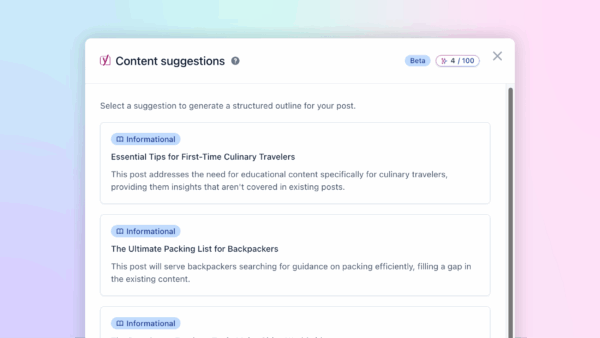
Amidst these sweeping industry changes, Yoast announced the launch of its AI Content Planner, a timely tool designed to help users navigate the complexities of AI-driven content creation. Recognizing the challenges of writer’s block and the heightened demand for structured, high-quality content, the AI Content Planner aims to transform a blank page into a structured draft in seconds. It offers intelligent topic suggestions, outline generation, and SEO optimization tips, directly addressing the need for efficiency and quality in the new content landscape.
The tool’s significance lies in its ability to empower content creators to meet the evolving demands of Google and other AI models. By providing a structured starting point, it helps users overcome the initial hurdles of content creation, ensuring that the output is organized, readable, and optimized for both human consumption and AI grounding. This aligns perfectly with the insights from the SEO update, particularly the decline of commodity content and the need for authoritative, well-structured information. It acts as an assistant, enabling users to focus on adding unique insights and expertise rather than spending excessive time on basic structuring.
The Yoast AI Content Planner is available to Yoast Premium users, integrating seamlessly into the WordPress editor. It represents Yoast’s commitment to providing practical solutions that help its users adapt and thrive in an increasingly AI-dominated digital environment. By facilitating the creation of high-quality, AI-friendly content, Yoast continues to play a pivotal role in guiding the SEO community through this transformative period.
The May 2026 SEO Update by Yoast underscored a critical juncture in the digital world. The confluence of Google’s AI-driven changes, the expansion of AI agents, and the evolving nature of content consumption demands a proactive and adaptive approach from anyone involved in online publishing, e-commerce, or digital marketing. The future of search and content is undeniably AI-first, requiring a strategic pivot towards quality, authenticity, and seamless integration within AI ecosystems.
Sign up for the next SEO Update by Yoast
For those looking to stay ahead of these rapid developments, the next SEO Update by Yoast is scheduled for June 30, 2026, at 4:00 PM CET (10:00 AM EST). Further insights and practical guidance on navigating the AI-driven landscape will be provided. Interested parties can sign up to join live and continue their education on these vital topics.