

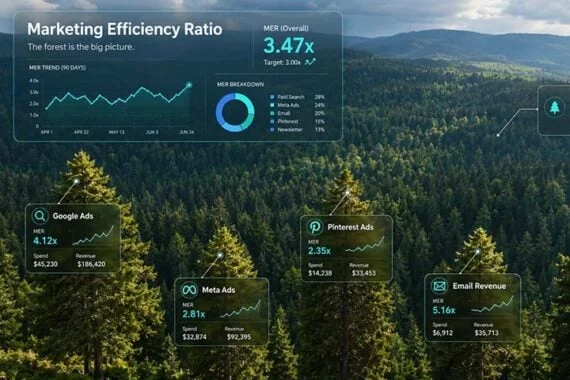
The landscape of ecommerce advertising is fraught with complexity, a reality that persists despite the proliferation of advanced AI-driven tracking techniques and a plethora of specialized tools. While individual platforms offer granular insights—Google Ads reporting Return on Ad Spend (ROAS), Meta tracking conversion value and cost per result, email platforms measuring revenue per send, and affiliate services detailing commissions and conversions—these metrics often represent isolated “trees” within a much larger “forest” of overall marketing performance. This fragmentation poses a significant challenge for ecommerce businesses striving to understand the holistic effectiveness of their promotional investments and achieve overarching revenue and growth objectives.
The inherent challenge lies in the disconnect between micro-level campaign performance and macro-level business goals. While it is undoubtedly crucial to monitor the ROAS of specific campaigns, this focus can obscure the larger picture of marketing’s contribution to the business’s bottom line. To bridge this gap, the Marketing Efficiency Ratio (MER) emerges as a powerful, yet often overlooked, indicator that provides a comprehensive view of marketing success. MER, in essence, offers a simplified yet profound way for ecommerce merchants to see the forest, rather than getting lost among the trees.
Understanding the Marketing Efficiency Ratio (MER)
At its core, the Marketing Efficiency Ratio is a straightforward metric designed to compare a business’s total revenue directly against its total marketing expenditure. It is not intended to supplant channel-specific performance indicators like ROAS, Customer Acquisition Cost (CAC), or Lifetime Value (LTV). Instead, MER serves as a complementary tool, offering marketers a valuable, high-level perspective on the overall impact of their marketing efforts on the entire business.
The calculation for MER is remarkably simple:
MER = Total Revenue / Total Marketing Spend
To illustrate, consider an ecommerce company that generated $500,000 in sales during a particular month and invested $100,000 in marketing activities. This $100,000 would encompass a broad spectrum of costs, including advertising spend across various platforms, agency fees, influencer collaborations, content creation, and affiliate commissions. Applying the MER formula, the company’s MER for that month would be:
$500,000 / $100,000 = 5
This result signifies that for every dollar invested in marketing, the company generated five dollars in revenue. This metric is often referred to by some marketers as “blended ROAS” because it consolidates all marketing expenditures and all revenue streams, providing a unified view that transcends the limitations of single-campaign or single-channel performance analyses.
MER Versus ROAS: Distinguishing Their Roles
While both MER and ROAS are critical performance indicators in the ecommerce realm, they answer fundamentally different questions and serve distinct strategic purposes.
Return on Ad Spend (ROAS) typically focuses on the performance of a specific campaign, advertising channel, or a particular marketing tactic. For instance, a Google Shopping campaign might report a ROAS of 4.2, indicating that for every dollar spent on that specific campaign, $4.20 in revenue was generated. ROAS is invaluable for tactical decision-making. A marketer might use ROAS data to decide whether to pause an underperforming campaign, adjust creative assets to improve engagement, or optimize bidding strategies for a particular ad set. It provides the detail necessary for granular campaign management.
Marketing Efficiency Ratio (MER), on the other hand, evaluates the performance of the entire marketing engine. It assesses whether the collective investment in marketing activities is generating adequate revenue for the business. While ROAS might inform decisions about individual campaign adjustments, MER helps a marketer understand the broader strategic question: Is the company’s overall marketing spend a worthwhile investment that contributes positively to profitability and growth? MER provides the strategic overview needed for resource allocation and overall marketing strategy validation.

The Crucial Inputs for Accurate MER Calculation
The utility and accuracy of the MER metric are directly dependent on the quality and completeness of its input data. A common pitfall is the omission of certain costs, which can artificially inflate the MER and present a misleadingly positive picture of marketing efficiency. To ensure an accurate and reliable MER, it is imperative to include all relevant marketing expenditures. This comprehensive approach typically encompasses:
- Direct Advertising Spend: This includes budgets allocated to platforms such as Google Ads, Meta Ads (Facebook/Instagram), TikTok Ads, LinkedIn Ads, and any other paid media channels.
- Agency and Consultant Fees: Any payments made to marketing agencies, freelancers, or consultants for strategy, execution, or management of campaigns.
- Affiliate Commissions: Payouts to affiliate partners for driving sales or leads.
- Influencer Marketing Costs: Payments to influencers, product seeding, and associated platform fees.
- Content Creation Expenses: Costs related to producing marketing content, such as blog posts, videos, social media graphics, and email newsletters.
- Marketing Technology Subscriptions: Fees for marketing automation platforms, CRM systems, analytics tools, email marketing software, and other MarTech stack components.
- Software and Tool Subscriptions: Costs associated with SEO tools, social media management platforms, and other analytical or operational software used by the marketing team.
- Employee Salaries and Benefits (Pro-rated): A portion of the salaries and benefits of marketing team members, especially if their roles are directly attributable to revenue-generating activities. This can be a more complex input to calculate but offers the most holistic view.
- Email Marketing Platform Costs: Expenses related to sending out email campaigns and managing subscriber lists.
- Public Relations and Outreach Costs: Expenditures on PR efforts, press releases, and media outreach designed to generate brand awareness and drive traffic.
- Promotional Costs: Expenses related to running sales, discounts, and other promotional offers that, while driving revenue, also represent a cost to the business.
Consistency is paramount. Once a decision is made on what to include in the marketing spend for a given period, that same methodology must be applied consistently across subsequent periods. For instance, if agency fees were included in the January marketing budget, they must also be factored into the February and March calculations to maintain comparability and enable accurate trend analysis. Inconsistent inclusion of costs can lead to fluctuating MER figures that do not reflect genuine changes in marketing efficiency.
MER’s Role in Strategic Budgeting
The true power of MER lies in its ability to provide clarity in the often non-linear world of ecommerce marketing. A single customer’s journey is rarely a straight line; it frequently involves multiple touchpoints across various channels. A shopper might first encounter a brand through a Meta ad on a Monday, receive a follow-up email on Wednesday, conduct a brand search on Friday, and finally make a purchase on Saturday. Each platform involved in this journey will attempt to claim credit for the conversion, leading to conflicting data and attribution debates.
While sophisticated multi-touch attribution models aim to allocate credit more equitably across these touchpoints, MER offers a pragmatic solution by effectively sidestepping the attribution argument altogether. It does not attempt to assign specific credit to a single channel or touchpoint. Instead, it focuses on the overall return generated by the aggregate marketing investment.
This blended perspective proves invaluable for budgeting decisions. If a company consistently operates profitably when its MER is 4.0, experiences significant challenges and reduced profitability at an MER of 3.0, and begins to lose money below an MER of 2.5, these figures become useful guardrails for marketing expenditure. Marketers can use these MER benchmarks to set spending limits and evaluate the financial viability of their promotional activities.
Furthermore, MER can help shift the organizational focus from vanity metrics like clicks, impressions, and platform-specific engagement rates to more impactful business outcomes such as revenue and profit. This strategic reorientation ensures that marketing efforts are aligned with the ultimate financial goals of the business.
The “Big Picture” and Strategic Implications of MER
It is crucial to acknowledge that there is no universally accepted “ideal” MER. The optimal MER varies significantly from one business to another, depending on several factors, most notably the company’s gross profit margin. For example, an ecommerce shop with a high gross margin of 70% can likely tolerate and sustain a lower MER compared to a business with a leaner 25% gross margin. The former can afford to spend a larger proportion of its revenue on marketing and still remain profitable, while the latter must be much more judicious with its marketing investments.
Conversely, a persistently high MER might signal an opportunity that is being missed. It could indicate that the company is potentially underinvesting in marketing and foregoing opportunities for accelerated growth. If a business is consistently achieving a MER of 10, it might be leaving significant revenue on the table by not scaling its successful marketing initiatives more aggressively.
Conversely, a low MER, particularly one that falls below the breakeven point determined by the company’s profit margins, could be a clear indicator of wasted marketing spend and a need for immediate strategic adjustments. It signals that the current marketing activities are not yielding sufficient returns to cover their costs and contribute to profitability.
In conclusion, MER stands out as a key metric because of its simplicity and ease of comprehension. It serves as a powerful complement to other vital financial and marketing performance indicators such as ROAS, CAC, margin analysis, and marketing mix modeling. Ultimately, MER provides marketers with the essential “big picture” view: it unequivocally answers whether a store’s overall marketing expenditure is effectively contributing to its financial success and strategic objectives. It is the ultimate arbiter of whether the entire marketing forest is healthy and productive, or if individual trees are consuming resources without yielding the desired fruit.
The adoption of MER by a growing number of ecommerce businesses reflects a maturing understanding of marketing’s strategic role. As the digital advertising ecosystem continues to evolve, with new platforms emerging and tracking methodologies becoming increasingly sophisticated yet simultaneously more fragmented, metrics like MER that offer a clear, overarching perspective will become indispensable for sustainable growth and profitability. It empowers businesses to move beyond the noise of individual campaign metrics and focus on the fundamental question of marketing’s economic contribution.








