

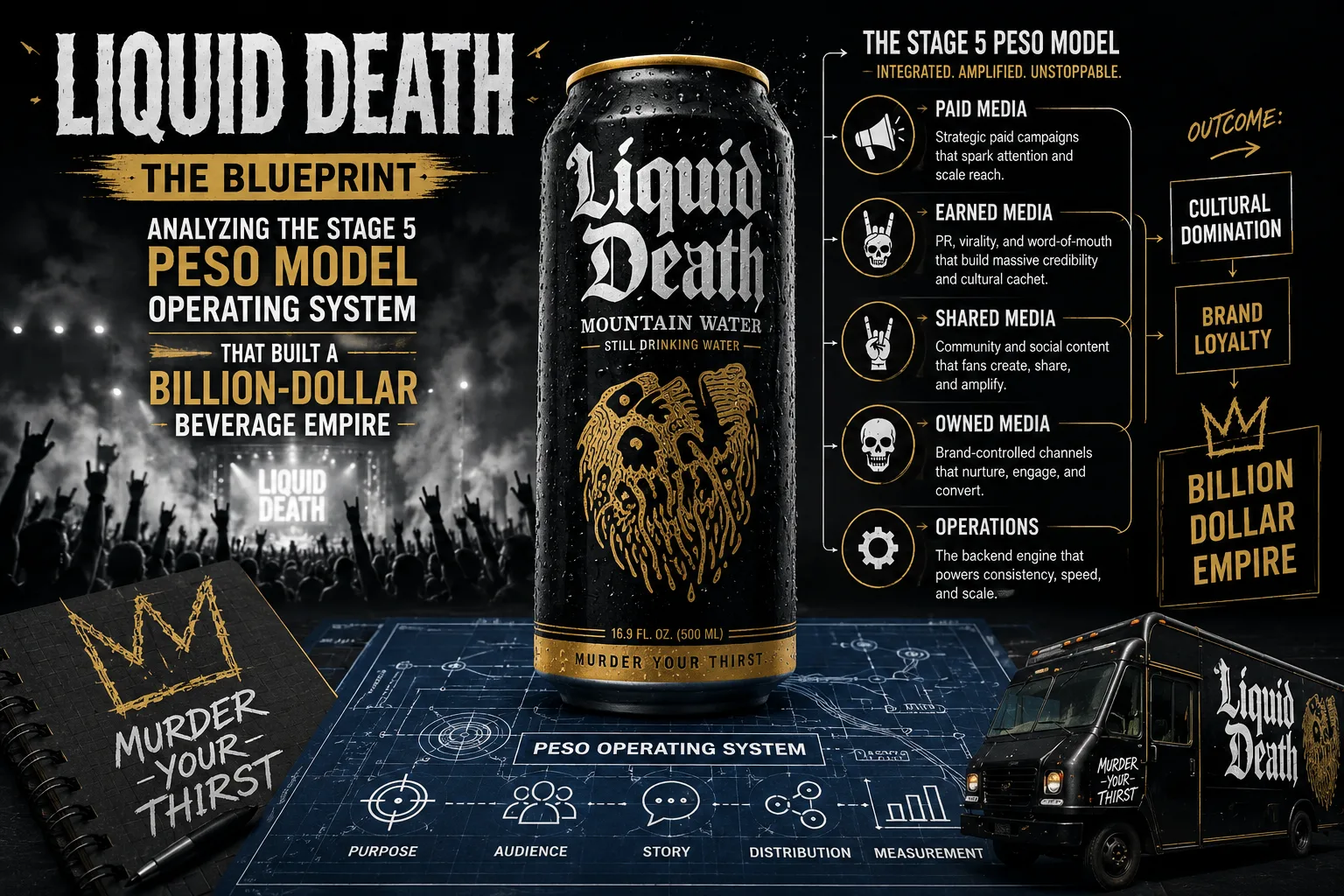
In March 2024, a company that sells water in tallboy aluminum cans closed a $67 million financing round, cementing a valuation of $1.4 billion. In an industry dominated by century-old conglomerates like Nestlé and Coca-Cola, Liquid Death achieved unicorn status in just five years. By 2023, the brand was reporting $263 million in retail sales, expanding into iced teas, sparkling waters, and electrolyte powders, and capturing the cultural zeitgeist with a ferocity previously reserved for energy drinks and sneaker drops.
To the casual observer, Liquid Death’s success looks like a series of lucky viral stunts. It looks like the triumph of an edgy aesthetic—heavy metal typography, skull graphics, and the tagline “Murder Your Thirst”—over the serene, blue-tinted marketing of Dasani or Evian.
But beneath the chaos, the punk-rock posturing, and the comedy-first marketing lies one of the most sophisticated communication architectures in modern business. Liquid Death is not just a masterclass in branding; it is a textbook execution of the Stage 5 PESO Model.
The PESO framework (Paid, Earned, Shared, Owned media) is a staple of public relations and marketing. However, 91% of marketing teams never evolve past the foundational stages. They run siloed channels with competing KPIs. Liquid Death operates at Stage 5: Leadership. At this maturity level, every channel feeds the others flawlessly, and the communication operating system itself becomes an impenetrable competitive moat.
Here is the blueprint of how Liquid Death weaponized the Stage 5 PESO Model to build a billion-dollar beverage empire out of the most commoditized product on Earth.
Decoding the Stage 5 PESO Model
Before dissecting Liquid Death’s playbook, it is essential to understand the framework they have mastered. The PESO Model categorizes a brand’s communication channels into four quadrants:
-
Paid Media: Sponsored content, social media advertising, and programmatic display. Reach you buy.
-
Earned Media: Press coverage, organic influencer mentions, and public relations. Credibility you earn.
-
Shared Media: Organic social media, community management, and user-generated content. Engagement you co-create.
-
Owned Media: The website, the packaging, the blog, and original video content. Destinations you control.
Most brands build this left-to-right, starting with heavy paid media to drive traffic. Stage 5 reverses this logic.
In a Stage 5 (Leadership) ecosystem, Owned media is the unshakeable foundation. Earned media is engineered to point directly to Owned assets. Shared media activates the community around both. Paid media is strictly reserved as an accelerant for content that has already proven its organic viability. Most importantly, at Stage 5, the integration is so tight that competitors cannot copy the strategy by simply hiring the same agency or spending the same budget. The system is the strategy.
Here is how Liquid Death engineered each quadrant to achieve Stage 5 maturity.
OWNED Media: Entertainment Over Advertising
In the Stage 5 PESO model, Owned media is not just a landing page or a corporate blog; it is a proprietary content engine that audiences actively seek out. Liquid Death’s founder, Mike Cessario, a former Netflix creative director, built the company on a simple, ruthless premise: Stop making marketing. Start making entertainment.
The Product as the Ultimate Owned Channel
Liquid Death’s most powerful Owned media asset is the physical can. Cessario noticed that while musicians on the Vans Warped Tour were sponsored by energy drink brands, they were secretly drinking water out of Monster cans to maintain their “cool” aesthetic. Water branding was soft; energy drink branding was aggressive.
By packaging Alpine spring water in 16.9 oz aluminum tallboys featuring melting skulls, Liquid Death created an Owned asset that doubled as a wearable statement piece. It allowed health-conscious consumers in bars, concerts, and parties to hold a beverage that looked like a craft IPA or a punk-rock energy drink.
The “Death to Plastic” Mission
A Stage 5 Owned strategy requires an underlying philosophy that transcends the product. Liquid Death’s mission is environmentalism, but stripped of the typical corporate softness. Instead of “Save the Earth,” their Owned messaging screams “Death to Plastic.” This gives their content an inherent, righteous edge. They aren’t just selling water; they are waging a violent war against plastic pollution.
The In-House Production Studio
Rather than relying on outside ad agencies to rent attention, Liquid Death operates like an in-house comedy network. Their Owned media channels (YouTube, their website) are filled with high-production-value sketches, short films, and mockumentaries.
When they launched their line of flavored sparkling waters (Severed Lime, Mango Chainsaw, Berry It Alive), they didn’t write a press release. They produced an infomercial parody featuring a fictional 1990s workout guru. Because their Owned content is genuinely hilarious and not a thinly disguised sales pitch, it becomes the gravitational center for the rest of the PESO model.
EARNED Media: The Engineered Spectacle
At the foundational levels of the PESO model, Earned media means sending press releases to journalists and hoping for a mention. At Stage 5, Earned media means engineering cultural spectacles that the press is absolutely forced to cover.
Liquid Death does not chase the news cycle; they manufacture it through calculated absurdity.
The “Kids Drinking Beer” Super Bowl Hack
For their first Super Bowl appearance, Liquid Death couldn’t afford a $7 million national ad spot. Instead, they bought regional ad placements for a fraction of the cost. The commercial featured heavily pregnant women and young children violently crushing tallboy cans and chugging the contents to a soundtrack of aggressive party music.
The visual cognitive dissonance—kids looking like they were binge-drinking beer—was perfectly engineered for outrage and virality. The punchline, of course, was that they were just staying hydrated with mountain water. The PR machine caught fire. News outlets, morning shows, and marketing trades covered the “controversial” ad for weeks. Liquid Death generated tens of millions of dollars in Earned media value from a minimal regional media buy.
Weaponizing Celebrity Partnerships
Typical beverage brands pay athletes to hold their product and smile. Liquid Death creates Earned media events by collaborating with celebrities who align with their chaotic energy:
| The Collaborator | The Stunt | The Earned Media Impact |
| Tony Hawk | Painted 100 skateboards using the legend’s actual drawn blood. | Global press coverage across sports, pop culture, and business media. Sold out in minutes. |
| Martha Stewart | Created a “Dismembered Moments” luxury candle shaped like a severed hand holding a can. | Bridged the gap between suburban lifestyle media and alternative punk culture. |
| Chace Crawford | Partnered with “The Deep” from The Boys to wage war on the “brainwashing of sugar.” | Hijacked the massive cultural conversation around Amazon’s biggest television show. |
| Steve-O | Created a supernatural voodoo doll of the Jackass star. | Reached the exact demographic of nostalgic millennials seeking alternative entertainment. |
Every one of these stunts is designed with the same architecture: Create a physical, absurd Owned asset (a blood skateboard), release a high-quality Owned video explaining it, and watch the Earned media pour in.
SHARED Media: Cultivating the “Country Club”
Shared media is the true test of a brand’s cultural resonance. If Owned media is what the brand says about itself, and Earned media is what the press says about the brand, Shared media is what the public says to each other.
At Stage 5, Shared media is highly systematized community management. Liquid Death has mastered the art of turning consumers into rabid advocates, and even more impressively, turning haters into fuel.
The “Sell Your Soul” Loyalty Program
Liquid Death doesn’t have a standard points-based loyalty program. To join the Liquid Death Country Club and get access to exclusive merchandise, customers must literally “sell their soul” to the company via a legally binding (but entirely satirical) contract on their website. Hundreds of thousands of people have signed it.
This creates a shared identity. Members don’t just buy water; they are part of an inside joke. This leads to massive organic sharing on social media, where fans post pictures of their cans at concerts, in the office, or at the gym.
Greatest Hates: Monetizing the Trolls
When a brand aggressively disrupts a category, it inevitably attracts detractors. Early on, Liquid Death received scathing comments from confused internet users: “This is the dumbest idea ever.” “I’d rather lick sweat off a fat guy’s back than drink this.”
A standard marketing team would delete the comments. A Stage 5 marketing team weaponizes them.
Liquid Death took their most vicious 1-star reviews and hate comments and turned them into a heavy metal album titled Greatest Hates, recording actual songs with lyrics composed entirely of internet vitriol. They released the album on Spotify and pressed it on vinyl.
They followed this up with the “Blind Taze Test.” Instead of traditional blind taste tests, they invited their online haters to a studio, hooked them up to a real taser, and challenged them to identify the “worst tasting water” (Liquid Death). If they guessed wrong, they got zapped.
By embracing their detractors, Liquid Death created a bulletproof Shared media ecosystem. You cannot troll Liquid Death, because they will simply screenshot your comment, set it to a death metal riff, and make money off it. This self-awareness makes their community fiercely loyal.
PAID Media: Pouring Gasoline on the Fire
The most common mistake brands make is relying on Paid media to carry a weak message. They spend millions forcing mediocre content in front of unengaged audiences.
In Liquid Death’s Stage 5 PESO Model, Paid media is the final step, not the first. It is used exclusively to amplify Owned, Earned, and Shared media that has already proven its ability to generate attention organically.
When Vice President of Marketing Andy Pearson noted that Liquid Death doesn’t “spend money on media to force people to watch,” he was highlighting this exact philosophy. They use Paid social ads to distribute their comedy sketches (Owned media), their viral stunts (Earned media), and their user-generated content (Shared media) to highly targeted lookalike audiences.
Because their content is inherently entertaining, their cost-per-click (CPC) and cost-per-impression (CPM) are significantly lower than industry averages. The algorithm rewards content that keeps users on the platform. By feeding the advertising algorithms high-retention comedy rather than boring product pitches, Liquid Death gets a massive discount on their Paid media spend.
The Stage 5 Integration: The Flywheel in Action
To see the Stage 5 PESO Model in its final, frictionless form, we only need to look at how Liquid Death approaches a standard product expansion—such as their entry into iced tea.
A traditional brand launching a new iced tea would follow a linear path:
-
Formulate the tea.
-
Design a label.
-
Pay an agency for a slogan.
-
Buy billboard and banner ads (Paid).
-
Send press releases to beverage trade magazines (Earned).
Here is how Liquid Death executed the launch using their integrated operating system:
1. The Owned Foundation:
They named the products “Grim Leafer,” “Armless Palmer,” and “Rest in Peach.” They designed the cans with their signature morbid artwork and formulated the tea with agave nectar to fit the “Death to Sugar” narrative.
2. The Shared Spark:
They seeded the new flavors to their “Country Club” members first, generating organic hype and a flood of user-generated content across Instagram and TikTok before the product even hit retail shelves.
3. The Earned Spectacle:
They didn’t release a PR statement; they released a hilarious mockumentary-style infomercial about how older people love tea, featuring aggressively hardcore grandmothers headbanging to thrash metal while drinking Grim Leafer. This forced culture, marketing, and business journalists to write about the launch.
4. The Paid Amplification:
Once the video began going viral organically and the press was writing about it, Liquid Death put their Paid media budget behind it. They targeted fans of heavy metal, extreme sports, and comedy on YouTube and Instagram, driving massive traffic to their e-commerce store and Amazon listings.
5. The Feedback Loop:
When the Arnold Palmer estate threatened legal action over the name “Armless Palmer,” Liquid Death didn’t retreat in silence. They leaned into it, publicly changing the name to “Dead Billionaire” and creating a whole new cycle of Earned, Shared, and Owned media out of the legal threat.
Every channel fed the other. The Owned video generated Earned press. The Earned press fueled Shared conversations. The Shared conversations provided the data for targeted Paid ads. The Paid ads drove millions in sales and captured new emails for the Owned database.
The Ultimate Competitive Moat
The beverage industry is littered with the corpses of brands that tried to out-spend the conglomerates. Liquid Death survived, and ultimately conquered, by refusing to play the traditional marketing game.
Their $1.4 billion valuation is not a reflection of the water inside the can. It is a reflection of the proprietary media empire they have built around it. They are an entertainment company that happens to monetize through hydration.
The Liquid Death blueprint proves that the Stage 5 PESO Model is not just a theoretical framework for PR professionals. When a brand integrates its Paid, Earned, Shared, and Owned media into a singular, relentless pursuit of audience entertainment, it stops being a marketing strategy. It becomes a cultural phenomenon. And in the modern attention economy, culture is the only currency that scales.









