The advent of answer engine optimization (AEO) audit tools marks a critical juncture for any organization seeking to maintain brand visibility and accuracy in the rapidly evolving digital ecosystem. While traditional SEO audits have historically focused on tracking search rankings and website crawl health, AEO tools extend this scrutiny to measure visibility across the burgeoning platforms where buyers now receive direct, AI-generated recommendations. This represents a new, indispensable measurement layer for SEO managers, content strategists, and growth marketers, many of whom are still adapting to this paradigm shift.
The Rise of Answer Engines: A New Digital Frontier
The digital landscape has undergone a profound transformation, spearheaded by the widespread adoption of generative AI models such such as OpenAI’s ChatGPT, Google’s Gemini, and Perplexity AI. These platforms have fundamentally altered how users seek and consume information. Instead of presenting a list of links for users to sift through, these answer engines provide direct, synthesized responses, often citing specific sources. This shift, which gained significant momentum in late 2022 and early 2023 with the public release of advanced AI chatbots, has created an entirely new dimension for digital marketing and brand management.
Historically, SEO professionals meticulously optimized websites for search engine algorithms, aiming for top organic rankings to drive traffic. The goal was to appear prominently in the "ten blue links." However, with answer engines, the objective shifts to ensuring a brand is not only cited but also accurately represented within these AI-generated summaries. Reports from leading analytics firms indicate a substantial increase in users leveraging AI for product research, recommendations, and problem-solving, underscoring the urgency for brands to adapt their strategies. Some industry estimates suggest that a significant percentage of future search queries will involve direct interaction with AI, rendering traditional link-based visibility less impactful for certain user intents. This contextual backdrop highlights why AEO is no longer a niche concern but a mainstream imperative.
Understanding the Imperative: Why AEO Audits are Crucial for 2026 and Beyond
For brands to thrive in this new environment, they must actively monitor their presence within answer engines. Buyers increasingly turn to AI for direct recommendations on products, services, and information, making inclusion in these citations paramount. AEO audit tools are designed precisely to measure this answer engine visibility, ensuring that brands appear accurately and for the most relevant queries.
Beyond initial visibility, the dynamic nature of AI models necessitates continuous auditing. AI algorithms are constantly retraining on new data, and competitors are ceaselessly publishing fresh content. A brand prominently featured in a Perplexity citation today could easily disappear next month if a more authoritative or better-optimized source emerges. Therefore, effective AEO audit tools treat visibility tracking as an ongoing, iterative process rather than a static snapshot. This continuous monitoring is crucial for maintaining competitive advantage and safeguarding brand reputation in a volatile digital space. Without it, brands risk losing control over their narrative as AI models independently synthesize information from the web.
Navigating the AEO Audit Process: A Step-by-Step Guide
Successfully auditing Answer Engine Optimization involves a structured approach, moving from initial assessment to ongoing monitoring and reporting.
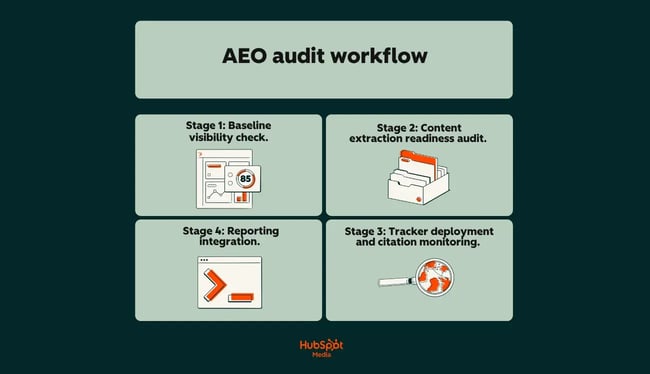
Step 1: Baseline Visibility Check
Before investing in specialized AEO software, a foundational diagnostic is essential. Tools like HubSpot’s AI Search Grader offer a free baseline assessment of answer engine visibility. This initial check allows teams to pinpoint exactly where their brand is currently cited (or absent) across key platforms such as ChatGPT, Perplexity, and Gemini, providing crucial data before committing resources to dedicated tools. This step helps in understanding the current state and identifying immediate gaps.
Step 2: Content Extraction Readiness Audit
Even with baseline visibility, content must be structured in a way that AI models can easily parse and extract information. Answer engines excel at identifying and summarizing distinct "chunks" or paragraphs of relevant information. Content marketers must proactively reformat their existing material. This includes:
- Answer-first introductions: Beginning articles with a direct answer to the primary query.
- Q&A blocks: Dedicated sections that explicitly pose and answer common questions.
- Comparison tables: Structured data that AI can easily interpret for comparative responses.
An audit of the top 50 to 100 pages against these structural criteria is vital to ensure content is "AI-extraction-ready."
Step 3: Tracker Deployment and Citation Monitoring
Once a baseline is established and content is optimized for extraction, the next phase involves deploying dedicated AEO trackers. These tools are invaluable for continuous monitoring, mapping which specific queries trigger brand citations, assessing the accuracy of those citations, and identifying emerging visibility gaps. They move beyond manual spot-checks to provide systematic data on brand presence.
Step 4: Reporting Integration
The final step integrates AEO citation data into existing marketing dashboards. AEO success extends beyond mere visibility; it encompasses citation share, brand accuracy, customer sentiment, and overall share of voice. Connecting AEO performance with traditional SEO gains and other key marketing metrics, such as lead generation or conversion rates, allows marketing teams to demonstrate the tangible impact of their AEO efforts to stakeholders. This holistic view is crucial for justifying investment and demonstrating ROI.
Tailoring Your AEO Strategy: Tools for Every Enterprise Size
The specific requirements for AEO auditing vary significantly based on company size, team maturity, and available budget. A bespoke approach ensures that the chosen tools and strategies align with organizational capabilities and objectives.
Startup and SMB Stack: Validating Initial Presence
For startups and small to medium-sized businesses (SMBs), the initial focus is often on answering the fundamental question: "Does AI search even acknowledge our brand?" Manual spot-checks and free tools are often sufficient at this stage to validate basic AI visibility.
- Recommended Stack: Manual queries on ChatGPT, Perplexity, Gemini, combined with free tools like HubSpot’s AI Search Grader.
- Best for: Teams of one to five marketers needing to confirm AI visibility before allocating significant budget.
- Advantages: Zero cost, provides immediate answers to crucial early questions. If initial audits reveal zero brand presence, the immediate priority should be content reformatting, not software investment.
- Pro Tip: Before considering paid tools, ensure at least 30% of your key pages incorporate answer-first intros, Q&A sections, and comparison tables. Content readiness is a prerequisite for AI visibility.
Mid-Market Stack: Scaling Monitoring and Integration
As organizations grow, manual checks become unsustainable. Mid-market teams require solutions that offer ongoing citation monitoring and integrate with existing marketing workflows, without necessarily adopting expensive enterprise platforms.
- Recommended Stack: A dedicated AEO tracker (often integrated within a broader SEO suite or available as a standalone, specialized tool) alongside existing SEO and CRM platforms.
- Best for: Teams of five to 20 marketers with a dedicated SEO function, requiring continuous citation monitoring, query research capabilities, and integration with existing marketing reporting infrastructure.
- Advantages: Reduces manual effort, provides actionable insights into citation trends, and allows for more sophisticated query research. Enables proactive adjustments to content strategy based on AI feedback.
Enterprise Stack and Compliance Checklist: Comprehensive Governance and Attribution
Enterprise-level organizations face complex challenges, including standardizing measurement across multiple business units, geographical regions, and diverse product lines, all while avoiding "tool sprawl." Their AEO solutions must consolidate citation tracking and content governance with their existing technology ecosystems.
- Recommended Stack: An enterprise-grade AEO platform integrated with a robust marketing attribution system (e.g., HubSpot’s Marketing Hub) and potentially a specialized content governance tool.
- Best for: Teams of 20+ marketers, multi-brand organizations, and industries with stringent regulatory compliance requirements.
- Advantages: Solves the critical measurement problem by allowing CMOs to see AEO success metrics (like citation share) alongside established KPIs. Facilitates centralized control over brand messaging and compliance across various AI platforms.
- Enterprise Vendor Checklist: Before committing to an enterprise AEO vendor, ensure they offer:
- Multi-platform coverage (all major answer engines).
- Granular data on citation accuracy and source attribution.
- API access for seamless integration with internal systems.
- Robust reporting and analytics capabilities.
- Compliance features for regulated industries.
- Scalable pricing based on tracked queries and answer engines, rather than seat count, to manage data volume costs effectively.
Implementing an Immediate AEO Workflow
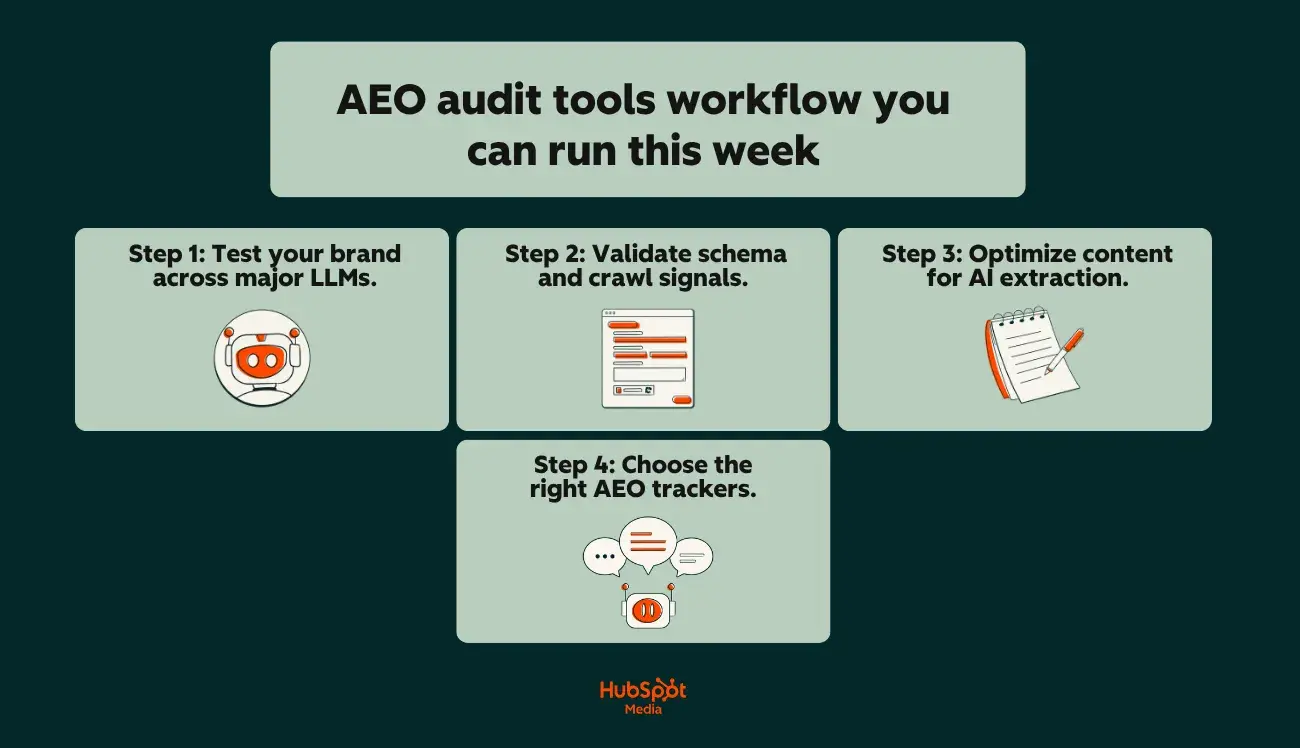
For immediate action, teams can implement a practical AEO audit workflow within a week.
Step 1: Test Your Brand Across Major Answer Engines.
Conduct baseline testing across ChatGPT, Perplexity, and Gemini. This initial data collection on brand appearance (or absence) is the cornerstone of any AEO audit.

- Process:
- Compile a list of 20-30 critical, high-intent queries relevant to your brand, products, or services.
- Manually enter these queries into each of the three primary answer engines.
- Record whether your brand is cited, the accuracy of the citation, and the specific content referenced.
- Tool Support: HubSpot’s AI Search Grader can automate much of this, providing a quick baseline to cross-reference with manual findings.
- Pro Tip: Standardize your query list. Consistency is key for tracking progress over time.
Step 2: Validate Schema and Crawl Signals.
AI engines can only cite content they can effectively access and parse. This step ensures technical visibility.
- Checks:
- robots.txt and sitemap.xml: Ensure key pages are discoverable and not inadvertently blocked.
- Structured Data (Schema Markup): Verify that relevant schema (e.g., FAQPage, HowTo, Product) is correctly implemented to help AI understand content context.
- Canonical Tags: Confirm proper canonicalization to prevent duplicate content issues.
- Core Web Vitals: Assess page loading speed and user experience, as these indirectly influence AI processing and user engagement.
Step 3: Optimize Content for AI Extraction.
Visibility and crawl access are moot if content isn’t structured for AI.
- Audit Criteria for Top Pages:
- Answer-First Intros: Does the first paragraph directly answer the core question of the page?
- Q&A Blocks: Are explicit question-and-answer sections present for common queries?
- Comparison Tables: Is comparative information presented in clear, tabular formats?
- Concise Paragraphs: Are paragraphs short, focused, and easily digestible by AI?
- Outcome: A prioritized list of your top 20-50 pages, ranked by extraction readiness, with specific reformatting actions.
- Pro Tip: HubSpot’s Content Hub offers AI-optimized modules like answer-first layouts and FAQ components to streamline this process.
Step 4: Choose the Right AEO Trackers.
With data informing the decision, evaluate paid AEO audit tools.
- Decision Points:
- Baseline Results: If visibility is low, focus on tools that aid content reformatting first. If visibility is present but inconsistent, prioritize tracking tools.
- Budget & Scale: Match tools to your company size and team maturity (startup, mid-market, enterprise).
- Integration: Select tools that integrate seamlessly with your existing marketing and SEO infrastructure.
Sustaining Visibility: Automating Recurring AEO Reports
A one-time AEO audit provides a snapshot; a recurring system reveals progress, regressions, and underlying causes. Automation is key to sustainability.
Weekly: Citation Alerts and Brand Accuracy Flags
Weekly monitoring catches critical issues before they escalate.
- Automate:
- Citation Alerts: Notifications when your brand is cited by an answer engine.
- Accuracy Flags: Automated checks for any misrepresentation of pricing, product capabilities, or brand messaging within AI responses.
- Competitive Mentions: Alerts for competitor citations for your target queries.
- Pro Tip: Route these alerts to existing SEO or marketing Slack channels/email lists to consolidate workflows.
Monthly: Citation Share Reviews and Content Performance
Monthly reviews shift from reactive monitoring to strategic analysis.
- Automate/Review:
- Citation Share Analysis: Track your brand’s share of citations for key queries against competitors.
- Content Performance Review: Correlate citation changes with recent content updates or new publications.
- Query Gap Analysis: Identify new queries where competitors are cited but your brand is not.
- Sentiment Analysis: Assess the sentiment around your brand in AI-generated responses.
Quarterly: Full Engine Tests and Stack Evaluation
Quarterly reviews provide a strategic, high-level perspective.
- Automate/Review:
- Comprehensive Baseline Rerun: Re-execute the initial full query set across all major answer engines to track macro progress.
- Tool Stack Evaluation: Assess whether current AEO software still meets evolving needs and budget constraints.
- Leadership Reporting: Present strategic insights, ROI, and future recommendations to senior management.
- Competitor Deep Dive: Analyze competitor AEO strategies and identify new threats or opportunities.
Avoid These AEO Audit Tool Pitfalls
While the potential of AEO is vast, common missteps can hinder effectiveness.
Pitfall 1: Tool-First Buying
The most prevalent mistake is acquiring AEO software without a preceding baseline visibility test and content audit. Teams must first understand their current standing and identify improvement areas (especially content readiness) before investing in tools. This ensures that the chosen software addresses genuine needs rather than becoming an underutilized expense.
Pitfall 2: Weak Documentation and No Measurement Framework
Many teams adopt AEO tools but lack a clear definition of success. Without a predefined measurement framework, data collected can be meaningless. Before deployment, establish clear KPIs (e.g., citation share growth, accuracy rate, sentiment score) and integrate this framework directly into the reporting platform. HubSpot’s Marketing Hub, for instance, allows for centralized AEO reporting alongside campaign attribution.
Pitfall 3: Single-Engine Focus
Testing visibility exclusively in one answer engine (e.g., ChatGPT) and extrapolating those results to the entire AI ecosystem is a critical error. Each AI engine sources data differently, retrains on varying schedules, and applies unique citation logic. A brand that performs well in ChatGPT might be entirely absent from Perplexity or Gemini, creating significant blind spots. A comprehensive AEO strategy demands multi-platform monitoring.
Industry Perspectives and Future Outlook
Industry experts widely agree that AEO represents the next frontier in digital marketing. "The shift from link-based search to answer-driven discovery is irreversible," states a prominent digital marketing analyst. "Brands that fail to optimize for answer engines risk becoming invisible to a significant portion of their target audience." This paradigm shift elevates content quality and structured data to unprecedented importance, demanding a proactive and adaptive approach from marketers.
The implications for content creation are profound. Content will increasingly need to be authoritative, concise, and structured for easy extraction, moving beyond traditional keyword stuffing. The role of the SEO professional is expanding to include "AI content auditing" and "citation management." Furthermore, ethical considerations surrounding AI citations, such as bias and accuracy, will likely prompt stricter regulations and require brands to have robust internal governance frameworks for their AEO strategies.
Conclusion
The contemporary search landscape mandates the strategic adoption and diligent use of AEO audit tools. As buyers increasingly rely on ChatGPT, Perplexity, and Gemini for direct product and service recommendations, brands must ensure their accurate and prominent appearance for relevant queries. AEO audit tools empower teams to evaluate performance, diagnose visibility gaps, and proactively secure their position in this evolving digital frontier.
To effectively navigate this transition, organizations should:
- Conduct a thorough baseline visibility check across all major answer engines.
- Prioritize content reformatting for optimal AI extraction.
- Select AEO trackers tailored to their specific company size and needs.
- Implement a robust, automated reporting cadence for continuous monitoring and strategic analysis.
The era of answer-driven discovery is here, and a comprehensive AEO strategy, supported by the right audit tools, is no longer optional but essential for sustained brand relevance and competitive advantage.


 Nana
Nana
 Laily UPN