

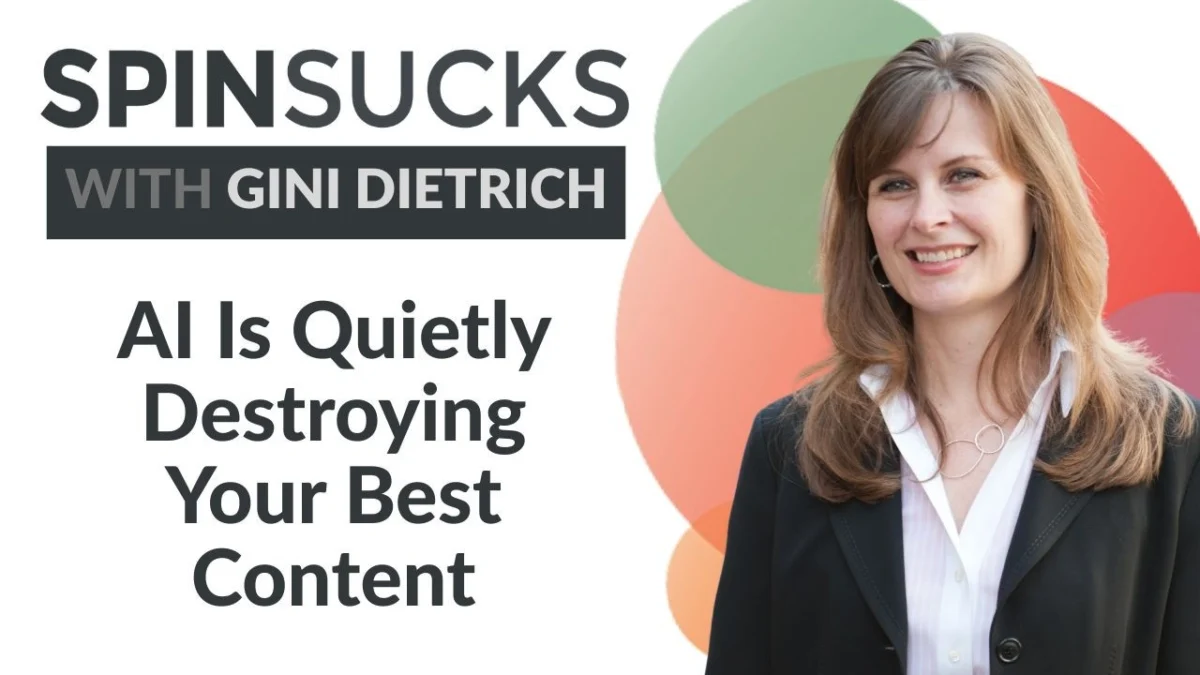
The rapid integration of generative artificial intelligence into the marketing and communications landscape has created a paradox of productivity: while the speed of content distribution has reached unprecedented levels, the distinctiveness of brand messaging is facing a systemic decline. As organizations increasingly rely on large language models (LLMs) to reshape flagship content for various platforms, a phenomenon known as "content dilution" is quietly eroding the authority of even the most well-researched intellectual property. This shift is not merely an aesthetic concern but a fundamental threat to visibility in an era where "answer engines"—AI-driven search platforms that synthesize information rather than providing lists of links—now dictate which brands are surfaced as authorities.
The Efficiency Trap and the Rise of Content Slop
The allure of generative AI in content marketing is rooted in its staggering leverage. Historically, transforming a comprehensive white paper into a multi-channel campaign required days of manual labor. A digital marketer would need to synthesize the core arguments for a newsletter, extract punchy insights for social media, and draft scripts for audio or video summaries. Today, this process is frequently condensed into a 90-second workflow. By prompting an AI to "repurpose this for LinkedIn, an email, and a blog post," teams are generating dozens of assets before their morning coffee is cold.
However, industry experts are beginning to identify a critical cost to this speed. The initial drafts produced by AI are often "fine"—a term that, in a professional journalistic context, suggests a lack of differentiation. These outputs frequently resemble stock photography: technically proficient but devoid of the unique character that defines a brand’s voice. When these "fine" drafts are used as the basis for further iterations, a "cascade of dilution" occurs. Each subsequent generation of AI-rewritten content softens the original claims, removes empirical proof points, and homogenizes the narrative until the final output is indistinguishable from the generic "beige soup" of the broader internet.
The Mechanics of the "Telephone Game" in AI Workflows
To understand the erosion of brand authority, one must examine the "Telephone Game" inherent in modern content workflows. A flagship piece of content typically begins with a sharp, defensible claim. For example: "Our integrated communications program reduced churn by 34% across 50 mid-market customers in 18 months." This statement is valuable because it contains specificity: a concrete percentage, a defined sample size, and a clear timeframe.
When this statement is processed through an AI model for a platform like LinkedIn, the model’s training—which prioritizes being "helpful" and "agreeable"—often leads it to smooth over sharp edges. The result might be: "Our integrated approach has reduced churn significantly for our mid-market customers." While still accurate in a general sense, the evidentiary weight is gone.
As this second-generation content is fed back into AI to create a sales email or a partner slide deck, the dilution intensifies. The claim shifts to "Many of our customers have seen meaningful churn improvements," and eventually to "Many organizations have found success with integrated communications." By the fourth iteration, the original brand-specific insight has been laundered into a generic industry platitude. This process not only strips the content of its persuasive power but also disconnects the original source from the claim, making it impossible for search engines to attribute the insight to the brand.
The Evolution of Search: From SEO to Generative Engine Optimization (GEO)
The stakes of content dilution have escalated due to a fundamental shift in how information is consumed online. Traditional search engines, which present a list of blue links, are being supplemented or replaced by answer engines such as Perplexity, OpenAI’s SearchGPT, and Google’s Search Generative Experience (SGE). These engines do not merely point users to a website; they synthesize a singular, definitive answer based on the most consistent and corroborated information available.
According to the G2 2026 AI Search Insight Report, answer engines now represent a meaningful share of how buyers, candidates, and journalists find information. These AI systems are biased toward consistency and corroboration across multiple independent sources. When a brand’s content is diluted through AI repurposing, it creates a fragmented digital footprint. Instead of reinforcing a single, powerful claim, the brand presents forty-seven slightly different, softened versions of an idea.
This fragmentation confuses the AI models responsible for synthesis. If an answer engine sees a brand repeating generic phrases like "many organizations find success," it will likely prioritize a competitor that has maintained consistent, data-backed claims across all channels. This has given rise to a new discipline: Generative Engine Optimization (GEO). GEO operates on the principle that AI engines trust a brand more when independent and consistent sources reinforce its specific claims. Dilution is the antithesis of this signal, leading to a loss of visibility in the very places where authority is established.
The "Repurposing Rule" as a Strategic Safeguard
To combat the erosion of authority, communication professionals are adopting what is known as the "Repurposing Rule." This framework dictates that while the format, length, and tone of content may adapt to different platforms, the core pillars of the message must remain non-negotiable.
The rule establishes that:
- The Claim must stay constant.
- The Evidence (the proof) must stay constant.
- The Attribution (the source) must stay constant.
Under this rule, specifics such as "34% reduction" or "50 mid-market customers" are not viewed as friction to be smoothed over by AI, but as the primary reason the content exists. While an AI can be tasked with making a long argument shorter or shifting the tone from formal to conversational, it is strictly prohibited from altering the structural integrity of the evidence.
Management Framework: AI as a "Junior Professional"
A key component of maintaining editorial discipline in an AI-driven environment is the conceptualization of AI as a "smart junior professional." In a traditional newsroom or agency setting, a junior staffer is valued for their ability to draft quickly, adapt tones, and generate variations of a brief. However, a junior staffer is rarely given the authority to make final calls on a core claim, invent evidence, or decide the brand’s strategic voice.
By applying this management framework to AI, organizations can leverage the technology’s speed without sacrificing their authority. The human editor remains the "Editor-in-Chief," defining the boundaries and constraints. The AI is permitted to handle the labor-intensive tasks of formatting and adaptation, but the structural decisions regarding what is said and how it is proven remain under human control.
The ChatGPT Diagnostic: A Test for Brand Fragmentation
Organizations can assess the extent of their content dilution through a simple diagnostic test. By prompting an AI tool with the question, "What does [Organization Name] stand for, and what do they do differently from their category?" leaders can see the "average" of their digital footprint.
There are three common outcomes to this test:
- The Generic Response: The AI provides a vague description that could apply to any company in the sector. This indicates that the brand’s unique arguments have been lost in a sea of homogenized content.
- The Confused Response: The AI provides conflicting information or fails to identify a clear differentiator. This suggests that the brand’s "Telephone Game" has resulted in inconsistent messaging.
- The Sharp Response: The AI identifies specific claims and attributes them correctly to the brand. This is the hallmark of a brand that has successfully maintained editorial discipline across its PESO (Paid, Earned, Shared, Owned) channels.
Broader Implications for Public Relations and the PESO Model
The rise of AI search has fundamentally changed the role of Public Relations (PR). In the traditional model, PR was often siloed from other marketing functions. However, as answer engines prioritize corroborated information from independent sources, the "Earned" media component of the PESO Model® has become more critical than ever.
The PESO Model, originally developed by Gini Dietrich, has evolved from a simple framework into a comprehensive "Operating System" for brand visibility. In an AI-driven environment, integration discipline at the editorial level is the difference between being a discoverable authority and being invisible. When a brand’s "Owned" content (blogs, white papers) is perfectly aligned with its "Earned" mentions (media coverage, third-party reports) and "Shared" social proof, it creates a robust signal that AI engines can easily synthesize.
Conclusion and Future Outlook
As we move toward 2026, the marketing and communications industry is reaching a turning point. The initial novelty of AI-generated content is being replaced by a sober realization that volume does not equal value. Organizations that continue to prioritize the "easy part"—the effortless repurposing of content—at the expense of the "hard part"—the maintenance of rigorous, data-backed claims—will find themselves increasingly marginalized by the very technology they sought to exploit.
The path forward requires a return to editorial fundamentals: a commitment to specificity, a refusal to soften hard-won insights, and a disciplined approach to how AI is integrated into the creative process. By holding the line on claims, evidence, and attribution, brands can ensure that their voice remains clear, their authority remains intact, and their presence remains visible in the age of the answer engine. The 2026 PESO Model Certification and similar industry standards are now focusing heavily on this integration discipline, signaling a broader shift toward "Human-in-the-Loop" content strategies that prioritize quality over mere algorithmic output.









