rifanmuazin
The process by which business-to-business (B2B) buyers discover solutions has undergone a radical transformation, shifting from a predictable, linear path to a complex, multi-environment journey. Once characterized by straightforward searches and a manageable shortlist of options, B2B discovery is now a protracted and often untraceable phenomenon, unfolding over extended periods and across a diverse array of digital and physical spaces. This evolution presents significant challenges for marketers seeking to connect with potential clients, demanding a fundamental rethinking of engagement strategies.
Recent research underscores the profound shift in buyer behavior. McKinsey’s findings indicate that B2B buyers now interact with an average of ten distinct channels throughout their decision-making process. This fragmentation means that understanding and confidence are not acquired in a single, decisive moment but rather accumulate gradually through repeated exposure, comparison, and validation. The traditional notion of a clear buyer funnel, moving sequentially from awareness to consideration to decision, has become largely obsolete. Instead, buyers navigate a dynamic ecosystem of information, piecing together insights from various sources without a definitive starting point.
The implications of this shift are profound for B2B marketing. The era of relying on first impressions alone is over. Today, success hinges on the enduring strength and consistency of a brand’s narrative as it withstands scrutiny across multiple touchpoints. Buyers are no longer passively receiving information; they are actively comparing, contrasting, and seeking corroboration across different platforms and through varied voices. This necessitates a marketing approach that prioritizes continuity, coherence, and unwavering credibility across all customer interactions.
The Fragmentation of B2B Buyer Journeys
The traditional B2B sales funnel, once a foundational concept for marketers, has been significantly disrupted. Buyers no longer follow a neatly defined path from initial awareness to final purchase. Instead, their discovery process is characterized by a series of interactions that occur across multiple environments, often without a clear or predetermined beginning. Each of these environments plays a unique role in shaping buyer perception and decision-making, and no single channel can bear the full weight of influencing a complex B2B transaction on its own.

AI-powered tools, for instance, frequently serve as an initial point of orientation, enabling buyers to quickly frame and define the problems they are seeking to solve. Search engines then become crucial for validation, allowing buyers to verify claims, compare different perspectives, and gather a broader understanding of available solutions. Peer-driven communities offer invaluable lived experiences and authentic testimonials, while expert voices and a brand’s owned content provide deeper insights and help buyers evaluate the practical applicability of an idea. These interactions are not mutually exclusive; rather, they complement and build upon one another, contributing to a cumulative understanding.
The core intent of B2B buyers – to make sound and informed decisions – remains unchanged. What has fundamentally altered is their methodology for reducing uncertainty. Instead of placing their trust in a single, authoritative source, buyers increasingly engage in a comparative analysis of signals across a multitude of platforms. This meticulous process of cross-referencing and seeking consistency precedes any commitment to a particular vendor or solution.
In this fragmented landscape, mere visibility is no longer sufficient. If a brand’s messaging or core propositions shift, contradict themselves, or lose clarity as buyers transition between different channels, it can lead to a significant erosion of confidence. Consequently, multi-channel discovery is less about the breadth of reach and more about the depth of continuity. The paramount objective is to ensure that the fundamental thinking and value proposition of a brand remain intact and consistent, regardless of where buyers seek reassurance or validation.
Research Insights into Multi-Channel Discovery Challenges
Compelling data from the report The State of B2B Thought Leadership in 2026 corroborates this seismic shift in buyer discovery. The research, which surveyed 797 senior B2B marketers, highlights a widespread sentiment of strain as marketing teams grapple with the complexities of supporting buyer evaluation across a multitude of disparate environments simultaneously.
A significant challenge identified by respondents is fragmentation, with one-third of marketers reporting limited visibility into the performance of their efforts across the entire buyer journey. Another third of those surveyed indicate an over-reliance on a small number of communication channels. These statistics strongly suggest that while marketers acknowledge the increasing prevalence of buyers encountering their ideas in a wider array of contexts, many lack the structured frameworks and integrated strategies necessary to manage these encounters in a cohesive and connected manner.
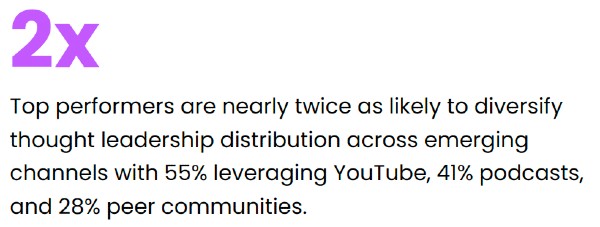
Concurrently, the influence within the B2B ecosystem is becoming increasingly democratized. High-performing marketing teams are demonstrably more likely to diversify their distribution of thought leadership content across emerging channels, extending their presence beyond a limited set of established platforms. This includes a more pronounced utilization of video content, podcasts, and online peer communities. These environments offer buyers the opportunity to revisit ideas, interpret nuanced perspectives, and validate their understanding over time, fostering a deeper level of engagement and trust.
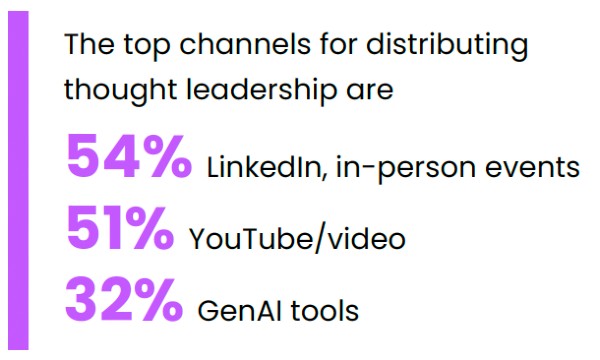
The report further illuminates a growing disconnect between how B2B marketers currently disseminate thought leadership and the actual methods by which buyers discover it. While platforms like LinkedIn and traditional in-person events continue to hold significant sway, video has emerged as a channel of increasing importance. Notably, nearly one-third of buyers now report leveraging Generative AI (GenAI) tools to discover thought leadership – a channel that a substantial portion of marketers still treat as a secondary or less critical component of their strategy. This oversight represents a significant missed opportunity to engage buyers at an early and formative stage of their research.
The collective findings from this research underscore a critical challenge for B2B organizations. The issue is not merely about selecting the "right" channel; it is about ensuring that the underlying core message and value proposition are consistently presented wherever buyers choose to validate, compare, and ultimately build confidence in their purchasing decisions. This requires a holistic and integrated approach to content strategy and distribution.
Buyer Strategies for Uncertainty Reduction Across Channels
As the discovery process expands across a broader spectrum of environments, B2B buyers strategically leverage each channel for a specific type of reassurance. The value of each interaction point becomes more apparent when viewed through the lens of risk reduction rather than simply as an opportunity for message delivery. This nuanced understanding is crucial for marketers seeking to optimize their engagement strategies.
For instance, AI-driven tools and search engines are often employed for rapid problem framing and initial validation, allowing buyers to quickly ascertain the scope of potential solutions and compare high-level information. Peer communities and social media platforms serve as critical conduits for social proof, enabling buyers to gauge real-world experiences and the collective sentiment surrounding a particular product or service. Expert content and analyst reports offer in-depth analysis and authoritative validation, bolstering confidence in the technical merits and market positioning of a solution. Finally, a brand’s owned content, such as white papers, case studies, and webinars, provides comprehensive details and allows for a deeper dive into the specifics of a solution, offering direct reassurance from the vendor.
The sequence of these interactions is not as critical as the distinct function each touchpoint serves. Buyers are not passively consuming information; they are actively building confidence incrementally. Each channel addresses a different facet of their information needs, and collectively, these interactions determine whether an idea or a proposed solution feels sufficiently reliable to warrant further action. This iterative process of information gathering and validation is central to mitigating the inherent risks associated with significant B2B investments.
High-Performing B2B Brands: Architects of Multi-Channel Discovery
Leading B2B brands acknowledge that they do not have absolute control over where buyer discovery takes place. Buyers encounter information in diverse locations, at varied times, and often outside of any pre-defined campaign structure. Consequently, the strategic imperative shifts from achieving channel dominance to cultivating consensus around a consistent and compelling brand narrative. This means striving to be the "best answer" in a meaningful way, appearing precisely where buyers are looking, where they place their trust, and where they are most susceptible to influence.
Instead of planning individual channel strategies in isolation, top-tier B2B marketers begin with a clearly articulated point of view. They then diligently ensure this perspective is supported by robust proof and demonstrable credibility across all potential buyer touchpoints. The language used, the evidence presented, and the overall framing of their message remain aligned, whether that message appears within an AI-generated summary, a search engine result, a peer-to-peer discussion, or a more in-depth piece of owned content. This unwavering continuity of narrative, bolstered by irrefutable proof, is a cornerstone of what is termed "Best Answer Marketing." This approach also resonates strongly with emerging concepts such as LinkedIn’s notion of "Buyability," which emphasizes the importance of being discoverable and compelling at the moment of buyer readiness.
These results-oriented B2B marketers also recognize that repetition is not a sign of inefficiency but rather a strategic necessity. Buyers anticipate encountering key ideas multiple times throughout their research process. When content is intentionally designed, each subsequent exposure serves to add context, reinforce understanding, and reduce the cognitive load required for buyers to develop trust in what they are observing. This consistent reinforcement builds familiarity and strengthens the perceived credibility of the brand.
Perhaps most importantly, high-performing marketers architect their discovery strategies around actual buyer behavior. They operate under the assumption that buyers will invariably compare sources, actively seek external validation, and revisit ideas as their decision-making process evolves. By structuring information and the discovery journey with this inherent buyer behavior in mind, brands can optimize their visibility not only for human audiences but also for the rapidly advancing AI and Large Language Model (LLM) systems that are increasingly influencing buyer research. The ultimate goal is not to enforce a rigid, linear path but to simplify each evaluation point by maintaining a steadfast consistency in the underlying core message and value proposition.
Multi-Channel Discovery: The Premium on Consensus and Consistency
The current era of multi-channel discovery does not mandate that brands be omnipresent across every conceivable platform. Instead, it requires them to be consistently reliable and credible wherever buyers happen to be looking for information. The advantage in this evolving marketplace shifts away from sheer channel mastery and toward the cultivation of narrative coherence.
Buyers do not develop confidence in their purchasing decisions through isolated, disconnected interactions. Their confidence is built when ideas remain steadfast under scrutiny, when the evidence supporting a claim does not waver across different channels, and when the guidance provided feels cumulative and progressive. In this light, the often-unseen objective of multi-channel discovery extends far beyond mere reach; its primary function is to build unwavering confidence.
B2B companies that grasp this fundamental principle move beyond simply being "seen" to being "believed" – positioning themselves as Best Answer Brands. This transition signifies a profound shift from a transactional marketing mindset to one focused on establishing deep-seated trust and authority. By consistently delivering reliable, credible, and coherent information across the diverse landscape of buyer discovery, these brands build enduring relationships and secure their place as trusted partners in their clients’ success.
To gain a more comprehensive understanding of the strategies employed to leverage proof for building consensus and becoming a Best Answer Brand, interested parties are encouraged to download the comprehensive report, Answer Engine: The State of B2B Thought Leadership in 2026. This resource offers detailed insights into how leading B2B marketers are actively designing for multi-channel discovery and fostering consensus across the varied touchpoints where buyers conduct their research. The report provides actionable intelligence for navigating the complexities of modern B2B buyer journeys and establishing a dominant presence in a crowded marketplace.