

The digital advertising landscape has reached a significant milestone as paid search advertising generated $102.9 billion in U.S. revenue throughout 2024, solidifying its position as the largest digital advertising format by a substantial margin. This scale is driven by a fundamental market reality: paid search provides brands with the unique ability to appear before consumers at the precise moment of high-intent inquiry. However, as the market matures, the complexity of maintaining a profitable return on ad spend (ROAS) has intensified. Industry data indicates that rising cost-per-lead (CPL) averages and heightened competition have transformed paid search from a simple keyword-bidding exercise into a sophisticated discipline requiring deep technical knowledge of auction mechanics, campaign architecture, and post-click optimization.
The Economic Dominance of Search Advertising
According to recent industry reports, search advertising now accounts for approximately 39.8% of all digital advertising revenue. This dominance is not merely a matter of volume but of efficiency. Unlike social media advertising, which often relies on interruption-based marketing, search advertising is demand-driven. The $102.9 billion expenditure in the U.S. reflects a broader global trend where businesses are shifting budgets toward channels that offer measurable attribution and immediate visibility.
Google Ads remains the undisputed leader in this space, commanding roughly 90% of the global search market share. Its ecosystem extends beyond the traditional search results page to include YouTube, the Google Display Network, Gmail, and Google Maps. Meanwhile, Microsoft Advertising has carved out a significant niche, particularly in the B2B sector. By syndicating ads across Yahoo, AOL, DuckDuckGo, and Ecosia, and expanding into exclusive channels such as Netflix’s ad-supported tier, Microsoft provides a critical alternative for reaching high-value audiences in North America and Europe.
A Chronology of Paid Search Evolution
To understand the current state of paid search, one must look at the technological trajectory that brought the industry to its $100 billion status.
- The Late 1990s (The Genesis): The concept of paid search began with GoTo.com (later Overture), which introduced the first auction-based system where the highest bidder won the top spot.
- 2000 (The Launch of Google AdWords): Google entered the market with a self-service portal, initially charging on a cost-per-thousand-impressions (CPM) basis before pivoting to the pay-per-click (PPC) model.
- 2005 (The Quality Score Revolution): Google introduced the “Quality Score,” a pivotal shift that meant money alone could not buy the top position. Relevance and user experience became equal partners to bid price.
- 2010s (Mobile and Extensions): The rise of smartphones forced search engines to adopt mobile-first ad formats and “extensions” (now called assets), providing users with more information like phone numbers and location data directly on the results page.
- 2021–Present (The AI and Automation Era): The introduction of Performance Max (PMax) and Responsive Search Ads (RSAs) signaled a shift toward machine learning. Modern campaigns now rely on AI to test thousands of headline combinations and bid in real-time based on millions of user signals.
The Mechanics of the Modern Search Auction
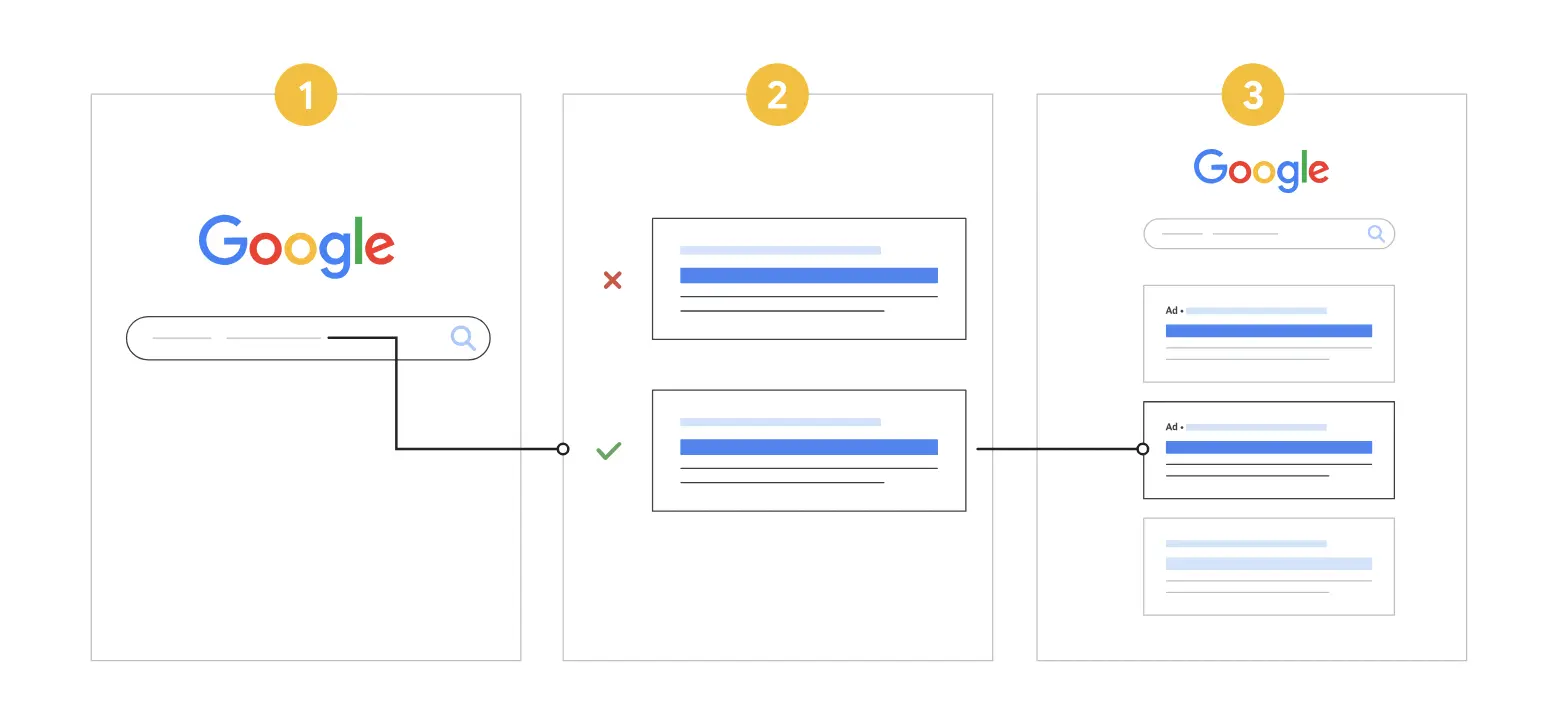
The modern paid search auction is a high-speed computational feat that occurs in milliseconds every time a user hits “enter.” It is governed by a five-step process that determines the visibility of a brand.

First, the user enters a query. Second, the search engine triggers an auction, identifying all advertisers bidding on relevant keywords who meet specific targeting criteria such as location and device. Third, the system calculates an “Ad Rank” for each participant. Ad Rank is not a static number but a dynamic score based on the bid amount, the Quality Score (which includes expected click-through rate, ad relevance, and landing page experience), and the expected impact of ad assets.
The fourth step determines the winner. The advertiser with the highest Ad Rank takes the top position, but they do not necessarily pay their maximum bid. In the fifth step, the “Actual CPC” is calculated. Under this second-price auction model, the winner pays only $0.01 more than what is required to beat the Ad Rank of the competitor immediately below them. This system incentivizes advertisers to improve ad quality rather than simply inflating budgets.
Strategic Comparison: Paid Search versus Organic SEO
While both paid search and Search Engine Optimization (SEO) aim to capture traffic from search engine results pages (SERPs), they serve different strategic functions. Paid search offers immediate results, precise targeting control, and instant scalability. It is particularly effective for product launches, seasonal promotions, or competing in “commercial” keyword spaces where organic results are dominated by massive aggregators.
In contrast, organic search is a long-term play. It typically takes three to twelve months to see significant results from SEO, but it offers a lower direct cost per visit over time. Market analysts suggest that the most resilient digital strategies employ a “hybrid” approach: using paid search to capture immediate demand and gather keyword data, while simultaneously building organic authority to capture informational queries and long-term traffic.
Diversification of Ad Formats
As the search landscape has grown, so too have the formats available to marketers.
- Responsive Search Ads (RSAs): These are now the industry standard. Advertisers provide multiple headlines and descriptions, and Google’s AI assembles them into the most effective combination for each specific user.
- Performance Max (PMax): This represents the pinnacle of automation, allowing a single campaign to serve ads across Search, Display, YouTube, and Maps. It uses “audience signals” rather than just keywords to find potential customers.
- Shopping Ads: Crucial for e-commerce, these ads use product feed data from the Google Merchant Center to display images, prices, and reviews, bypassing traditional text-based copy.
- Apple Search Ads: For app developers, this is a critical channel, placing ads at the top of App Store search results where intent to download is highest.
The Critical Role of the Post-Click Experience
Perhaps the most significant shift in 2024 is the recognition that “the click” is no longer the final metric of success. With the average cost per lead rising from $66.69 in 2024 to an estimated $70.11 in 2025, the margin for error has narrowed. Industry experts emphasize that a campaign’s success is increasingly determined by the “post-click experience”—the quality and relevance of the landing page.
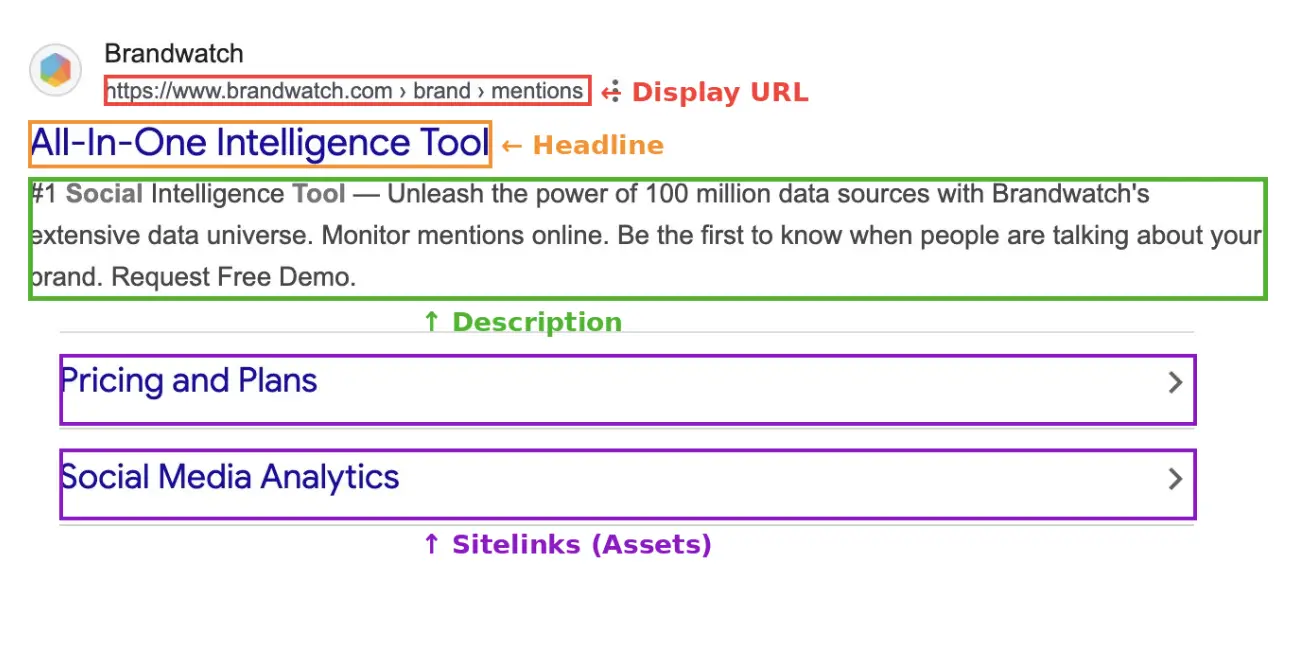
A common pitfall in paid search is “message mismatch,” where an ad promises a specific offer but the landing page delivers generic corporate information. Research indicates that even a one-second delay in mobile page load time can reduce conversion rates by up to 20%. Furthermore, sending paid traffic to a general homepage rather than a dedicated, conversion-optimized landing page often results in “leaky” funnels where users drop off due to a lack of clear direction.
Data-Driven Implications and Market Analysis
The transition to a more expensive and competitive search environment has forced a re-evaluation of Key Performance Indicators (KPIs). While Click-Through Rate (CTR) and Cost Per Click (CPC) remain important for monitoring health, the industry is moving toward “Profit-Based Bidding.” This involves tracking the actual lifetime value (LTV) of a customer acquired through search rather than just the initial conversion.
Furthermore, privacy regulations and the deprecation of third-party cookies have made first-party data more valuable than ever. Search engines are responding by leaning more heavily into “Enhanced Conversions,” a feature that uses hashed first-party data to provide a more accurate picture of how ads lead to sales across different devices.

Broader Impact and Future Outlook
The broader impact of the $102.9 billion search market is felt across the global economy. Small businesses now have the tools to compete with multinational corporations on a level playing field, provided they can master the technical nuances of the auction. However, the barrier to entry is rising. The “set it and forget it” mentality of early 2010s search marketing has been replaced by a need for continuous experimentation.
Looking toward 2025 and 2026, the integration of Generative AI into search—such as Google’s Search Generative Experience (SGE)—is expected to change how ads are displayed. Advertisers will likely need to optimize for “conversational” queries and visual search as AI-driven summaries become a standard part of the user journey.
Ultimately, paid search remains the most powerful engine for digital growth because it respects the user’s intent. As long as people use search engines to solve problems and find products, the auction will remain the heartbeat of the digital economy. The winners in this high-stakes environment will be those who combine the efficiency of AI-driven bidding with the human touch of compelling creative and seamless post-click experiences.







