The latest comprehensive study from Pew Research reveals that ChatGPT maintains its formidable position as the most favored artificial intelligence chatbot among American consumers, even as the overall adoption of AI tools continues its rapid ascent. The research further delineates that the predominant application for these sophisticated conversational agents remains assistance with search queries, significantly outweighing other functionalities such as image generation or specialized professional tasks. This insight underscores a critical phase in the broader AI shift, offering a granular view into how a significant portion of the U.S. populace is integrating these emerging technologies into their daily lives.
The Accelerating Pace of AI Adoption
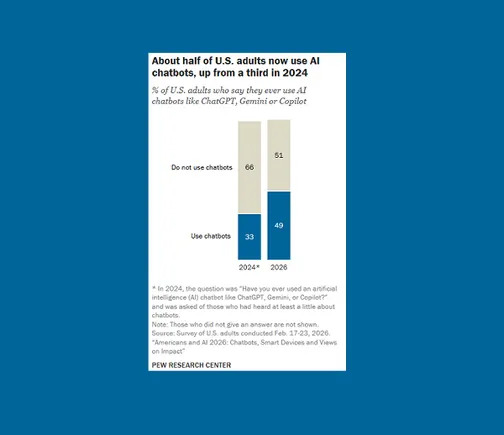
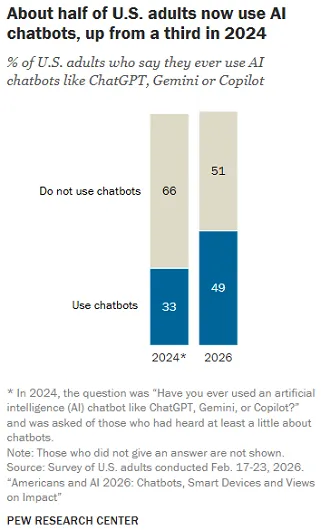
The findings, derived from a robust survey encompassing over 5,000 Americans, paint a vivid picture of escalating AI engagement. Approximately half of all U.S. adults now report utilizing AI chatbots, marking a substantial increase from just 33% recorded in 2024. This notable surge within a mere two-year span highlights the accelerated mainstreaming of AI, moving from early adopter curiosity to widespread consumer utility. The speed of this adoption curve is a testament to the intuitive interfaces and perceived value offered by these tools, which have rapidly become accessible through various platforms.
The introduction of ChatGPT by OpenAI in late 2022 catalyzed a global phenomenon, democratizing access to powerful large language models (LLMs) and sparking an unprecedented wave of innovation and public discourse around artificial intelligence. Prior to this, AI-powered conversational agents largely existed within niche applications or as rudimentary virtual assistants. ChatGPT’s ability to generate coherent, contextually relevant, and creative text in response to diverse prompts quickly captured public imagination and set a new benchmark for AI interaction. This first-mover advantage, coupled with continuous refinement, has allowed ChatGPT to embed itself deeply in the public consciousness, making it almost synonymous with the concept of an “AI chatbot.”
ChatGPT’s Enduring Lead Amidst Rising Competition
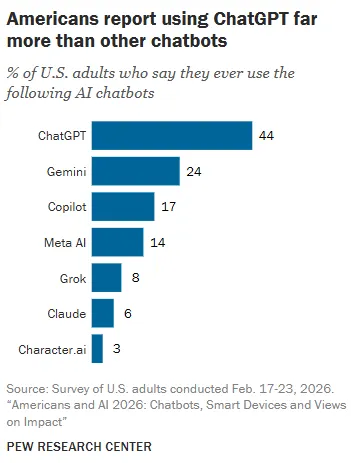
Despite an increasingly crowded and competitive landscape, with formidable entrants like Google’s Gemini, Microsoft’s Copilot, Meta AI, Anthropic’s Claude, xAI’s Grok, and Character.ai vying for market share, ChatGPT continues to hold a significant lead. The Pew data indicates that 44% of U.S. adults who use chatbots are leveraging ChatGPT, a figure that solidifies its market dominance. This enduring popularity can be attributed not only to its early market entry but also to its consistent performance, brand recognition, and a user-friendly interface that has lowered the barrier to entry for millions.
Following ChatGPT, Google’s Gemini secures the second position in popularity, leveraging Google’s vast ecosystem and search dominance. Microsoft’s Copilot, deeply integrated into the Windows operating system and Microsoft 365 suite, ranks third, benefiting from its enterprise reach and productivity focus. Meta AI, Grok, Claude, and Character.ai trail further behind, each carving out specific niches but collectively facing the challenge of dislodging ChatGPT’s entrenched user base. Claude, in particular, has garnered considerable attention for its focus on safety and constitutional AI principles, appealing to users and enterprises seeking more ethical and reliable AI interactions. However, the Pew study clearly illustrates the uphill battle newer entrants face in overcoming the market leader’s established momentum.
Understanding User Behavior: Primary Use Cases
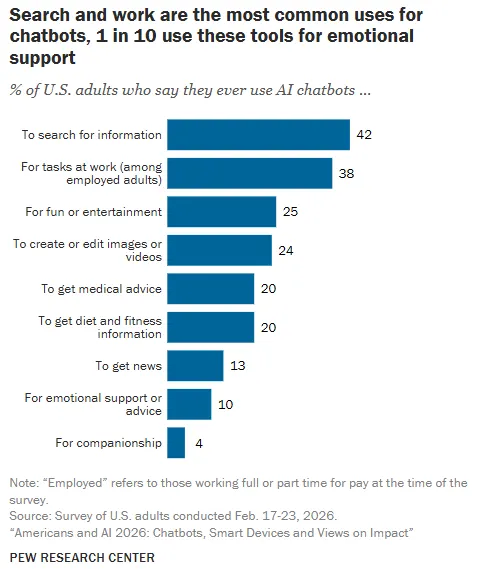
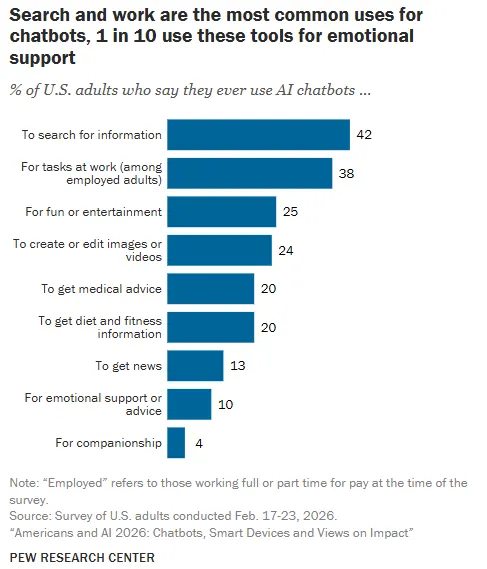
A significant revelation from the study is the pronounced preference for using AI chatbots to assist with search-related activities. This finding suggests that for the average American consumer, AI chatbots are primarily perceived as advanced information retrieval and summarization tools, enhancing or augmenting traditional search engine functionalities. Users are tapping into these systems to quickly obtain answers, summarize lengthy articles, generate ideas, or explore complex topics without navigating multiple web pages. This use case aligns perfectly with the core capabilities of LLMs to process and synthesize vast amounts of information efficiently.
Conversely, the study highlights a surprising disconnect between platform offerings and actual consumer usage in other areas. Only 24% of respondents reported using AI chatbots for generating images or videos. This statistic is particularly noteworthy given the substantial investment by major social media platforms and tech companies in developing and promoting generative AI features for visual content creation. Platforms are actively pushing tools that enable users to create intricate images, stylistic videos, and augmented reality experiences with simple text prompts. The “mystery,” as the original article posits, lies in why, despite the technical impressiveness and marketing efforts, these visual AI generation features have yet to achieve widespread consumer adoption on par with text-based assistance.
Several factors could contribute to this disparity. The learning curve for effective visual prompt engineering might be higher, requiring more specific skills to achieve desired results. Concerns over AI-generated imagery’s authenticity, potential for misuse (e.g., deepfakes), or even the aesthetic quality of the output might also deter casual users. Furthermore, the perceived immediate utility of text-based search assistance for everyday tasks might simply outweigh the novelty or entertainment value of image generation for the average consumer. For many, a quick answer or summary is a more tangible productivity gain than a generated image, however impressive.
The Productivity and Information Dividend
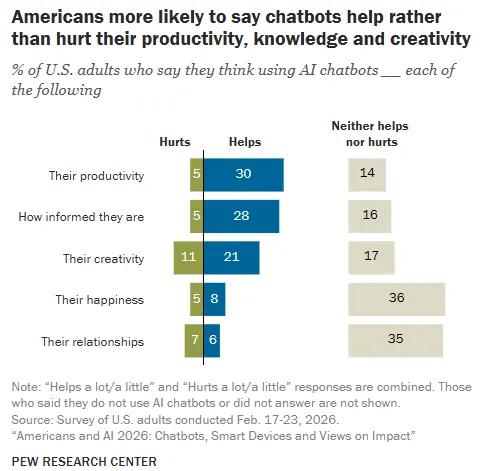
Beyond specific use cases, the Pew Research study sheds light on the perceived value proposition of AI chatbots. A substantial 30% of respondents indicated that these tools tangibly improve their productivity and help them stay informed. This metric is crucial for understanding the long-term viability and integration of AI into daily routines. For professionals, students, and general users alike, the ability to quickly draft emails, brainstorm ideas, summarize documents, or understand complex subjects can translate into significant time savings and enhanced efficiency.
This “productivity dividend” is a key driver of continued adoption. As AI models become more sophisticated and integrated into various software applications, their potential to streamline workflows across industries will only grow. For example, marketing professionals can use AI to generate ad copy, educators can create lesson plans, and customer service agents can leverage AI for quick access to information, all contributing to a more efficient operational environment. The role of AI as an “informer” also speaks to its capacity to democratize access to knowledge, offering personalized explanations and summaries that cater to individual learning styles and information needs.
The Web Publisher’s Dilemma: AI Overviews and Referral Traffic
One of the most profound implications of the rise of AI chatbots, particularly those integrated into search engines, concerns the ecosystem of web publishing and referral traffic. The Pew study highlights a growing trend: a significant portion of users who encounter Google’s AI Overviews are utilizing them directly, rather than clicking through to the underlying source links. This presents a considerable challenge for web publishers, content creators, and businesses that rely heavily on organic search traffic for visibility, advertising revenue, and customer acquisition.
Google’s introduction of AI Overviews, which provide direct, generative AI-powered answers at the top of search results pages, was initially met with mixed reactions. While Google maintained in August 2023 that these AI previews were not significantly impacting overall referral numbers—arguing that users shown AI overviews actually saw more links and tapped through to a broader range of websites—the Pew data offers a counter-narrative. The inclination of users to consume information directly from the AI-generated summary rather than venturing further down the search results page or clicking external links suggests a shift in information consumption patterns.
This shift poses an existential threat to business models built on advertising impressions and referral clicks. If users increasingly find their answers within the AI overview, the incentive to create original, in-depth content for external websites diminishes. Publishers may face declining ad revenues, reduced brand exposure, and a struggle to monetize their intellectual property. The challenge for Google and other search providers is to balance the utility of direct AI answers with the imperative to sustain a healthy and vibrant web publishing ecosystem, which ultimately feeds the AI models themselves. Strategies like prominently crediting sources, offering clear pathways to original content, and exploring new monetization models for publishers within the AI-driven search environment will be critical.
Competitive Landscape and Future Outlook
The insights from Pew Research underscore the intense competition within the AI chatbot market. While ChatGPT enjoys a substantial lead, the rapid evolution of Google Gemini, Microsoft Copilot, and Claude suggests that the landscape is far from static. Each major player is investing billions in research and development, aiming to differentiate their offerings through unique features, superior performance, ethical guidelines, or seamless integration into their respective product ecosystems.
Google’s strategy with Gemini, for instance, focuses on multimodal capabilities, allowing it to understand and process not just text but also images, audio, and video, aiming for a more holistic AI experience. Microsoft’s Copilot leverages its deep integration with Windows and enterprise software to offer productivity enhancements directly within popular applications. Anthropic’s Claude prioritizes safety and interpretability, positioning itself as a more reliable and less “hallucinatory” alternative, particularly appealing to businesses with stringent compliance requirements. Meta AI, integrated across Meta’s social platforms, aims to bring generative AI to everyday communication and content creation for billions of users.
The ongoing “AI race” is not merely about market share but also about shaping the future of digital interaction. As these platforms evolve, they will likely become more personalized, proactive, and embedded in various aspects of life, from education and healthcare to entertainment and commerce. The data suggests that for now, utility and ease of access are paramount for the average user, with “search assistance” acting as the primary gateway to AI adoption.
Broader Implications and Challenges
The Pew data provides crucial context for understanding the broader implications of this “major shift in digital connectivity.” While the growth in AI usage is undeniable, the insights also suggest that the transformation may not be as universally profound or immediate as some proponents predict. The primary value drivers—productivity and information access through search—are significant but perhaps less revolutionary than the grander visions of fully autonomous AI agents or widespread creative AI applications.
Nonetheless, the shift carries profound implications across various sectors:
- For Businesses: Companies must adapt their digital strategies to account for AI-driven search. This includes optimizing content for AI summarization, exploring direct integrations with AI platforms, and rethinking customer engagement models.
- For Education: AI chatbots are becoming indispensable tools for students and educators, offering personalized learning, research assistance, and content generation. However, this also necessitates new approaches to academic integrity and critical thinking skills.
- For Policy Makers: The rapid adoption of AI raises critical questions about data privacy, algorithmic bias, misinformation, and the future of work. Regulatory frameworks are struggling to keep pace with technological advancements.
- For Society: The long-term impact on human cognition, information consumption habits, and the nature of creative work remains a subject of intense debate and research. The potential for AI to exacerbate existing inequalities or create new forms of digital divides also needs careful consideration.
In conclusion, the Pew Research study offers a vital snapshot of AI chatbot adoption in the U.S. at a pivotal moment. It confirms ChatGPT’s dominant position, highlights the centrality of search-related functions for consumers, and reveals the complex challenges facing web publishers due to AI overviews. While the “AI shift” is clearly underway, its trajectory is being shaped by practical utility and perceived value, rather than merely technological novelty. The coming years will undoubtedly witness continued innovation, fierce competition, and an ongoing societal dialogue about the most effective and ethical ways to integrate artificial intelligence into the fabric of our digital lives.