

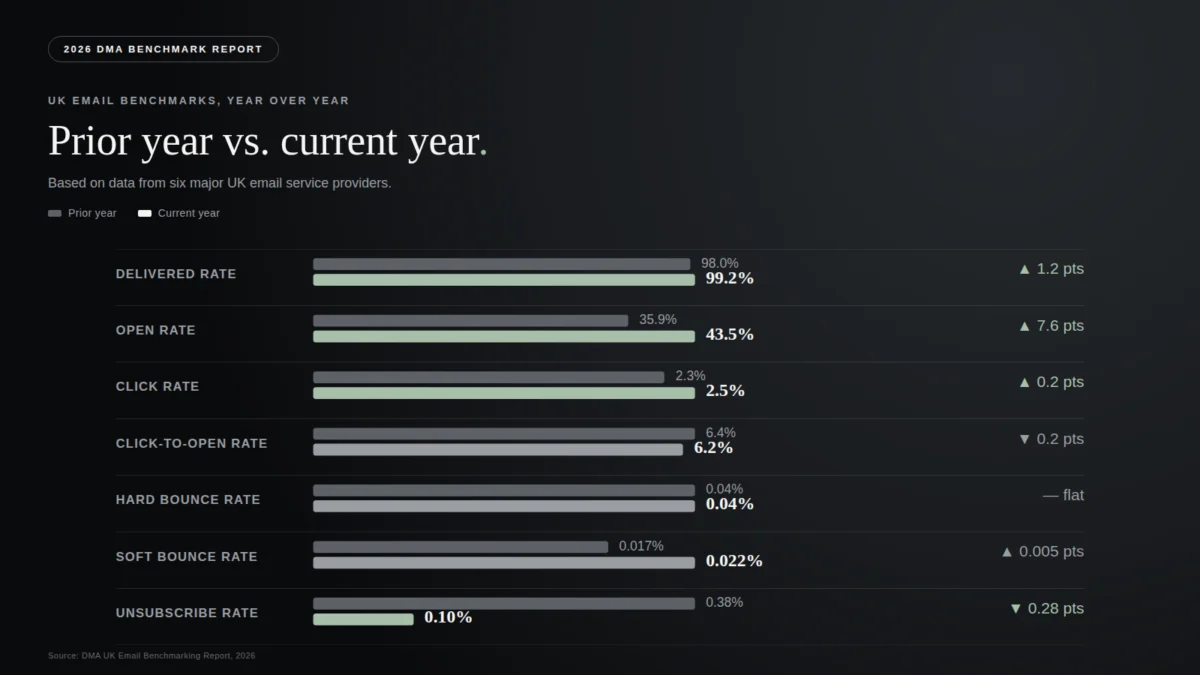
The fiercely competitive realm of email marketing demands a constant re-evaluation of what constitutes "good" performance. The latest DMA (Data & Marketing Association) UK Email Benchmarking Report for 2026, proudly sponsored by Validity, offers an unparalleled lens into the current state of the channel, meticulously delineating the benchmarks that separate proficient programs from truly exceptional ones. This comprehensive analysis, drawing upon aggregated data from six prominent email service providers, provides the most robust and complete overview of UK email performance available today. Its insights are crucial for marketers aiming to leverage email’s immense potential for revenue generation and to navigate the increasingly complex digital ecosystem. The report underscores a dynamic shift in how email effectiveness is measured, moving beyond traditional metrics to embrace a more holistic understanding of subscriber engagement and brand value.
Contextualizing the UK Email Marketing Landscape
The Data & Marketing Association (DMA) has long been a pivotal force in shaping best practices and providing critical insights for the marketing industry in the UK. Its annual benchmarking reports are eagerly anticipated, serving as vital guides for businesses seeking to optimize their digital strategies. This year’s report arrives at a time when digital communication channels, particularly email, are under increased scrutiny due to evolving consumer privacy expectations, technological advancements like Artificial Intelligence (AI), and stricter enforcement by mailbox providers. Validity, a global leader in email deliverability and sender reputation, brings its deep expertise to the sponsorship, reinforcing the report’s focus on the technical underpinnings of successful email programs. Their collaboration highlights the growing importance of deliverability as a cornerstone of effective email marketing, moving beyond mere content creation to ensure messages actually reach their intended audience. The UK market, characterized by its mature digital adoption and stringent regulatory environment (including GDPR), presents unique challenges and opportunities that this report seeks to illuminate, offering localized insights that are often lost in broader global analyses.
Positive Trends Amidst Shifting Sands: The Headline Numbers
Overall, the 2026 report paints an encouraging picture for the email channel in the UK, signaling a resilient and adaptable marketing tool. Year-over-year data indicates a general uplift in key performance indicators, reflecting marketers’ increasing sophistication in leveraging email for customer acquisition, retention, and engagement. While specific figures can fluctuate across industries, the overarching narrative is one of continued growth and strategic importance for email within the marketing mix. This positive trajectory can be attributed to several factors: enhanced personalization capabilities, greater emphasis on subscriber consent, and the integration of email with broader customer relationship management (CRM) systems, leading to more targeted and relevant communications.
However, a deeper dive into sector-specific performance reveals significant variances, underscoring the nuanced nature of email engagement. Retail and travel sectors, for instance, recorded comparatively lower click-through rates (CTR) at 1.0 percent and 1.2 percent respectively. This might initially seem concerning, suggesting a struggle for engagement in these highly competitive consumer-facing industries. Yet, as the report later elaborates, these numbers may not reflect a true decline in performance but rather a transformation in how engagement is measured and attributed, particularly due to the influence of AI. In stark contrast, the B2B sector demonstrated a remarkable improvement in delivered rates, climbing from 90.7 percent to 95.6 percent. This substantial jump is a clear indicator of a heightened focus within B2B organizations on refining their acquisition strategies and rigorously maintaining list hygiene. This could be driven by a greater understanding of data quality’s impact on lead generation, compliance efforts, and a professionalization of B2B digital marketing teams investing in tools and practices to ensure their valuable messages reach decision-makers. Such improvements in foundational metrics like delivered rates lay the groundwork for better overall ROI in a channel critical for complex sales cycles.
Delivery is Not Deliverability: The Critical Distinction
One of the most profound takeaways from the report is the crucial distinction between "delivery" and "deliverability." While a reported delivered rate of 99.2 percent might appear robust on the surface, it offers an incomplete and potentially misleading view of email effectiveness. "Delivery" simply means an email has been accepted by the recipient’s mail server. It does not, however, guarantee that the email successfully landed in the subscriber’s primary inbox. This is where "inbox placement rate" (IPR) becomes the indispensable metric. IPR measures the percentage of emails that actually reach the inbox, bypassing spam folders, promotional tabs, or being blocked entirely.
Globally, IPRs currently hover around 87 percent, implying that approximately one in every eight legitimate, permission-based marketing emails fails to reach its intended destination. The UK average IPR, while slightly better at around 91 percent, has experienced a decline of more than two percentage points. This downturn is largely attributed to mailbox providers intensifying their enforcement of bulk sender requirements. Major email service providers (ESPs) such as Microsoft, which commands roughly a 30 percent share of UK inboxes, have implemented more stringent filtering algorithms and reputation checks. Microsoft Outlook and Hotmail are notoriously challenging environments for senders, often requiring meticulous adherence to best practices in authentication (SPF, DKIM, DMARC), sender reputation, and engagement signals. This heightened scrutiny means that even well-intentioned marketers can find their emails diverted or blocked if their sending practices, list quality, or content do not meet the evolving standards set by these gatekeepers. For revenue leaders, monitoring and optimizing IPR should be the paramount concern. A typical sender operating at a 90 percent inbox placement rate has an immediate, significant opportunity for a double-digit revenue lift without needing to invest additional resources in content creation or creative design. Improving IPR by even a few percentage points can translate into substantial financial gains, as more messages directly reach the customer, increasing the likelihood of engagement and conversion. This emphasizes the strategic importance of investing in deliverability tools and expertise to ensure marketing efforts are not wasted at the first hurdle.
The Evolving Click Story: AI’s Influence on Engagement
While overall click-through rates have shown only a modest increase, a more significant and complex transformation is occurring beneath the surface, largely driven by the burgeoning influence of Artificial Intelligence. AI-powered email summaries and smart assistants, integrated into many modern inbox environments (e.g., Gmail’s AI features, Microsoft’s Copilot), are increasingly capable of identifying and surfacing key calls-to-action (CTAs) directly within the inbox preview or summary. This means a subscriber might click a link directly from an AI-generated snippet without ever formally "opening" the email itself.
This paradigm shift presents a double-edged sword for marketers. On one hand, it can accelerate the customer journey, driving traffic to landing pages more efficiently by presenting high-intent links upfront. On the other hand, it fundamentally alters the dynamic of engagement, as senders effectively cede the initial "click decision" to an AI’s interpretation of which link is most relevant or important. This loss of direct control over the initial interaction means that the traditional narrative arc of an email, designed to lead the reader through content to a specific CTA, might be bypassed. This phenomenon likely contributes to the seemingly "weak" sector numbers observed in retail and travel. It’s improbable that these sectors genuinely experienced a halving of their click performance year-over-year. Instead, the more plausible explanation is that AI summaries and assistants are facilitating fewer, but higher-intent, clicks. Subscribers who click via AI summaries are often already primed and clear about their purpose, leading to potentially higher conversion rates downstream, even if the raw click numbers appear lower in traditional analytics. Consequently, the real challenge for marketers is not necessarily declining performance but an urgent and critical need for sophisticated, multi-touch attribution models. Without these, understanding the true impact of email campaigns and the journey subscribers take when AI intermediates the initial engagement becomes incredibly difficult, leading to misinformed strategic decisions and undervalued marketing efforts.
The "Brand Billboard" Effect: Unlocking Value from Inactive Subscribers

A significant proportion of any email program’s subscriber list, often as much as 50 percent, consists of "inactive" users – individuals who haven’t opened or clicked an email within a defined period (e.g., 6-12 months). Marketers frequently harbor a reluctance to mail these segments, primarily driven by concerns about negatively impacting deliverability metrics through low engagement signals or increased spam complaints. However, this cautious approach often overlooks a substantial hidden value: email’s persistent role as a "brand billboard" in the inbox.
Even without direct engagement like opens or clicks, subscribers consistently encounter sender names and subject lines. This passive exposure contributes significantly to brand recall, recognition, and overall brand equity. The report highlights that when these indirect, "alternative responses" are factored into the equation, inactive subscribers can astonishingly account for approximately 25 percent of an email program’s total revenue. This revenue is not driven by direct email engagement but rather by the cumulative impact of brand reputation. A subscriber who consistently sees a brand’s emails in their inbox, even if they don’t open them, builds a subconscious familiarity and trust. This can translate into actions such as directly visiting a store, searching for a product review online, navigating straight to the brand’s website via a search engine, or even making an offline purchase. These actions, while not directly attributable to a specific email open or click, are undeniably influenced by the continuous, subtle presence of the brand in the inbox. This "billboard effect" provides a compelling argument for reassessing list suppression strategies and for incorporating brand-driven metrics into program valuation. It suggests that a blanket suppression of inactive segments might inadvertently cut off a valuable, albeit indirect, revenue stream, emphasizing the need for a more nuanced approach to list management that considers the broader, long-term impact of brand visibility.
Re-evaluating Opens: A Diminished, But Not Useless, Metric
The "open rate" has historically been a cornerstone metric in email marketing, signaling initial engagement and the effectiveness of subject lines and sender names. However, the report cautions that its utility as a standalone success metric has significantly diminished. Data from Zeta Global, a contributor to this year’s report, reveals a striking discrepancy: unique opens were recorded at 40 percent, while the "true open" rate – stripped of mailbox provider inflation – stood at a mere 11 percent. This implies that roughly three-quarters of recorded opens may not represent a genuine human interaction but rather automated processes.
Several factors contribute to this inflation. Mailbox providers often pre-fetch images in emails for security scanning, which can trigger an "open" pixel even if a human subscriber never actually views the message. Furthermore, privacy-enhancing features, such as Apple Mail Privacy Protection (MPP) introduced in 2021, automatically load all remote content, including tracking pixels, when an email is received, regardless of whether the user opens it. Validity’s own observations corroborate this, with many customers reporting significant drops in Gmail open rates in Q1, primarily due to changes in Gmail’s image-fetching behavior and general inbox updates. Crucially, click rates for these same customers remained stable during the same period, confirming that subscriber engagement had not genuinely collapsed.
Despite these limitations, open rates still retain some directional value. They remain useful for relative comparisons in A/B testing (e.g., an 80 percent open rate in one version still outperforms a 60 percent rate in another, assuming consistent pre-fetching). Moreover, for Apple-based traffic specifically, an open is only recorded when a message has genuinely achieved inbox placement and the user has viewed it, making it a more reliable signal in that specific context. However, the overarching recommendation for marketing leaders is clear: stop treating open rate as a definitive, standalone measure of success. Its volatility and susceptibility to technical inflation necessitate a pivot towards more robust and verifiable engagement metrics.
From Static Testing to Continuous Optimization: The AI-Driven Evolution
The traditional paradigm of A/B testing, which involves methodically testing one variable at a time (e.g., subject line A vs. subject line B), is rapidly losing its relevance in the age of advanced processing power and artificial intelligence. The sheer volume of data, coupled with sophisticated AI algorithms, now enables marketers to treat an entire email program as a dynamic, continuous testing environment. In this evolving landscape, improvements are no longer identified through scheduled, isolated test cycles but are instead discovered and implemented automatically, often in real-time, based on continuous learning and adaptation.
This shift towards continuous optimization, often powered by machine learning, allows for multivariate testing on a massive scale, optimizing elements like send time, content variations, personalization tokens, and even sender reputation in an ongoing fashion. What remains immutable, however, is the critical need for meticulous measurement. The focus, however, shifts to a more sophisticated array of signals that provide a clearer picture of true engagement and long-term value:
- Inbox Placement Rate (IPR): The fundamental metric ensuring messages reach the intended destination.
- Reply Signals: Direct responses from subscribers, indicating a high level of engagement and interest.
- Conversion Rates: The ultimate measure of direct ROI, tracking desired actions post-email.
- Bounce Rates (Hard & Soft): Indicators of list health and deliverability issues.
- Spam Complaint Rates: Critical for sender reputation; low rates are essential.
- Unsubscribe Rates: Tracking audience fatigue and content relevance.
- Time Spent on Landing Pages: A deeper indicator of content interest beyond just a click.
- Forwarding & Sharing: Evidence of highly valuable content that recipients deem worthy of sharing.
These sophisticated signals collectively support the adoption of a newer, more comprehensive Key Performance Indicator (KPI) that merits attention from the C-suite: Return on Relationship (RoR). Unlike traditional last-touch attribution models, which often oversimplify the customer journey, RoR tracks the cumulative impact of various interactions over time. This includes opens, clicks, repeat purchases, retention rates, and even passive brand exposure. RoR captures whether a history of consistent, relevant email engagement is effectively building enough trust and brand loyalty to make the next message worthwhile, fostering long-term customer value rather than just transactional gains. It acknowledges that customer relationships are built over time through a series of interactions, not just a single conversion event, and that email plays a crucial role in nurturing these relationships.
The Bottom Line for Email ROI: Strategic Priorities for Future Leaders
Translating these insightful benchmarks into tangible revenue growth requires a strategic recalibration of priorities for marketing leaders. Three critical imperatives emerge for those aiming to elevate their email programs and secure a competitive edge:
- Prioritize Deliverability as a Core Business Function: Move beyond merely tracking "delivered" rates to obsessing over Inbox Placement Rate (IPR). This involves investing in robust deliverability tools, monitoring sender reputation, ensuring proper email authentication (SPF, DKIM, DMARC), and maintaining impeccable list hygiene. Recognise that every percentage point increase in IPR directly translates to more eyes on your message and a direct uplift in potential revenue.
- Redefine Engagement and Attribution in an AI-Driven World: Acknowledge that AI-generated summaries and intelligent inboxes are fundamentally altering how subscribers interact with emails. This necessitates a shift from simplistic last-click attribution to sophisticated multi-touch attribution models and the adoption of metrics like Return on Relationship (RoR). Marketers must understand the indirect pathways to conversion and attribute value across the entire customer journey, recognizing the "brand billboard" effect of inactive subscribers.
- Embrace Continuous Optimization Powered by Advanced Analytics and AI: Abandon the limitations of periodic A/B testing in favor of an always-on, AI-assisted optimization approach. Leverage data analytics to identify micro-segment opportunities, predict optimal send times, personalize content dynamically, and make real-time adjustments. This proactive, adaptive strategy ensures that email programs are constantly evolving and improving, maximizing efficiency and impact without manual intervention.
The email channel continues to be a powerhouse for digital marketing, but its effectiveness is increasingly tied to a nuanced understanding of its evolving dynamics. Programs that are meticulously built to measure the right things—inbox placement, genuine reply signals, and the strength of long-term customer relationships, rather than inflated opens and misleading clicks—are the ones poised to emerge as the new leaders in next year’s benchmarking reports. Forward-thinking teams already leveraging solutions like Validity Engage are actively embedding this continuous, AI-assisted optimization into their daily program management. This approach transforms the annual benchmarking report from a mere "report card" into an ongoing practice of excellence, ensuring that email remains a potent and profitable engine for business growth in an increasingly complex digital landscape. By focusing on these strategic priorities, marketers can unlock the full potential of their email investments, driving sustainable revenue and fostering deeper customer relationships.








