

Modern digital optimization programs frequently produce extensive lists of tactical victories, yet few can provide a Chief Financial Officer with a precise accounting of how those wins translate into incremental revenue. This discrepancy is often dismissed as a reporting failure, but industry experts suggest the issue is rooted in the foundational stages of strategy: how organizations determine which customer data points warrant action. In the current economic climate, where digital transformation budgets are under increased scrutiny, the ability to distinguish between observational correlations and causal revenue drivers has become the primary differentiator between successful and stagnant marketing departments.
Customer data only generates tangible value when it alters a business decision that would have otherwise remained unchanged, and only when the resulting outcome outweighs the total cost of implementation and long-term maintenance. For data-driven organizations, the challenge lies in identifying which segments of customer information can pass this "Crossover Test" before significant capital is committed to building personalized experiences.
The Correlation Trap: Distinguishing Between Fast Growth and Personalization Efficacy
A frequently cited 2021 study by McKinsey & Company found that high-growth companies generate approximately 40% more of their revenue from personalization than their slower-growing counterparts. While many marketing executives interpret this as definitive proof that personalization is the engine of growth, a deeper analysis reveals a potential "selection bias." High-growth companies typically possess larger budgets, more sophisticated data infrastructure, and superior engineering resources. In this context, personalization may be a symptom of success rather than its primary cause.
The danger of misinterpreting such data was famously illustrated by researchers at Yahoo. In an analysis of display advertising, the team studied whether seeing a brand’s ad increased the likelihood of a user searching for that brand. Observational data suggested a massive "lift" of between 870% and 1,200%. However, when the researchers employed a randomized controlled trial (RCT) with a dedicated holdout group, the actual lift was revealed to be a mere 5.4%. The vast majority of the "lift" seen in the observational data was attributed to users who were already planning to search for the brand, regardless of whether they saw the ad.
This gap between observational data and causal reality was further popularized by Ron Kohavi and Stefan Thomke in the Harvard Business Review. Their analysis underscored a fundamental truth in digital commerce: customer data is exceptional at describing historical behavior, but it is inherently limited in predicting how those same customers will respond to a novel experience. Consequently, many highly researched audience segments generate more operational overhead than incremental profit.
The Crossover Interaction: The Only True Justification for Personalization
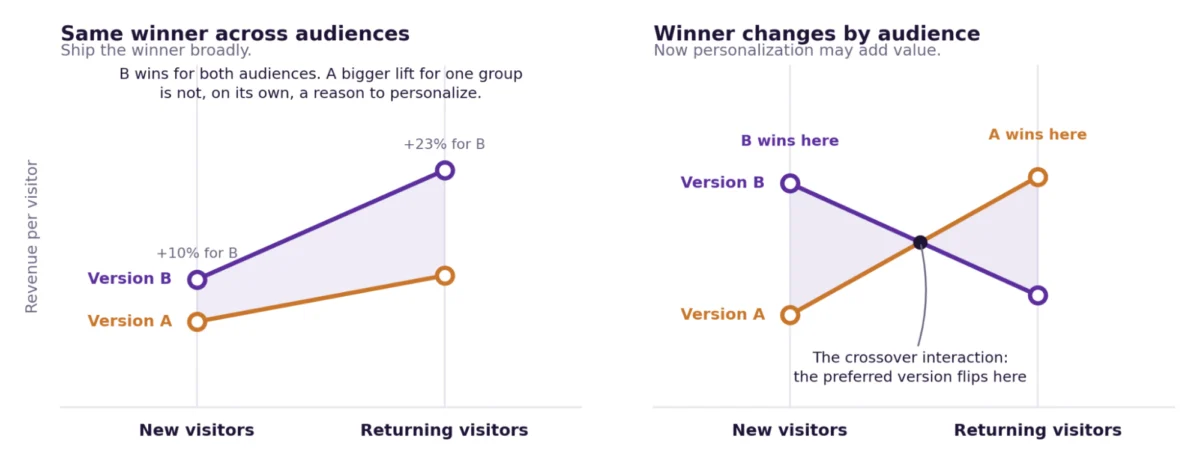
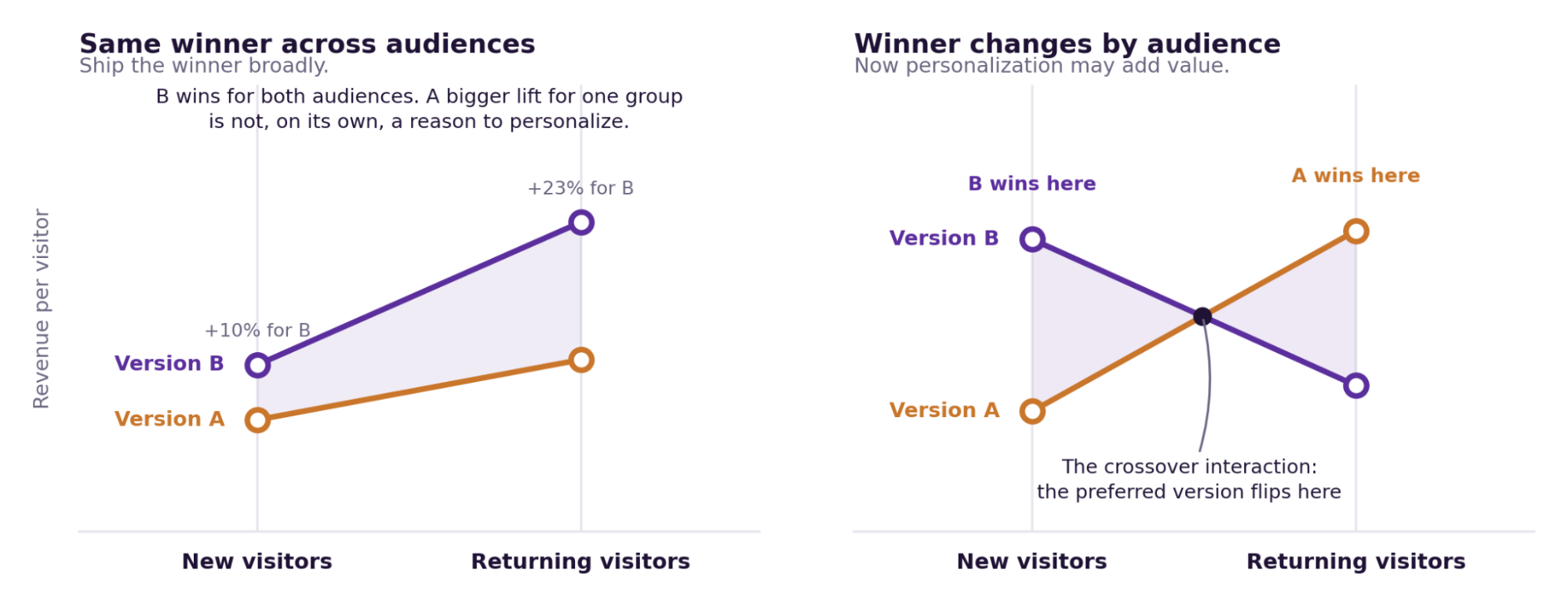
The primary misconception in modern optimization is the belief that different customer segments automatically require different digital experiences. To illustrate this, consider a standard A/B test on a product detail page. If Version B outperforms Version A by 3% for general visitors and by 9% for returning customers, the instinctive reaction is to create a personalized experience specifically for the returning group.

However, from an efficiency standpoint, if Version B is the winner for everyone, the most profitable decision is to deploy Version B globally. This captures the gains across all segments without the added costs of maintaining separate codebases, creative assets, and tracking rules. The strategic case for personalization only begins when a "crossover interaction" occurs—meaning Version B wins for Group X, but Version A wins for Group Y.
Without a crossover interaction, a complex targeting strategy is at an immediate disadvantage. It introduces technical debt, increases the surface area for bugs, and requires ongoing QA (quality assurance) for an outcome that could have been achieved through a simple, universal rollout.
New Research: The Wharton Study on Personalization Value
Recent academic research has quantified the volatility of personalization returns. Anya Shchetkina and Ron Berman of the Wharton School recently published a study testing five common personalization methods across two large-scale field studies. Despite the studies having nearly identical setups—including approximately 20 variations and similar high-performing versions—the results were starkly different.
In the first study, personalization outperformed a universal rollout of the best version by 18%. In the second study, the gain was only 4%. The 4x difference in value was not a result of the personalization algorithm’s sophistication but rather the nature of the customer data itself. In the first instance, the data successfully identified groups that responded differently to the experiences; in the second, the data failed to provide actionable distinctions.
This leads to a critical realization for data scientists and marketers: an increase in the volume of customer data does not correlate linearly with the value of personalization. Value is only unlocked when data identifies meaningful differences in how customers respond to specific stimuli.
The Four-Question Diagnostic for Strategic Personalization
Before committing resources to a personalized segment, organizations are encouraged to apply a rigorous four-part diagnostic. If a proposed strategy fails any of these criteria, the most fiscally responsible action is usually a broad rollout of the winning experience.
1. Is there a genuine "flip" in the winner?
The goal is to find a segment where the best-performing version changes. A segment that simply shows a "stronger lift" for the same winner is a reason to accelerate the rollout, not to bifurcate the experience.

2. Was the segment defined a priori?
Data mining after a test is completed often leads to "p-hacking," where random fluctuations are mistaken for significant trends. If a segment is discovered post-hoc, it should be treated as a new hypothesis to be validated in a subsequent test, rather than a definitive conclusion.
3. Is the signal actionable in real-time?
A personalization strategy based on Lifetime Value (LTV) is useless if the system cannot identify the user’s LTV until after they have completed their purchase. The data signal must be available before the decision point in the customer journey.
4. Does the incremental gain exceed the operational cost?
Every personalized rule carries an "annualized incremental cost," including content production, QA testing, platform fees, and reporting overhead.
The Economics of Maintenance: Calculating the Minimum Win Needed
To move personalization from a marketing tactic to a business strategy, teams must calculate the "Minimum Lift Needed" to break even. The formula is:
Minimum Lift Needed = Annualized Incremental Cost of Personalization ÷ Annual Profit Generated by the Eligible Group
Consider a hypothetical scenario where a personalized rule is applied to a segment representing 12% of a site’s 2 million annual visits. If that group generates $960,000 in annual revenue with a 40% profit margin ($384,000), and the cost to maintain the personalization (QA, content, dev time) is $18,000 per year, the "Minimum Win" required is 4.7%. If the test only yields a 3% lift, the personalization actually results in a net loss of $6,500 annually for the business, despite being a "winning" test.
This economic reality was evidenced in a case study involving a major travel and hospitality brand. The company developed a personalized lodging page for premium repeat visitors, which showed a 6% lift in testing. However, because the audience was relatively small and the maintenance costs for seasonal updates were high, the $13,500 in incremental profit was eclipsed by $15,000 in operating costs. The brand ultimately chose to shelf the personalization in favor of broader site improvements that offered higher upside.
Chronology of Digital Optimization: From Testing to Unified Data
The evolution of digital optimization has moved through three distinct phases:
- The Experimental Era (2000–2010): Focus was on simple A/B testing of headlines and buttons. Traffic was treated as a monolithic block.
- The Segmentation Era (2011–2019): The rise of Customer Data Platforms (CDPs) allowed marketers to slice data by device, location, and basic behavior. This led to an explosion of personalization rules, many of which were never audited for ROI.
- The Causal Inference Era (2020–Present): Leading organizations are now moving toward "unified customer profiles." Tools like the Wingify Data Platform are being used to integrate behavioral, purchase, and CRM data to create more sophisticated hypotheses. The focus has shifted from "can we personalize?" to "should we personalize?"
Measuring Cumulative Impact: The Airbnb Methodology
Even when individual tests pass the Crossover Test, the sum of all reported wins often exceeds the actual revenue growth of the company. This "optimization gap" occurs because some significant results are the product of random variation, and others suffer from "decay" over time.
To combat this, researchers Minyong Lee and Milan Shen at Airbnb proposed the use of a persistent holdout group. By keeping a small percentage (e.g., 1–5%) of traffic entirely isolated from all changes shipped by the optimization program, a company can compare the long-term performance of the "accumulated winners" against the baseline experience. This provides the finance department with a credible, empirical estimate of the program’s total contribution to the bottom line, stripping away the noise of individual test reports.
Strategic Implications for the Future
As organizations look toward 2025 and beyond, the focus of personalization will likely shift away from the quantity of rules toward the quality of signals. Running more tests against the same tired audience definitions (e.g., "Mobile Users" or "East Coast Visitors") is unlikely to yield breakthrough results. Instead, the next frontier involves using unified data to identify the "hidden" crossover interactions that are currently obscured by siloed data.
The path forward for optimization teams is to audit their test history. By reviewing the last twenty experiments and identifying where the winning experience genuinely changed by audience, teams can identify a "shortlist" of validated personalization opportunities. For most, this list will be shorter than expected, but it will represent the high-confidence bets that actually justify the complexity of a personalized digital ecosystem. In the words of industry veterans, the most successful strategy is often to ship the winner globally and continue searching for the customer differences that truly change the decision.







