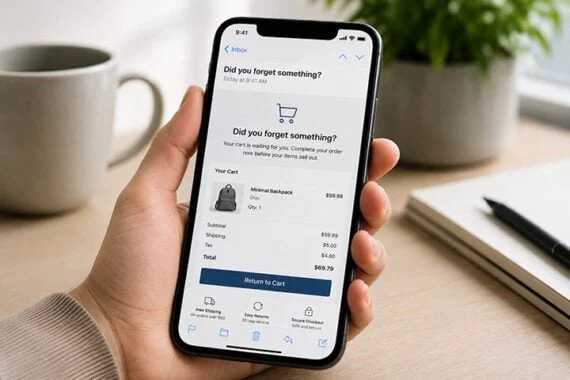
Effective cart abandonment emails and text messages do more than remind shoppers about items left behind. They use product details, reassurance, and incentives to address customer concerns and reopen a conversion path. After three decades of online shopping, cart recovery remains a critical component of e-commerce success, representing a significant opportunity to recapture lost revenue and enhance customer relationships.
The Persistent Challenge of Abandoned Carts
The reality of e-commerce is stark: a substantial portion of online shopping carts are abandoned before a purchase is completed. According to the Baymard Institute, a leading e-commerce research firm, approximately 70% of online shopping carts never convert. This staggering figure translates into billions of dollars in potential revenue left unrealized by online retailers annually. This persistent challenge has driven the development and refinement of automated recovery strategies, with abandoned cart emails serving as a foundational channel for many businesses.
The core difficulty in effective cart recovery lies in the nature of the data captured. When a shopper leaves items in their cart, the e-commerce platform records the outcome – an abandoned cart – but not the underlying reason. While the merchant knows which products were left behind, understanding the specific customer concern that led to the abandonment is not immediately apparent. This lack of insight into the "why" complicates the implementation of targeted and effective recovery tactics.
Obstacles to completing a purchase typically fall into three broad categories:
- Pricing and Cost Concerns: This is perhaps the most common deterrent. Shoppers may be surprised by unexpected shipping fees, taxes, or the overall cost of the items. A perceived lack of value for money or the presence of cheaper alternatives elsewhere can also lead to abandonment.
- Technical and Usability Issues: A clunky website, a complicated checkout process, or technical glitches can frustrate shoppers and drive them away. Issues such as a lack of guest checkout options, mandatory account creation, or slow page loading times can significantly impact conversion rates.
- Decision Paralysis and Information Gaps: Shoppers might leave items in their cart due to a need for more information, a desire to compare options, or simply a change of mind. Concerns about product quality, return policies, or the trustworthiness of the vendor can also contribute to indecision.
Evolving Recovery Tactics to Address Shopper Hesitation
Given these common obstacles, most cart recovery messages employ corresponding tactics designed to mitigate these concerns and entice shoppers back to complete their purchase.
- Product Reminders: The most basic form of recovery, these messages simply remind the shopper of the items left in their cart, often with images and direct links. This addresses simple forgetfulness or a temporary distraction.
- Discount and Incentive Offers: A popular tactic involves offering a discount code, free shipping, or a special promotion to incentivize immediate purchase. This directly addresses price sensitivity and perceived value concerns.
- Urgency and Scarcity: Creating a sense of urgency, such as "limited stock" or "offer expires soon," can encourage faster decision-making. This is particularly effective for popular or high-demand items.
- Social Proof and Reviews: Highlighting positive customer reviews, testimonials, or product ratings can build trust and address concerns about product quality or vendor reliability.
- Addressing Specific Concerns: More sophisticated messages might proactively address common hesitations, such as a clear explanation of the return policy or reassurance about secure payment processing.
While each of these tactics can be effective in recovering a sale, it is crucial to recognize that no single option is a universal fit for every abandoned cart scenario. The effectiveness of a particular tactic often depends on the specific reasons behind the shopper’s abandonment.
The Significant Opportunity in Cart Recovery
The sheer volume of abandoned carts presents a substantial opportunity for e-commerce businesses. Reclaiming even a fraction of these lost sales can significantly boost revenue and profitability. While abandoned cart email remains the baseline recovery channel, its effectiveness is well-documented. According to Ringly, an abandoned cart statistics resource, emails in this category boast an average open rate of 50.5% and a conversion rate of 10.7%. This indicates that a significant percentage of recipients are engaging with these messages and, importantly, completing their purchases.
Emerging channels are also demonstrating impressive performance. SMS and phone outreach, for instance, can often outperform email in terms of engagement and direct recovery rates due to their immediate nature and higher visibility. This suggests a strategic advantage for businesses that diversify their recovery efforts across multiple communication platforms.
The Limitations of Fixed-Sequence Automations
Many existing cart abandonment automations operate on predefined triggers and branches, often referred to as fixed sequences. In this model, merchants define delays, craft messages, and establish conditions for offering incentives. While these rules make cart recovery manageable and scalable, they inherently require merchants to anticipate every conceivable variation in customer behavior and intent.
The challenge with large product catalogs is particularly acute. Products can vary widely in terms of profit margins, the typical consideration period required by customers, and the specific concerns that might lead to abandonment. A single, fixed sequence struggles to account for this diversity. For example, a general discount offered to a shopper who intended to return later without needing an incentive might erode profit margins unnecessarily. Conversely, emphasizing product features for a shopper whose primary concern was high shipping costs misses the mark entirely.

Fixed sequences also tend to make broad assumptions about the shopper’s intent. They may offer a coupon to a shopper who was simply comparing prices and had no intention of buying immediately, or they might highlight shipping benefits to someone who abandoned the cart due to a payment processing error. This lack of nuance can lead to suboptimal recovery efforts and missed opportunities.
Optimizing Recovery: The Manual Approach
Faced with the limitations of rigid automations, marketers have two primary avenues for improving cart conversions and recovery: manual optimization and AI-driven decisioning. The manual approach involves a focused effort on refining existing strategies. Merchants who adopt this path can concentrate on four key areas:
- Audience Segmentation: Instead of treating all abandoned carts equally, merchants can segment their audience based on factors like cart value, product category, customer loyalty, or previous engagement. This allows for the tailoring of messages and offers to specific groups. For instance, high-value carts might receive a more personalized outreach with a premium incentive, while first-time abandoners might receive a gentler reminder.
- A/B Testing Messaging and Offers: Continuous experimentation is vital. Merchants should rigorously A/B test different subject lines, message copy, calls to action, and incentive types (e.g., percentage discount vs. dollar amount discount vs. free shipping). Understanding which variations resonate best with different customer segments is crucial for ongoing improvement.
- Timing and Frequency Optimization: The timing of recovery messages can significantly impact their effectiveness. Sending too many messages too soon can be perceived as intrusive, while waiting too long can mean the shopper has moved on. Testing different send times and cadences, perhaps with a series of messages spread over a few days, can help identify the optimal approach.
- Post-Purchase Follow-Up: While not directly cart recovery, a positive post-purchase experience can indirectly influence future cart abandonment rates by fostering loyalty. This includes prompt shipping, clear communication, and excellent customer service.
Manual optimization necessitates a commitment to better measurement. Key metrics such as revenue per recipient provide insight into the value generated by each recovery sequence. Furthermore, the use of control groups—shoppers who do not receive recovery messages—is essential. This allows merchants to accurately assess whether the outreach is generating incremental sales or simply attributing sales to shoppers who would have converted anyway. This rigorous approach ensures that recovery efforts are genuinely contributing to the bottom line.
The Rise of AI Decisioning in Cart Recovery
A more advanced and increasingly adopted recovery option is what customer engagement platforms term "AI decisioning." This sophisticated approach leverages artificial intelligence to dynamically manage and optimize cart recovery efforts.
An AI decision system works by evaluating a complex array of customer and cart signals. It then compares these signals against a library of approved recovery tactics, which the merchant has pre-defined. Based on this analysis, the AI selects the most opportune message, offer, and timing combination that is most likely to achieve the merchant’s desired outcome, such as completing a purchase.
Under an AI decisioning framework, merchants retain strategic control and define the "what" and "why" of their recovery campaigns. This includes creating a repertoire of recovery treatments—ranging from simple reminders and product reassurance to compelling offers like free shipping or discounts. Merchants also establish crucial parameters such as margin limits, message frequency caps, and eligibility criteria for promotions.
The AI then takes over the "when" and "how" of deployment on an individual shopper basis. It can consider a multitude of factors in real-time, including the current cart value, the specific product types in the cart, the shopper’s past purchase history, and their recent online behavior leading up to the abandonment. This level of granular analysis is beyond the capabilities of static, fixed-sequence automations.
This approach represents a significant departure from conventional email automation. While fixed sequences execute a merchant’s predefined instructions rigidly, AI decisioning dynamically evaluates those instructions for each individual shopper. Crucially, the AI learns from the resulting outcomes—purchases, ignored messages, and continued cart abandonment—to continuously refine its decision-making process.
While an AI model may not explicitly know the shopper’s precise reason for leaving their cart, it can make highly informed attempts based on patterns and correlations observed from vast amounts of data. It identifies which tactics have historically yielded the best results for similar shoppers under similar circumstances, allowing for a more intelligent and adaptive recovery strategy.
The Future of Cart Recovery: Intelligence and Personalization
Ultimately, effective cart abandonment automations must transcend simple reminders. Whether through meticulous manual optimization or the implementation of advanced AI decisioning, the overarching goal should be to identify the most probable obstacle preventing a purchase and strategically remove it. The landscape of e-commerce is continuously evolving, and the ability to adapt and personalize recovery efforts is becoming paramount. By understanding the nuances of customer behavior and leveraging intelligent technologies, businesses can transform abandoned carts from a point of loss into a powerful avenue for driving sales and fostering lasting customer loyalty. The ongoing innovation in this space promises even more sophisticated and effective strategies for reclaiming lost revenue in the years to come.