The latest DMA UK Email Benchmarking Report, sponsored by Validity, provides an indispensable analysis of the rapidly evolving landscape of email marketing, offering a granular look at what distinguishes successful email programs from those merely treading water in a highly competitive digital channel. This comprehensive report, drawing data from six major email service providers, represents the most authoritative view of UK email performance currently available, serving as a vital resource for marketers aiming to optimize their strategies and harness the significant revenue potential of email.
The Evolving Ecosystem of Email Marketing
Email marketing, often lauded for its robust return on investment, is undergoing profound transformations. The digital environment is characterized by heightened user expectations, increasingly sophisticated spam filters, stringent data privacy regulations like GDPR, and the disruptive emergence of artificial intelligence. These factors collectively redefine the benchmarks for success, pushing marketers beyond traditional metrics towards a more holistic understanding of engagement and value. The DMA’s annual report, a staple in the UK marketing calendar, provides a crucial pulse check, helping businesses navigate these complexities by pinpointing where the industry stands and identifying the levers for growth.
The Data & Marketing Association (DMA) has long been at the forefront of advocating for and guiding the marketing industry in the UK. Its annual benchmarking reports are eagerly anticipated, providing data-driven insights that help businesses align their strategies with best practices. Validity, a global leader in email deliverability and sender reputation, serves as a key sponsor, bringing its deep expertise in ensuring emails reach the inbox—a foundational element often overlooked in performance analysis. This partnership underscores the report’s credibility and its emphasis on actionable insights, particularly concerning the often-misunderstood nuances of email delivery versus true inbox placement.
Headline Performance: A Snapshot of the UK Email Landscape
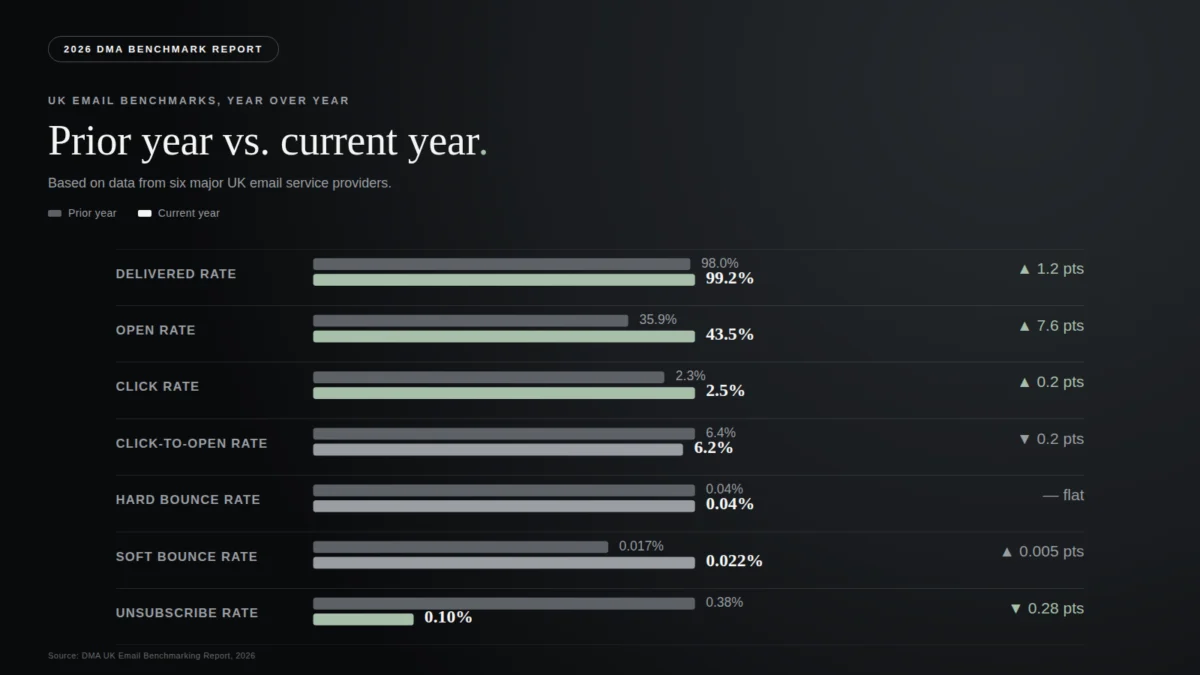
The 2026 report paints a largely positive picture for the email channel overall, indicating a resilient and adaptable marketing medium. Year-over-year trends show an upward trajectory in several key metrics, reflecting concerted efforts by marketers to refine their approaches. While specific percentage changes vary across different metrics, the general sentiment is one of cautious optimism. For instance, delivered rates—the percentage of emails successfully reaching a recipient’s server—have shown consistent improvement, underscoring better list hygiene and technical setup across the board.
However, a deeper dive into sector-specific performance reveals significant variance. The report highlights that retail and travel sectors recorded the lowest click rates, at 1.0 percent and 1.2 percent respectively. This contrasts sharply with sectors like B2B, which posted the most significant improvement in delivered rates, climbing from 90.7 percent to an impressive 95.6 percent. This sharp increase in B2B delivered rates is a clear indicator of enhanced acquisition strategies and meticulous list hygiene practices, as businesses in this segment increasingly recognize the importance of reaching their professional audience effectively. The divergence in performance across sectors underscores the need for tailored strategies, acknowledging that what works for one industry may not translate directly to another.
Beyond Delivery: The Critical Distinction of Inbox Placement Rate
One of the report’s most salient points is the crucial distinction between "delivered rate" and "inbox placement rate" (IPR). A high delivered rate, such as the UK average of 99.2 percent cited in the report, can be misleading. It merely signifies that an email reached the recipient’s mail server, not necessarily that it landed in the primary inbox. Many emails are filtered into spam folders, promotions tabs, or are blocked entirely before ever being seen by the recipient. This is where IPR becomes the true barometer of email effectiveness.
Globally, IPRs currently hover around 87 percent, implying that approximately one in eight legitimate, permission-based marketing emails never makes it to the intended inbox. The UK’s average IPR, while slightly better at around 91 percent, has experienced a concerning decline of over two percentage points. This downturn is largely attributed to mailbox providers tightening their enforcement of bulk sender requirements, a trend that has accelerated in recent years. Microsoft’s email services, which command roughly 30 percent of the UK inbox market, are cited as particularly challenging for senders to consistently achieve high inbox placement. This challenge for UK marketers is a significant one, as missing the inbox means missed opportunities for engagement, conversion, and ultimately, revenue. For any marketing leader focused on maximizing email ROI, IPR is the foundational metric to monitor. Improving a typical sender’s 90 percent inbox placement rate by even a few points can yield an immediate, double-digit uplift in revenue, without requiring any additional investment in content or creative development.
The Shifting Dynamics of Clicks in the Age of AI
While overall click rates have seen a modest increase, the report uncovers a more complex narrative beneath the surface, heavily influenced by the burgeoning role of artificial intelligence. AI-generated email summaries are increasingly surfacing call-to-action links directly within the inbox interface, allowing subscribers to interact with content without ever formally "opening" the email. This functionality, while potentially driving immediate traffic, fundamentally alters the traditional click decision, ceding a degree of control to an AI’s judgment about which link holds the most relevance.
This technological shift likely accounts for the seemingly weak click performance in sectors like retail and travel. It is improbable that these programs genuinely experienced a halving of their click performance year-over-year. A more plausible explanation is that AI summaries and assistants are generating fewer, but potentially higher-intent, clicks. Subscribers who click directly from an AI summary may be more pre-qualified or ready to engage with the specific offer presented. Consequently, the real story here is not necessarily declining performance, but rather an urgent and growing need for more sophisticated attribution models. Traditional last-touch attribution struggles to accurately credit these AI-mediated interactions, necessitating a re-evaluation of how marketers measure the impact of their email campaigns.
The "Brand Billboard" Effect: Valuing Inactive Subscribers
A significant finding from the report challenges conventional wisdom regarding inactive email subscribers. Most email programs inherently carry a segment of inactive subscribers, often constituting as much as 50 percent of the total list. Marketers are typically hesitant to engage this segment, fearing potential negative impacts on deliverability metrics. However, this reluctance overlooks email’s powerful, albeit passive, role as a "brand billboard" in the inbox.
Subscribers, even if they don’t open or click, still see the sender’s name and subject line. This consistent brand exposure, even without direct engagement, can trigger other valuable responses. These "alternative responses" include visiting a store, checking a product review online, or navigating directly to the brand’s website. When these indirect conversions are factored into the equation, inactive subscribers can astonishingly account for roughly 25 percent of a program’s total revenue. This revenue is driven primarily by sustained brand reputation and top-of-mind awareness rather than immediate email engagement. This revelation provides a meaningful number to integrate into any strategic discussion concerning list suppression strategies or overall program valuation, suggesting that a blanket approach to pruning inactive segments might be detrimental to overall revenue.

The Diminished Utility of Open Rates
The report strongly advises against treating open rate as a standalone success metric, emphasizing its diminished utility in the current email landscape. Data contributed by Zeta Global to this year’s report indicates a stark discrepancy: unique opens were reported at 40 percent, compared to a "true open" rate—with mailbox provider inflation stripped out—of just 11 percent. This suggests that approximately three-quarters of recorded opens may not reflect genuine, human interaction.
Validity has corroborated this phenomenon firsthand. In Q1, many of its customers observed significant drops in Gmail open rates. This was primarily explained by changes to Gmail’s image-fetching behavior and general inbox updates, rather than a genuine collapse in subscriber engagement. Critically, click rates for these same customers remained steady over the same period, confirming that subscribers had not disengaged from the content.
While open rates still hold some directional value—useful for relative comparisons in A/B tests (an 80 percent open rate still outperforms 60 percent)—and for Apple-based traffic specifically (where an open is only generated upon actual inbox placement), they are no longer a reliable indicator of active engagement. Marketers must shift their focus to more definitive engagement signals that reflect true user intent and interaction.
From A/B Testing to Continuous, AI-Driven Optimization
The traditional model of A/B testing, which typically involves isolating and testing one variable at a time, is rapidly losing relevance in the face of advanced technological capabilities. The exponential growth in processing power and the sophistication of AI have made it possible to conceptualize and manage an entire email program as a continuous testing environment. In this paradigm, improvements are not identified and implemented through scheduled, episodic test cycles, but rather automatically and iteratively, driven by real-time data analysis and machine learning algorithms.
This shift necessitates a re-evaluation of what signals are measured and prioritized. Marketers must move beyond superficial metrics and focus on indicators that truly reflect customer relationship strength and long-term value. While the original report text left the specific signals blank, logical inferences for such a system would include:
- Reply Signals: Tracking direct responses to emails, indicating high intent.
- Forward Rates: Measuring the viral spread of content, signifying value.
- Time Spent on Content: Analyzing engagement duration with linked content.
- Sentiment Analysis: Gauging emotional responses to email content (where applicable).
- Multi-Channel Engagement: Correlating email activity with interactions across other touchpoints (website, app, social media).
- Conversion Paths: Mapping the journey from email interaction to ultimate purchase or desired action, even if indirect.
These advanced signals underpin a newer Key Performance Indicator (KPI) that warrants boardroom attention: Return on Relationship (RoR). Unlike last-touch attribution, which only credits the final interaction before a conversion, RoR tracks the cumulative impact of all engagement over time—opens, clicks, repeat purchases, retention, and even passive brand exposure. RoR captures whether a history of positive email engagement is building enough trust and affinity to make the next message, and indeed the overall brand relationship, genuinely valuable to the subscriber.
Strategic Imperatives for Future Success
The insights from the 2026 DMA UK Email Benchmarking Report coalesce into three paramount priorities for marketing leaders striving to translate these benchmarks into tangible revenue growth:
-
Prioritize and Optimize Inbox Placement: Marketers must elevate inbox placement rate (IPR) to a primary KPI, dedicating resources to improving sender reputation, adhering to mailbox provider best practices, and leveraging tools that provide granular deliverability insights. This involves meticulous list hygiene, proper authentication protocols (SPF, DKIM, DMARC), and vigilant monitoring of sender scores. The potential for a double-digit revenue lift from optimized IPR makes this an immediate and high-impact area for investment.
-
Adapt to AI-Driven Engagement and Attribution: The rise of AI-generated email summaries and assistants demands a fundamental rethinking of how email interactions are measured and attributed. Marketers need to move beyond simple click tracking and invest in sophisticated multi-touch attribution models that can accurately credit indirect and AI-mediated engagement. This also implies a strategic focus on crafting clear, concise calls-to-action that are easily digestible by AI and human readers alike, ensuring that the most critical links are highlighted effectively.
-
Embrace Continuous, Relationship-Centric Optimization: The era of episodic A/B testing is yielding to continuous, AI-assisted optimization. This requires a shift in mindset towards real-time data analysis and iterative improvements across the entire email program. Crucially, this optimization must be guided by metrics that reflect the strength of the customer relationship, culminating in the adoption of Return on Relationship (RoR) as a core KPI. RoR encourages a long-term view of customer value, recognizing that building trust and fostering sustained engagement yields far greater returns than chasing fleeting, last-touch conversions.
As remarked by a Validity spokesperson, "The report clearly indicates that ‘good enough’ email performance is no longer sufficient. The market demands excellence, and excellence now means deep understanding of deliverability, intelligent adaptation to AI, and a relentless focus on the customer relationship. Tools like Validity Engage are designed precisely for this new reality, allowing teams to build continuous, AI-assisted optimization into their daily operations, transforming benchmarks from annual report cards into ongoing practices of growth."
For the DMA, the report serves as a call to action for the entire industry. "The 2026 Email Benchmarking Report is more than just data; it’s a roadmap," stated a representative from the DMA. "It underscores the incredible power of email when executed strategically, but also highlights the evolving challenges. UK marketers have a clear mandate: innovate, optimize for true inbox success, and measure the enduring value of customer relationships. Those who embrace these principles will be the leaders in the years to come."
The trajectory of email marketing in the UK, as illuminated by the 2026 DMA UK Email Benchmarking Report, points towards a future where success hinges on a blend of technical mastery, strategic foresight, and a profound understanding of customer behavior. Programs built to measure the right things—inbox placement, reply signals, and relationship strength, rather than just superficial opens and clicks—are precisely the ones poised to emerge as the new leaders in subsequent benchmark reports. The time for reactive adjustments is over; the era of proactive, intelligent, and relationship-driven email marketing has arrived.