

The Philosophical Shift: From Objective Data to Subjective Interpretation
For years, the industry standard for digital testing has been rooted in the quest for objectivity—the idea that data, if collected in sufficient quantities, will reveal an undeniable truth. However, Bronzini argues that the concept of objectivity in testing is inherently flawed. Every experiment is shaped by subjective judgment calls: the chosen confidence threshold, the minimum detectable effect (MDE), the sample size requirements, and the specific moment a stakeholder decides to terminate a test.
These parameters are not merely technical settings; they are the architectural blueprints that determine what the data is allowed to say. In this context, "noise" becomes the central protagonist of the experimental narrative. While most teams focus on the "signal"—the measured lift or conversion increase—it is the underlying stochastic noise that dictates whether that signal is visible or entirely obscured. Understanding and modeling this noise is what separates high-growth organizations from those that run hundreds of tests yet fail to see any long-term cumulative impact on their bottom line.

A Chronology of Experimental Methodology
To understand the current state of CRO, one must look at the historical trajectory of A/B testing in the corporate world.
- The Academic Era (Pre-2010): Testing was largely a specialty function derived from clinical trials and academic research. The primary goal was to avoid Type I errors (false positives) at all costs, leading to the near-universal adoption of the 95% confidence interval.
- The Tooling Boom (2010–2018): The rise of accessible platforms like Optimizely, VWO, and Convert.com democratized testing. However, this era was characterized by "significance chasing," where teams often ignored the statistical rigor required to make those tools effective, leading to widespread "regression to the mean."
- The Decision Science Era (2019–Present): Led by practitioners like Bronzini, the industry is beginning to treat experimentation as a resource allocation problem rather than a laboratory exercise. This era focuses on the "Decision Policy," which balances the cost of various error types against the potential for business growth.
The Three Failure Modes of Modern Experimentation
A central tenet of the emerging decision-policy framework is the recognition that experiments fail in three distinct ways, yet the industry typically only prepares for one.
1. The False Positive (The Wrong Winner)
This occurs when a team implements a change that actually has no effect or a negative effect, because random noise pushed the measurement into the "significant" range. Traditional statistical significance (p-values) was designed specifically to guard against this. While effective, focusing exclusively on this error creates a "short blanket" effect—protecting the feet while leaving the rest of the body exposed.

2. The Missed Winner (The Inconclusive Trap)
This is perhaps the most expensive error for a growing company. A "missed winner" happens when a variation produces a genuine improvement, but because of traffic constraints or high variance, the results never cross the arbitrary 95% threshold. These winners are filed away as "inconclusive" and forgotten. In reality, most companies lack the massive traffic required to reach high statistical power (the ability to detect a winner if one exists). Consequently, their "inconclusive" pile is often a graveyard of missed revenue opportunities.
3. The Inflated Winner (The Winner’s Curse)
The third failure mode is the most insidious: shipping a winner whose impact is vastly exaggerated. If a true lift is 3%, but the noise in the data is high, the experiment might only show as "significant" if the noise happens to swing in a positive direction, showing a measured lift of 12%. When the change is deployed, the 12% lift "regresses" back to the true 3%, leading stakeholders to lose faith in the testing program. Strict thresholds do not produce more accurate estimates; they simply ensure that only the most extreme, noise-amplified results are ever selected.
Supporting Data: The Meta-Experiment Simulation
To illustrate these failure modes, Bronzini developed a sophisticated simulation model that replays the same experiment thousands of times under controlled conditions. In one notable scenario, a meta-experiment was designed with a known "true lift" of 3.2% and a sample size of 500 total conversions over a four-week period.
The results were revealing:
- Significance Rate: Using a standard 95% two-tailed confidence interval, only 12 out of 100 runs were identified as "significant."
- Inconclusive Rate: 88 out of 100 runs—nearly 90% of the tests—were labeled as inconclusive, despite there being a real, positive 3.2% improvement.
- Measurement Bias: Among the 12 "winning" runs, the measured lift ranged from 9% to 14%.
This data provides empirical evidence that strict significance testing in low-to-medium traffic environments creates a "filter" that only allows exaggerated results to pass through. This explains why many CRO programs struggle to replicate their "test wins" in their annual financial reports.
The AI Revolution in Implementation and Strategy
As the theoretical side of experimentation shifts toward decision science, the execution side is being transformed by Artificial Intelligence. The most immediate impact has been the near-total removal of the developer bottleneck.
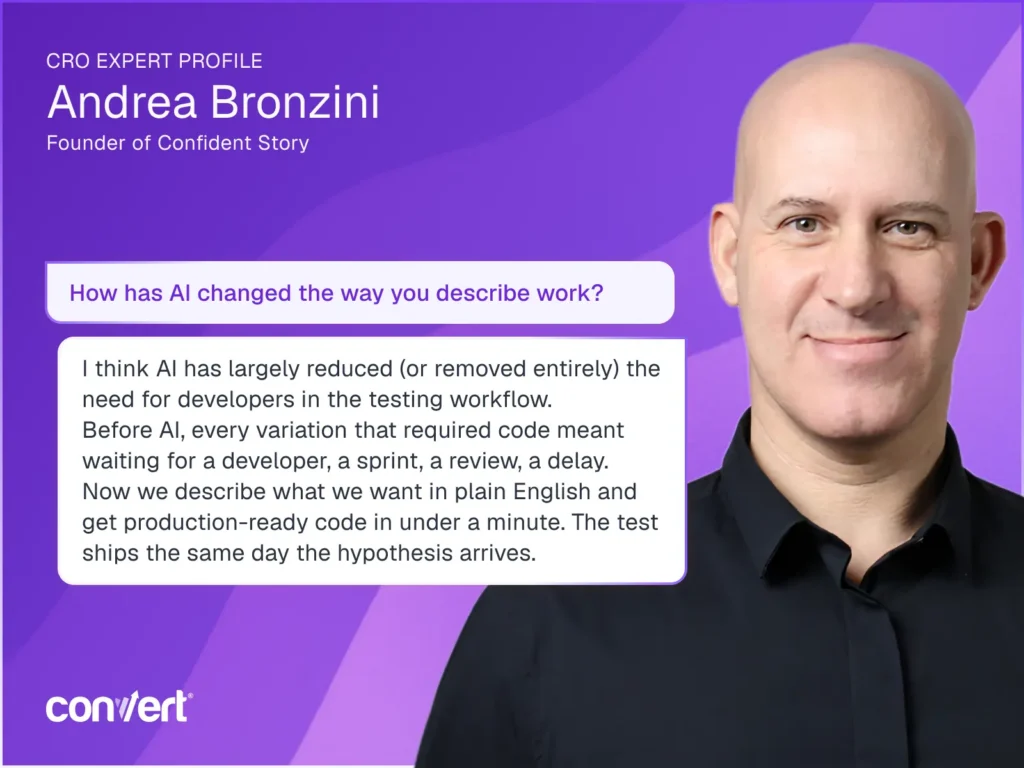
Previously, every experimental variation required a technical workflow: a developer had to write the JavaScript or CSS, followed by a sprint cycle, code review, and QA. This friction often led teams to favor "easy" tests, such as changing button colors or headlines, rather than bold structural changes.
With AI, practitioners can now describe complex UI changes in plain English—such as "reorder the checkout flow to prioritize mobile wallets and move the trust badges above the fold"—and receive production-ready code in seconds. This has two major implications:
- Velocity: Tests can go live the same day a hypothesis is formed.
- Boldness: When the "cost of code" drops to near zero, teams are more willing to test high-risk, high-reward hypotheses that were previously relegated to the permanent backlog.
The Autonomous Testing Loop
The next frontier, already being piloted by firms like Confident Story, is the fully autonomous testing loop. In this model, AI agents perform the following steps without human intervention:

- Insight Generation: Analyzing heatmaps, session recordings, and analytics data to identify friction points.
- Hypothesis Formation: Prioritizing ideas based on potential impact and ease of implementation.
- Variation Creation: Generating the code and creative assets for the test.
- Deployment and Monitoring: Running the experiment through a platform like Convert.com.
- Selection and Iteration: Identifying the winner based on a pre-defined decision policy, deploying it to 100% of traffic, and immediately starting the next cycle.
While this level of automation is technically possible, the consensus among experts is that human judgment remains the most critical component. Humans are needed to ask better questions, understand the deeper psychological nuances of the user base, and define the ethical and strategic boundaries of the "Decision Policy."
Industry Implications and Recommendations
The shift from "significance-seeking" to "decision-policy thinking" requires a change in how performance is measured. Practitioners are encouraged to move away from the binary "Win/Loss" record and instead track:
- Winner Capture Rate: How many of the estimated "true winners" is the program successfully identifying?
- Precision vs. Recall: Balancing the need for accuracy (precision) with the need to not miss out on real improvements (recall).
- Opportunity Cost: Calculating the lost revenue from "inconclusive" tests that were likely positive.
For practitioners to adjust, they must stop treating 95% confidence as a universal law. Instead, it should be treated as a variable. A company with massive traffic might afford a 99% threshold to be absolutely certain, while a startup with limited traffic might accept an 80% confidence level, recognizing that the risk of a false positive is lower than the risk of missing a growth-driving winner.

Conclusion: The Path Forward
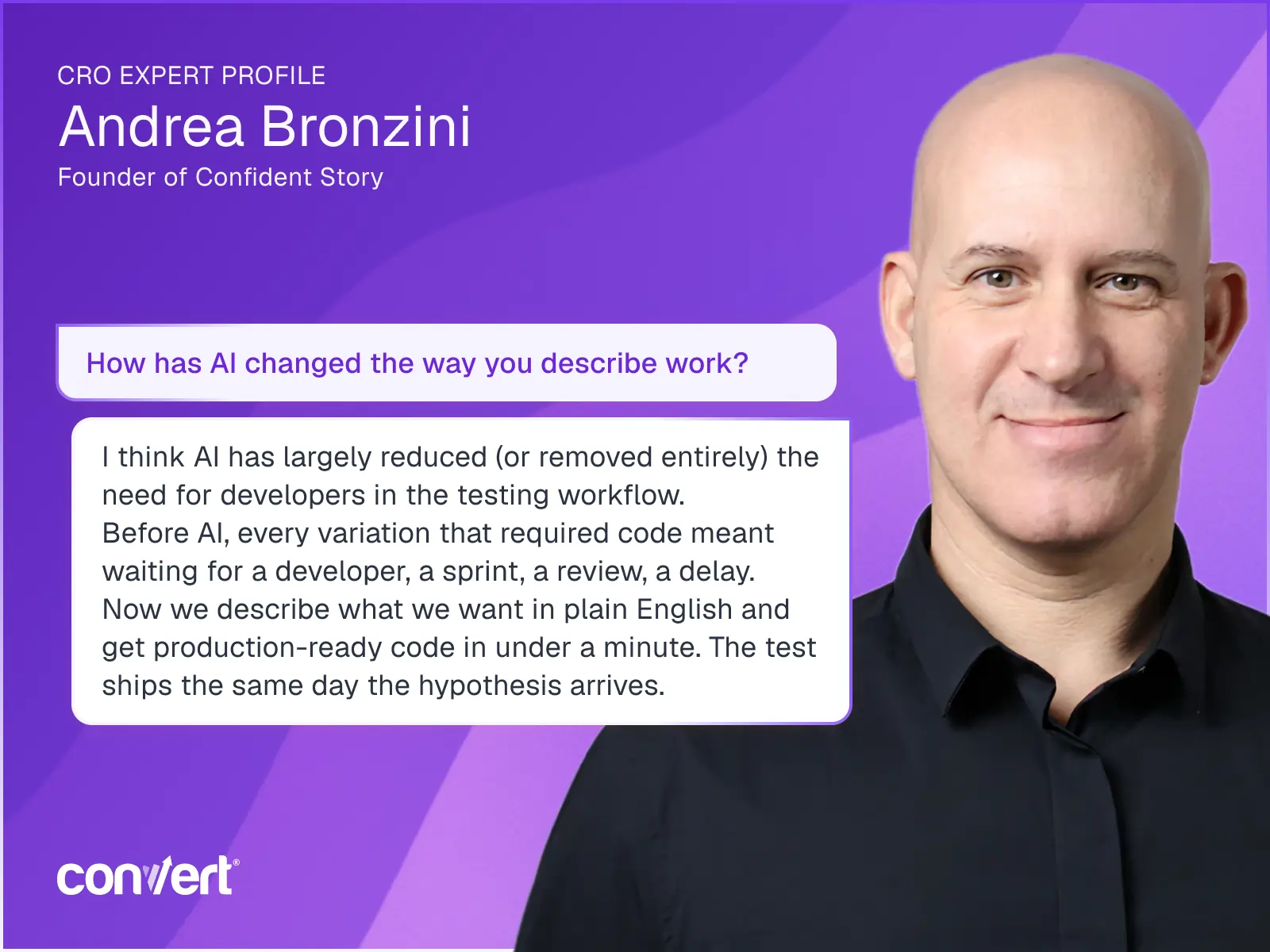
The discipline of optimization is increasingly becoming a "balancing act between errors." As AI takes over the repetitive tasks of coding and deployment, the value of a CRO professional will be found in their ability to design these balancing acts. By embracing the noise rather than fearing it, and by using AI to lower the barriers to experimentation, organizations can move beyond the "inconclusive" plateau and enter a phase of sustained, data-informed growth. The future of the industry lies not in the pursuit of a perfect, objective truth, but in the implementation of smarter, faster, and more courageous decision-making frameworks.







