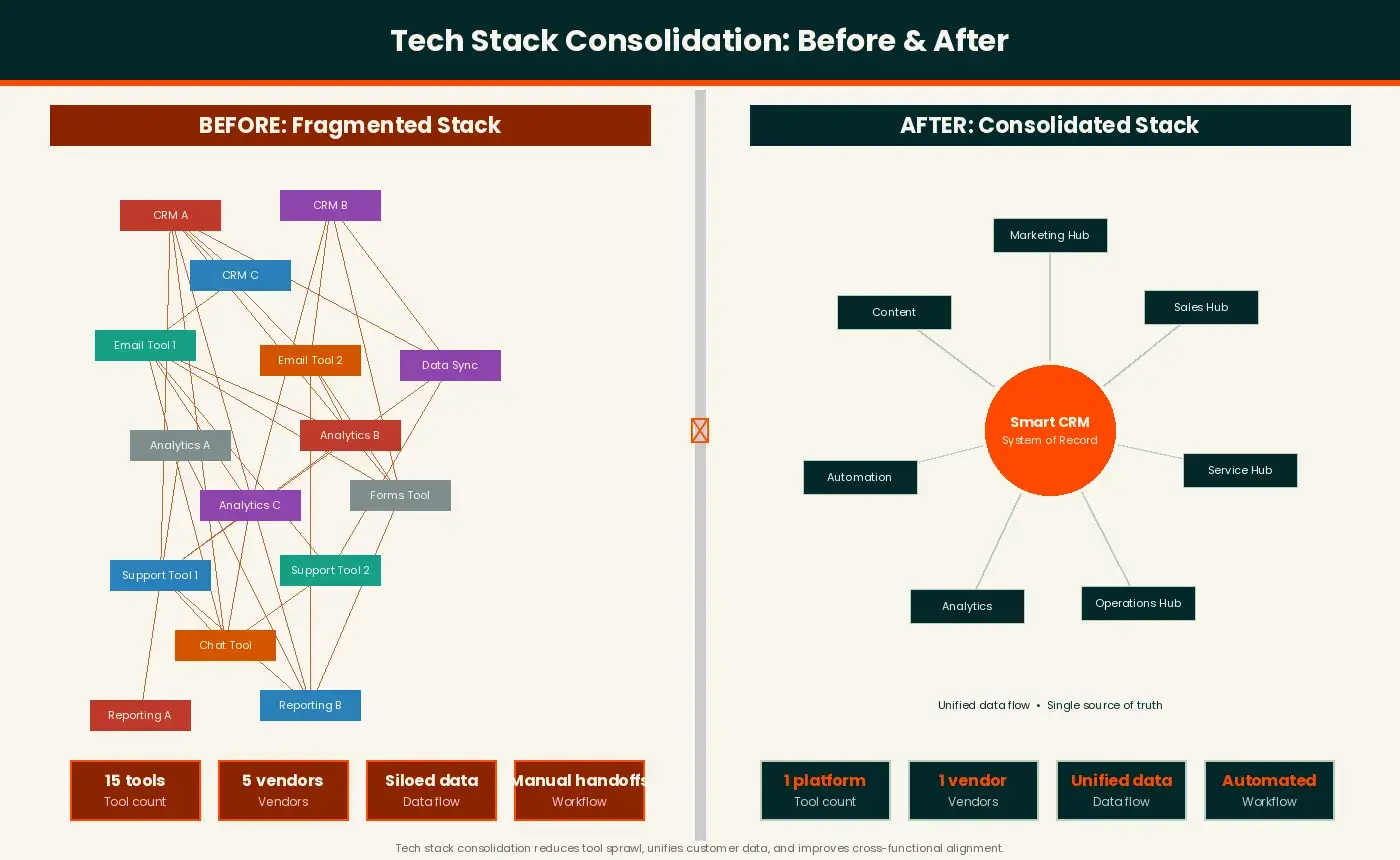
Tech stack consolidation represents a pivotal strategic initiative for modern organizations, moving beyond mere cost-cutting to fundamentally restructure the digital infrastructure that powers business operations and customer interactions. At its core, this process involves reducing the number of disparate software tools an organization employs, standardizing workflows on a smaller, more integrated set of systems. This approach aims to eliminate redundancies, enhance data integrity, and create a seamless operational environment that benefits every facet of a business, particularly those teams directly engaging with customers.
The proliferation of Software-as-a-Service (SaaS) solutions over the past two decades has led to what many refer to as "tool sprawl." While individual departments initially adopted specialized tools to address specific needs, this decentralized purchasing often resulted in fragmented data, redundant functionalities, and complex integration challenges. As a consequence, customer-facing teams frequently found themselves grappling with inconsistent information, struggling to automate processes across the full customer journey, and constantly rebuilding context as a customer moved from marketing outreach to sales engagement and then to post-purchase service. The business case for consolidation, therefore, extends far beyond simply reducing subscription fees; it’s about creating a unified, efficient, and data-driven ecosystem where every team operates from a single source of truth.
A foundational element of successful tech stack consolidation is establishing a robust Customer Relationship Management (CRM) system as the central system of record. This single platform is designed to house all critical customer data, power cross-functional workflows, and serve as the undisputed source of truth for every team that interacts with the customer. By doing so, organizations can ensure that insights derived from customer data are consistent, accurate, and readily accessible, enabling more informed decision-making and a significantly improved customer experience.
Understanding Tech Stack Consolidation and Its Strategic Importance
Tech stack consolidation entails a deliberate strategy to retire redundant tools, standardize operations on a core platform, and meticulously build cleaner, more efficient integrations between the essential tools that remain. This process is distinct from merely cancelling a few underutilized subscriptions. True consolidation demands a strategic decision-making framework: identifying which tools define the primary system of record, which serve as crucial extensions, and which have persisted simply due to inertia. It directly addresses the root causes of tool sprawl, rather than merely managing its symptoms one contract renewal at a time.
The paramount benefit derived from this strategic shift is the unification of customer data. When a CRM system effectively captures every customer interaction – from their initial website visit to subsequent purchases and renewals – internal teams are liberated from the arduous task of reconciling multiple definitions of an "active customer" before every crucial meeting. This unification dramatically accelerates reporting cycles, enables comprehensive automation across the entire customer lifecycle, and profoundly enhances the customer experience by providing representatives with immediate and complete historical context.
While cost savings are a tangible outcome, their importance is often secondary to the operational gains. Industry reports, such as those from Gartner, consistently show that software spending continues its upward trajectory even as organizations adopt more tools. This trend underscores that the true returns on consolidation stem from reinvesting operational efficiencies – better data quality, faster workflows, and fewer integration failures – into core business execution, rather than solely focusing on expenditure reduction. According to a 2023 Gartner CIO and Technology Executive Survey, while organizations seek efficiency, overall IT spending continues to grow, emphasizing the need for strategic investment rather than indiscriminate cuts. This suggests that the goal isn’t just to spend less, but to spend smarter, ensuring every dollar invested in technology yields maximum strategic value.
Chronology of Tool Sprawl and the Rise of Consolidation
The necessity for tech stack consolidation can be traced through the rapid evolution of enterprise software adoption:
- Early 2000s: The Rise of SaaS: The advent of cloud-based software democratized access to specialized tools. Departments could easily subscribe to solutions without significant upfront IT investment, leading to rapid adoption.
- 2010s: Decentralized Procurement and Shadow IT: As SaaS matured, departmental autonomy in software procurement surged. This led to "shadow IT" – applications purchased and managed without central IT oversight – further fragmenting data and creating redundancies.
- Mid-2010s: Integration Challenges Emerge: Organizations began to recognize the growing pains of disparate systems. Data silos made it difficult to get a holistic view of customers or business performance, leading to complex and fragile custom integrations.
- Late 2010s: Focus on Customer Experience: As customer expectations soared, the need for a unified customer view became critical. Companies realized that fragmented tech stacks directly hindered personalized experiences and efficient service delivery.
- Early 2020s: Economic Pressures and Strategic Imperative: Facing economic uncertainties, businesses prioritized efficiency, resilience, and optimizing existing investments. Tech stack consolidation transformed from a "nice-to-have" to a strategic imperative for operational agility and sustained growth.
When to Embark on Tech Stack Consolidation
The decision to initiate tech stack consolidation is typically triggered by a confluence of operational inefficiencies and strategic imperatives. Organizations should consider this undertaking seriously if they observe any of the following indicators:
- Fragmented Customer Data: Customer profiles are scattered across multiple systems, leading to incomplete views and inconsistent outreach.
- Redundant Tooling: Multiple departments are using different software for the same core function (e.g., several email marketing platforms, multiple helpdesk solutions).
- Excessive Integration Maintenance: IT or operations teams spend a disproportionate amount of time building and maintaining custom integrations between disparate tools.
- High Software Spend: The total cost of software subscriptions is escalating without a clear corresponding increase in operational efficiency or business value.
- Inconsistent Reporting: Teams struggle to generate unified, accurate reports dueabling to conflicting data sources and definitions.
- Inefficient Workflows: Manual data transfer, context switching between applications, and repetitive tasks hinder productivity.
- Security Vulnerabilities: A sprawling tech stack increases the attack surface and complicates compliance efforts.
- Poor User Adoption: Employees resist using certain tools due to complexity, lack of integration, or perceived redundancy.
If three or more of these conditions are present, consolidation is no longer merely an optional enhancement but a critical operational fix. As many CIOs and Heads of Operations attest, the optimal time to consolidate isn’t dictated by a specific tool count, but rather when the existing tech stack generates more friction and inefficiency than the tools themselves are designed to resolve.
Broad Benefits Across the Business Ecosystem

Tech stack consolidation yields profound benefits across various departmental functions:
- Marketing: A streamlined marketing technology (martech) stack significantly reduces the time marketers spend battling data discrepancies, allowing them to dedicate more resources to campaign strategy and execution. Attribution modeling becomes more precise when all customer touchpoints feed into a single platform. Automation – from lead nurtures and scoring to lifecycle stage changes – operates seamlessly across the entire funnel, facilitating personalized and timely engagement.
- Sales: Sales representatives operating from a unified CRM platform eliminate the need to toggle between multiple tools to understand a prospect’s history. Pipelines, activity logs, communication sequences, and vital notes all reside in one accessible location. This comprehensive view not only enhances individual rep productivity but also improves forecasting accuracy due to the completeness and reliability of underlying data.
- Service: Support teams gain immediate access to a full customer record – encompassing purchase history, past conversations, and open deals – without ever leaving their helpdesk interface. This contextual richness accelerates issue resolution, minimizes escalations, and critically, prevents customers from having to repeat their information, thereby significantly enhancing customer satisfaction.
- Operations, Finance, and IT: Vendor consolidation simplifies procurement processes, reduces the overall attack surface for cybersecurity threats, and empowers finance teams to accurately reconcile software spend against actual utilization. Operations teams can pivot from maintaining fragile custom integrations to focusing on higher-value strategic work, while IT gains greater control, visibility, and compliance assurance over the entire digital infrastructure.
A Step-by-Step Approach to Tech Stack Consolidation
Effective tech stack consolidation requires a structured, methodical approach. Teams often err by skipping the initial audit phase and moving directly to tool selection. The following steps outline a proven sequence for success:
Step 1: Comprehensive Stack Audit
Begin by compiling a complete inventory of every software tool your organization pays for or utilizes. This must include "shadow IT" – tools acquired and used by departments outside central procurement – and any free services that hold critical data. For each tool, document its owner, cost, renewal date, utilization rates, and how data flows in and out of it.
- Key Artifact: A master tool inventory detailing ownership, cost, renewal date, utilization metrics, and data flow diagrams for every identified tool.
Step 2: Prioritize Categories and Identify Quick Wins
Group similar tools by category (e.g., marketing automation, sales enablement, customer service). Within each category, identify redundant tools, opportunities for immediate cost savings, and critical integration gaps. Prioritizing "quick wins" – projects with low complexity but high impact – helps build momentum and frees up budget for more complex migrations.
Step 3: Define the System of Record and Data Standards
Crucially, decide where core customer data will permanently reside before selecting or retiring any tool. A CRM designated as the system of record implies:
- It serves as the authoritative source for customer data.
- All other tools either feed data into it or consume data from it.
- It orchestrates workflows across the customer journey.
Once the system of record is defined, establish clear data standards: consistent field naming conventions, precise lifecycle stage definitions, and robust deduplication rules. These standards are vital for ensuring predictable integrations and preventing data quality degradation during migration.
Step 4: Strategic Tool Selection
Evaluate each tool against a consistent set of criteria: its core functionality, the extent of its utilization, its integration capabilities with your defined system of record, and its total cost of ownership (TCO). Retain only those tools that demonstrably earn their place by providing unique value, high utilization, and seamless integration. The focus should be on desired business outcomes, not just features.
Step 5: Plan Migrations Without Disruption
Before decommissioning any tool, meticulously plan the migration process. This involves extracting all necessary historical data, thoroughly cleansing and transforming it to align with new data standards, and rigorously testing the new system’s functionality and integrations. Phased rollouts, starting with smaller departments or specific use cases, help identify and address issues early, minimizing broader disruption. Develop comprehensive rollback plans in case unforeseen problems arise.
Step 6: Enable Teams and Measure Adoption
Consolidation efforts often falter if teams revert to familiar old tools due to inadequate training or support. For each migrated function, provide comprehensive training, clear documentation, and accessible support channels. Track adoption rates alongside key business outcomes (e.g., data completeness, automation trigger rates, workflow completion rates) to gauge success beyond mere login counts. Creating internal champions can also significantly boost user buy-in.
Step 7: Establish Governance to Prevent Re-Sprawl
Without robust governance, tool sprawl can reappear within 12-18 months. Implement a formal software intake process for all new tool requests, assign clear category ownership for different software types, establish a regular renewal-based review cadence, and document all standards (data, integration, approved vendors) in an accessible knowledge base. Maintain a living tool inventory, updating it with every new purchase and renewal, to serve as a continuous governance record.
Common Challenges and Strategic Fixes
- Stakeholder Resistance: Teams often resist losing tools they’ve built workflows around.
- Fix: Involve key stakeholders early, demonstrate the benefits of the new system, address their specific concerns, and provide ample training and support. Highlight how consolidation benefits their daily work.
- Legacy Edge Cases: Some tools cover highly specific, niche workflows that no other system perfectly replicates.
- Fix: Evaluate if the edge case genuinely warrants a separate tool (high utilization, critical function, clean integration) or if a workaround within the core platform or a slightly modified workflow is acceptable. Document deliberate exceptions thoroughly.
- Integration Gaps: Systems assumed to connect seamlessly may require custom development.
- Fix: Prioritize platforms with open APIs and a robust partner ecosystem. Consider an Integration Platform as a Service (iPaaS) solution to manage complex integrations more effectively. Budget for potential custom development.
- Contract Timing: Being locked into long-term contracts for tools slated for retirement.
- Fix: Leverage contract renewal dates for phased consolidation. Negotiate early exit clauses or reduced rates if possible, or plan to run parallel systems until contracts expire.
- Dirty Data: Migrating poor-quality data into a new, clean system merely perpetuates the problem.
- Fix: Implement a rigorous data cleansing and deduplication process before migration. Establish ongoing data quality checks and governance rules in the new system.
- Missing Alignment with Procurement, Security, and Finance: Decisions made in isolation can create downstream issues.
- Fix: Ensure cross-functional executive sponsorship. Involve representatives from IT, Security, Finance, and Procurement from the project’s inception to ensure all perspectives are considered and risks are mitigated.
Preventing SaaS Sprawl After Consolidation
Maintaining a consolidated tech stack requires continuous vigilance and a proactive governance framework:
- Structured Intake Process: Mandate that all new software requests, including free trials, pass through a formal intake process. This form should cover the business case, cost analysis, integration requirements, security assessment, and a review of existing alternatives. This acts as a critical gatekeeper.
- Clear Category Ownership: Assign a named owner to each major tool category (e.g., Head of Marketing owns Marketing Automation, Head of Sales owns Sales CRM). These owners are responsible for renewals, utilization reviews, and evaluating new requests within their domain, eliminating ambiguity.
- Renewal-Based Review Cadence: Implement quarterly or semi-annual reviews tied to major contract windows. During these reviews, assess utilization against licensed seats, identify tools with low adoption nearing renewal, and make informed decisions about continuation or retirement.
- Documented Standards: Centralize all data standards, integration requirements, and an approved vendor list in an easily accessible knowledge base. Integrate these standards into onboarding processes for new hires in operations, IT, and marketing to ensure consistent adherence.
- Living Tool Inventory: Regularly update the master tool inventory established during the audit phase. This dynamic document serves as the official governance record and the baseline for future consolidation cycles, ensuring ongoing visibility and control.
Common Tech Stack Consolidation Mistakes to Avoid

Successfully navigating tech stack consolidation also means being aware of potential pitfalls:
- Failing to Involve Key Stakeholders Early: Excluding departmental leaders, end-users, or IT/security teams can lead to resistance, missed requirements, and low adoption.
- Underestimating Data Migration Complexity: Data migration is often the most challenging aspect. Underestimating the effort required for cleansing, transforming, and validating data can derail the entire project.
- Ignoring Change Management: Technology changes are also people changes. Neglecting robust communication, training, and support strategies can lead to frustration and a return to old habits.
- Focusing Solely on Cost Savings: While important, an exclusive focus on cost can lead to selecting inferior tools or cutting essential functionalities, ultimately harming productivity and capabilities.
- Not Establishing Ongoing Governance: Without clear rules for new software acquisition and regular reviews, tool sprawl will inevitably return, negating the benefits of consolidation.
- Lack of a Clearly Defined System of Record: Without a single, authoritative source for customer data, the benefits of integration and unified reporting will remain elusive.
- Attempting a "Big Bang" Migration: Trying to consolidate too many tools or departments simultaneously increases risk exponentially. A phased approach is almost always preferable.
A 90-Day Tech Stack Consolidation Blueprint
This plan outlines a typical 90-day sprint for initiating tech stack consolidation, adaptable based on organizational size and complexity.
Days 1–30: Audit and Strategic Alignment.
This initial phase focuses on discovery and securing executive buy-in.
| Week | Action | Owner | Artifact |
|---|---|---|---|
| Week 1 | Pull tool inventory from Finance, IT, and department heads. | RevOps / IT | Master Tool List |
| Week 1–2 | Add utilization, renewal dates, data flows, and departmental owners. | RevOps | Annotated Inventory |
| Week 2–3 | Map critical data flows and integration dependencies across tools. | IT / Ops | Data Flow Diagram |
| Week 3 | Present audit findings to leadership; align on strategic goals. | RevOps Lead | Findings Deck |
| Week 4 | Define the primary system-of-record candidate and initial data standards. | RevOps + Marketing + Sales | Standards Document |
Days 31–60: Prioritization and Planning.
This phase translates findings into actionable plans and prepares for execution.
| Week | Action | Owner | Artifact |
|---|---|---|---|
| Week 5 | Score tools against keep/retire criteria; identify quick-win opportunities. | RevOps | Scored Tool List |
| Week 6 | Confirm final system-of-record selection; validate integration feasibility. | RevOps + IT | Integration Map |
| Week 7 | Build detailed migration plan for identified quick wins, including data cleansing. | IT / Ops | Migration Runbook |
| Week 8 | Communicate the consolidation plan to affected teams; set preliminary go-live dates. | RevOps Lead | Change Comms Plan |
Days 61–90: Pilot Execution and Governance Setup.
This phase sees the first tangible results and establishes long-term control.
| Week | Action | Owner | Artifact |
|---|---|---|---|
| Week 9 | Execute pilot migration for the first quick-win tool. | IT / Ops | Pilot Report |
| Week 10 | Train affected teams on the new system and replacement workflows. | Enablement Lead | Training Materials |
| Week 11 | Go live with the first tool retirement; begin tracking adoption and initial metrics. | RevOps | Adoption Dashboard |
| Week 12 | Stand up formal governance: intake process, category owners, review cadence. | RevOps | Governance Document |
After Day 90, tech stack consolidation transitions into an ongoing process, with quarterly review cycles becoming standard practice to prevent the insidious return of tool sprawl and ensure continuous optimization of the digital landscape.
Frequently Asked Questions About Tech Stack Consolidation
How long does tech stack consolidation typically take?
Most consolidation efforts span three to twelve months, depending on the size and complexity of the existing stack, the intricacy of integrations, and the volume of data requiring migration. The 90-day plan outlines the initial audit-through-pilot phase. Comprehensive CRM migrations often consume a full quarter. Larger organizations with extensive stacks or multiple business units frequently manage consolidation in waves, extending over 12 to 18 months.
How can vendor lock-in be avoided during consolidation?
To mitigate vendor lock-in, prioritize platforms that offer open APIs and boast a well-documented partner ecosystem. Avoid proprietary data formats that make data extraction difficult. Negotiate explicit data portability terms into all enterprise contracts. Furthermore, maintaining a lightweight integration layer between your system of record and category-specific tools can help ensure that individual components remain replaceable if needed.
Do smaller teams also benefit from consolidation?
Absolutely, and often more directly. A five-person team managing eight disparate tools carries a proportionally higher overhead in terms of management and data fragmentation than a large enterprise team. For small teams, the primary benefits are significant time savings, cleaner data, and reduced operational complexity. Starting with a unified platform that natively covers multiple functions can entirely remove the burden of integration.
What metrics should be measured to confirm consolidation success?
Track success across four key areas: (1) Cost: Monitor total software spend and cost per seat. (2) Data Quality: Measure record completeness, duplicate counts, and adherence to field standardization. (3) Adoption: Assess active users and feature utilization rates. (4) Business Outcomes: Evaluate improvements in conversion rates, deal velocity, and customer satisfaction scores. Establish clear baselines before migration and conduct follow-up checks at 30, 60, and 90 days post-rollout to demonstrate impact.
How should edge-case tools be handled during consolidation?
Edge-case tools should be retained if they genuinely support a critical, unique workflow, demonstrate high utilization, and integrate cleanly with your primary system of record. Document these as deliberate exceptions within your governance framework. However, if an "edge case" tool has low utilization and a narrow application, it’s often more strategic to invest in developing a workaround or adapting workflows within your core platform rather than maintaining an additional vendor relationship and its associated complexities.
The journey toward a consolidated tech stack is a strategic imperative for organizations aiming to thrive in the digital age. By meticulously auditing, planning, executing, and governing their software ecosystem, businesses can unlock unparalleled operational efficiencies, foster superior customer experiences, and position themselves for sustainable growth.