The landscape of digital marketing is undergoing a profound transformation, with social media platforms increasingly mirroring the functionality of traditional search engines. This evolution has made Social Media Optimization (SMO) not just a complementary strategy to Search Engine Optimization (SEO), but a critical discipline in its own right for brands striving for visibility and engagement. In an environment where platforms like TikTok and Instagram are becoming primary discovery tools for billions, mastering SMO is paramount for achieving faster follower growth, higher engagement rates, increased clicks, and ultimately, greater conversions. This article delves into the core principles of SMO, differentiating it from SEO, highlighting its benefits, outlining a strategic audit process, and detailing 15 essential tactics across engagement, growth, conversion, and accessibility optimization, alongside effective measurement strategies.
Defining Social Media Optimization in the Modern Era
Social Media Optimization (SMO) encompasses the comprehensive process of refining a brand’s social media content, profiles, and overarching strategies to yield superior results. This involves a spectrum of improvements, from minor, tactical adjustments to individual posts—such as optimizing captions or selecting the ideal posting time—to significant strategic decisions, including platform selection and content mix architecture. At its heart, SMO is about enhancing discoverability and performance across social networks, ensuring content not only reaches the intended audience but also resonates deeply enough to drive desired actions.

A pivotal shift driving the heightened importance of SMO is the behavioral change among social media users. Platforms are no longer merely spaces for social connection; they are potent engines for discovery and information retrieval. Users are increasingly turning to Instagram, TikTok, and even X (formerly Twitter) to research products, find local businesses, or seek instructional content, bypassing traditional search engines like Google for certain queries. This fundamental change necessitates that optimization efforts extend beyond merely satisfying feed algorithms to actively ensuring content is findable through in-app search functions.
Effective SMO is inherently data-driven. It relies heavily on performance analysis, meticulous audience research, and insights gleaned from social listening. By understanding what audiences are searching for, how they interact with content, and what competitors are doing, brands can tailor their strategies to maximize impact.
SMO Versus SEO: Complementary Pillars of Discoverability
While often conflated, Social Media Optimization and Search Engine Optimization (SEO) are distinct yet highly complementary disciplines. Both share the overarching goal of enhancing a brand’s findability, but they operate within different ecosystems. SEO focuses on improving visibility and ranking within traditional search engines like Google and Bing, driving organic traffic to websites. SMO, conversely, targets visibility and engagement within social media platforms, influencing appearances in feeds, recommendations, and in-app search results across networks such as Instagram, TikTok, LinkedIn, Facebook, X, and Threads.

The tactical approaches for each also differ significantly. SEO employs keyword research, on-page content optimization, technical site health, and backlink building. SMO, however, emphasizes profile and caption keywords, strategic hashtag usage, optimal posting times, engaging content formats (especially visual and video), and fostering direct audience engagement.
Despite their differences, SMO and SEO are increasingly intertwined. Social content can act as a powerful catalyst for branded searches on Google, generate valuable backlinks when other sites reference compelling posts, and extend the shelf-life and reach of blog content already optimized for search engines. Furthermore, as social platforms adopt search functionalities, many SEO principles, such as keyword research and content structuring for categorisation, are becoming directly applicable to SMO. Treating SMO and SEO as two integrated components of a unified discoverability strategy, rather than competing channels, is crucial for comprehensive digital success.
| Feature | Social Media Optimization (SMO) | Search Engine Optimization (SEO) |
|---|---|---|
| Primary Focus | Visibility and engagement on social platforms | Rankings and traffic from search engines |
| Where it Happens | Instagram, TikTok, LinkedIn, Facebook, X, Threads | Google, Bing, and other search engines |
| Key Tactics | Profile/caption keywords, hashtags, posting times, formats, engagement | Keyword research, on-page content, technical health, backlinks |
| Measurement Metrics | Reach, engagement rate, follower growth, social referral traffic | Impressions, rankings, organic sessions, conversions |
The Imperative of SMO: Unlocking Business Impact
With a staggering 5.75 billion social media users projected worldwide in 2026, the potential reach of social platforms is immense. Social media optimization is the mechanism through which brands can effectively cut through the digital noise, ensuring their content not only reaches the right people but also performs optimally once it does. When posts are designed for discoverability, relevance, and high performance, the entire marketing funnel benefits, from initial awareness to final conversion.
The benefits of a robust SMO strategy are multi-faceted and directly contribute to business growth:
- Increased Reach and Visibility: Optimized content is more likely to appear in feeds and search results, expanding a brand’s audience beyond existing followers.
- Enhanced Engagement Rates: By tailoring content to audience preferences and platform algorithms, brands can foster deeper interactions, leading to more likes, comments, shares, and saves.
- Higher Conversion Rates: Clear calls to action (CTAs) and strategically placed links guide engaged users towards desired business outcomes, such as website visits, lead generation, or direct sales.
- Stronger Brand Awareness and Recognition: Consistent, optimized content helps build a recognizable brand voice and visual identity, embedding it in the minds of the target audience.
- Improved Customer Loyalty: By actively engaging with the audience and providing valuable content, brands can cultivate a loyal community that feels connected and heard.
- Competitive Edge: Brands that prioritize SMO can outperform competitors by capturing more attention, driving more traffic, and building a more engaged community.
- Better Data and Insights: Optimized content is trackable, providing invaluable data on audience preferences, content performance, and overall strategy effectiveness.
Ultimately, when content is meticulously optimized for discovery, relevance, and performance, it becomes significantly easier to cultivate an audience and translate that attention into tangible business impact.
Laying the Foundation: The Social Media Audit
Before embarking on any optimization efforts, a clear understanding of the current social media standing is essential. A comprehensive social media audit provides this baseline, allowing brands to measure the impact of future optimizations and often revealing immediate opportunities for improvement.

A streamlined five-step audit process includes:
- Inventory Current Presence: Document all active social media accounts, noting platform, URL, and primary purpose.
- Performance Analysis: Collect key metrics for the past 3-6 months (e.g., reach, engagement rate, follower growth) across all platforms.
- Audience Demographics: Review existing audience data to understand who is currently engaging with the brand and if it aligns with target demographics.
- Content Assessment: Evaluate top-performing and underperforming content, identifying patterns in formats, topics, and posting times.
- Competitive Review: Analyze key competitors’ social media strategies, identifying their strengths, weaknesses, and potential gaps in the market.
This initial audit establishes the "before" picture, providing critical context for every subsequent optimization effort. For a more detailed approach, a full social media performance review guide can offer an in-depth framework.
The Five Pillars and 15 Tactics of Social Media Optimization
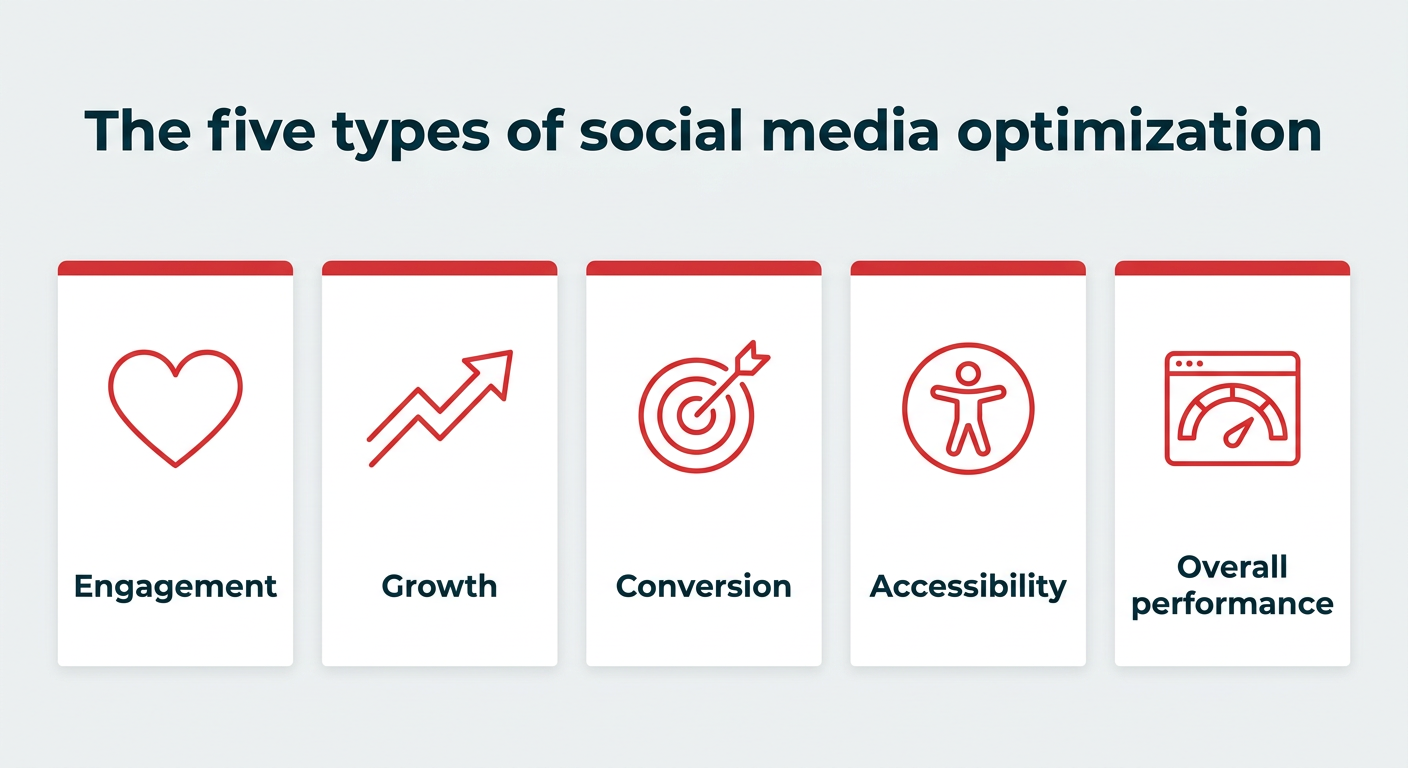
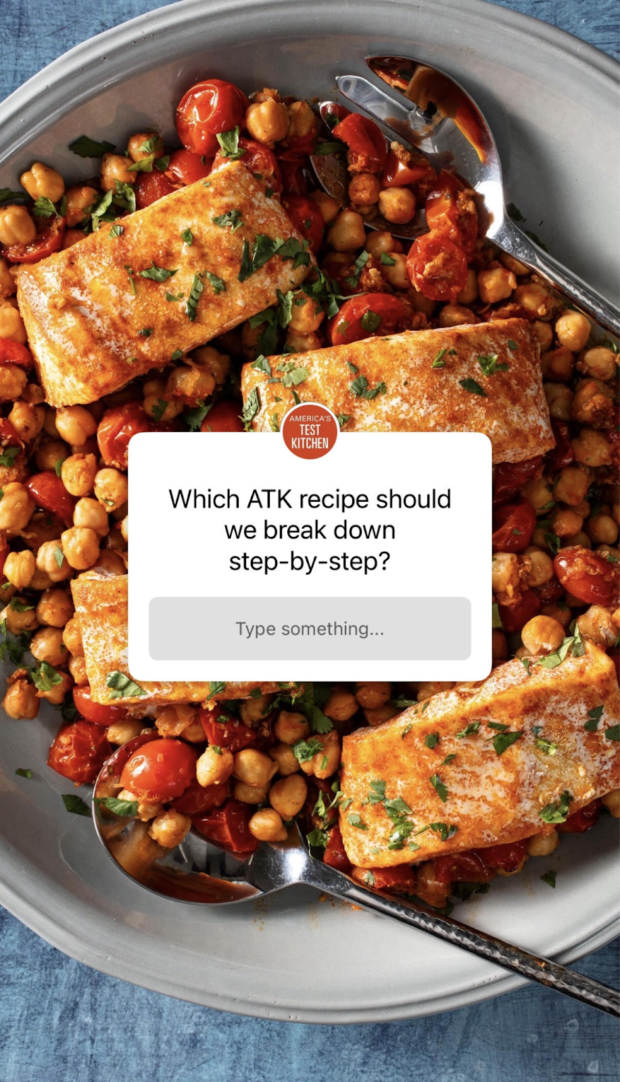
Social media optimization can be broadly categorized into five strategic types: Engagement, Growth, Conversion, Accessibility, and Content Optimization. Each type addresses a specific facet of social media performance, and together they form a holistic framework for maximizing impact.
Here are 15 key tactics, broken down by these five categories, to elevate your social media strategy:
Engagement Optimization
Engagement optimization focuses on creating content that prompts users to stop scrolling, react, and respond. These tactics leverage timing, format, and conversational elements to reliably boost engagement rates.
1. Post at the Right Times: Timing is crucial for visibility. While general best times exist, individual audience habits dictate optimal posting windows. Research from Hootsuite identifies universal baselines:
- Facebook: Tuesday, 9 AM
- Instagram: Monday, 3 PM-9 PM
- X (Twitter): Wednesday, Thursday, and Friday, 9 AM-11 AM
- LinkedIn: Tuesday and Wednesday, 4 AM-6 AM
- TikTok: Thursday, 7 AM-11 AM
These serve as starting points; true optimization comes from analyzing platform-specific analytics for your unique audience, considering industry, geography, and follower activity patterns. Newer platforms like Threads, lacking extensive historical data, require continuous monitoring of internal analytics.
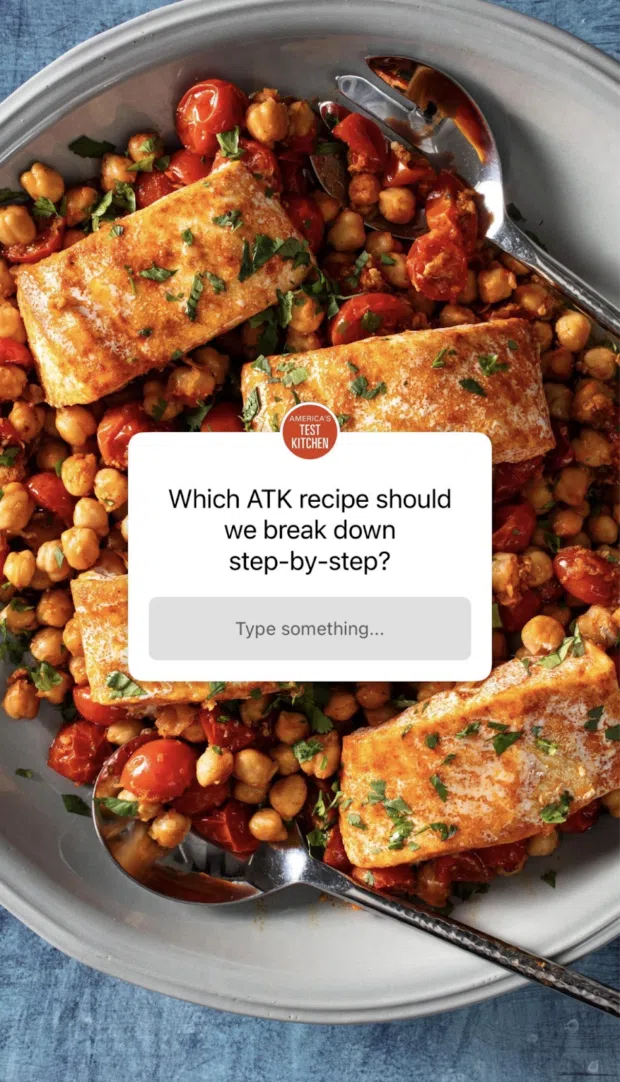
2. Ask Questions and Use Interactive Formats: Direct questions are potent engagement drivers, provided they are relevant and compelling to the audience. Interactive formats offer low-friction ways for users to respond. Instagram Story stickers (questions, polls, quizzes, sliders) and LinkedIn polls are excellent examples. These quick, easy responses are highly favored by feed algorithms, boosting content visibility.
3. Lean into Short-Form Video and Visual Formats: Visually compelling content forms the backbone of social media, capturing attention in fast-paced feeds. Short-form video (Reels, TikToks, YouTube Shorts) is currently a dominant format, with YouTube Shorts alone averaging 200 billion daily views. These formats are aggressively surfaced to non-followers, making them powerful tools for expanding reach. Carousels also perform strongly, with Hootsuite research showing Instagram carousels achieving a 3% engagement rate, slightly ahead of Reels at 2.7%. The "swipe left" temptation proves effective on platforms like LinkedIn, Facebook, and X as well. The optimal strategy involves a diverse content mix of video, carousels, and static posts to hedge against algorithm shifts and cater to varied audience preferences.
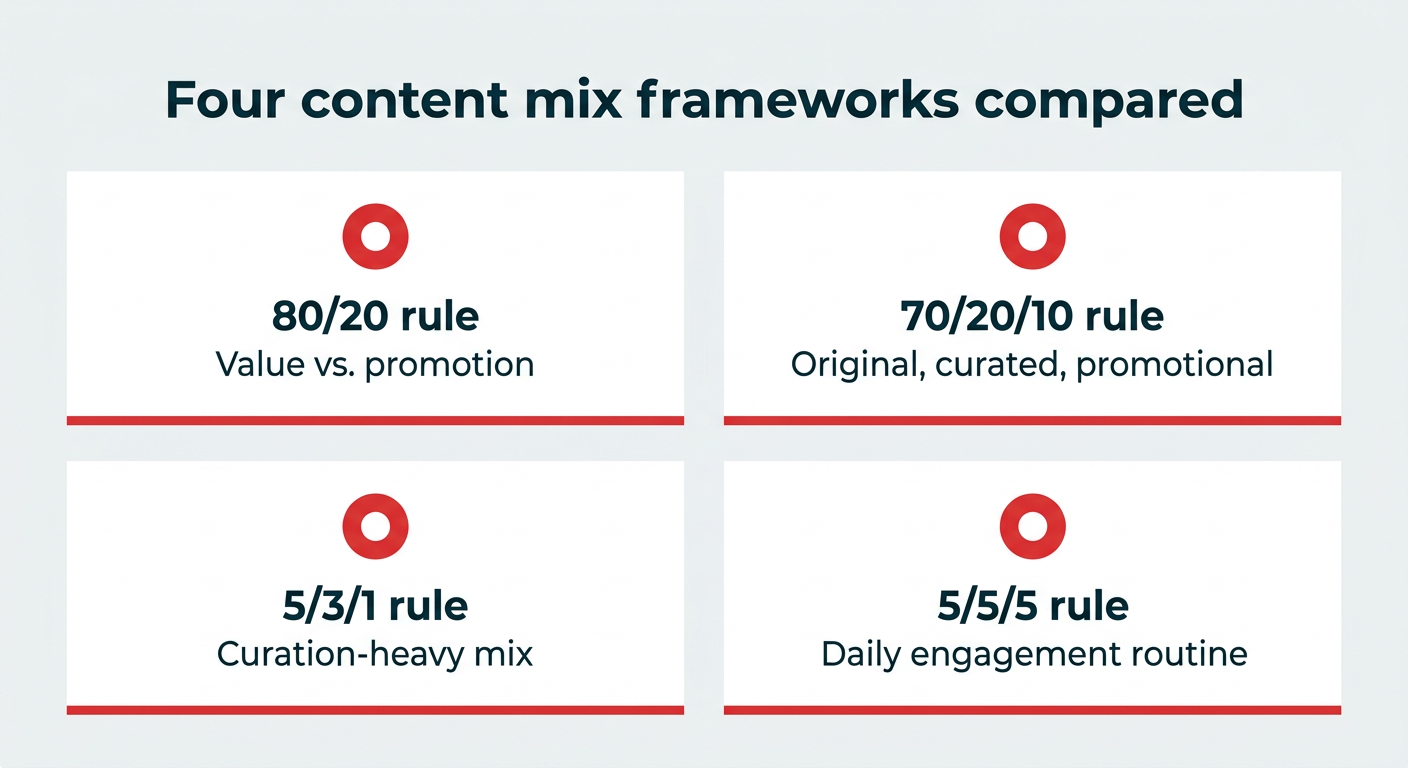
4. Follow a Content Mix Framework: Constantly promotional content quickly alienates audiences. Content mix frameworks provide simple ratios to balance promotional efforts with value-driven content.
- 80/20 Rule: 80% value-driven content (informative, entertaining), 20% promotional. Ideal for brands establishing their presence.
- 70/20/10 Rule: 70% original content, 20% curated content, 10% promotional. Suited for teams with daily publishing schedules across multiple networks.
- 5/3/1 Rule: 5 curated posts, 3 original posts, 1 promotional post out of every 9. Favors thought leadership and industry commentary accounts.
- 5/5/5 Rule: 5 minutes liking posts, 5 minutes commenting, 5 minutes sharing/reposting daily. Focused on community building and creator accounts through active engagement.
These frameworks are guidelines; their effectiveness should be tracked and adjusted based on actual audience response.

5. Post the Right Amount of Content: Consistency often trumps volume. Experts suggest optimal posting frequencies:
- Facebook: 1-2 times per day
- Instagram: 3-5 times per week
- X (Twitter): 1-5 times per day
- LinkedIn: 3-5 times per week
- TikTok: 1-3 times per day
Experimentation is key to finding the "sweet spot" that maintains engagement without overwhelming the audience or stretching team resources.
6. Engage with Your Audience in the Comments: Publishing is only half the battle. Active engagement in the comments section signals to algorithms that the content is valuable and warrants broader distribution.
- Prompt Replies: Respond to comments promptly, especially positive ones or questions.
- Ask Follow-Up Questions: Extend conversations by posing additional questions.
- Address Concerns: Professionally handle negative feedback or inquiries.
- Acknowledge All Comments: Even a simple "like" or emoji can show appreciation.
- Delegate Management: For larger brands, assign dedicated team members or use tools to manage comment flow efficiently.
Treating comments as an integral part of the publishing workflow can significantly boost both reach and positive sentiment.

Growth & Discoverability Optimization
Growth optimization focuses on expanding reach to new audiences by maximizing discoverability through keywords, hashtags, and profile optimization.
7. Optimize Your Bio for Search: A social media bio is often the first impression. It must clearly articulate the brand’s purpose, what value it offers, and why someone should follow. Hootsuite’s X bio, for example, explicitly states "social media tools, tips, news, and resources," immediately clarifying its value proposition. Crucially, bios now function as search fields. Including relevant keywords (e.g., "travel tips" for a travel company) enhances discoverability for new users searching within the platform. Key tips include using keywords naturally, adding a clear call to action, utilizing emojis for visual appeal, and ensuring consistency across platforms.
8. Include Relevant Keywords in Your Captions: The era of minimalist captions is over. Platforms, including Instagram, now recommend integrating relevant keywords into post captions to aid discoverability. This is driven by user behavior, with Ipsos research showing 93% of daily TikTok users research products on the platform before buying. Platforms scan caption text to categorize content and inform recommendation algorithms. While beneficial for lesser-known brands, keyword usage must remain natural, avoiding "keyword stuffing" that appears spammy. Utilizing analytics tools like Google Analytics to identify high-performing website keywords can provide strong candidates for social captions. Social SEO caption tools can also assist in generating keyword-rich copy efficiently.
9. Add the Right Hashtags to Your Posts: Hashtags remain a fundamental optimization technique for content discoverability. Modern best practices emphasize quality over quantity, with platforms advising on strategic usage:

- Relevance: Use only hashtags directly related to the content.
- Specificity: Mix broad and niche hashtags for wider reach and targeted engagement.
- Moderation: Avoid excessive hashtags; Instagram suggests 3-5, while TikTok prefers 3-8.
- Brand-Specific Hashtags: Create unique hashtags for campaigns or community building.
- Placement: Integrate naturally into captions or place at the end.
These guidelines apply across most social networks. Tools like free hashtag generators can streamline the process of finding relevant and effective tags.
10. Tag Accounts and Leverage User-Generated Content (UGC): Tagging relevant brands, creators, or customers is not just good etiquette; it’s a powerful reach extender. Tagged accounts often reshare content, exposing it to their own followers. User-generated content (UGC)—customer photos, reviews, unboxing videos—is highly trusted and authentic. Resharing UGC not only boosts credibility but also incentivizes the original creator to amplify the post. A common strategy involves creating a branded hashtag, monitoring its use, requesting permission to reshare, and always crediting the original creator.
11. Learn from Your Competitors: Competitor analysis offers invaluable insights, effectively providing free market research. Brands can observe rival strategies to identify successful tactics and market gaps. Focus on:
- Top-Performing Content: What content types, topics, and formats generate the most engagement?
- Audience Engagement: How do competitors interact with their audience?
- Platform Presence: Which platforms do they prioritize, and why?
- Messaging and Tone: What brand voice do they employ?
The goal is not to copy but to identify underserved topics or formats that your brand can uniquely address, establishing a distinct market position.
Conversion Optimization
Conversion optimization focuses on transforming social media activity into measurable business outcomes by guiding users to specific actions and tracking their journey.
12. Include a CTA and Link in Your Bio: For driving conversions, a clear call to action (CTA) and a clickable link in the profile bio are indispensable. Encourage visitors to navigate to a website, online store, or specific landing page. The bio link should be dynamic, updated regularly to highlight current campaigns, product launches, or new content. Tools like "link in bio" services (e.g., One Click Bio) allow multiple links from a single bio, effectively creating a micro-landing page to promote diverse content and direct traffic.
13. Optimize Your Links with UTMs: Most social posts contain links redirecting users to external sites. To accurately attribute traffic and understand which posts and platforms are generating results, these links must be trackable. UTM (Urchin Tracking Module) parameters are essential for this. By adding specific tags to URLs, marketers can precisely identify the source, medium, and campaign that drove a click, providing critical data for refining strategies and proving ROI. Link shorteners with tracking capabilities can also assist in this process.
Accessibility Optimization
Accessible content ensures broader reach and often performs better, as clear visuals and descriptive text benefit all users, especially those in noisy environments or on small screens.

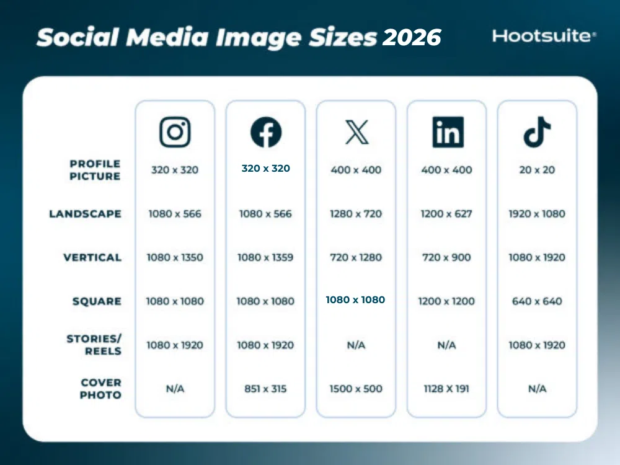
14. Make Sure Your Images Are the Right Size: Using correctly sized, high-resolution images is fundamental. Blurry or poorly cropped visuals undermine professionalism and can deter engagement. A consistent, high-resolution profile picture (typically a logo) across all channels reinforces brand recognition. When crossposting images, adhering to platform-specific image size guidelines is crucial to prevent distortion and ensure optimal display. Social media management tools can automate resizing, preventing common errors.
15. Add Alt Text and Captions to Visual Content: Accessibility features significantly broaden content reach and improve overall performance. Not all users experience social media content identically; therefore, incorporating accessibility into the optimization strategy is vital.
- Alt Text (Alternative Text): Descriptive text for images that screen readers can convey to visually impaired users. It also helps platforms understand image content for better categorization and search.
- Closed Captions and Transcripts: Essential for videos, allowing hearing-impaired users or those watching without sound to understand content.
- Clear, Concise Language: Easy-to-understand captions benefit everyone.
- High Contrast Colors: Ensures readability for text overlays on images or videos.
These elements not only make content inclusive but also provide additional textual context for algorithms, potentially boosting visibility.
Measuring the Impact of SMO: Data-Driven Refinement

Optimization is only valuable if its effects are measurable. A rigorous approach to tracking performance against the initial audit baseline is critical. Regular review cycles are essential for continuous improvement.
Key areas to evaluate include:
- Audience Growth: Is the follower count increasing, and is it attracting the target demographic?
- Engagement Metrics: Are likes, comments, shares, and saves improving?
- Website Traffic: Is social media driving more qualified traffic to the website?
- Conversion Rates: Are desired actions (sign-ups, purchases) increasing from social referrals?
- Brand Sentiment: How is the brand perceived on social media?
- Competitor Performance: How does the brand’s performance compare to rivals?
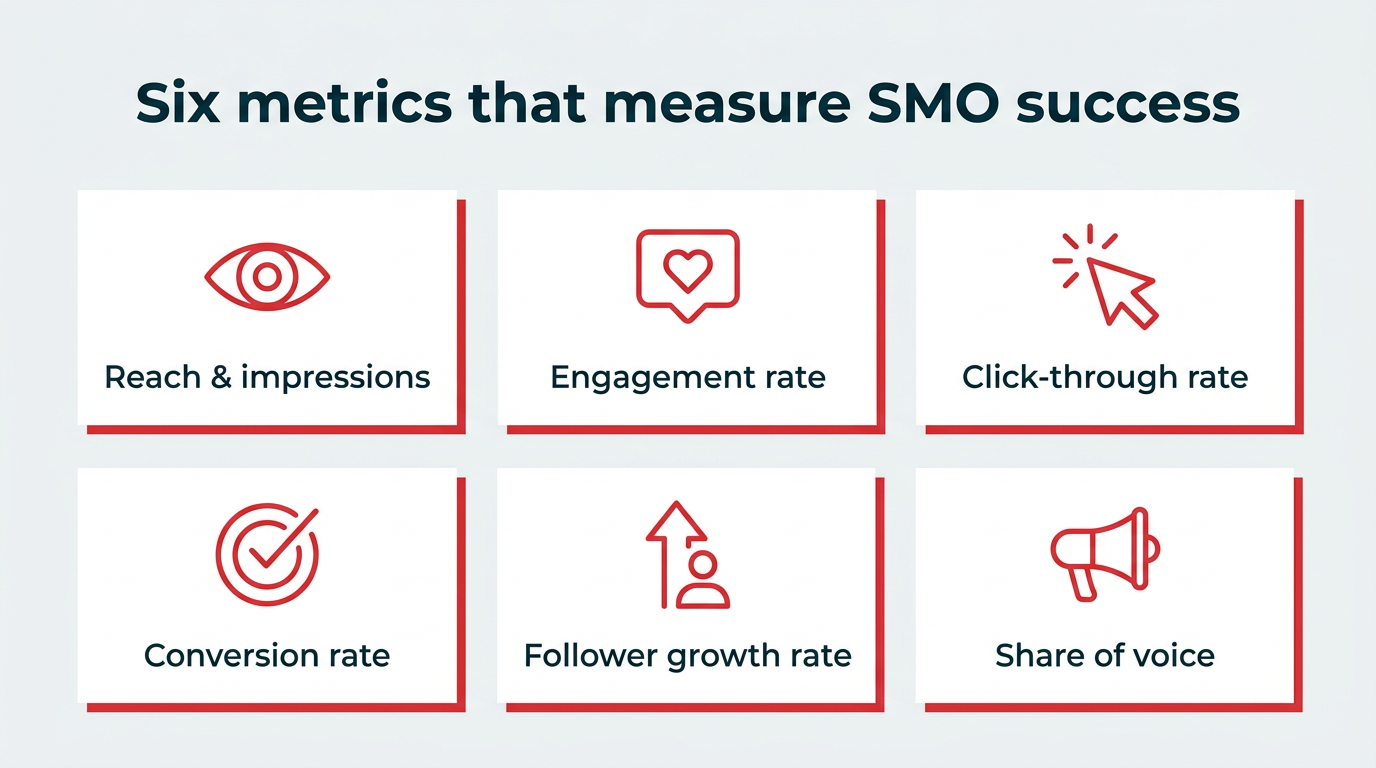
Metrics worth tracking include:
- Reach: Number of unique users who saw the content.
- Engagement Rate: Percentage of audience that interacted with content.
- Click-Through Rate (CTR): Percentage of users who clicked a link.
- Conversion Rate: Percentage of users who completed a desired action.
- Follower Growth Rate: Speed at which the audience is expanding.
- Social Referral Traffic: Traffic to website originating from social media.
- Impressions: Total number of times content was displayed.
- Brand Mentions: Number of times the brand was mentioned.
- Sentiment: Overall emotional tone of mentions.
- Share of Voice: Proportion of discussion about the brand versus competitors.
A manageable cadence for review includes weekly performance checks for outliers, a deeper monthly analysis, and a comprehensive quarterly re-audit. Crucially, change only one variable at a time (e.g., posting time, format, caption style) to accurately attribute changes in performance.
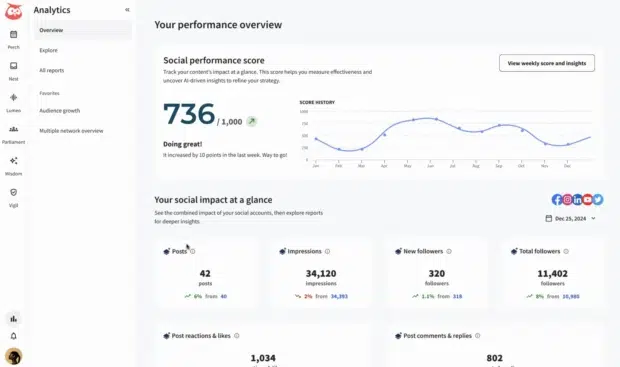
Social media analytics dashboards, such as Hootsuite Analytics, are invaluable for monitoring and improving performance across all social channels. These tools should offer cross-network comparison in a single view, customizable reporting for stakeholders, and competitive benchmarking to contextualize results. Such dashboards allow brands to compare their performance against industry averages with ease, providing crucial insights for strategic adjustments.
Platform-Specific Optimization Nuances
While the five pillars of SMO apply universally, each social network has unique characteristics and user behaviors that necessitate tailored approaches:
- Facebook: Prioritize community building, group engagement, and diverse content formats (long-form video, image carousels).
- Instagram: Dominated by visuals; focus on high-quality images, Reels, Stories, and carousels. Leverage hashtags and interactive stickers.
- X (Twitter): Emphasize real-time engagement, trending topics, concise messaging, and quick responses.
- LinkedIn: Professional networking is key; focus on thought leadership, industry insights, and professional development content.
- TikTok: Driven by short-form, authentic, trend-driven video. High engagement often comes from creative, relatable content.
- Threads: Still evolving, but emphasizes real-time conversations and strong textual engagement, similar to early X.
The common thread across all platforms is to align content format and language with how users inherently engage with each app. Continuous analysis of internal analytics for each platform will guide specific optimization efforts.
Conclusion: The Evolving Imperative of SMO
Social media optimization has evolved from a tactical afterthought to a strategic imperative in the digital marketing landscape. As social platforms increasingly integrate search functionalities and users adopt them as primary discovery channels, brands must adapt their approaches to ensure maximum visibility, engagement, and conversion. By systematically applying the 15 tactics across engagement, growth, conversion, and accessibility optimization, underpinned by rigorous auditing and performance measurement, businesses can navigate this complex environment successfully. The ongoing shift demands a dynamic, data-driven strategy that treats social media not just as a broadcast channel, but as a vital engine for connection, discovery, and ultimately, sustained business growth.