Cannes, France – Once a seemingly incongruous addition to the prestigious Cannes Lions International Festival of Creativity, retail media networks have firmly established their presence, evolving from their lower-funnel, performance-driven origins to embrace broader, upper-funnel marketing strategies and the transformative potential of artificial intelligence. This year’s festival, marked by an intensified focus on technology and innovation, saw retail media platforms like Instacart further expand their ambitions, moving beyond traditional sponsored search and display ads to integrate with channels like video and even branded entertainment.
The shift reflects a significant evolution in how brands approach consumer engagement and sales. Initially, retail media was perceived as a tactical tool primarily for driving immediate conversions within e-commerce environments. However, as the digital advertising landscape matures and consumer journeys become increasingly complex, the need for integrated strategies that span the entire marketing funnel has become paramount. Cannes Lions, the global benchmark for creative excellence, provides the ideal platform for these evolving retail media players to showcase their enhanced capabilities and forge partnerships that blend commerce with compelling creative storytelling.
Ali Miller, General Manager of Advertising at Instacart, articulated this strategic pivot during an interview at Cannes last week. “Leaning into the opportunity to connect commerce and creative, this is the place to do that,” Miller stated, emphasizing the platform’s commitment to bridging the gap between product discovery and purchase. This sentiment underscores a broader industry trend: the recognition that the point of sale is no longer merely the end of the customer journey but a fertile ground for creative inspiration and brand building.
Instacart, a leading grocery delivery and technology platform serving over 2,200 retailers, used its presence at Cannes Lions to unveil a suite of product enhancements designed to push its advertising solutions further into the upper and mid-funnel. A key announcement was the introduction of a new Ads Studio, a collaborative space intended to empower brands to co-create campaigns and capitalize on specific cultural moments. This initiative builds upon previous successes, such as a notable Super Bowl campaign last year that creatively integrated numerous CPG mascots. The Ads Studio promises to leverage Instacart’s first-party data to support brainstorming, execution, and measurement, thereby strengthening the synergy between its retail media operations and its in-house creative agency, Local Produce.
“We’re really hoping to get in conversations with brands before they even have fully arrived at a concept,” Miller explained, highlighting the ambition to be involved in the earliest stages of campaign ideation. “Let us ideate and come up with great concepts together that can be activated throughout the year.” This proactive approach signals a move towards becoming a strategic partner rather than just a media vendor, offering brands insights and creative fuel grounded in real-time consumer behavior and purchase intent.
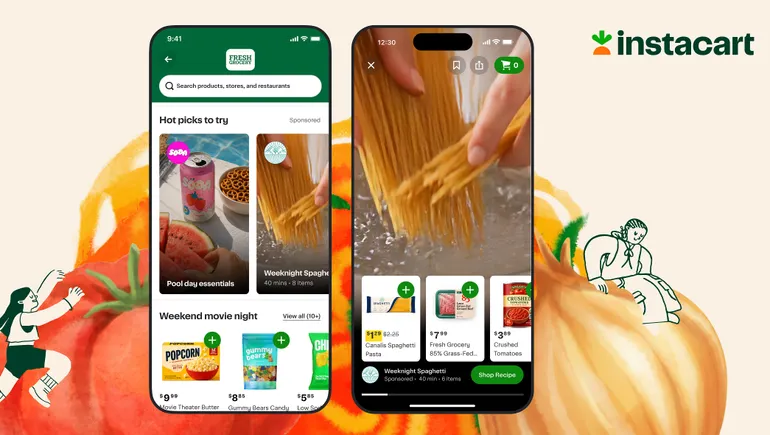
Further solidifying its commitment to a more engaging and integrated advertising experience, Instacart also introduced its “Immersive Feed,” a new shoppable vertical video format within the Instacart app. Drawing parallels to the popular short-form video experiences found on platforms like TikTok, this feature allows brands to deliver video content ranging from five to 30 seconds, directly integrated with add-to-cart functionality. This innovative format is currently being piloted by brands such as Hellmann’s, Kettle & Fire, Rachael Ray Nutrish, and Siete Foods. The primary objective of the Immersive Feed is to drive both product discovery and immediate transactions by showcasing recipes, product demonstrations, and recommendations in a visually compelling and interactive manner. Instacart intends to expand this feed to include organic content through partnerships and sponsored creator integrations, further blurring the lines between entertainment and commerce.
“When you think about recipe content, product demonstrations, personal care content, beauty content – vertical video is the perfect format for this,” Miller remarked, underscoring the versatility of the Immersive Feed and its potential for diverse brand applications. The “sky’s the limit” sentiment suggests a forward-looking vision for how brands can leverage this format to connect with consumers in a more dynamic and immediate way.
The Dawn of AI-Powered Commerce and Advertising
Beyond its advancements in creative and video formats, Instacart used its Cannes Lions platform to articulate a compelling vision for the future of advertising powered by artificial intelligence. The company is developing an AI-driven shopping assistant designed to help users navigate complex dietary needs, meal planning, and other consumer challenges, such as generating gluten-free meal ideas for a family of four. While the monetization strategy for this AI assistant is still being refined, Miller indicated that Instacart “likely” plans to begin experimenting with advertisements within the program in the latter half of this year.
Instacart’s approach to integrating ads into its AI assistant is deliberately measured, prioritizing user experience and feedback over rapid monetization. This cautious strategy is informed by the growing understanding that the integration of AI into consumer-facing applications requires a delicate balance to maintain trust and utility. The company’s robust growth in its advertising segment, with ad revenue increasing 16% year-over-year to $286 million in the first quarter, provides a strong financial foundation for this experimental approach.
“We really want to make sure that it’s a two-way street,” Miller emphasized regarding the AI assistant’s development, suggesting a commitment to ensuring the technology benefits both consumers and advertisers. This philosophy aligns with the broader industry conversation surrounding AI ethics and responsible deployment, particularly in advertising.
The precise placement of AI-powered advertising within Instacart’s broader marketing mix remains an open question, mirroring the evolving strategies of other AI platforms that have also adopted a “to be determined” stance on their ultimate advertising funnel integration. Potential use cases discussed by Miller include sponsored recipes and occasion-based shopping lists (e.g., for a barbecue), surfacing targeted deals and offers, and facilitating deeper product exploration.
“We’re going to see what ends up being the dominant behavior that consumers turn to AI for. My hypothesis is that we are going to be able to see more of this upper funnel, kind of mid-funnel-y behavior,” Miller predicted. This forecast suggests that AI assistants could play a crucial role in the early stages of the consumer journey, driving discovery and influencing brand perception before a purchase decision is solidified. This capability positions AI not just as a transactional tool but as a powerful engine for brand engagement and consideration.
The implications of this evolution in retail media are far-reaching. As platforms like Instacart move beyond performance marketing to embrace creative storytelling and AI-driven personalization, they are increasingly competing for larger portions of brand advertising budgets traditionally allocated to publishers and social media platforms. The ability to connect creative execution with measurable commerce outcomes directly within the shopping environment offers a compelling proposition for brands seeking to optimize their marketing spend and drive tangible business results.
Furthermore, the integration of AI into the shopping experience promises to unlock new levels of personalization and efficiency for consumers. By providing intelligent assistance in meal planning, recipe discovery, and product selection, Instacart’s AI assistant could fundamentally alter how consumers interact with grocery shopping, making it a more intuitive, enjoyable, and less time-consuming activity. For advertisers, this presents an unprecedented opportunity to reach consumers at their moments of highest intent, with tailored messages and offers delivered through a trusted and helpful interface.
The journey of retail media networks from niche performance channels to sophisticated, full-funnel marketing partners at Cannes Lions signifies a fundamental reshaping of the advertising industry. As these platforms continue to innovate, leveraging creative excellence and the power of AI, they are poised to redefine the boundaries of commerce and advertising, offering a glimpse into a future where every interaction is an opportunity for connection and conversion. The continued integration of these capabilities at major industry events like Cannes Lions will undoubtedly accelerate this transformation, setting new benchmarks for creativity, technology, and consumer engagement in the years to come. The strategic importance of retail media at such influential forums underscores its ascent from a supplementary channel to a central pillar of modern marketing strategies.