Ali Ikhwan
In the rapidly evolving landscape of artificial intelligence, the prevailing strategy for improving AI agent performance has long been a pursuit of "bigger and better" models. However, new findings from Google Research suggest that the bottleneck in agentic workflows often lies not within the neural weights of the large language model (LLM) itself, but in the "harness"—the surrounding architecture of prompts, tools, memory systems, and control loops that dictate how the model interacts with its environment. This shift in perspective, codified in the Harness² framework, represents a significant departure from model-centric development, focusing instead on the systematic optimization of the agent’s operational scaffolding.
The core premise of Harness² is that an AI agent’s reliability is a product of its environment as much as its intelligence. When an agent fails a task, the immediate instinct of many developers is to upgrade to a more parameter-heavy model. Yet, research demonstrates that different configurations of instructions and tools, known as harnesses, excel at different tasks. For instance, while a specific configuration like Claude Code might outperform rivals in spreadsheet management and software engineering, a different setup like Codex may lead the field in navigating complex web-based tasks. The implication is clear: a fixed, one-size-fits-all harness inevitably leaves performance on the table.
The Problem with Prompt-Centric Optimization
Historically, developers have attempted to fix agent errors by refining or expanding the system prompt. This approach, often referred to as "prompt engineering," has reached a point of diminishing returns. Google’s research into Harness² highlights a critical flaw in this strategy: every additional instruction comes with a tangible computational and performance cost.
System prompts are processed repeatedly throughout the duration of a task. As these prompts grow in length and complexity, they consume an increasing portion of the model’s token budget. In many cases, the agent may run out of context window before the task is finished, leading to abrupt failures. Furthermore, a rule embedded in a text prompt is merely "advice" that the model may or may not follow. In contrast, Harness² advocates for moving critical constraints into the control loop or middleware, where they can be enforced by code rather than suggested by text.
Architecture and Components of Harness²
To address these limitations, Harness² exposes eight distinct components that govern agent behavior. These components are categorized into four groups: Context, Tool Interface, Delegation, and Middleware.
- Context (System Prompt, Guardrails, Memory, Skills): These define what the model perceives before it takes an action.
- Tool Interface (Tool Guidance, Scripts): This dictates how tools are described to the model and the syntax required to invoke them.
- Delegation (Subagents): This allows the primary agent to hand off specific sub-tasks to a "clean" context, preventing the main thread from becoming cluttered.
- Middleware (Plugins): This controls behavior within the tool loop, allowing for automated interventions that do not require the model’s active attention.
The strategic advantage of this modularity is that many of these components remain dormant until triggered. Unlike a long system prompt that is always "on" and consuming tokens, a plugin or a subagent only incurs a cost when it is actively engaged. This allows for a much more sophisticated agent behavior without the overhead of token bloat.
The Propose, Probe, Compose Methodology
At the heart of Harness² is a three-stage recursive loop designed to adapt the agent’s harness at test time. This is particularly valuable for tasks that the designers never anticipated, as it allows the agent to self-correct based on observable failures.
The Propose Stage: When a task is initiated, the agent runs the workflow once. Two separate "editors" then analyze the execution log. The first editor focuses on workflow mechanics, identifying technical failures such as broken tool calls or syntax errors. The second editor acts as a domain specialist, proposing subject-matter rules or better strategies for the specific task at hand.
The Probe Stage: The framework then generates an edited version of the harness and runs the same task a second time. This produces a second execution log that can be compared against the first. This stage is critical; research indicates that without this validation step, letting an agent simply rewrite its own prompt actually results in a 10% drop in performance.
The Compose Stage: Finally, the framework compares the two runs. An edit is only retained if it fixed a concrete, observable failure from the initial attempt. If the edit did not produce a measurable improvement, it is discarded. This ensures that the harness only grows in complexity when that complexity is justified by a gain in reliability.
Empirical Results and Benchmarking
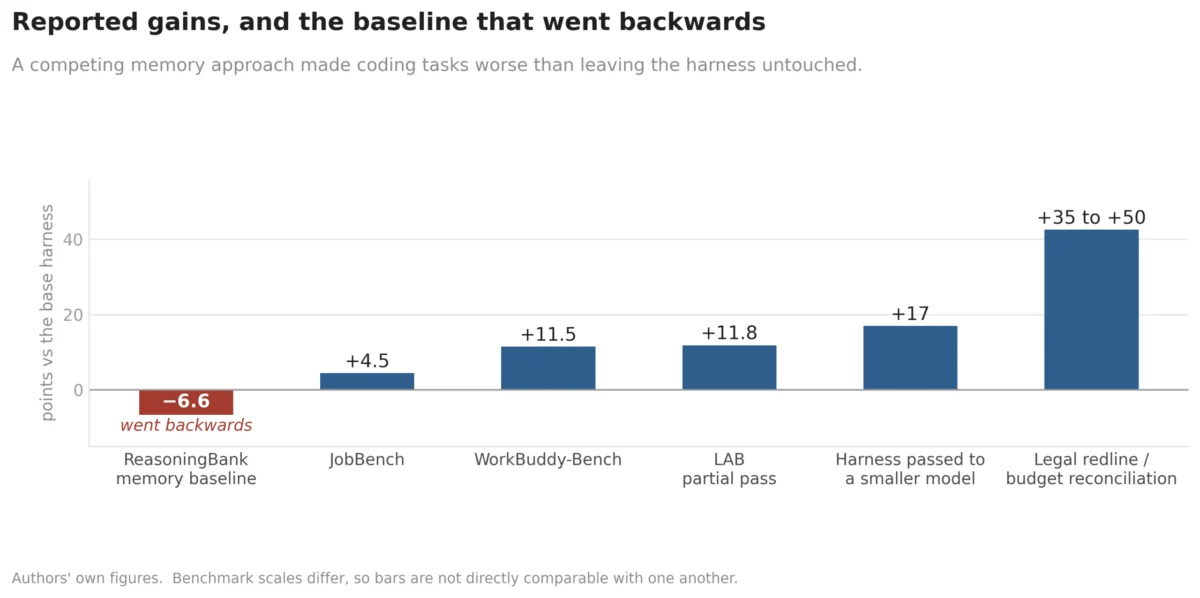
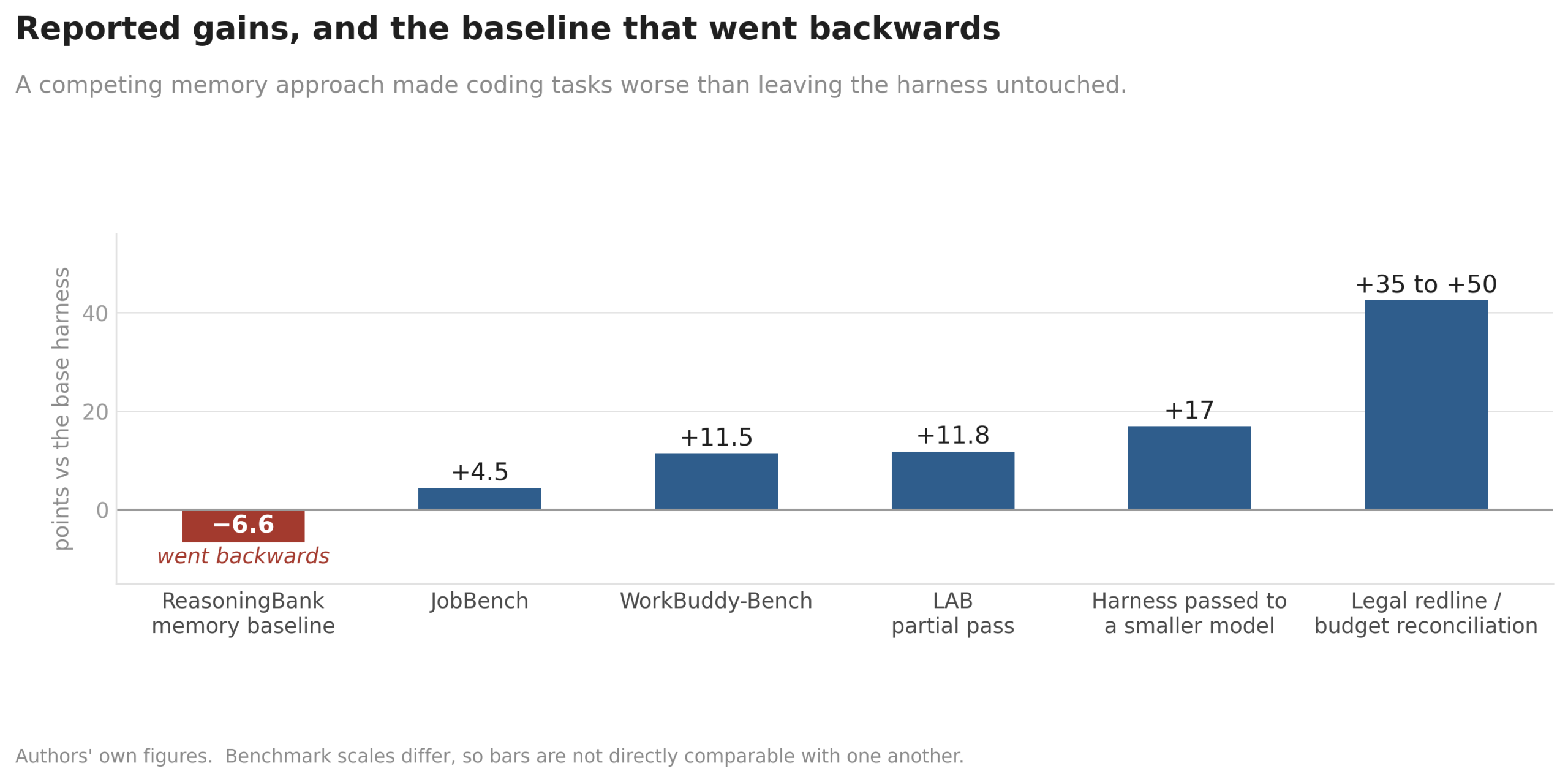
The efficacy of Harness² has been validated across several professional benchmarks, including WorkBuddy-Bench, JobBench, and LAB. Using models such as Gemini 3.5 Flash and GLM-5, the research team observed consistent improvements across every tested configuration.

Specific data points from the research include:
- WorkBuddy-Bench: An improvement of up to 11.5 points.
- LAB (Partial Pass Rate): An increase of 11.8 percentage points.
- Legal and Financial Tasks: In specialized domains like legal redlining and budget reconciliation, the framework saw performance jumps of 35 to 50 points in a single recursive step.
- Cross-Model Portability: Perhaps the most significant finding was that a harness evolved on a high-capacity, expensive model (like Gemini 1.5 Pro) could be handed to a smaller, cheaper model (like Gemini 1.5 Flash), resulting in an immediate 17-point performance boost for the smaller model.
These results suggest a new paradigm for AI deployment: organizations can use powerful models to "train" or evolve the perfect harness for a specific task, and then deploy that harness using much more cost-effective models in production.
Technical Implementation and "The Demo Trap"
For developers looking to implement Harness², the project is available via Google Research’s GitHub repository. It requires a Linux environment, Python 3.12, and the uv package manager. While a local demo is available that requires no API keys, it is important to distinguish between the "plumbing" and the "method."
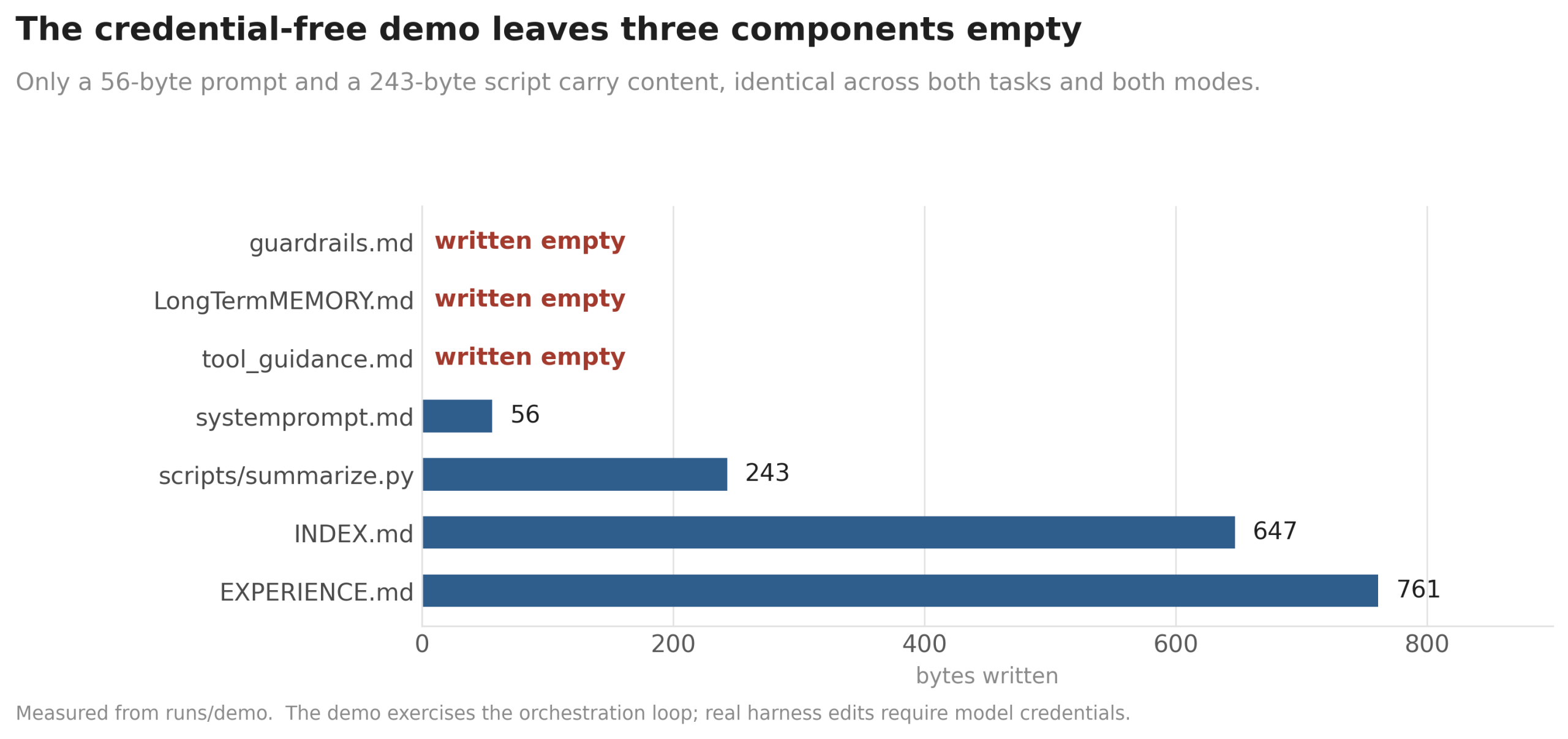
The local demo confirms that the recursive loops, probing mechanisms, and composition logic are functioning correctly. However, because the demo uses deterministic editors rather than live LLMs, it does not actually rewrite the harness with meaningful content. To see the true power of the framework—where the agent learns from its mistakes and updates its own "Experience" logs—developers must provide model credentials and run the system against real-world benchmarks.
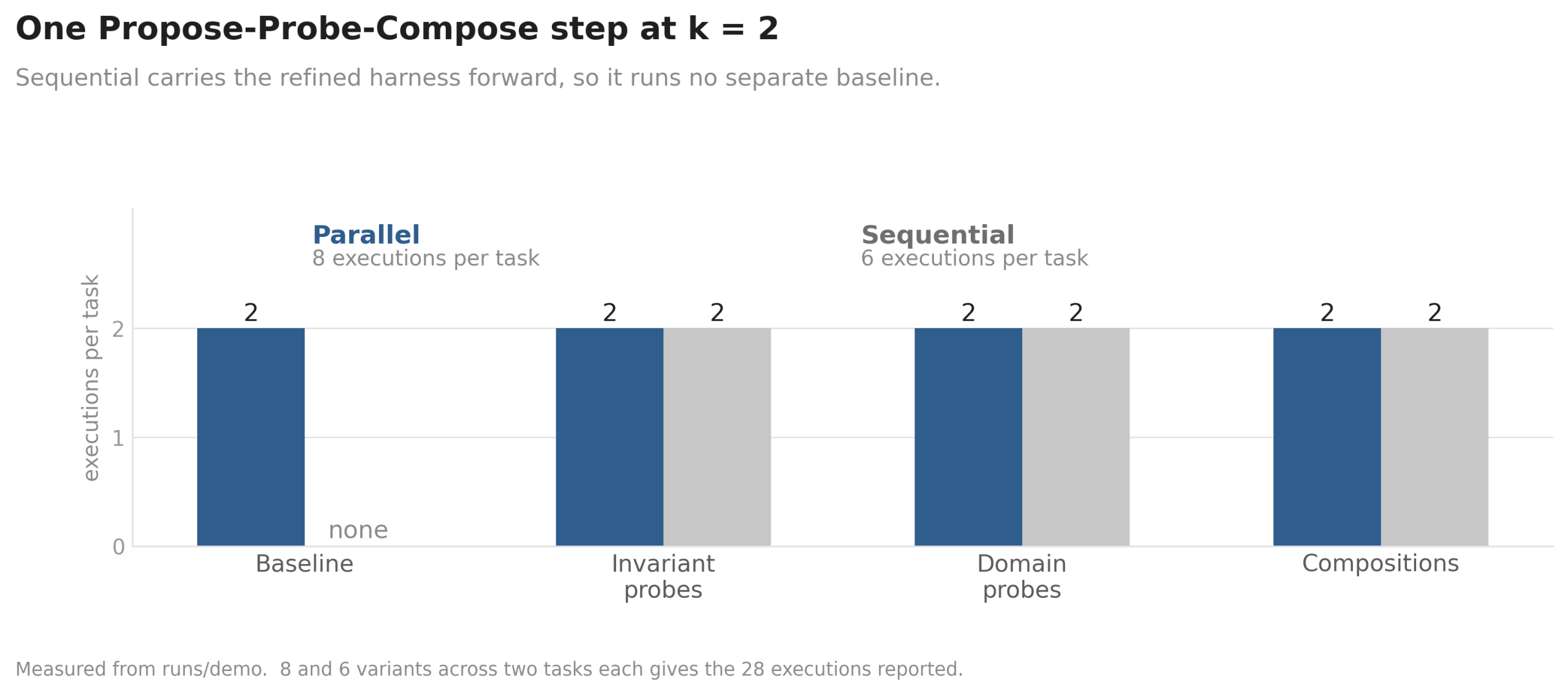
A typical run involves a significant amount of data generation. In a two-task run, the system may execute 28 different variants of a task and write over 2,300 files. This high volume of "trial and error" is what allows the system to find the optimal configuration, but it also requires careful management of filesystem resources and API costs.
Chronology of Development and Industry Context
The development of Harness² follows a series of industry-wide realizations regarding the fragility of AI agents. In 2023, the rise of "AutoGPT" and similar autonomous agents sparked excitement, but also highlighted the "infinite loop" problem—where agents would get stuck repeating the same error.
By early 2024, the focus shifted toward "agentic workflows," where human-designed loops provided the necessary guardrails. Harness² represents the next logical step in this timeline: automating the design of those guardrails. By using a "Propose, Probe, Compose" cycle, Google is effectively applying the scientific method to agent configuration.
Broader Implications for the AI Industry
The implications of the Harness² research extend far beyond mere performance metrics. By proving that the "harness" is a transferable asset, Google has opened the door for a new marketplace of AI configurations. We may soon see a future where developers trade and sell optimized harnesses for specific industries—such as a "Medical Diagnostics Harness" or a "Tax Compliance Harness"—that can be applied to any underlying LLM.
Furthermore, this research challenges the "bigger is always better" narrative in AI. If a smaller model with a superior harness can outperform a larger model with a generic one, the economic landscape of AI shifts toward optimization and engineering rather than just raw compute power.
Analysis of Implications
The move toward Harness-level recursion marks a transition from "stochastic" agent behavior to "verifiable" agent behavior. By enforcing rules through the control loop (Middleware) rather than just suggesting them in prompts, developers can create agents that are safer and more predictable.
However, the cost of this reliability is a significant increase in the number of model calls required during the development or "tuning" phase. With 4 to 20 full agent runs required per task to find the optimal harness, the initial investment is high. But for enterprise-level applications where failure is not an option—such as legal redlining or financial reconciliation—this "upfront" cost is a small price to pay for a system that eventually operates with near-human precision on a low-cost model.
In conclusion, Harness² provides a rigorous, data-driven framework for building better AI agents. It serves as a reminder that in the quest for artificial intelligence, the "body" (the harness) is just as important as the "brain" (the model). By focusing on how agents receive instructions and manage their work, Google Research has provided a roadmap for making AI agents more reliable, more efficient, and ultimately, more useful in professional environments.


 Jia Lissa

 Iffa Jayyana