Reynand Wu
The digital landscape is undergoing a seismic shift, with automated bots now significantly outnumbering human users in website requests. Recent data, as highlighted by NBC News, indicates that bots account for a substantial 57% of all website traffic. This surge in non-human activity presents a critical challenge for marketers and website owners: traditional analytics tools, while adept at understanding human behavior, offer limited insights into the rapidly growing volume of machine-driven interactions. It is within this evolving context that Microsoft Clarity has emerged as a potentially transformative solution, offering specialized features to help businesses decipher the complex world of AI-driven web traffic.
Microsoft Clarity, a platform already recognized for its user experience and website analytics capabilities, has been actively developing AI visibility features designed to provide a clearer picture of how artificial intelligence crawlers, search engines, and assistants interact with digital properties. To assess the efficacy of these new tools, a detailed evaluation was conducted over several weeks on the website of Brainlabs, a prominent digital marketing agency. This in-depth analysis sought to understand the practical applications and potential benefits of Clarity’s AI visibility features for businesses grappling with the increasing presence of bots.
Setting Up AI Visibility Features: A Streamlined Entry Point
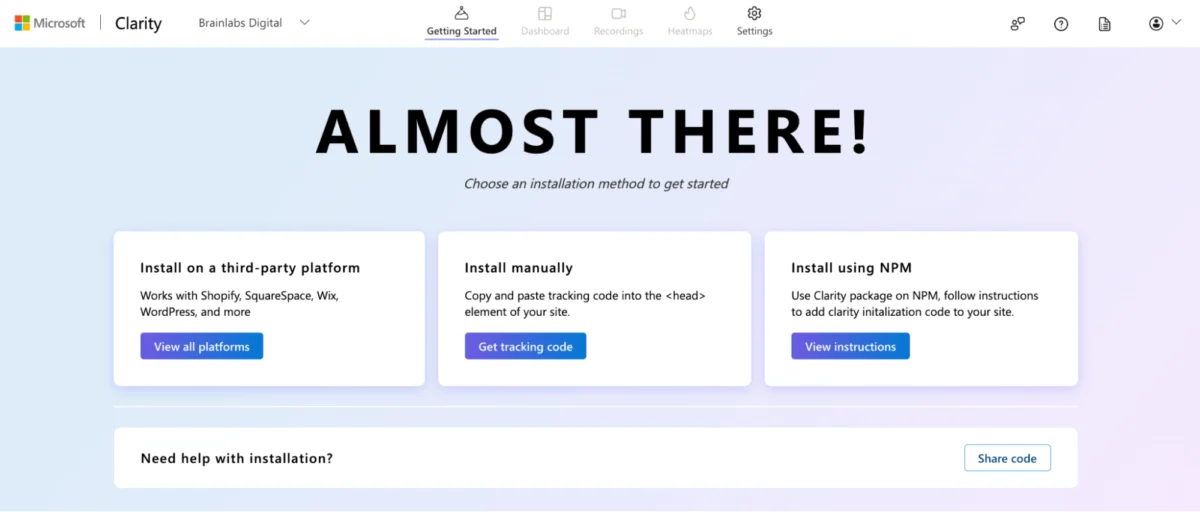
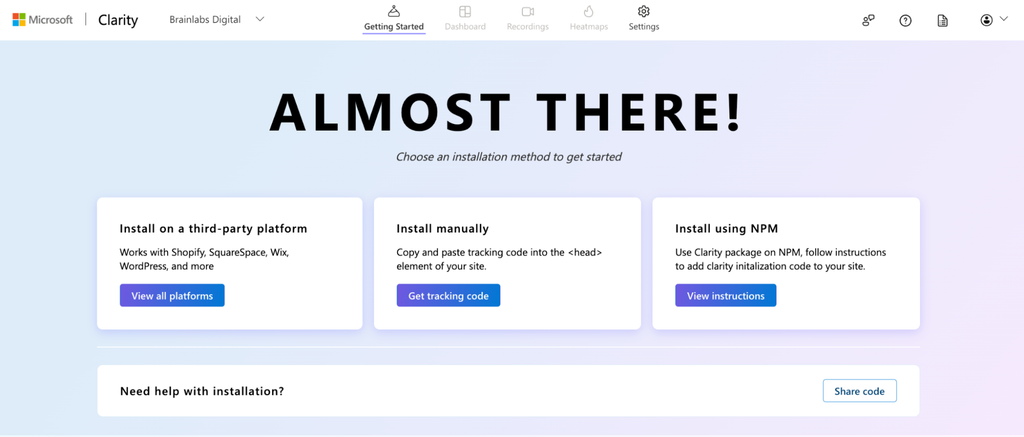
The initial barrier to entry for Microsoft Clarity is remarkably low, a significant advantage for businesses looking to expand their analytics capabilities without substantial investment. The platform is entirely free to use, and its core functionality can be implemented with minimal effort. The setup process primarily involves integrating a simple tracking script onto a website, a task that typically takes mere minutes. While direct installation is a straightforward option, Clarity also provides integrations for popular content management systems and e-commerce platforms such as Shopify and WordPress, further simplifying the deployment for a wide range of users.
However, unlocking the full potential of Clarity’s AI visibility features requires a more comprehensive approach beyond the initial script installation. Certain advanced dashboard views and deeper analytical insights necessitate additional integrations. Brainlabs, for instance, connected their Google Analytics account to Clarity to gain a more holistic view of their website traffic. Furthermore, a crucial step involved configuring a WordPress plugin to channel server-log data directly into Clarity’s bot activity dashboard. This integration proved particularly valuable, as it surfaced critical information that would otherwise be buried within complex log files, making it accessible and actionable. Microsoft provides extensive setup documentation, guiding users through various installation options and integration possibilities, ensuring that even those with less technical expertise can navigate the process effectively.
Understanding the Bots: Who’s Crawling Your Site and Why
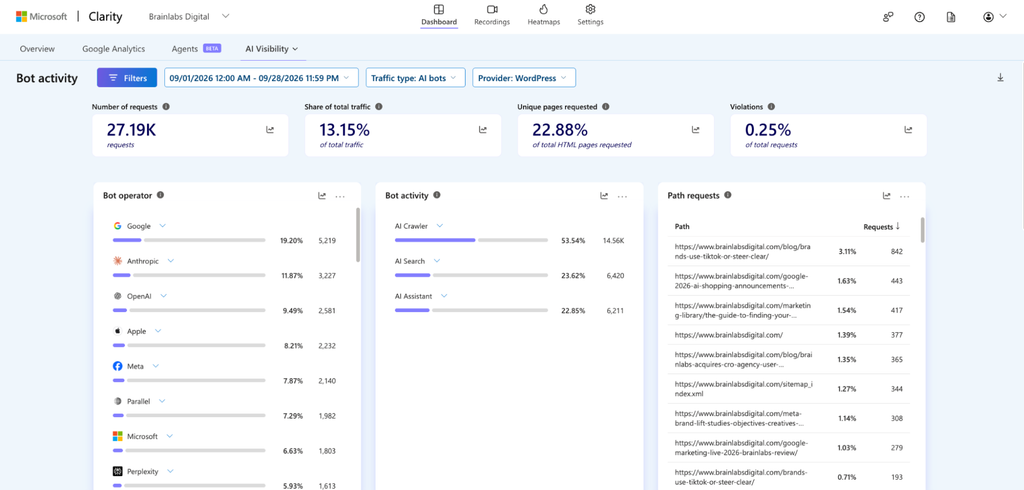
At the heart of Clarity’s AI visibility offering lies its dedicated bot activity dashboard. This feature provides a granular breakdown of bot interactions, detailing which bots are visiting, their frequency, and the specific pages they are accessing. Crucially, Clarity categorizes these bots into three distinct types:
- AI Crawlers: These are automated programs designed to systematically explore and index web content, often for the purpose of building vast databases for AI models or search engines. They are the digital equivalent of librarians meticulously cataloging every book in a library.
- AI Search and Assistants: This category encompasses bots that are directly involved in responding to user queries or performing tasks initiated by AI assistants. They are the interactive agents that users engage with when seeking information or assistance.
- Other Bots: This broad category includes a variety of automated programs that may not fall neatly into the above classifications, such as website monitoring tools, security bots, or legitimate site maintenance scripts.
The ability to differentiate between these bot types is not merely an academic exercise; it carries significant practical implications for marketers. A bot’s presence on a website does not automatically translate to direct user engagement with a brand or indicate that a brand’s content is being actively incorporated into AI-generated answers. Understanding the underlying purpose of bot activity provides a more accurate and nuanced starting point for data interpretation.
During the testing period, Brainlabs observed significant AI bot activity on their own website. Between September 1 and September 28, 2026, Clarity recorded approximately 27,190 AI bot requests, which constituted 13.15% of the traffic analyzed within that specific dashboard. Within this AI bot traffic, AI crawlers were the most prevalent, accounting for 53.54% of the requests. AI Search and AI Assistant activities followed, representing 23.62% and 22.85% of the AI bot traffic, respectively. Prominent entities such as Google, Anthropic, and OpenAI were identified as some of the most active operators, although their respective request volumes varied considerably. This detailed breakdown allows for strategic adjustments in content creation and SEO efforts, targeting the specific types of AI interactions that hold the most relevance for the business.
The Aftermath of a Bot Visit: Scrapes vs. Referrals
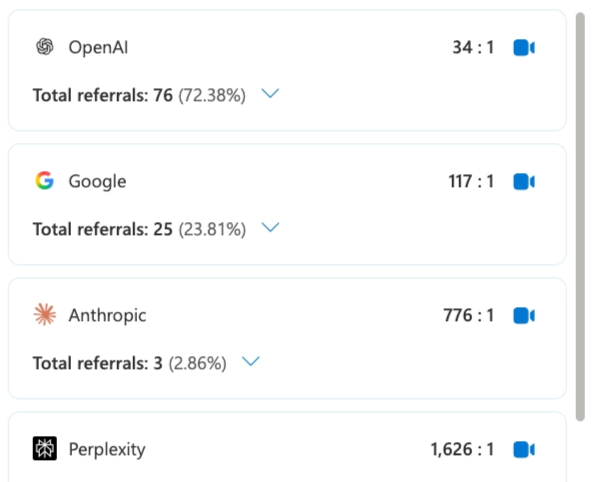
Clarity’s scrape-to-referral ratio offers a unique lens through which to evaluate the efficacy of AI scraping activities in driving actual user traffic. This metric compares the volume of AI scraping activity against the number of referral visits originating from AI platforms. Over the analyzed period, Brainlabs reported an average scrape-to-referral ratio of 90:1, with a total of 105 referrals from AI platforms. However, these numbers exhibited significant variation across different AI providers. OpenAI, for instance, showed a ratio of 34:1 with 76 referrals, while Google presented a ratio of 117:1 with 25 referrals. Anthropic’s data indicated a ratio of 776:1 with only three referrals.
These disparities invite careful consideration regarding which platforms deliver the most valuable traffic. It is important to note that referral traffic alone does not always fully encapsulate the role an AI platform might have played in a customer’s decision-making journey. Therefore, marketers are advised to treat this ratio as one component within a broader analytical framework, alongside traditional traffic, conversion, and visibility data. It serves as an additional data point, rather than a definitive measure of how often a bot crawl translates into a qualified click or a subsequent conversion.
AI Citations and Topic Insights: Unveiling Content Relevance
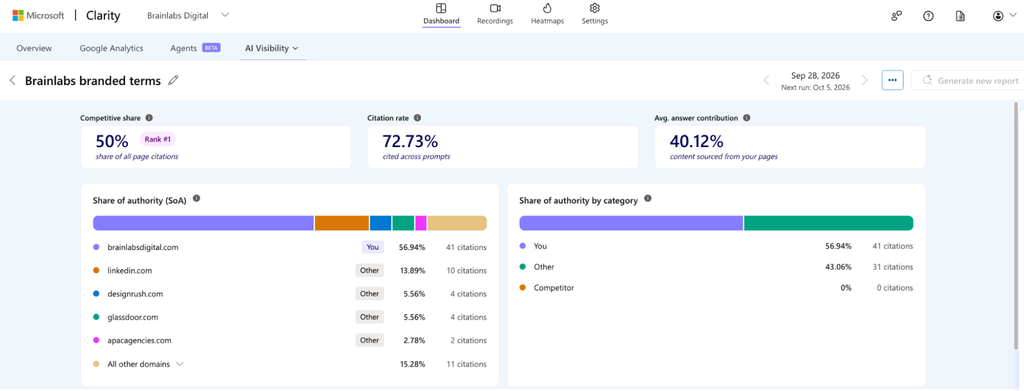
Microsoft Clarity’s Topic Insights feature, currently in beta, offers a groundbreaking capability for businesses to understand how their content is being cited and utilized by AI platforms. This feature allows users to define specific topics and then track the frequency with which their website appears in AI-generated answers to related prompts. For Brainlabs’ branded terms, Clarity indicated a citation rate of 72.73% across the tracked prompts, with a competitive share of 50%. The company’s website earned 41 citations, with 56.94% of these contributing to their share of authority.
While strong branded term results are often expected and are a common benchmark for most websites, the true value of Topic Insights emerged when analyzing non-branded prompts. By examining broader prompts that did not explicitly mention Brainlabs, the feature revealed significant gaps in areas such as AI search measurement and agentic enablement – two core service areas that Brainlabs aims to be recognized for. This insight provides a clear roadmap for content strategy, highlighting opportunities to create more authoritative content in these underserved areas to capture a larger share of AI-driven discovery.
It is important to acknowledge the limitations of the Topic Insights feature, given its beta status. It does not automatically generate prompts for users, and the tracking is capped at 15 prompts per topic. Consequently, the accuracy and relevance of the results are heavily dependent on the quality and strategic selection of the prompts chosen by the user. While the "grounding queries" in the Citations tab can offer a starting point, they primarily reflect existing content placement rather than identifying areas of absence. Therefore, comprehensive prompt research, competitive analysis, and ongoing validation remain essential components of an effective AI visibility strategy. Brainlabs has further elaborated on their approach to prompt prioritization and scoring in their recently published "State of AI Visibility report 2026."
Connecting Technical Glitches to Real User Experiences
Beyond its nascent AI-focused features, Microsoft Clarity’s established analytics capabilities proved to be a surprisingly actionable component of the testing period. The platform seamlessly integrates Core Web Vitals, JavaScript errors, and behavioral signals such as dead clicks, rage clicks, and excessive scrolling. Critically, each of these metrics is directly linked to related session recordings, allowing for a deep dive into user interactions.
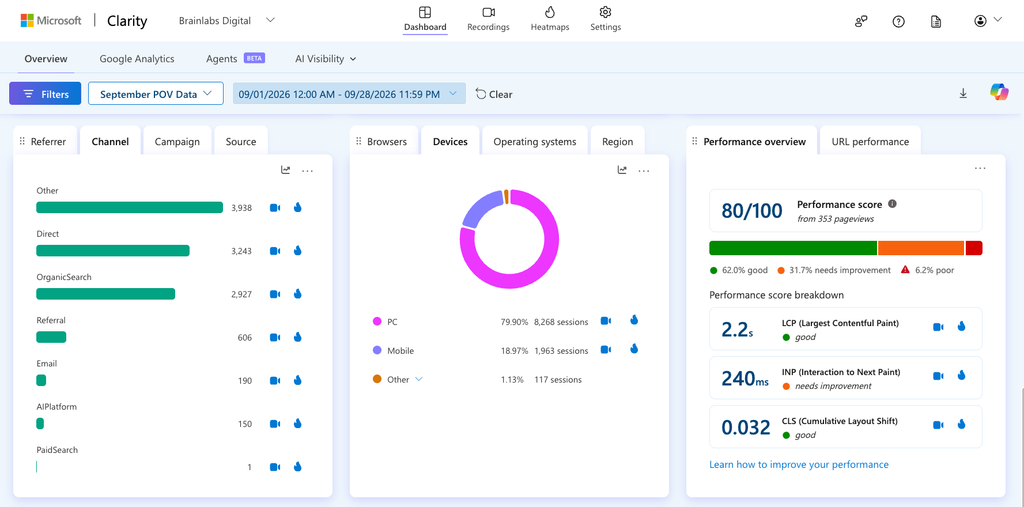
In the observed period, Clarity’s performance overview for Brainlabs’ website scored 80 out of 100 across 353 pageviews within the selected view. While this sample size is relatively small, it offered a valuable snapshot. The Largest Contentful Paint (LCP) was rated favorably at 2.2 seconds, indicating good loading performance for key content. However, the Interaction to Next Paint (INP) metric, at 240 milliseconds, was flagged as an area requiring improvement, suggesting potential delays in user interactivity. During the same period, 6.75% of sessions exhibited dead clicks, and 2.92% involved quick backs, signals that point to potential usability issues or user frustration.
The real power of Clarity’s session recordings lies in their ability to translate abstract performance data into tangible user experiences. An error report might indicate that something has broken on the site, but a session recording shows precisely what a visitor was doing at the moment of that failure. A compelling example of this was observed on Brainlabs’ client feedback page. Adhering to their cultural code of "Feedback is a Gift," a malfunctioning feedback form represents a significant issue that requires swift resolution. Clarity’s session recordings highlighted instances where clients encountered repeated JavaScript errors and made multiple attempts to submit their feedback. While a single session might not always indicate a widespread trend, it provides precise visual evidence of where to investigate and rectify technical problems.
Expanding the Measurement Stack: Clarity’s Role in the Modern Toolkit
After several weeks of rigorous testing, Microsoft Clarity has solidified its position as a valuable addition to Brainlabs’ measurement arsenal, offering a distinct perspective on website access and utilization. While Google Analytics remains the central pillar of their reporting infrastructure, and existing AI visibility tools like Ahrefs, Peec.ai, and seoClarity continue to provide essential organic performance context, Clarity introduces significant new insights. Its most potent contributions lie in its detailed bot activity analysis and its unique ability to connect site errors directly to the real-world behavior of users.
The landscape of AI visibility features is still largely in its developmental stages, with many tools remaining in beta. Consequently, the quality and utility of the data generated are highly dependent on meticulous configuration, the clarity of the questions being asked, and the user’s diligence in interpreting the results. Brainlabs also noted that some of the most insightful data often requires navigating beyond the primary dashboards, necessitating a degree of exploration and familiarity with the platform’s structure.
For marketers contemplating the adoption of Microsoft Clarity, the platform’s free accessibility makes it an undeniably attractive proposition. The recommended approach is to begin by clearly defining the specific questions the business aims to answer and identifying any existing gaps in their current measurement stack. Subsequent steps involve connecting the relevant data sources and dedicating time to thoroughly understand what each dashboard and metric is truly measuring. By integrating Clarity thoughtfully, businesses can begin to bridge the knowledge gap created by the escalating volume of bot traffic, gaining a more comprehensive and actionable understanding of their digital presence in an increasingly automated world. The ongoing evolution of AI necessitates a parallel evolution in our measurement tools, and Clarity appears poised to play a significant role in this critical transition.

 Ali Ikhwan