Black Friday and Cyber Monday (BFCM), now largely encapsulated within "Black Week," represent an unparalleled peak for e-commerce, with businesses generating a significant portion of their annual revenue during this condensed period. Recent Omnisend research underscores this critical importance, revealing that nearly 10% of brands achieved half or more of their yearly orders, and 31% secured at least 15% of their total annual orders during Black Week 2025. This intense retail window demands a sophisticated, interconnected strategy encompassing readiness, customer acquisition, conversion optimization, and, crucially, the transformation of impulse purchases into enduring customer relationships. As the average order value (AOV) surged from $164 in 2024 to $215 in 2025, alongside a robust 36% year-over-year (YoY) growth in orders, the stakes for 2026 are exceptionally high, compelling businesses to refine their approaches to maximize profitability and long-term value.
The Evolution of Black Friday: From Single Day to Strategic Week
The concept of Black Friday originated in the 1950s as a singular, in-store shopping event marking the unofficial start of the holiday retail season. Over decades, it gradually expanded, first into a weekend affair and, with the advent of e-commerce, seamlessly integrated Cyber Monday. Today, for online retailers, Black Friday is less a single day and more a strategic "Black Week," an extended period that commences well before the actual Friday and extends through Cyber Monday. This prolonged engagement window, as evidenced by 16.6% of brands generating 30% or more of their entire year’s orders in a single week in 2025, necessitates a holistic, multi-stage strategy. Businesses can no longer afford to view these events in isolation; instead, they must orchestrate a continuous flow of engagement designed to capture diverse shopper motivations across different channels.
Understanding the Nuances: Black Friday vs. Cyber Monday
While often grouped, Black Friday and Cyber Monday exhibit distinct characteristics in shopper behavior and product focus, demanding tailored strategic responses. Black Friday traditionally caters to impulse-driven purchases, with consumers actively seeking deep discounts on fashion items, skincare, apparel, home decorations, and general consumer goods. Shopping during this period is heavily mobile-first, with users often discovering deals through social commerce and in-app notifications. In 2025, U.S. online sales for Black Friday reached an impressive $11.8 billion, as reported by Adobe Analytics, reflecting this high-volume, discount-centric activity.
Conversely, Cyber Monday, typically observed the following Monday, attracts a more deliberate and value-conscious shopper. Its focus traditionally leans towards higher-ticket electronics, computers, and more expensive or designer apparel. Purchases during Cyber Monday are often more planned, with shoppers utilizing both mobile and desktop devices to research and finalize their decisions, often influenced by email marketing campaigns. This discernment contributed to Cyber Monday’s even higher U.S. online sales figure of $14.25 billion in 2025.
Key Distinctions:
- Dates: Black Friday 2026 falls on November 27, with Cyber Monday on November 30.
- Sales Volume (2025 U.S. Online): Black Friday saw $11.8 billion, while Cyber Monday recorded $14.25 billion.
- Device Focus: Black Friday is predominantly mobile-driven; Cyber Monday sees a balance between mobile and desktop.
- Product Categories: Black Friday features home goods, appliances, jewelry, toys, and fast fashion. Cyber Monday emphasizes electronics, computers, and higher-end apparel.
- Shopper Psychology: Black Friday appeals to impulse buyers; Cyber Monday attracts more deliberate, planned purchases.
- Channel Emphasis: Social commerce and mobile app deal-hunting characterize Black Friday; email marketing and desktop browsing are more prominent on Cyber Monday.
- Average Order Value (AOV): Black Friday generally sees a lower AOV due to steeper, broader discounting, while Cyber Monday’s focus on electronics contributes to a higher AOV.
Recognizing these differences is paramount. A truly effective strategy integrates both, leveraging the extended Black Week to deploy tiered deals and personalized offers, thereby protecting margins while maximizing revenue across varied consumer segments and purchasing motivations.
The Four Pillars of an Enduring Black Week Strategy
Success in the 2026 Black Week hinges on a meticulously planned, four-part strategy: readiness, customer acquisition, conversion optimization, and long-term retention.
Pillar 1: Strategic Readiness and Pre-Event Planning (3+ Months Out)
Preparation for Black Week 2026 should commence at least three months in advance, typically by late August or early September. This initial phase is critical for laying a robust foundation. Businesses must conduct a comprehensive audit of their physical and digital infrastructure, ensuring inventory levels are adequate, supply chains are secure, and website performance is optimized for anticipated traffic surges. A crucial early decision involves defining margin retention strategies, such as setting minimum-spend thresholds for discounts or strategically bundling products, to ensure profitability isn’t eroded by aggressive promotions. For Shopify users, specialized preparation guides are available to streamline platform-specific optimizations.
Approximately six to eight weeks before Black Week, the focus shifts to understanding and segmenting the audience. High-value customers, first-time visitors, and previous purchasers should receive differentiated offers. This is also the ideal time to initiate list-building efforts through Black Friday pop-ups and launch early-bird campaigns. Reaching shoppers before the deluge of offers begins can significantly improve engagement and capture attention.
Pillar 2: Dynamic Acquisition and Conversion Tactics (2-3 Weeks Out & During Black Week)
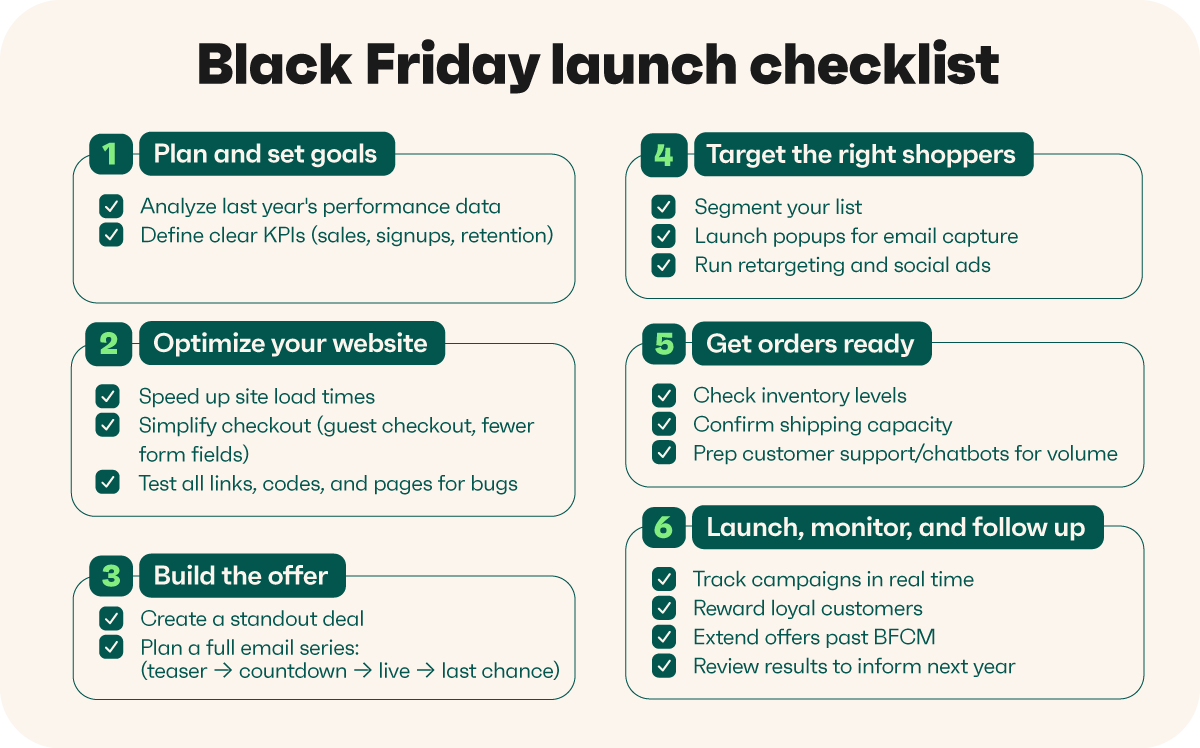
With only two to three weeks until Black Week, the emphasis is on campaign development and rigorous testing. Drafting compelling Black Friday email campaigns and SMS messages, utilizing proven templates and engaging subject lines, is essential. The most effective strategies unify communication across multiple channels, ensuring a consistent brand message and seamless customer journey. This period is also opportune for introducing holiday gift guides, subtly extending the shopping season beyond Black Week.
The Black Week launch itself demands precision. All preparatory work should culminate in a final, comprehensive check. This includes verifying landing page functionality, confirming automation triggers, and ensuring all technical elements are flawlessly operational. During Black Week, strategic timing of email sends, informed by research on optimal engagement periods, combined with targeted BFCM Facebook ad campaigns, will expand audience reach and drive traffic. Furthermore, robust abandoned cart recovery mechanisms—spanning email, SMS, and push notifications—are indispensable, as cart abandonment is a common occurrence during high-volume sales events.
Pillar 3: Protecting Profit Margins Amidst Discounting
While deep discounts are synonymous with Black Friday, maintaining profitability is paramount. Several strategies can safeguard margins:
- Minimum Purchase Thresholds: Implement tiered discounts that incentivize higher spending. For instance, a 10% discount on purchases over $30 and a 20% discount on orders exceeding $50 encourages customers to add more items to their cart to unlock greater savings, thereby increasing AOV. The same principle can be applied to free shipping offers.
- Strategic Product Bundling: Pair lower-margin, discounted items with higher-margin complementary products. This approach not only increases average order value but also introduces customers to a wider range of your catalog. For example, bundling a discounted skincare serum with a full-price moisturizer.
- Stricter Return Policies for Heavily Discounted Items: To mitigate the financial impact of returns on heavily discounted merchandise, businesses can implement stricter return policies for these specific items. Crucially, this must be communicated with absolute transparency to customers before purchase to avoid dissatisfaction.
- Gifts with Purchase: Offer a complimentary gift with every order, often tied to a spending threshold. This adds perceived value without directly cutting into product margins. For example, a sample-sized product for purchases between $50-$99, a full-sized complementary item for $100-$199, and a premium gift set for orders over $200. Evaldas Mockus, VP of Growth at Omnisend, advises, "Focus on value if you can’t give big discounts. If your discounts don’t go higher than 10-15%, it’s totally fine. You can also consider things like extended warranties, free shipping, future purchase credit, exclusive early access, and loyalty bonuses to entice customers."
- Free Shipping on Non-Discounted Items: Offer free shipping as an incentive when a non-discounted item is included in the cart. This subtly encourages customers to purchase full-price products, thereby bolstering overall profitability. Regardless of the specific offer, consolidating all promotions onto a single, dedicated Black Friday landing page simplifies ad spend tracking, streamlines customer navigation, and provides a clear, unified data set for post-event analysis.
Pillar 4: Cultivating Long-Term Customer Loyalty (Post-Black Week)
The period immediately following Black Week is as crucial as the event itself for long-term business health. The focus shifts from transactional sales to building sustainable customer relationships. Implement post-purchase email flows specifically tailored for Black Friday buyers, acknowledging their discount purchase while subtly introducing the full-price catalog. Timing is critical: a limited-time offer sent two to three weeks after Black Friday, while the shopping impulse is still somewhat active, often outperforms generic "come back" messages sent much later.
Sophisticated customer segmentation is vital here. Categorize Black Friday shoppers by what they bought, the discount depth they received, and their overall engagement. This granular segmentation allows for highly personalized Q4 and Q1 win-back campaigns that resonate with the specific motivations that drove their initial purchase. As demonstrated by CLVmaxers, a retention agency, optimizing welcome automation sequences led to a 52% increase in open rates and a 7.5% conversion rate, generating over 1,000 first-time orders in 12 months. This highlights the immense potential of converting Black Friday impulse buyers into loyal, repeat customers through strategic retention efforts.
Technical Resilience: Ensuring Your Store is Battle-Ready
Beyond marketing and pricing strategies, the technical backbone of an e-commerce store must be robust enough to withstand the immense pressure of Black Week traffic. Key considerations include:
- Website Speed and Performance: High page load times can lead to significant bounce rates. Stress-test the website to ensure it can handle peak traffic without degradation in performance.
- Checkout Process Optimization: The checkout flow must be seamless, fast, and mobile-friendly. Any friction points, such as complex forms or slow payment processing, can result in abandoned carts. Conduct thorough testing on both desktop and mobile devices.
- Traffic Resilience and Scalability: Ensure hosting infrastructure can scale dynamically to accommodate sudden spikes in visitors. Cloud-based solutions and Content Delivery Networks (CDNs) are essential for global reach and stability.
- Integration with Marketing Platforms: Platforms like Omnisend offer native integrations with e-commerce systems like Shopify, WooCommerce, and BigCommerce, ensuring seamless data flow for marketing automations without complex custom setups.
Beyond Sales: The Rise of Responsible Black Friday
In 2026, e-commerce trends indicate a growing consumer preference for conscious buying and brand transparency. A responsible Black Friday sale involves more than just honest discounting, eschewing inflated "was" prices and ensuring clear communication about stock levels and shipping timelines.
Furthermore, businesses are increasingly leveraging Black Friday for purpose-driven initiatives. Brands like Allbirds have famously raised prices on Black Friday, donating the extra revenue to climate-related causes, aligning with environmentally conscious consumers. Similarly, outdoor brand Amundsen opted for experiential marketing, offering free waffles at physical locations, fostering community rather than solely pushing discounts. Such unconventional approaches not only enhance public relations but also highlight a brand’s commitment to social and environmental impact, resonating deeply with a segment of the modern consumer base.
Conclusion and Outlook for 2026
The Black Week phenomenon in 2026 represents a critical juncture for e-commerce. Success will be defined not merely by the volume of sales generated during the event, but by the strategic foresight and execution across readiness, acquisition, conversion, and, most importantly, retention. The increasing AOV and YoY order growth underscore the market’s dynamism and consumer appetite for deals, yet simultaneously demand sophisticated margin protection and customer loyalty initiatives.
Brands that excel will be those that adapt to evolving consumer behaviors, including conscious buying, mobile-first interactions, and the early use of AI for deal research. By viewing Black Friday and Cyber Monday as integral components of a larger, interconnected Black Week strategy, businesses can not only capitalize on immediate revenue opportunities but also cultivate lasting customer relationships, ensuring sustained growth beyond the holiday rush. The future of Black Friday is not just about making sales, but about building an intelligent, responsive, and responsible e-commerce ecosystem.