By Tom Swanson, Senior Engagement Manager at Heinz Marketing
The integration of Artificial Intelligence (AI) into business-to-business (B2B) marketing is no longer a hypothetical future; it is a present reality. As AI tools and applications rapidly evolve, marketers are actively seeking practical, real-world applications to enhance their strategies and operational efficiency. This article delves into several key use cases, drawing from actual implementations observed and experienced by industry professionals. We will explore how AI is being leveraged for data enrichment, optimizing knowledge bases, and prioritizing quality over sheer quantity in marketing output, offering valuable insights for organizations navigating this transformative landscape.
The Evolving AI Landscape in B2B Marketing
The proliferation of AI resources, from generative models and agent-based systems to sophisticated data analysis tools, has created a rich, albeit sometimes overwhelming, ecosystem for B2B marketers. While countless whitepapers and blog posts offer theoretical frameworks, the true test lies in practical application. Tom Swanson, Senior Engagement Manager at Heinz Marketing, highlights this transition, stating, “As a B2B agency guy, I see a lot of AI implementations from a diverse array of companies, teams, and organizations. Today, in this post, I am going to share some lessons learned and stories from the field.” This perspective underscores the importance of ground-level experience in understanding AI’s tangible impact.
The agency environment, by its nature, provides a unique vantage point, exposing professionals to a wide spectrum of AI projects and their varied outcomes. This broad exposure allows for the distillation of best practices and common pitfalls, crucial for organizations seeking to harness AI’s potential effectively. The following sections detail specific instances where AI has demonstrably altered marketing workflows and outcomes.
Overcoming Data Limitations with Custom AI Solutions
A significant challenge for many B2B marketers, particularly those targeting niche or local markets, is the limitations of off-the-shelf data solutions. While comprehensive platforms like ZoomInfo excel in providing data for large enterprises, their efficacy diminishes when dealing with smaller, localized businesses. This is a critical bottleneck, as access to relevant decision-makers is paramount for effective outreach.
One compelling use case involves a company that encountered these limitations when focusing on local businesses. Traditional ABM (Account-Based Marketing) strategies, heavily reliant on extensive firmographic and technographic data, proved less fruitful. The company recognized that for smaller entities, the granular data required for precise targeting was often unavailable or prohibitively expensive to acquire through conventional means.
To address this, the team developed a custom AI-powered solution utilizing Claude Code. This innovative script was designed to automate the data acquisition process. It begins by scanning public records weekly for businesses that meet predefined criteria. Subsequently, it leverages web scraping to gather additional information about these identified businesses, filling in gaps in a structured template. This automated workflow, deployed on a cloud server for consistent weekly execution, significantly augmented their data collection capabilities. The outcome was remarkable: this AI-driven approach yielded double the actionable data compared to what was achievable with ZoomInfo in that specific context.
This example illustrates a key principle: AI can be instrumental in creating bespoke solutions for niche market challenges. While ZoomInfo remained valuable for the company’s broader, enterprise-level strategic initiatives, the AI solution provided a powerful, cost-effective alternative for their local SMB outreach, demonstrating AI’s adaptability and ability to fill critical gaps in existing martech stacks.

Streamlining Demand Generation with AI-Powered Intake
In the realm of demand generation, teams often serve multiple stakeholders across different business units, leading to complex and often inconsistent request processes. This scenario, characterized by a high volume of incoming requests, diverse stakeholder needs, and the pressure for rapid turnaround, presents a fertile ground for AI-driven optimization.
A recent Marketing Orchestration engagement highlighted such a situation. The demand generation team was struggling with the inherent inefficiencies of managing varied request formats and incomplete information. The core problem was the lack of standardization in how projects were initiated, making it difficult for the team to accurately assess scope, allocate resources, and provide reliable timelines. This often resulted in delays, miscommunication, and a general bottleneck at the beginning of the workflow.
The solution involved leveraging AI to standardize the intake process, not by imposing rigid, lengthy briefing documents on requestors, but by empowering AI to interpret and structure unstructured data. AI’s proficiency in transforming raw, varied inputs into a consistent, actionable format proved invaluable. Requests could be submitted in any form, and the AI would then parse, standardize, and validate the information with both the requestor and the execution team.
The benefits of this AI-driven intake system were manifold. Firstly, it dramatically improved the clarity and accuracy of project briefs, enabling the demand generation team to queue projects more efficiently and provide more precise time and effort estimations. Secondly, by addressing the “garbage in, garbage out” issue at the very outset of the workflow, the team gained a clearer understanding of their genuine operational bottlenecks. This allowed them to focus on solving more substantive challenges within their process, rather than being perpetually hampered by inconsistent initial inputs. The ability of AI to handle unstructured data, especially with optimized context windows to minimize errors, proved to be a significant workflow enhancer, directly impacting project velocity and team capacity.
The Underrated Power of Knowledge Base Chunking in RAG
The implementation of Retrieval Augmented Generation (RAG) systems, which enhance Large Language Model (LLM) capabilities by providing them with access to specific knowledge bases, is becoming increasingly prevalent. The objective is to move beyond generic LLM responses and provide contextually relevant, accurate information derived from proprietary or curated sources. However, a common oversight, even among experienced professionals, is the critical role of “chunking” in optimizing these knowledge bases.
A project initiated with the intention of building a robust knowledge base for RAG encountered unexpected challenges related to execution times and token usage, leading to increased costs. The initial approach involved ingesting large volumes of documentation without a systematic method for breaking them down. This proved to be an expensive lesson learned.
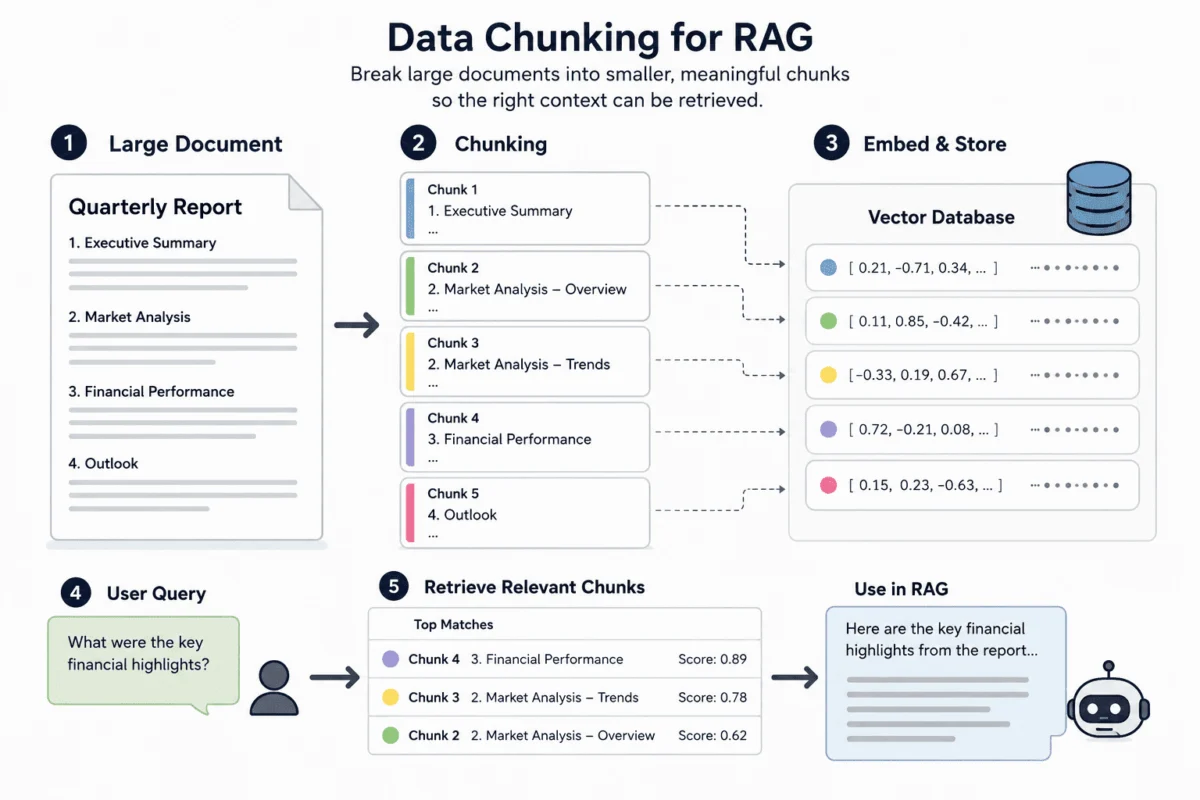
The realization dawned that large, un-chunked knowledge bases, while comprehensive, can significantly slow down retrieval processes and inflate token consumption when interacting with LLMs via APIs. The solution lies in effective chunking: breaking down documentation into smaller, manageable segments. Each chunk is then classified, often through a process called vectorization, which assigns it a unique representation based on its content and characteristics. This allows RAG systems to efficiently retrieve the most relevant chunks of information when a query is made, rather than processing entire documents.
For any organization looking to build RAG tools, understanding and implementing effective chunking strategies is paramount. This involves:
- Defining Optimal Chunk Size: Experimenting with different chunk sizes to balance comprehensiveness with retrieval efficiency.
- Implementing Semantic Chunking: Utilizing techniques that break content based on semantic meaning rather than just fixed character limits.
- Leveraging Vector Databases: Employing specialized databases designed to store and query vectorized data for rapid retrieval.
- Iterative Refinement: Continuously evaluating and refining chunking strategies based on RAG performance metrics.
By adopting a thoughtful approach to knowledge base chunking, businesses can significantly improve the performance, cost-effectiveness, and overall utility of their RAG implementations.
Balancing Speed and Quality in AI-Driven Campaign Generation
The allure of AI in marketing often centers on its ability to accelerate processes, particularly campaign ideation and execution. However, the pursuit of speed can sometimes come at the expense of quality and strategic depth, especially in B2B contexts where the stakes are often higher.
Many clients express a desire to use AI to drastically reduce the time from campaign concept to launch. While AI can standardize briefs, shorten service-level agreements (SLAs), and ensure consistent output, a purely volume-driven approach to campaign generation in B2B marketing can be counterproductive. Unlike B2C markets where broad reach and high frequency can sometimes drive results, B2B sales cycles are typically longer, involve higher customer acquisition costs (CAC), and demand a more nuanced approach to buyer engagement.
In one particular case, a client successfully employed AI to achieve remarkable speed in their campaign ideation and execution workflow. They standardized briefs, streamlined processes, and achieved consistent outputs. However, a critical observation was that campaign performance did not see a commensurate improvement. The AI, while adept at generating content, was producing output that, while technically sound, began to lack the distinctive voice and strategic creativity required to resonate with human buyers.
The fundamental issue is that while AI can assist buyers in their research, the ultimate decision to engage, book a meeting, or trust a brand still rests with a human. This requires content that not only informs but also builds rapport and instills confidence. The client’s experience led to a recalibration: retaining the efficiency gains from AI tooling but strategically integrating human oversight at critical junctures. This ensured that creative elements requiring strategic insight, nuanced understanding, and calculated risk-taking were handled by human marketers.
This scenario highlights a crucial dichotomy in AI-driven marketing: the need to serve two distinct demands. The first is the demand for operational efficiency and speed, where AI excels. The second is the demand for strategic creativity, human connection, and nuanced brand storytelling, where human input remains indispensable. A truly effective AI workflow, therefore, should aim to orchestrate the best aspects of people, tools, and processes, recognizing that AI is a powerful augmentative force, not a complete replacement for human strategic thinking.
Conclusion: The Ongoing Evolution of AI in Marketing
The landscape of AI in marketing is in a perpetual state of flux. As AI capabilities continue to advance, the ability of AI to generate compelling content for human audiences will undoubtedly improve. However, for the present, the lessons learned from practical implementations provide invaluable guidance. By focusing on specific, well-defined use cases like data enrichment, knowledge base optimization, and the intelligent integration of AI with human strategy, B2B marketers can unlock significant value.
The agency environment, with its exposure to diverse challenges and innovative solutions, offers a unique perspective on these evolving trends. The key takeaway is that AI’s greatest potential lies not in replacing human ingenuity, but in augmenting it, creating more efficient, effective, and ultimately, more impactful marketing strategies. For those seeking to delve deeper into these AI applications and share further experiences, engagement remains open.