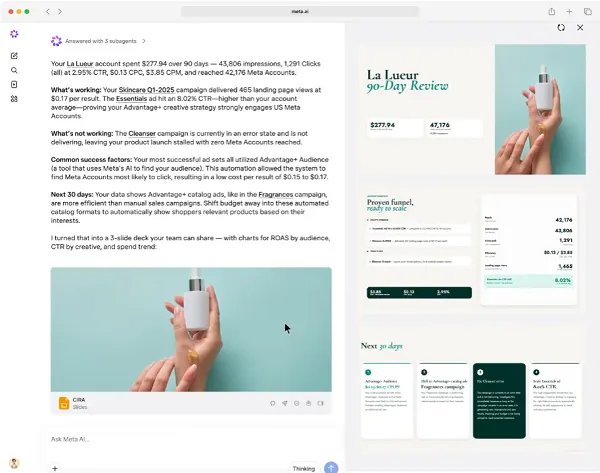
Meta Platforms has introduced significant enhancements to its artificial intelligence tools aimed at empowering small and medium-sized business (SMB) owners, enabling them to integrate analytics from multiple critical sources to optimize their platform strategies. This new capability allows SMBs to consolidate data from their Facebook and Instagram analytics, Meta Ads, and Google Workspace directly into Meta AI. The integration is meticulously designed to power more accurate AI recommendations, provide deeper insights, and ultimately help businesses maximize their performance across Meta’s expansive ecosystem and beyond.
The Evolving Landscape of SMB Digital Marketing and Meta’s Strategic Imperative
Small and medium-sized businesses globally face a complex and increasingly competitive digital marketing landscape. With limited resources, often a lack of dedicated marketing teams, and the sheer volume of data generated across various platforms, SMBs frequently struggle to derive actionable insights and optimize their online presence effectively. The global digital advertising market, estimated to be worth over $600 billion, sees a significant portion of spending from SMBs, yet many report challenges in measuring return on investment (ROI) and understanding complex analytics dashboards. According to a 2023 survey by Salesforce, 62% of SMBs reported that they don’t have enough time to dedicate to marketing, and 53% cited a lack of internal expertise as a major barrier.
Meta, recognizing the critical role SMBs play in its advertising revenue – often accounting for a substantial percentage of its total ad sales – has long invested in tools to support this segment. From the early days of Facebook Pages and Ads Manager to the more recent introduction of Meta Business Suite, the company has consistently sought to simplify digital operations for smaller enterprises. This latest AI integration marks a strategic escalation of that commitment, aligning with Meta’s broader "AI-first" pivot announced in early 2023. The company has publicly committed to investing hundreds of billions of dollars into AI development, a testament to its belief in AI as the next frontier for both consumer and business applications. This investment is not just about competing with tech giants like Google and Microsoft in the AI race but also about creating a more valuable and sticky ecosystem for its vast user and business base.
A Deep Dive into the Enhanced Meta AI Features
The core innovation lies in Meta AI’s newfound ability to ingest and synthesize data from disparate sources. Previously, while Meta provided analytics within its platforms, a holistic view encompassing external data like Google Workspace insights was challenging to achieve without manual aggregation or third-party tools.
-
Multi-Source Data Integration: The integration of data from Facebook and Instagram analytics, Meta Ads, and Google Workspace is pivotal.
- Facebook & Instagram Analytics: Provides insights into audience demographics, content performance, reach, engagement, and follower growth on Meta’s social platforms.
- Meta Ads Data: Offers granular details on campaign performance, ad spend, conversions, cost-per-acquisition (CPA), and overall advertising ROI.
- Google Workspace: This is a significant addition, potentially allowing Meta AI to access data from Google Analytics (website traffic, user behavior), Google Sheets (business data, sales figures), and even Google Docs (marketing plans, content outlines). This cross-platform data synthesis provides a truly 360-degree view of an SMB’s digital footprint, moving beyond just Meta’s walled garden.
-
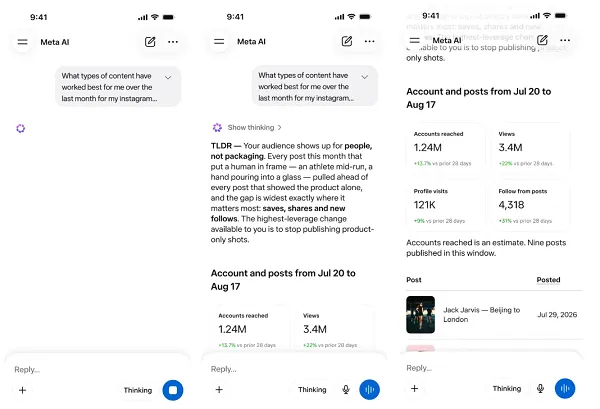
Conversational AI for Strategic Guidance: Meta AI leverages natural language processing to engage with business owners through conversational prompts. Instead of sifting through endless reports, users can ask direct questions in the app, such as "How can I improve my Facebook ad performance?" or "What type of content resonates most with my Instagram audience?"
- Detailed Explanations and Insights: The AI can then provide comprehensive answers, explaining why certain strategies are recommended, backed by the integrated data. For example, it might identify that ads targeting a specific demographic on Facebook are underperforming compared to Instagram, or that website traffic from a particular Meta ad campaign is high but conversion rates are low, suggesting a landing page issue.
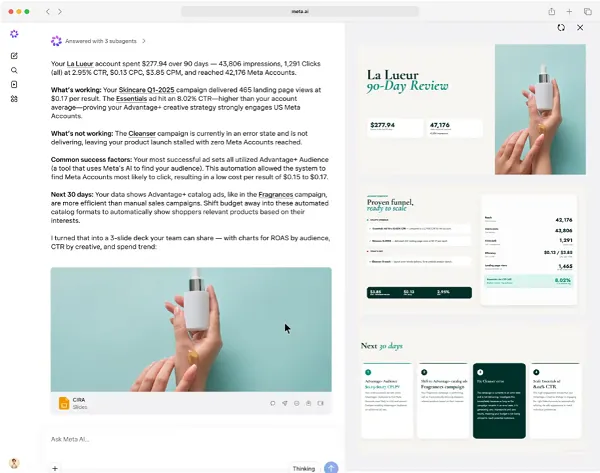
- Specific Guidance with Ad Examples: The system goes beyond general advice by offering pointers on improvements and opportunities based on actual ad examples. It can analyze creative elements, call-to-actions, and targeting parameters, suggesting concrete changes to enhance effectiveness. This prescriptive approach is invaluable for SMBs without in-house marketing specialists.
-
Automated Task Management and Workflow Streamlining: Beyond analysis and recommendations, Meta AI can translate insights into actionable tasks.

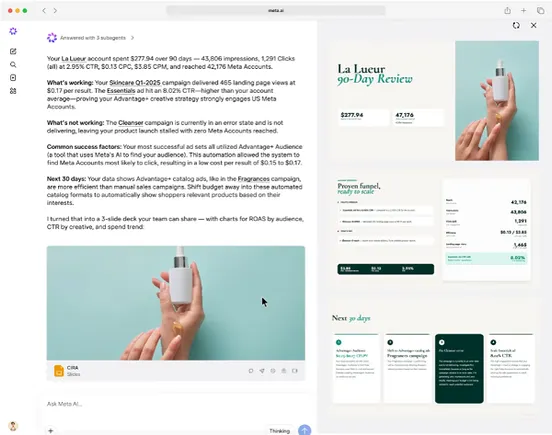
- Document and Spreadsheet Generation: It can convert complex analytical findings into digestible documents or structured spreadsheets, simplifying reporting and internal communication.
- Recurring Tasks and Reminders: To ensure consistent execution, the AI can generate recurring tasks and reminders, helping business owners stay on top of key elements like budget monitoring, content scheduling, or ad campaign adjustments. This proactive assistance minimizes the risk of missed opportunities or neglected optimization efforts.
Chronology of Meta’s AI and Business Tool Evolution
Meta’s journey to this advanced AI offering for SMBs has been incremental, reflecting a broader industry trend towards intelligent automation:
- Early 2010s: Introduction of Facebook Pages for businesses and the foundational Facebook Ads Manager, revolutionizing how SMBs could reach audiences.
- Mid-2010s: Expansion of advertising capabilities to Instagram following its acquisition, and the introduction of more sophisticated targeting options.
- Late 2010s: Development of Facebook Business Suite (later Meta Business Suite) to centralize page management, messaging, and basic analytics across Facebook and Instagram. Initial AI-driven optimizations began to appear within ad campaign settings, primarily focused on bid management and delivery.
- 2021-2022: Significant investments in AI research and development, particularly in large language models (LLMs) and generative AI, leading to the release of Llama models for researchers. Meta’s focus was heavily on the metaverse vision, but AI development continued in parallel.
- Early 2023: Meta officially pivots to an "AI-first" strategy, emphasizing AI integration across all products. Launch of consumer-facing Meta AI assistants and advanced features in its apps.
- Late 2023/Early 2024: Rollout of initial generative AI tools for advertisers within Meta Ads Manager, assisting with creative generation and text variations.
- Current Announcement: Integration of multi-source data into Meta AI for SMBs, marking a significant step towards comprehensive strategic guidance and automation.
The Competitive Landscape and Market Context
The market for AI-powered business tools is intensely competitive, with major tech players and specialized SaaS providers vying for market share.
- Google: A formidable competitor with its Google Ads AI, Performance Max campaigns, and the integration of Bard/Gemini into Google Workspace and Google Analytics. Google’s vast data ecosystem, particularly search and web activity, offers a unique advantage.
- Microsoft: With Copilot integrated into Microsoft 365, Dynamics 365, and Viva Sales, Microsoft is aggressively pushing AI for productivity and business operations, leveraging its enterprise software dominance.
- Marketing Automation Platforms: Companies like HubSpot, Salesforce (with Einstein AI), and Adobe Experience Cloud offer comprehensive marketing, sales, and service automation solutions, increasingly powered by AI for personalization and efficiency.
Meta’s offering distinguishes itself through its unparalleled first-party data on social behavior and ad performance within its platforms. By integrating Google Workspace data, Meta AI is attempting to bridge the gap between social engagement and broader web/business operations, positioning itself as a central hub for SMB digital strategy. The global SMB market is projected to reach over $1.5 trillion by 2027, with digital transformation and AI adoption being key growth drivers. Meta’s strategic move aims to capture a larger share of this market by reducing the complexity barrier for smaller businesses.
Implications for Small Businesses: Opportunities and Challenges
This advancement carries significant implications for SMBs:
- Democratization of Data Analytics: It levels the playing field, providing small businesses with sophisticated analytical capabilities that were once exclusive to larger enterprises with dedicated data scientists and marketing teams. This can lead to more informed decision-making and better allocation of often-limited marketing budgets.
- Increased Efficiency and ROI: By streamlining data analysis and offering actionable recommendations, SMBs can save time and potentially achieve higher ROI on their digital marketing spend. The AI acts as a virtual marketing consultant, identifying inefficiencies and opportunities for growth.
- Skill Gap Reduction: Many SMB owners wear multiple hats and lack specialized marketing expertise. Meta AI can fill this gap, guiding them through complex strategies and offering best practices.
- Potential Challenges:
- Data Privacy Concerns: While Meta emphasizes user control, integrating data across platforms raises questions about data governance, security, and how information is shared and utilized by the AI. SMBs will need assurances about the privacy and security of their sensitive business data.
- Over-reliance on AI: There’s a risk that businesses might become overly dependent on AI recommendations without developing their own critical understanding of marketing principles. Human oversight remains crucial to interpret AI outputs and adapt them to unique business contexts.
- "Black Box" Nature of AI: While Meta aims to provide detailed explanations, the underlying algorithms of AI can sometimes be opaque. SMB owners might struggle to fully understand the rationale behind certain recommendations, potentially leading to a lack of trust.
- Learning Curve: While designed for simplicity, any new tool requires a learning curve. SMB owners will need to invest time in understanding how to best leverage Meta AI’s capabilities.
Meta’s Monetization Strategy: The Path to Meta One
Crucially, Meta has stated that while it’s free to get started with these new AI features, "as we expand, businesses that want to use them even more will be able to subscribe to Meta One." This signals a clear monetization strategy for Meta’s massive AI investments.
- Freemium Model: Offering initial access for free is a common strategy in the SaaS industry to drive adoption and allow users to experience value before committing to a subscription. It allows SMBs to test the waters and integrate the AI into their workflows.
- Subscription for Expanded Features: The "Meta One" subscription is likely to unlock advanced analytics, more comprehensive integrations, higher usage limits, priority support, and potentially more sophisticated AI agents (like the "Business Agent" and "Business Assistant" Meta has teased).
- Justification for Charging: Given the hundreds of billions of dollars Meta has poured into AI development, establishing a direct revenue pathway is a logical and necessary step. This mirrors moves by other tech giants, such as Microsoft’s Copilot subscriptions or Google’s premium Workspace AI features.
- User Reactions: While initial free access will be welcomed, the transition to a paid model could be a point of contention for some SMBs, especially if they become heavily reliant on the tools. Transparency regarding features included in the free tier versus the paid subscription will be vital to manage expectations and ensure continued adoption.
Expert and User Reactions (Inferred)
Digital marketing analysts are likely to view this as a significant step forward in making sophisticated AI accessible to SMBs. They would praise the potential for increased efficiency and data-driven decisions but caution against complete automation without human oversight. Concerns about data privacy and the potential for increased costs down the line would also be highlighted.
SMB owners, on the other hand, would likely express a mix of eagerness and skepticism. Many would welcome tools that simplify marketing complexities and save time, especially those struggling with analytics. However, a segment might remain wary of fully trusting AI with critical business strategies or be hesitant to adopt another subscription service, particularly if the value proposition isn’t immediately clear or if they perceive it as Meta simply moving features behind a paywall. Meta’s official statements would likely continue to emphasize its commitment to empowering businesses of all sizes, fostering innovation, and helping them thrive in the digital economy.
Conclusion: The Future of AI in Business Operations
Meta’s latest enhancements to its AI tools for small businesses represent a significant leap towards embedding advanced artificial intelligence directly into the operational fabric of digital marketing. By enabling multi-source data integration and offering conversational, actionable insights, Meta is not just providing a tool but positioning itself as a strategic partner for SMBs navigating the complexities of the online world.
This initiative is a critical step in Meta’s broader vision of developing all-encompassing AI agents that can eventually reduce manual workload by automating key aspects of promotional activities. While the idea of AI "taking the wheel" might still be a distant future for many SMBs, who are naturally more cautious about fully automating core processes, the current offering lays the groundwork for that evolution. It establishes a framework where AI acts as a powerful assistant, analyzing, recommending, and even initiating tasks. The strategic decision to offer initial free access before transitioning to a subscription model via "Meta One" is a calculated move to drive widespread adoption and subsequently monetize its substantial AI investments. As AI continues to mature, the balance between human intuition and AI efficiency will define the future of business operations, with Meta AI poised to play an increasingly central role in transforming the global SMB ecosystem.