Crafting public relations campaigns that genuinely resonate and achieve tangible results is a perennial challenge for marketing professionals. The elusive quest for groundbreaking ideas, coupled with the pressure to guarantee success, often leads to creative blocks and hesitant execution. However, the landscape of digital PR has evolved, offering sophisticated tools and methodologies that significantly increase the probability of a campaign becoming a resounding success. This article outlines a robust, two-step process, heavily reliant on in-depth research and strategic content analysis, designed to generate high-impact campaigns that secure extensive media coverage, valuable backlinks, and widespread social engagement.
The Foundational Challenge in Modern PR Ideation
In today’s hyper-connected and content-saturated world, the average consumer is bombarded with thousands of marketing messages daily. For PR professionals, this presents a dual challenge: not only must campaigns cut through the noise, but they must also deliver measurable outcomes in terms of brand visibility, audience engagement, and crucially, link acquisition for SEO. The days of purely speculative brainstorming are waning; contemporary PR demands a data-driven approach, where creative intuition is fortified by empirical evidence of what captures attention and incites action. According to a recent industry report by the Public Relations Society of America (PRSA), campaigns leveraging robust audience insights and content trend analysis are 40% more likely to achieve their primary objectives compared to those based solely on creative guesswork. This shift underscores the imperative for a structured, research-first methodology in developing impactful PR initiatives.
Step 1: Unearthing Resonant Content Themes and Emotional Drivers
The initial phase of crafting a successful PR campaign hinges on a deep understanding of the content landscape relevant to your brand or client. This isn’t merely about identifying popular topics; it’s about discerning themes that consistently generate significant discussion, attract media attention, and provoke strong emotional responses from audiences. The primary metrics for success at this stage are widespread media coverage and valuable backlinks, with social engagement serving as a crucial secondary Key Performance Indicator (KPI).
-
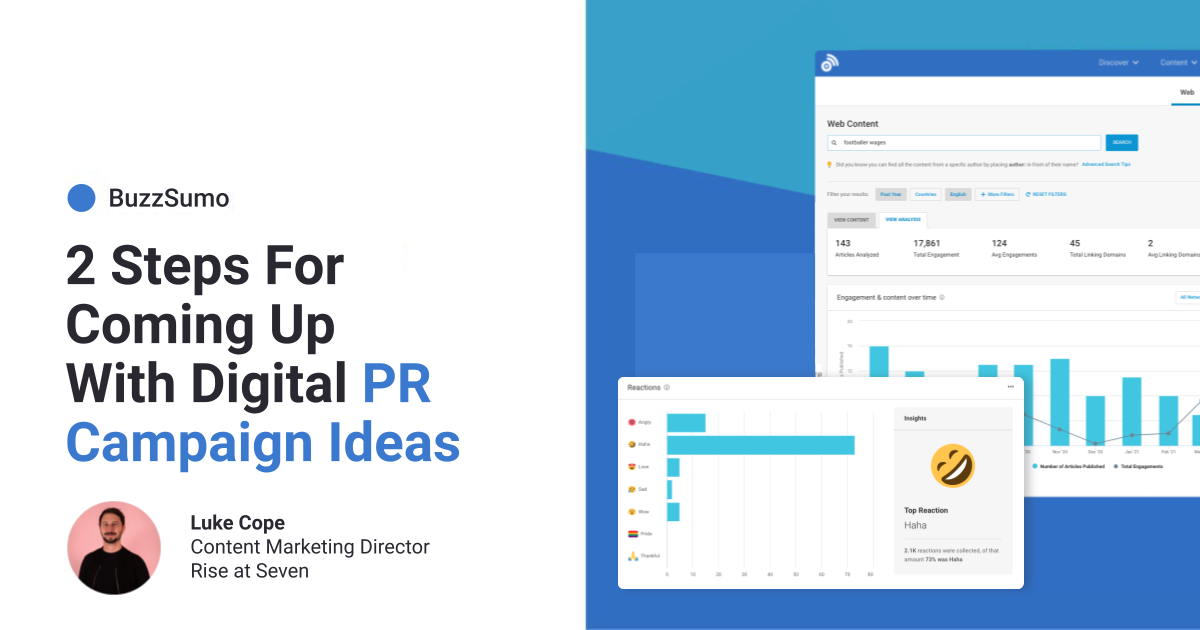
Systematic Content Analysis: Before a concrete campaign idea even begins to form, professionals should leverage advanced content intelligence platforms, such as BuzzSumo’s Content Analysis Report. This tool allows for a systematic exploration of vast datasets of published content, revealing patterns in engagement, sharing, and sentiment. The process begins with the core product or service and then strategically expands to adjacent, yet highly relevant, topics.
- Example: The Honeymoon Industry: If a client specializes in honeymoon packages, the initial search term would naturally be “Honeymoons.” The Content Analysis Report would then reveal not only the volume of content published around this term but also its average social shares, backlinks, and, critically, the emotional reactions it elicits. From there, the research should branch out to related themes like “Weddings,” “Engagement Rings,” “Romantic Getaways,” or even “Destination Weddings.” This iterative process continues until the explored themes become too far removed from the core offering, ensuring relevance while broadening the scope for innovative ideas.
- Identifying Consistent Engagement: The goal is to identify themes that are not just occasionally popular but consistently discussed and shared over time. This consistency indicates enduring public interest and journalistic appetite, providing a stable foundation for a campaign. The BuzzSumo reports, often visualized with trend graphs, clearly show the ebb and flow of content production and engagement, highlighting evergreen topics versus fleeting fads. For instance, while “Honeymoons” might show steady interest, “Engagement Rings” could reveal seasonal spikes or particularly high emotional engagement, indicating a fertile ground for content.
-
Decoding Emotional Resonance: Beyond mere popularity, understanding the emotional undercurrents of successful content is paramount. Content that evokes strong emotions—whether joy, surprise, anger, sadness, or awe—is significantly more likely to be shared and discussed. By analyzing the sentiment associated with articles on target themes, PR professionals can pinpoint the emotional levers that truly move an audience. This qualitative insight is invaluable for shaping the narrative and tone of a prospective campaign.
- For example, articles about lavish celebrity weddings might elicit “awe” or “aspiration,” while discussions around wedding planning stress might tap into “empathy” or “humor.” Recognizing these emotional touchpoints allows for the creation of content that is not just informative but deeply relatable and shareable.
Case Study: “A World Without Light Pollution” – Tapping into Awe and Concern
Consider the campaign “A world without light pollution,” which aimed to visually depict major cities stripped of their artificial glow, revealing a starlit sky. The research journey for this campaign exemplifies the two-step process:
- Product Theme: The client offered “Star maps,” a niche product with limited immediate campaign potential.
- Secondary Theme Exploration:
- “Supermoons”: High social engagement, offered opportunities for reactive PR due to regular occurrences.
- “Night Sky”: Consistently high social engagement, indicating public fascination.
- “Light Pollution”: Exhibited significant and growing social engagement. Critically, content analysis revealed this theme was experiencing a surge in discussion.
- Contextual Alignment: The timing was crucial. In [Year, inferred from article’s publishing date as 2021], public discourse around light pollution was intensifying due to factors like SpaceX’s Starlink satellite launches, which raised concerns about orbital debris and increased light interference for astronomers. Simultaneously, the global pandemic had sparked broader conversations about environmental pollution and its reduction, creating a highly receptive media environment.
- Emotional Analysis: Articles on light pollution frequently evoked emotions of “sadness” at the loss of natural night skies and “awe” at the potential beauty of a clear, starry vista. This dual emotional spectrum provided clear angles for campaign messaging: highlighting the problem while simultaneously showcasing a breathtaking alternative. This insight was pivotal in deciding the campaign’s visual, impactful nature. The campaign aimed to make people feel the loss and imagine the gain, maximizing its emotional punch.
Case Study: The “Footballer Car Cost Calculator” – Igniting Competitiveness and Disbelief
Another compelling example involved a campaign for a private number plate client. The core product theme, “Private number plates,” while having some amusing content, lacked the breadth for a high-impact campaign.
- Aspirational Lifestyle Themes: The research expanded to “Celebrity cars” and then more specifically to “Footballers cars.” Content analysis revealed a high volume of articles on these topics and, crucially, a torrent of reactions in the comments sections.
- Emotional Deep Dive: A closer examination of these comments unearthed a powerful emotional driver: public outrage and a sense of competitiveness. Readers were frequently “mad” at the excessive wealth displayed and instinctively compared their own financial realities to those of professional footballers. This insight was the genesis of the campaign idea.
- Idea Generation: The idea materialized: why not create a literal comparison? A calculator that allowed users to input their salary and see how long it would take them to afford a footballer’s car. This concept directly tapped into the identified emotions of disbelief and comparison, transforming passive reading into active, personalized engagement. This campaign brilliantly leveraged existing public sentiment to create a tool that was both entertaining and subtly provocative, guaranteeing shares and media mentions.
The success of these campaigns underscores a vital principle: a campaign built on thoroughly researched themes and deeply understood emotional triggers is inherently more likely to succeed. This meticulous groundwork removes much of the subjectivity from the ideation process, providing a robust, data-backed rationale for campaign development.
Step 2: Optimizing Format and Adding Strategic Depth
Once a compelling idea, rooted in resonant themes and emotional drivers, has been identified, the next critical step is to determine the optimal format for its presentation and to imbue it with sufficient depth and multiple angles for outreach. The format is not merely a stylistic choice; it dictates how the message is received, processed, and shared.
-
Format as a Differentiator: The chosen format must align perfectly with the campaign’s core message and desired emotional impact. A static blog post, for instance, would have severely undermined the “wow factor” intended by the “light pollution” campaign. Instead, an interactive slider, allowing users to toggle between “before” (light-polluted city) and “after” (starlit city) views, provided an immersive and engaging experience. This interactivity transformed a simple visual concept into a captivating digital asset.
- Interactive content, such as calculators, quizzes, and data visualizations, consistently demonstrates higher engagement rates. Industry benchmarks suggest that interactive content can generate twice the engagement of passive content, leading to longer dwell times and increased sharing.
-
Layering Depth and Angles: A powerful campaign idea, regardless of its initial simplicity, benefits immensely from added layers of depth and multiple journalistic angles. This strategic layering ensures the campaign appeals to a wider range of media outlets and offers diverse hooks for journalists.
- Expanding the “Light Pollution” Narrative: While the core visual was compelling, the campaign added significant depth by integrating data from the Bortle scale, a numerical scale used to quantify the darkness of the night sky. It showcased the stark contrast between cities rated 10 (heavily light-polluted) and what they would appear like at a Bortle 1 rating (pristine night sky). Furthermore, it expanded beyond a U.S. focus, acknowledging light pollution as a global issue, thus broadening its appeal to international media. Highlighting statistics like “85% of Americans have never seen the Milky Way” provided a powerful, relatable anchor for the campaign.
Case Study: “Touch the Germs” – Interactive Education for Civic Engagement
Another exemplary campaign, “Touch the Germs,” illustrated the power of an innovative format coupled with profound depth. Instead of a simple graphic or data list on germ prevalence, the team developed an interactive experience featuring a microscope function. Users could virtually “zoom in” on everyday objects to visualize the microscopic world of germs.
- Format Innovation: This interactive format elevated the campaign beyond mere information dissemination into an educational tool. The immersive nature made the abstract concept of germs tangible and impactful.
- Broadened Impact: The campaign’s depth and engaging format led to widespread media coverage. More significantly, it garnered attention from public officials, with the Mayor of London reportedly commenting on the issue. This demonstrates how a well-executed campaign, with the right format and depth, can transcend traditional PR objectives to influence public discourse and even civic policy.
Learning from Missed Opportunities: The “Space Junk” Campaign
Even strong thematic ideas can fall short if the format and depth are not fully realized. The “Who owns all the space junk?” campaign, while visually appealing and addressing a pertinent issue, serves as a valuable lesson. It effectively visualized the ownership of orbital debris by country, a compelling main angle.
- Potential for Deeper Engagement: However, the piece could have benefited from greater depth and interactivity. Imagine a dynamic timeline illustrating the accumulation of space junk since the 1960s, simulations of potential collision scenarios, or an interactive breakdown of different types of debris. What are the economic implications of a cluttered orbit? What are the proposed international solutions? These additional layers would have transformed a good visualization into a comprehensive, authoritative resource, attracting even more specialized media and scientific publications. This highlights that while site limitations can exist, the ambition for depth should always push boundaries.
The Elegance of Simplicity: “iPods Visualized as Vinyl”
Not all effective formats need to be technologically complex. Mark Johnstone’s campaign, “iPods visualized as vinyl,” showcased the power of simple yet brilliant visual juxtaposition. It tapped into cultural nostalgia and the ongoing debate between digital convenience and the tangible experience of physical media. The strength lay in its immediate visual impact and the implicit cultural commentary, proving that thoughtful design can be as impactful as complex interactivity.
Revisiting the “Footballer Car Calculator” – Multi-Angle Outreach
The “Footballer Car Cost Calculator” campaign, in addition to its ingenious format, was designed with numerous outreach angles from the outset. By analyzing data on weekly wages versus car costs, the campaign could generate various headlines:
- “How Many Years Would It Take the Average Worker to Afford a Premier League Star’s Supercar?”
- “The Most Extravagant Car Collections of Footballers Revealed”
- “The Astonishing Wage-to-Car Cost Ratio of Top Athletes”
These diverse angles allowed for tailored pitches to different media segments, from finance and lifestyle publications to sports news and general interest outlets, maximizing its media footprint.
Streamlining Outreach and Securing Stakeholder Buy-in
The rigorous research conducted in Step 1 serves a dual purpose beyond ideation: it significantly enhances the effectiveness of outreach and provides a data-backed foundation for securing internal and client approval.
- Targeted Seeding Lists: The initial content analysis in BuzzSumo provides a ready-made list of journalists and publications that have previously covered the identified themes. By exporting these details, PR professionals can create highly targeted media lists, ensuring pitches land with journalists who have a proven interest in the subject matter. This precision dramatically increases open rates and the likelihood of coverage, moving away from generic mass outreach. BuzzSumo’s studies on journalist pitching emphasize that personalization and relevance are key determinants of success.
- Data-Driven Sign-off: One of the most challenging aspects of PR is gaining approval for novel ideas, which are often perceived as subjective or risky. By presenting comprehensive research on content themes, engagement trends, and emotional drivers, PR professionals can quantify the potential impact of their ideas. This data-backed approach transforms a subjective pitch into an objective business case, demonstrating a high probability of success and de-risking the investment for clients and internal stakeholders. The ability to report on engagement and emotion across multiple themes and publishers, as facilitated by tools like BuzzSumo, provides irrefutable evidence for strategic decision-making.
Broader Implications for the Digital PR Landscape
The adoption of this two-step, research-driven methodology represents a significant evolution in digital PR. It elevates the discipline from a purely creative pursuit to a strategic function deeply integrated with content marketing, SEO, and overall brand strategy. Campaigns developed through this lens are not just “hits”; they are assets that build brand authority, drive organic traffic through valuable backlinks, and foster genuine connections with target audiences. In an era where trust and authenticity are paramount, demonstrating an understanding of audience interests and emotional needs through data-informed content is a powerful competitive advantage.
Key Takeaways for Enduring PR Success:
- Explore Broadly, Focus Deeply: Systematically research content themes related to your product/brand, branching out to adjacent topics. Prioritize themes that demonstrate consistent engagement and media coverage over time.
- Tap into Core Emotions: Understand the emotional responses (e.g., awe, anger, joy, sadness) that popular content within your themes elicits. Design campaigns to intentionally trigger one or two of these powerful emotions.
- Optimize Format for Impact: Select the absolute best format for your campaign idea – whether it’s an interactive calculator, a compelling visual story, or a simple yet resonant graphic. The format should enhance the message and emotional impact.
- Add Layers of Depth and Angles: Don’t settle for a single dimension. Enrich your campaign with additional data, comparative analysis, global perspectives, or historical context. This creates multiple hooks for journalists and broadens media appeal.
- Leverage Research for Outreach: Use your initial content analysis to build targeted media lists, ensuring your pitches are sent to journalists already interested in your campaign’s subject matter.
- Data-Validate Your Ideas: Present your research on themes, emotions, and potential impact to stakeholders. This objective data removes subjectivity, increases confidence, and secures buy-in for your innovative campaigns.
By meticulously integrating research, emotional intelligence, and strategic execution, PR professionals can consistently develop campaigns that not only capture attention but also deliver measurable, impactful results in the competitive digital landscape.