As the retail landscape continues its rapid evolution, Black Friday Cyber Monday (BFCM) has solidified its position as the most critical sales period for e-commerce brands globally. What began as a single-day event in the United States, marked by aggressive in-store discounts following Thanksgiving, has transformed into a multi-week digital phenomenon. Modern BFCM strategies demand sophisticated planning, particularly in email marketing, which remains a cornerstone of customer acquisition and retention. Brands leverage creative angles, from early access and social proof to mystery reveals and strategic discounts, to capture consumer attention in an increasingly crowded digital inbox. This deep dive explores ten pivotal email marketing ideas that have proven effective in maximizing engagement and driving substantial revenue during the BFCM period.
The Evolution of Black Friday and Its Digital Imperative

The term "Black Friday" originally referred to the day when retailers traditionally moved "into the black," or became profitable, after operating at a loss for much of the year. Historically, it was characterized by chaotic in-store rushes and doorbuster deals. However, with the advent of e-commerce, the event expanded, giving rise to "Cyber Monday" to specifically target online shoppers. Today, BFCM encompasses the entire Thanksgiving weekend, and often extends throughout November, creating a prolonged period of intense promotional activity.
For online retailers, email marketing stands out as a high-ROI channel during this period. Industry data consistently shows email marketing generating an average return of $36 for every $1 spent, making it indispensable for BFCM campaigns. Yet, the sheer volume of promotional emails inundating customer inboxes necessitates highly strategic, personalized, and engaging content to cut through the noise. Brands that succeed are those that understand their audience deeply and craft a compelling narrative that spans the entire customer journey, from pre-event anticipation to post-sale follow-up.
Phase 1: Building Anticipation and Exclusivity (Pre-BFCM)
The period leading up to Black Friday is crucial for laying the groundwork, generating excitement, and segmenting audiences for targeted offers.
1. Teasing the Sale Early to Cultivate Excitement
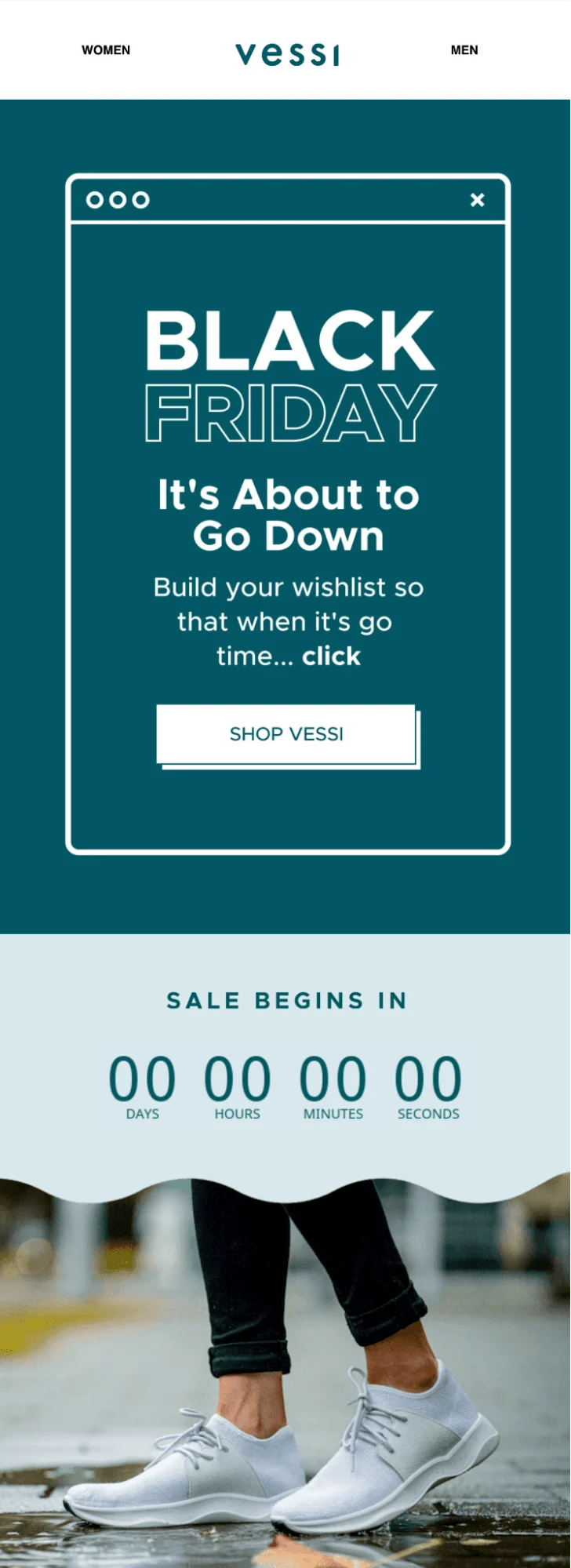
In a crowded market, early communication can be a significant differentiator. Retailers like Vessi, known for its waterproof footwear, effectively initiate their Black Friday marketing well in advance. Rather than immediately offering discounts, early teaser emails focus on building anticipation. A common tactic involves a countdown email, inviting customers to browse the store and curate a wishlist. The subject line, such as "You’re the first to know," instills a sense of exclusivity, which psychological studies confirm can significantly boost open rates.
- Why it works: Early engagement helps brands stand out amidst the deluge of BFCM emails. By encouraging customers to create wishlists, brands not only capture intent but also make subsequent Black Friday emails more likely to be opened and acted upon. This pre-event interaction fosters early affinity, preparing customers for future purchases.
- Implications: This strategy allows brands to identify highly engaged customers before the official sale, enabling more precise targeting. It also mitigates the risk of customers missing out on deals due to inbox overload on Black Friday itself. E-commerce platforms with robust wishlist functionalities are critical here.
2. Granting Early Access to VIPs and Loyal Customers
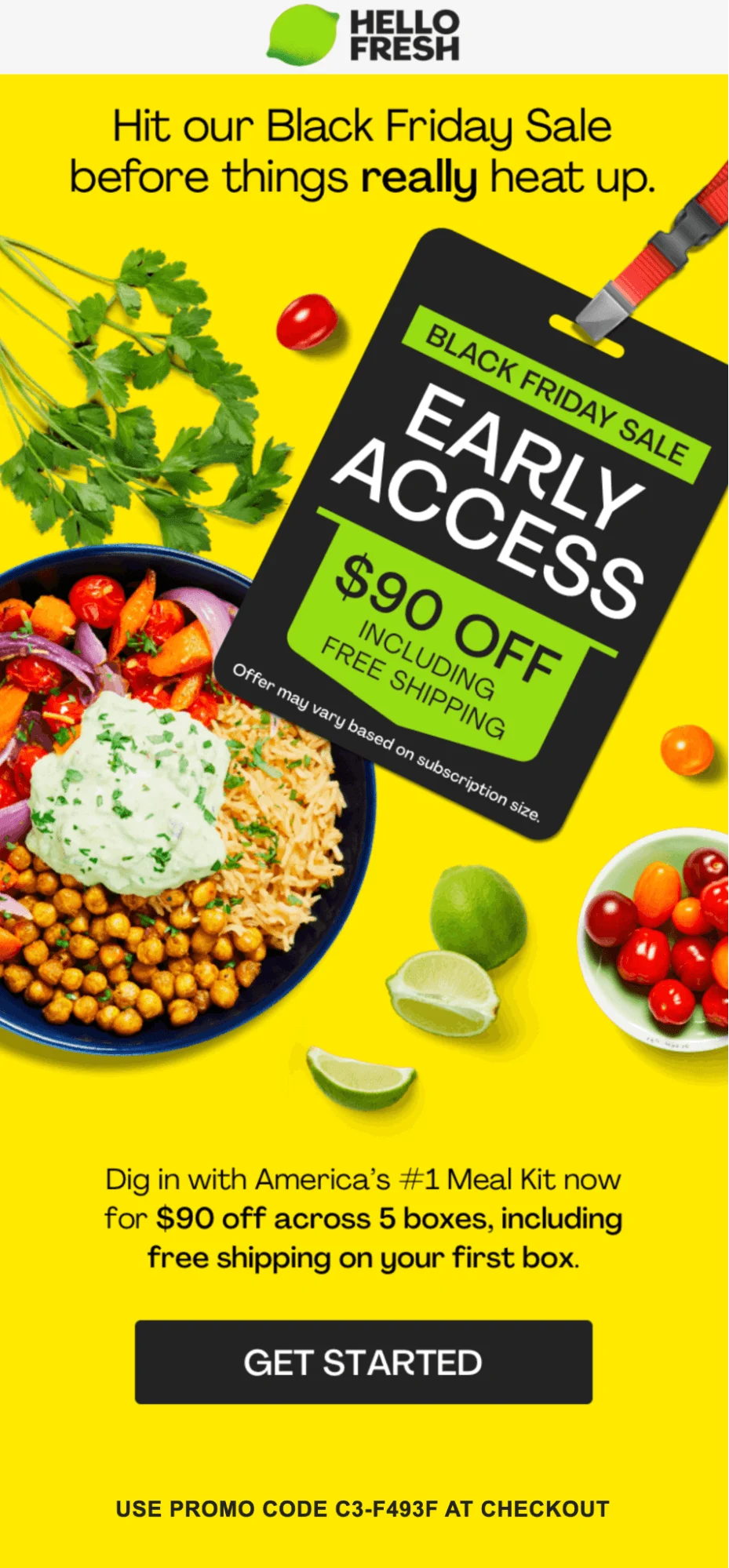
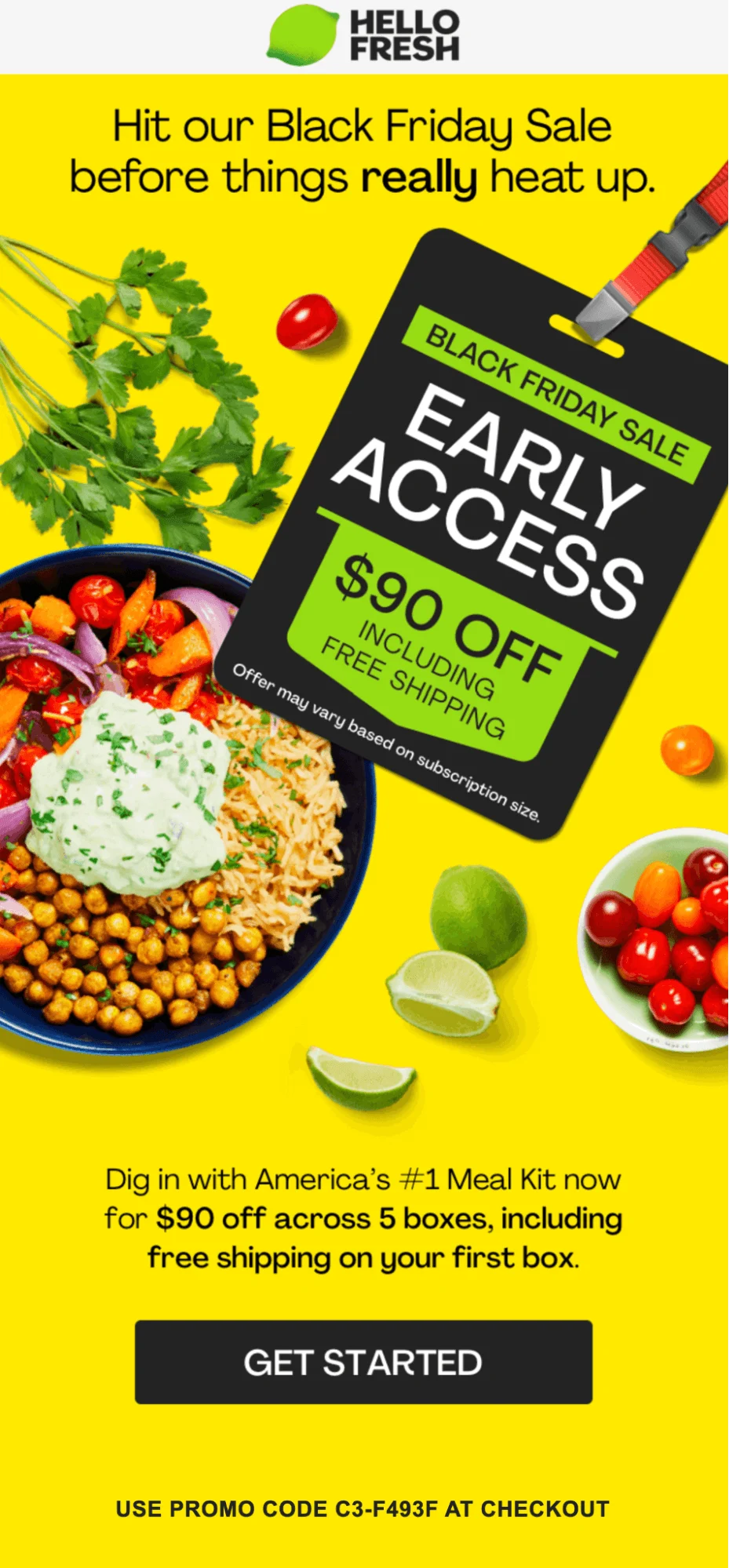
Rewarding customer loyalty is a powerful strategy, particularly during BFCM. Brands often extend early access to their most valued customers, such as VIPs or frequent purchasers, with exclusive offers. HelloFresh, for instance, offers existing customers early access to significant discounts, such as "$90 off with free shipping across five meal kits." Framing these discounts as a reward rather than a generic sale enhances the perception of exclusivity and appreciation.
- Why it works: Previous customers represent a "warm" audience, already familiar with and trusting of the brand. Providing them with early, exclusive access taps into their loyalty and increases the likelihood of repeat purchases before the main event. Data suggests that VIP segments often exhibit significantly higher open and conversion rates. For example, SM Global Shop reported a 65% open rate on its VIP emails, underscoring the effectiveness of this approach.
- Implications: This strategy not only drives early sales but also reinforces customer loyalty, making VIPs feel valued. It requires effective customer segmentation capabilities within an email marketing platform, allowing brands to identify and target high-value customer groups based on purchase history, frequency, and overall spend.
3. Leveraging Social Proof and Bestsellers for Credibility
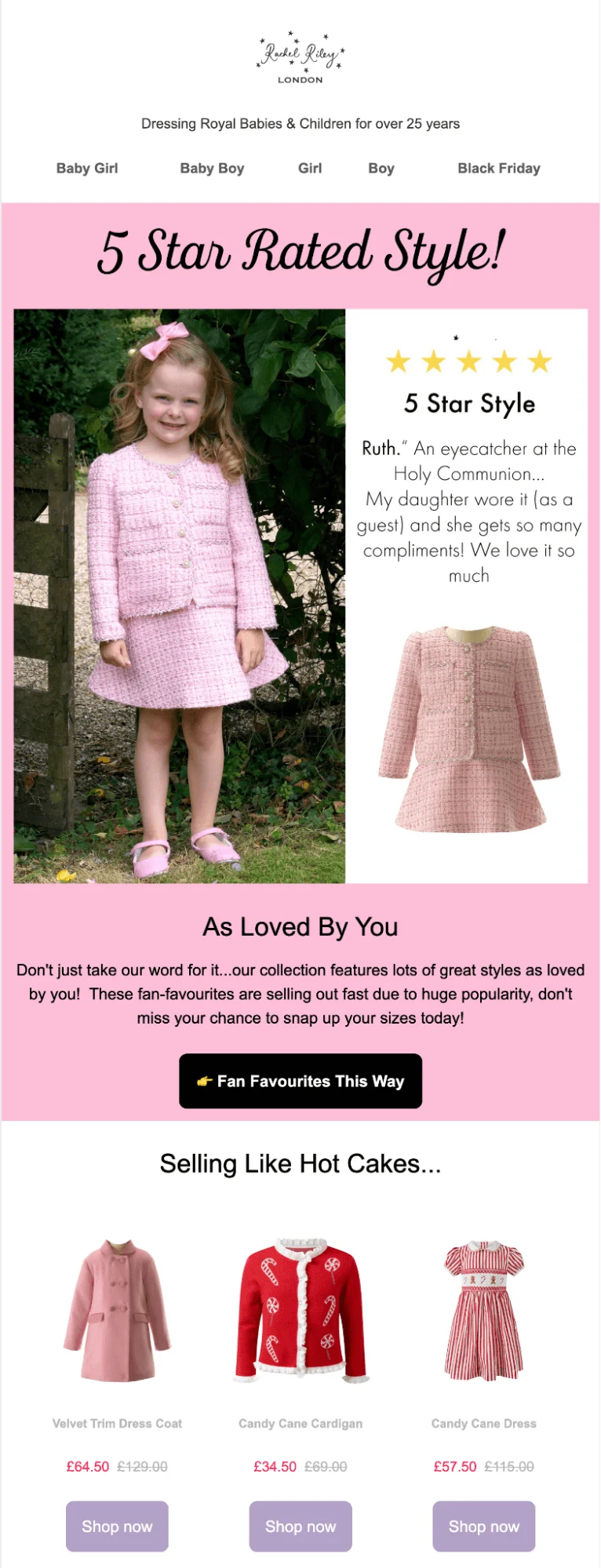
In an era of informed consumers, social proof is an invaluable marketing tool. Rather than solely focusing on discounts, some brands lead with customer testimonials and product ratings. Children’s clothing brand Rachel Riley successfully incorporates five-star ratings and written reviews into its Black Friday emails, emphasizing "5 Star Rated Style!" and "As Loved By You" sections. This approach highlights the product’s quality and popularity, often more persuasive than a percentage off.
- Why it works: Social proof directly addresses potential buyer skepticism, particularly for gift-givers unfamiliar with a brand or product. A positive review from a peer can be more compelling than any direct promotional message. By showcasing bestsellers alongside these reviews, brands guide hesitant shoppers towards popular and trusted choices. Rachel Riley’s success, with a 77% year-over-year increase in BFCM revenue driven largely by email, attests to this strategy’s power.
- Implications: Brands should actively collect and integrate customer reviews and ratings into their email campaigns. Lifestyle imagery depicting products in use further authenticates these testimonials. This strategy builds trust and helps customers make confident purchasing decisions, especially for items they may not have experienced personally.
Phase 2: Maximizing Engagement During BFCM Peak
Once the Black Friday period officially begins, strategies shift towards direct engagement, leveraging psychological triggers like curiosity and urgency.
4. Running Gamified or Mystery Offers for Interactive Engagement
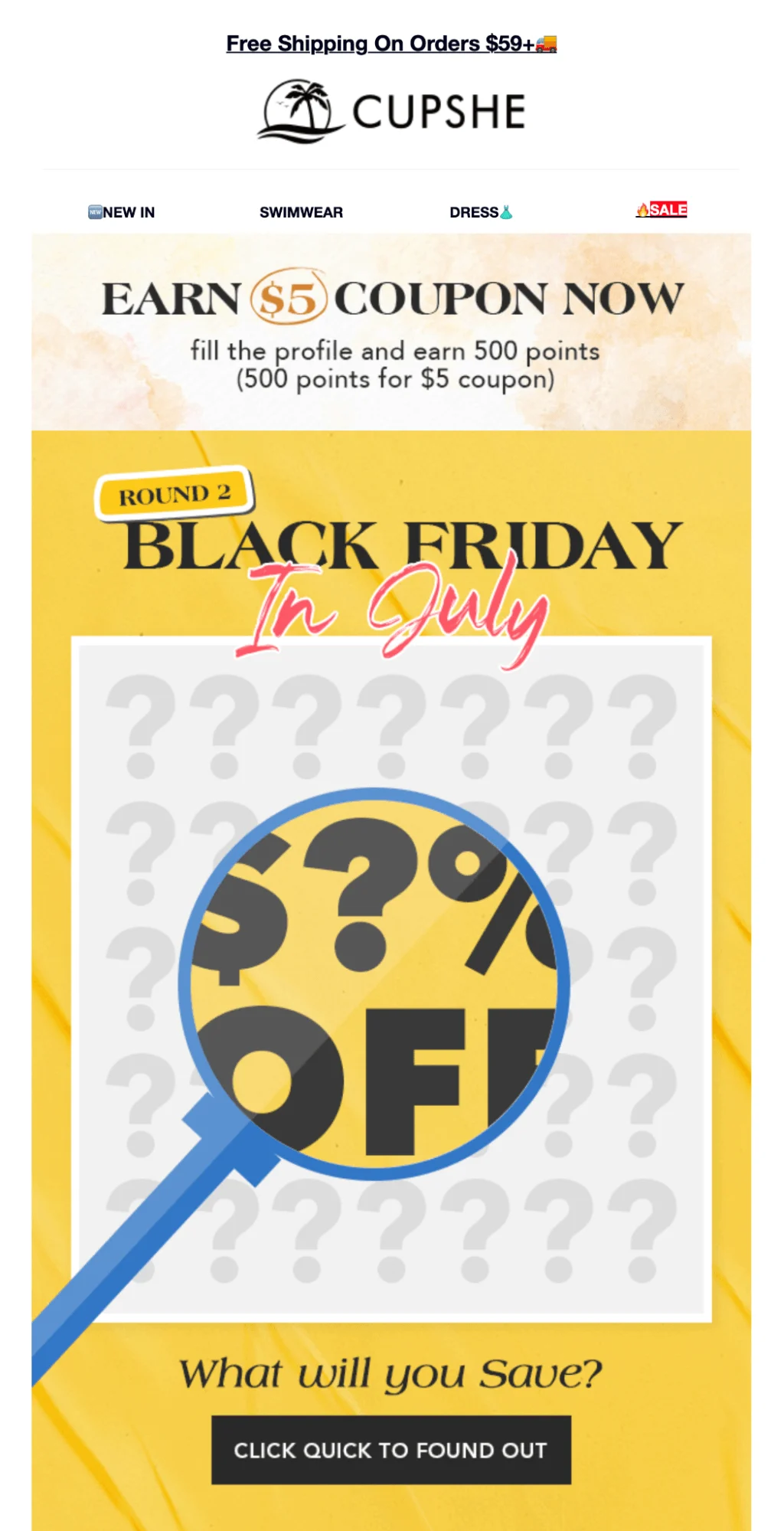
To break through the monotony of standard discount emails, gamified or mystery offers inject an element of fun and intrigue. Swimwear brand Cupshe, for example, used a "Black Friday in July" promotion that concealed the exact discount behind question marks, revealing just enough to pique curiosity (e.g., "$", "%", "OFF"). This encourages clicks and direct interaction.
- Why it works: Gamification taps into human curiosity and the desire for reward. A "spin-to-win" wheel, a "scratch-to-reveal" discount, or a mystery coupon creates an interactive experience that traditional static emails cannot. Even hesitant shoppers are often enticed to participate, increasing engagement rates and driving traffic to the website.
- Implications: Implementing gamified elements typically requires specialized email marketing tools or integrations. While effective, brands must ensure the reveal is genuinely rewarding to maintain customer trust and prevent disappointment. This strategy can be particularly potent during slower sales periods outside of the traditional BFCM window.
5. Offering Strategic Bundle or Tiered Deals to Increase AOV
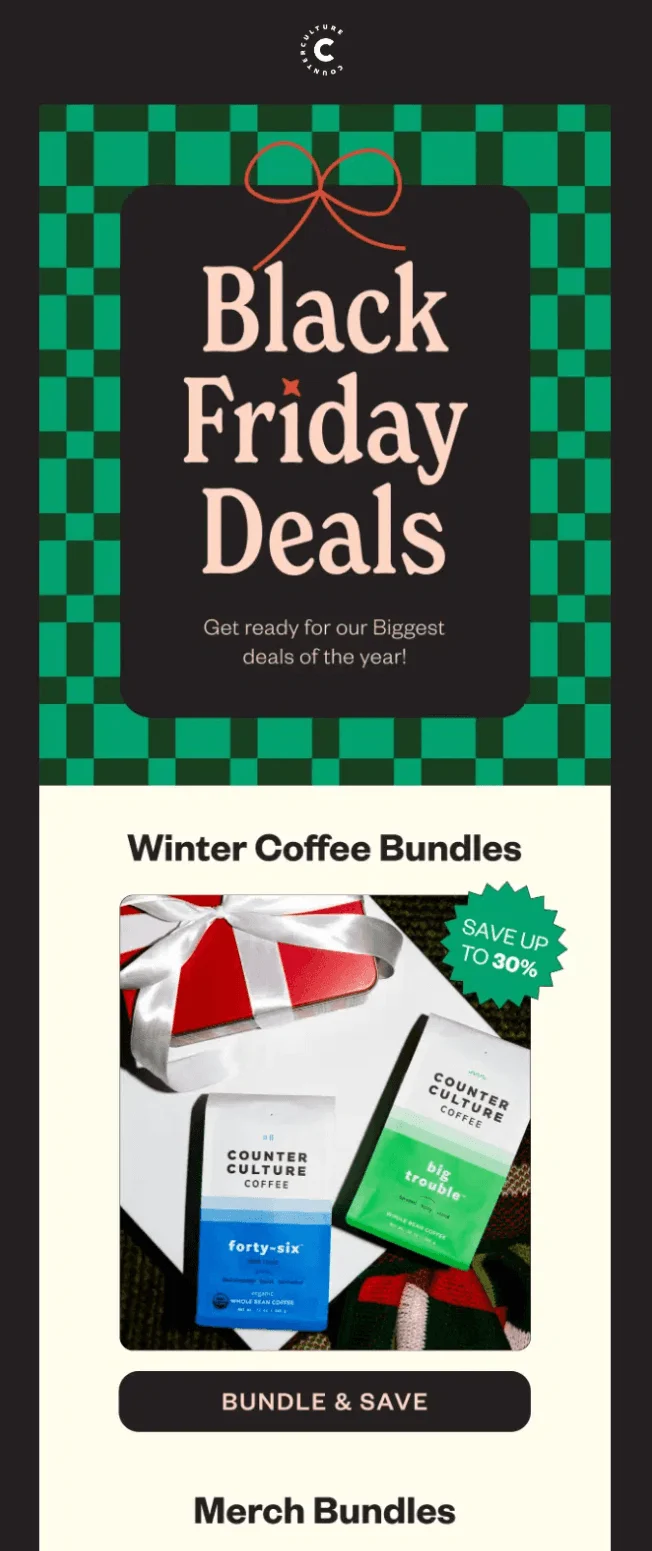
Beyond simple percentage discounts, bundle offers and tiered deals provide greater perceived value and encourage higher average order values (AOV). Counter Culture Coffee, for instance, groups complementary products into "winter coffee bundles" with clear savings (e.g., "Save up to 30%"). Tiered discounts, where customers save more as they spend more (e.g., 10% off $50, 15% off $100, 20% off $150), also incentivize larger purchases.
- Why it works: Bundles simplify the decision-making process for customers, especially gift-buyers, by curating related products into a single purchase. Tiered discounts motivate customers to add more items to their cart to reach a higher savings threshold. Both strategies align with the BFCM consumer mindset, where shoppers are often looking to maximize savings on multiple purchases.
- Implications: This requires careful product selection and pricing to ensure bundles offer genuine value while remaining profitable. Imagery should clearly communicate the value proposition, and calls-to-action should be direct, such as "Bundle & Save." This strategy is particularly effective for brands with diverse product catalogs suitable for gifting or complementary purchases.
6. Incorporating Countdown Timers to Create Urgency
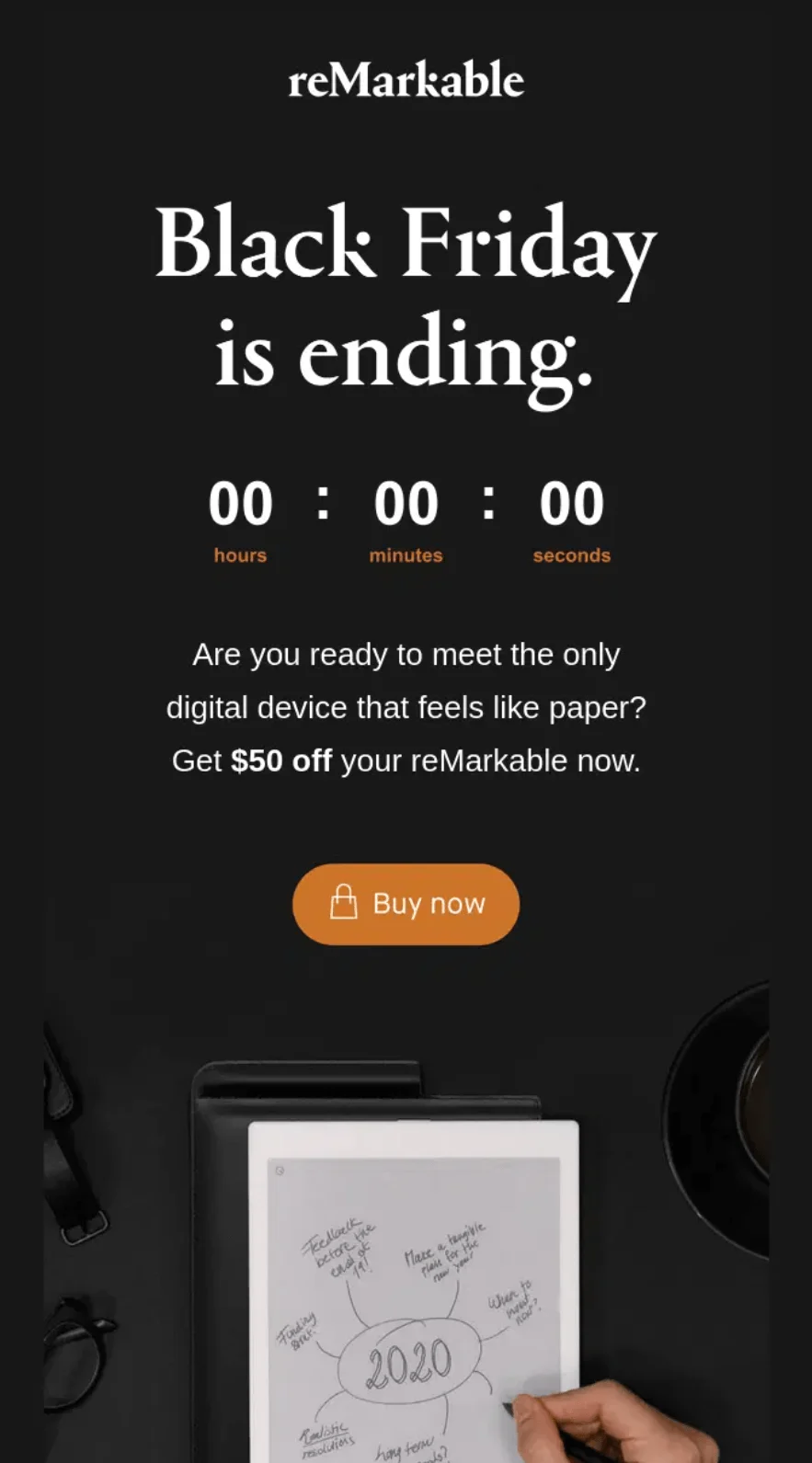
Urgency is a powerful psychological trigger in sales, and countdown timers visually reinforce the limited-time nature of BFCM deals. Brands like reMarkable, which sells e-ink paper tablets, effectively use live countdown clocks in their "last chance" emails. A prominent timer, coupled with a clear call-to-action like "Buy now," compels hesitant customers to act before the offer expires.
- Why it works: Countdown timers create a palpable sense of scarcity and fear of missing out (FOMO), driving immediate conversions. In the fast-paced BFCM environment, customers appreciate clear indicators of deal expiration, helping them prioritize their shopping.
- Implications: Dynamic countdown timers require specific email marketing platform features. Brands must ensure the timer is accurate and updates in real-time. Overuse of urgency can lead to customer fatigue, so this tactic is best reserved for critical moments like the final hours of a sale. Simplicity in design—logo, heading, timer, offer, and CTA—is often sufficient for maximum impact.
Phase 3: Sustaining Momentum and Reinforcing Values (Post-BFCM & Beyond)
The BFCM period doesn’t end with Cyber Monday; smart brands extend their influence through thoughtful follow-ups and value-driven messaging.
7. Adopting an Anti-Black Friday Stance with a Values-Based Angle
Not all brands participate in the heavy discounting typical of Black Friday. Luxury or premium brands, such as Amundsen Sports, might opt for an "anti-Black Friday" approach to preserve brand integrity and avoid training customers to only buy during sales. Their emails might feature "NO SALES, JUST VALUES" while still leveraging the "BLACK FRIDAY" heading to capture attention. This approach often highlights brand ethos, sustainability, craftsmanship, or adventure.
- Why it works: This strategy appeals to a segment of consumers who are wary of hyper-consumerism or prioritize brand values over deep discounts. It reinforces a premium brand’s positioning and avoids devaluing its products. While not generating direct discount-driven sales, it strengthens brand loyalty and attracts a specific demographic. Amundsen’s success with its order-confirmation email generating 16.7% of yearly revenue highlights the power of consistent brand messaging.
- Implications: This requires a strong brand identity and a clear articulation of values. It may not result in immediate BFCM sales spikes but contributes to long-term brand equity. Brands can offer alternative rewards, such as loyalty points, exclusive content, or charitable donations linked to purchases, instead of discounts.
8. Curating a Thoughtful Gift Guide for Seamless Shopping
For many, BFCM is the start of holiday gift shopping. A well-curated gift guide simplifies the purchasing process, particularly for those buying for others. Audio brand RØDE, for example, categorizes its products into "Signature Studio Kit," "Street Interview Kit," and "Ultimate Podcast Kit," each described with the ideal recipient in mind. This removes guesswork and facilitates quick decisions.
- Why it works: Gift guides cater directly to a key BFCM motivation: buying presents. By segmenting products not by category but by recipient or use case, brands streamline the shopping experience for overwhelmed consumers. This approach transforms a potentially confusing browsing experience into a clear path to purchase.
- Implications: Brands should analyze past sales data and popular product combinations to create compelling kits. Clear, descriptive names for bundles and concise explanations of who they’re for are essential. Adding an extra incentive, like RØDE’s "free beanie with any December purchase," can further encourage immediate action.
9. Mapping Out the Weekend with Daily Deals for Sustained Engagement
To maintain engagement throughout the extended BFCM weekend, some brands provide a clear schedule of daily deals. Island Olive Oil Company successfully lists specific dates, rewards, and savings in a series, enabling customers to plan their shopping and avoid missing out. This structured approach helps manage customer expectations and encourages multiple visits or purchases.
- Why it works: A "weekend guide" takes the pressure off immediate purchasing and allows customers to strategically plan their shopping. By offering different deals each day, brands provide continuous reasons for customers to return and explore new offers, thereby increasing engagement over the entire period.
- Implications: This strategy requires careful planning of promotions to ensure a fresh incentive each day. Clear visual presentation of the schedule within the email is vital. It’s particularly effective for segments of customers who prefer a more organized approach to their holiday shopping. Island Olive Oil’s success with automated emails generating 39% of total email marketing revenue underscores the importance of a well-orchestrated email strategy.
10. Extending Past Cyber Monday with Last-Chance Emails
Even after Cyber Monday concludes, there’s still an opportunity to capture sales from those who missed out or were holding out for better deals. Coffee brand Intelligentsia employs a post-event Black Friday strategy, sending "last-chance" emails with tiered discounts (e.g., 10-20% off) to entice late shoppers. These emails can also introduce new product releases, creating additional interest.
- Why it works: A last-chance email provides a final opportunity for fence-sitters and those who simply forgot or were too busy during the peak period. Tiered discounts encourage customers to increase their order value, while introducing new releases maintains product interest beyond the sale.
- Implications: The "extension" period should be clearly time-limited to maintain urgency without devaluing the original BFCM offers. Brands should segment customers who opened BFCM emails but didn’t purchase for these last-chance campaigns. This tactic effectively maximizes revenue from the extended holiday shopping window.
Conclusion and Broader Implications
The effectiveness of Black Friday email marketing hinges on strategic planning, deep audience understanding, and the ability to execute diverse, engaging campaigns. From building early anticipation with teasers and rewarding loyal customers with early access, to leveraging social proof, interactive gamification, and compelling bundles during the peak, each strategy plays a vital role. Furthermore, thoughtful post-BFCM tactics, including value-driven messaging and last-chance extensions, ensure sustained engagement and revenue.
In an increasingly competitive digital marketplace, brands must go beyond simple discounts. They need to craft a cohesive narrative that guides customers through the entire BFCM journey, addressing their psychological motivations for purchase. This involves leveraging sophisticated email marketing platforms capable of advanced segmentation, automation, and dynamic content. By meticulously planning campaigns and flows—including welcome series, abandoned cart reminders, and post-purchase follow-ups—businesses can not only drive significant sales during BFCM but also cultivate lasting customer relationships that extend far beyond the holiday season. The success of Black Friday email marketing ultimately lies in creating a high-quality customer experience that is both rewarding and memorable.