

The landscape of digital commerce is undergoing a fundamental transformation as organizations shift from gut-instinct decision-making to rigorous, evidence-based experimentation. At the forefront of this movement in the Nordic region is Lomax A/S, a leading Danish B2B supplier of office equipment, electronics, and furniture. Sanne Maach Abrahamsson, the Digital Team Lead at Lomax, has spearheaded the integration of Conversion Rate Optimization (CRO) and artificial intelligence within the company’s digital strategy. Her journey from the finance sector to becoming a prominent figure in the experimentation community illustrates a broader industry trend: the convergence of user-centered design, data science, and commercial accountability.
The Evolution of Experimentation at Lomax A/S
Lomax A/S, founded in 1962, has successfully navigated the transition from a traditional catalog-based business to a digital-first e-commerce powerhouse. For Abrahamsson, the transition into the world of digital optimization was not a calculated career move but an opportunistic pivot. With a professional background in finance and a formal education in interaction design, she was tasked with introducing CRO as a formal discipline at Lomax shortly after joining the company.

At the time, the concept of conversion rate optimization was relatively nascent within the organization. Abrahamsson’s initial mandate was to bridge the gap between user experience (UX) and measurable commercial outcomes. By applying the principles of interaction design—focusing on how users perceive and interact with digital interfaces—and combining them with the analytical rigor of her finance background, she established a framework where every website change had to be justified by empirical evidence.
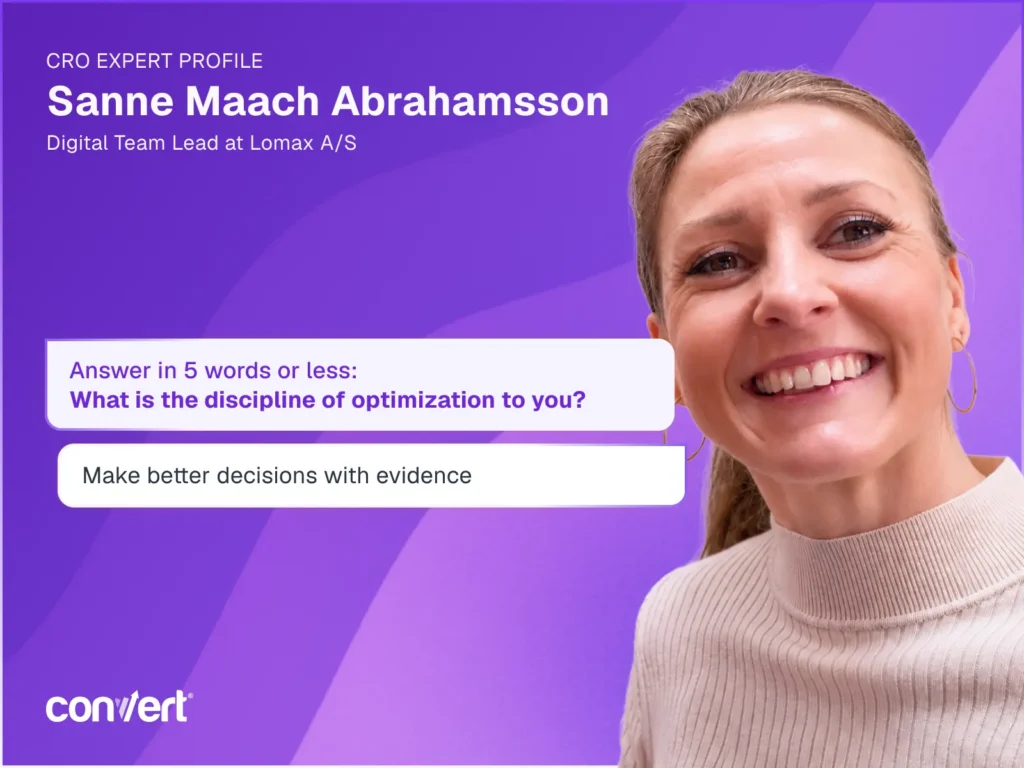
The discipline, as Abrahamsson defines it, is simple yet profound: "Make better decisions with evidence." This philosophy has allowed Lomax to move away from the "Highest Paid Person’s Opinion" (HiPPO) model, ensuring that the digital experience is shaped by actual customer behavior rather than internal assumptions.
Building a Shared Organizational Memory
One of the most significant challenges in modern experimentation is not the execution of tests, but the retention of knowledge. Abrahamsson notes that a recurring risk in digital teams is the "evaporation" of insights. When an experiment concludes, the results are often buried in outdated slide decks, archived Jira tickets, or the personal memories of departing employees. To combat this, Lomax has invested heavily in a learning infrastructure designed to serve as a single source of truth.

The centerpiece of this infrastructure is a structured database built on Airtable, which serves as a repository for test documentation, qualitative research, roadmaps, and final results. By centralizing this data, Lomax ensures that every experiment contributes to a "shared organizational memory." This approach allows the team to identify long-term patterns in customer behavior rather than treating every test as an isolated event.
To further enhance this system, Abrahamsson’s team has integrated Claude, an advanced large language model (LLM), with their Airtable database. This integration allows for the rapid synthesis of historical data. Instead of manually auditing dozens of past experiments, the team can use AI to search for specific themes—such as how B2B customers react to bulk pricing displays or free shipping thresholds—and generate a summary of findings in seconds. This move from individual results to synthesized patterns represents a major leap in how mature experimentation teams operate.
The Role of Artificial Intelligence in Modern Workflows
The rise of generative AI has prompted a re-evaluation of the experimentation process. For Abrahamsson and her team, the goal of incorporating AI is not merely to increase the velocity of testing, but to improve the quality of the insights derived. The focus is on automating repetitive, low-value tasks to allow human practitioners to focus on high-value judgment calls.

"AI opens up new possibilities, which has raised my ambitions as well," Abrahamsson explains. Tasks that previously required significant manual labor or additional headcount are now handled by AI agents. However, she warns against the "volume trap"—the temptation to run a high quantity of tests simply because AI makes it easier. If an organization cannot process the results or turn them into actionable business decisions, the increased volume is counterproductive.
The current strategy at Lomax involves finding the "human-in-the-loop" balance. If the time required for a human to review and correct an AI’s output equals the time it would have taken to do the work manually, the tool is discarded. The value of AI in the CRO process is currently concentrated in data synthesis, initial drafting of variants, and the categorization of qualitative feedback from customer surveys.
Case Studies in Risk Mitigation: Avoiding Expensive Failures
In a professional journalistic context, the success of a CRO program is often measured by the "uplift" it generates. However, Abrahamsson argues that the most valuable experiments are frequently those that prevent costly mistakes. She highlights two specific instances where experimentation saved Lomax from significant technical and financial debt.
The Video Automation Experiment
Management at Lomax was initially enthusiastic about a third-party tool designed to automatically populate product pages with videos. The tool functioned by scraping YouTube and matching content to the Lomax product catalog. On the surface, the business case was strong: video engagement is a known driver of conversion, and manual video curation is labor-intensive.
However, a controlled A/B test revealed a different reality. The automated tool frequently pulled influencer content that didn’t align with the brand, included videos in incorrect languages, and produced a disjointed user experience. The experiment showed a clear drop in both conversion rates and average order value (AOV). By testing the tool before committing to a long-term contract, the team avoided a multi-thousand-euro investment in a product that would have actively harmed the business.
AI-Generated Product Descriptions
In another study, the team compared human-written product descriptions against AI-generated versions across various levels of the site funnel. The results were nuanced. On individual product pages, the AI descriptions outperformed human copy by providing clear, structured information that helped customers make quick purchasing decisions. Conversely, on category-level pages, the AI-generated text was perceived as generic and lacked the creative "hook" necessary to engage users at the discovery stage.
This experiment provided a vital lesson in the limitations of current AI: it excels at utility-driven information but struggles with brand-aligned storytelling. This insight allowed Lomax to implement a hybrid model where AI handles the technical specifications while human copywriters focus on high-impact category pages.
Supporting Data and Industry Context
The shift toward the "judgment-based" model described by Abrahamsson is supported by broader industry trends. According to the 2024 State of Experimentation report, high-maturity organizations are 2.5 times more likely to have a centralized knowledge base for their testing results. Furthermore, data from Gartner suggests that by 2026, 60% of digital marketing leaders will rely on AI-augmented experimentation to drive personalization, yet only 20% will successfully integrate these tools into their decision-making frameworks.
The B2B e-commerce sector, in which Lomax operates, presents unique challenges for CRO. Unlike B2C retail, where emotional triggers often drive purchases, B2B buyers are typically motivated by efficiency, bulk pricing, and logistical reliability. This makes the "evidence-based" approach even more critical, as small friction points in the procurement process can lead to the loss of high-value corporate accounts.

Strategic Implications: The Shift from Execution to Judgment
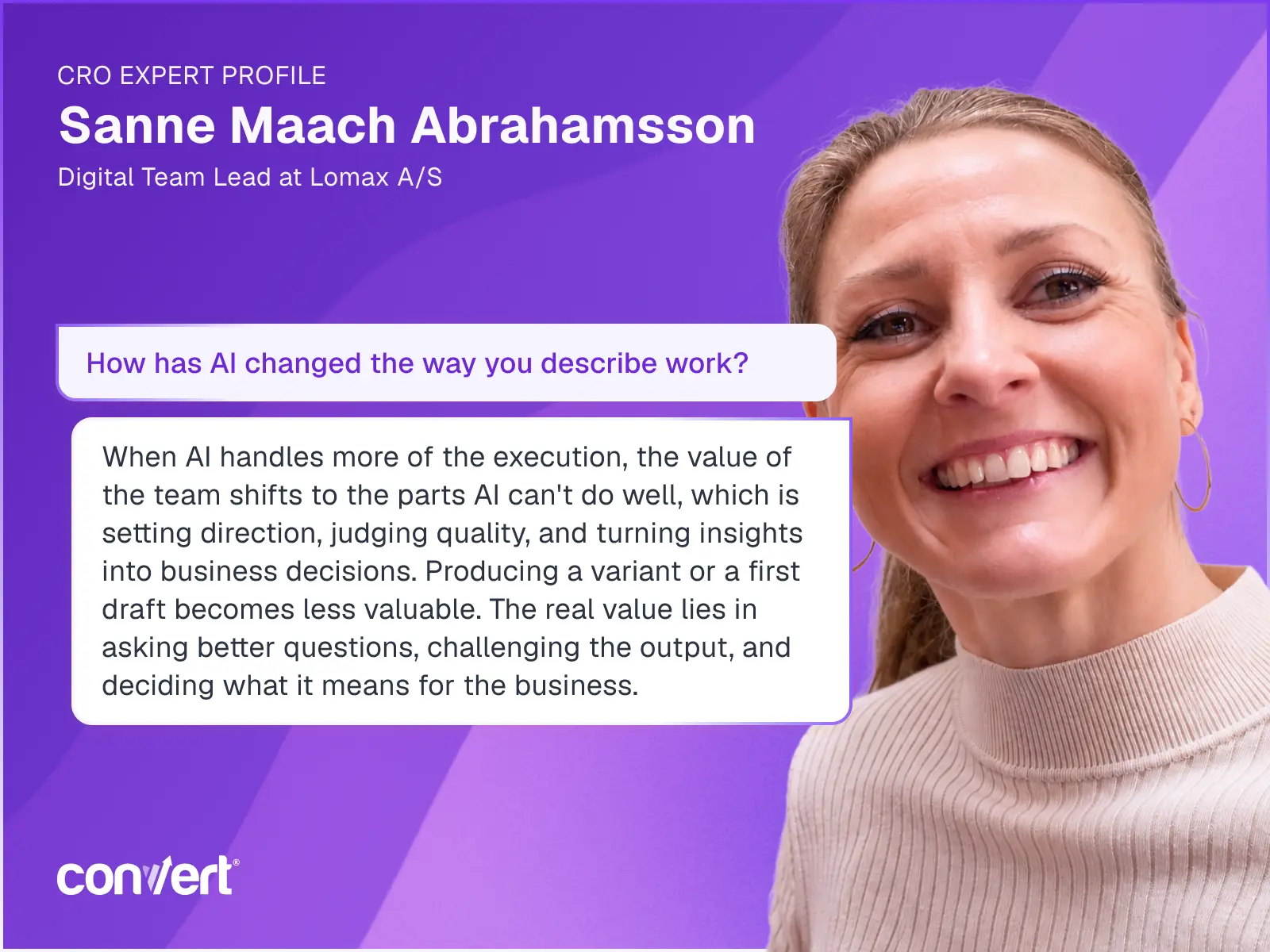
As AI continues to simplify the execution phase of digital marketing—writing code, generating images, and analyzing basic data sets—the competitive advantage of a digital team is shifting. Abrahamsson posits that the future of the discipline lies in "asking better questions" and "challenging the output."
In her view, the role of a leader in this environment is to manage both human talent and AI agents. The focus is on maintaining high quality and ensuring that the team remains curious and critical of the data they receive. The practitioners who will thrive in the next decade are not those who can run the most tests, but those who can most effectively translate a test result into a strategic business pivot.
Conclusion and Future Outlook
The integration of CRO and AI at Lomax A/S serves as a blueprint for other organizations looking to professionalize their digital operations. By prioritizing a "shared organizational memory" and focusing on risk mitigation through testing, Sanne Maach Abrahamsson has demonstrated that the true value of experimentation lies in its ability to make an organization "smarter" over time.

As the industry moves forward, the emphasis will likely remain on the "judgment" aspect of the human-AI partnership. For Lomax, the roadmap involves further refining their AI-driven insights and continuing to use experimentation as a shield against expensive business errors. In the rapidly evolving digital economy, the ability to learn from failure is becoming just as valuable as the ability to engineer success.







