rifanmuazin
Instapage, a leading provider of post-click automation and landing page solutions, has announced the launch of AI Collections, a sophisticated new feature set designed to eliminate the manual bottlenecks associated with large-scale marketing personalization. This technological advancement allows marketing teams to automate the creation of hundreds of unique, audience-specific landing pages from a single template, reportedly increasing the speed of production by up to three times compared to traditional manual methods. By integrating generative artificial intelligence directly into the page-building workflow, Instapage aims to bridge the gap between marketing strategy and execution, enabling brands to deliver highly relevant experiences to every segment of their audience without the historical overhead of manual duplication and content management.
The Challenge of Personalization at Scale
For over a decade, digital marketers have recognized that personalization is the primary driver of conversion rate optimization (CRO). According to industry data from McKinsey & Company, companies that excel at personalization generate 40% more revenue from those activities than average players. Despite this clear financial incentive, the "Personalization Paradox" remains a significant hurdle: while consumers demand tailored experiences, the operational cost of creating those experiences often outweighs the benefits for all but the largest enterprises.
Historically, personalizing a campaign meant creating a master landing page and then manually duplicating it for every keyword, audience segment, or geographic location. This process required editors to manually swap out headlines, images, and body copy across dozens or hundreds of individual URLs. Not only is this process prone to human error, but it also creates a massive maintenance burden. When a core brand message or pricing detail changes, teams are forced to update every duplicated page individually. AI Collections is positioned as the solution to this structural inefficiency, transforming the landing page from a static file into a dynamic, data-driven asset.
Technical Architecture of AI Collections
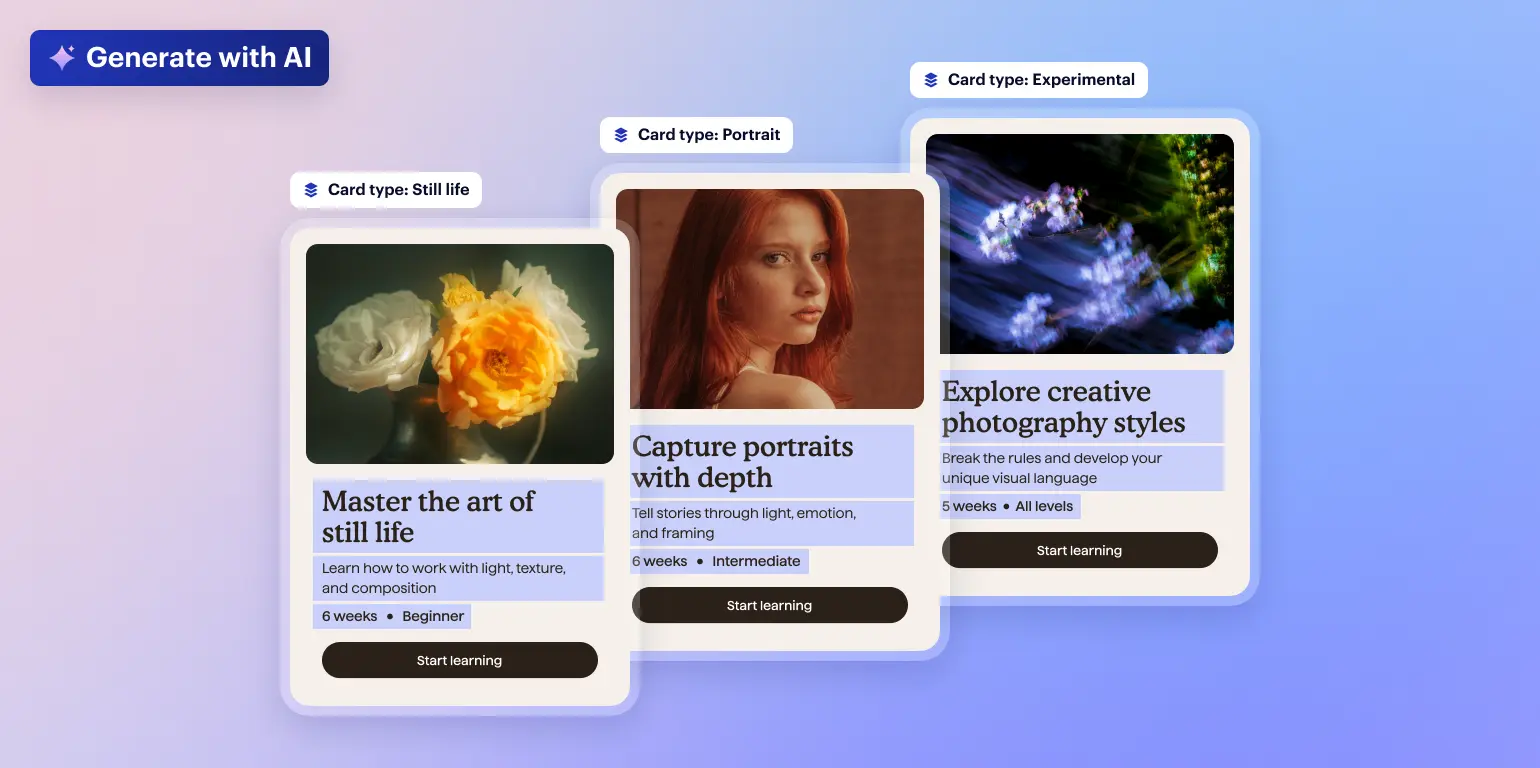
The core innovation of AI Collections lies in its shift from page-based management to a database-driven architecture. Rather than treating each landing page as a separate entity, the system utilizes a centralized content table. This table functions as the "brain" of the campaign, where each row represents a unique page and each column represents a dynamic content element—such as a headline, a call-to-action (CTA), or a hero image description.
The workflow begins with the creation of a master template. Marketers can take an existing high-performing page and convert it into a "Collection Template." From there, the AI takes over the technical heavy lifting through two primary mechanisms: AI Placeholders and Dynamic Content Generation.
Automated Placeholder Identification
One of the most time-consuming aspects of setting up dynamic pages is identifying and mapping which elements on a page should change. AI Collections utilizes machine learning algorithms to analyze the design and layout of a page. The AI automatically identifies optimal text blocks for personalization and inserts "placeholders." This removes the need for marketers to manually tag every element, a process that previously required a deep understanding of the platform’s backend or basic coding knowledge. Once the AI suggests these placeholders, users can review, edit, or remove them, ensuring that the creative vision remains under human control while the tedious setup is automated.
Generative Content Population
Once the structural framework is established, the system leverages large language models (LLMs) to populate the content table. Instead of writing 50 different headlines for 50 different target industries, a marketer can provide a single prompt describing the target audience and the specific value proposition for each entry. The AI then generates publish-ready copy tailored to those specific parameters. This integration ensures that the messaging remains consistent with the brand voice while being granularly tuned to the specific needs of the visitor.
A Chronology of Landing Page Evolution
To understand the significance of AI Collections, one must look at the evolution of post-click technology over the last twenty years.
- The Static Era (1995–2005): Landing pages were hard-coded HTML files. Any change required a developer, making personalization nearly impossible for fast-moving marketing teams.
- The Drag-and-Drop Era (2006–2015): The rise of SaaS platforms like Instapage allowed non-technical marketers to build pages. While this democratized design, scaling still required "cloning" pages one by one.
- The Dynamic Text Era (2016–2022): Tools introduced Dynamic Text Replacement (DTR), which allowed simple URL parameters to change specific words on a page. While useful for PPC, it lacked the ability to change entire layouts or complex messaging blocks.
- The AI-Driven Automation Era (2023–Present): With the launch of AI Collections, the industry moves into a phase where the AI understands the context of the page and the intent of the audience, automating both the design structure and the creative execution at a massive scale.
Supporting Data and Market Impact
The shift toward AI-automated personalization is backed by compelling market data. A recent survey of over 1,000 marketing executives found that 68% cited "lack of resources/time" as the primary reason they do not personalize their landing pages. Furthermore, data from the Content Marketing Institute suggests that 71% of B2B marketers are now using AI to assist with content generation, but only a small fraction have integrated it into their structural workflows.
By offering a "3x faster" production cycle, Instapage is targeting a significant reduction in the Cost Per Acquisition (CPA). In digital advertising, particularly on platforms like Google Ads and Meta, "Quality Score" and "Ad Relevance" are critical. When a landing page perfectly matches the ad copy and user intent, these platforms reward the advertiser with lower costs and better placements. AI Collections allows advertisers to achieve a 1:1 ratio between ads and landing pages, a feat previously reserved for companies with massive internal web teams.
Operational Impact and Industry Reactions
Industry analysts suggest that the launch of AI Collections will have a ripple effect across various marketing disciplines.
In the realm of Account-Based Marketing (ABM), where sales teams target specific high-value companies, AI Collections allows for the creation of bespoke pages for every target account. An SDR (Sales Development Representative) could theoretically generate 100 personalized landing pages for 100 different prospects in the time it previously took to draft a single follow-up email.
From a growth marketing perspective, the ability to test 50 different variations of a value proposition across different demographic segments provides a wealth of data that was previously too expensive to collect. "The limitation has never been our desire to test; it has been our bandwidth to build," noted one senior growth lead at a Silicon Valley fintech firm during a closed beta of the tool. "Moving the management of pages into a spreadsheet-like interface changes the game for our experimentation velocity."
Broader Implications for the Future of CRO
The introduction of AI Collections signals a broader shift in the role of the digital marketer. As AI takes over the "execution" phase—the duplicating, the editing, and the manual entry—the marketer’s role shifts toward "orchestration." Success in this new era will depend less on one’s ability to navigate a design editor and more on one’s ability to provide high-quality context and prompts to the AI.
Furthermore, the integration of "fluid grid blocks" within the Instapage ecosystem ensures that as AI generates varying lengths of text, the page layout adjusts automatically to maintain visual integrity. This solves the "design break" problem where dynamic content often overlaps or ruins the aesthetic of a page.
As marketing technology continues to consolidate, the ability to deliver personalized experiences at scale is becoming a baseline requirement rather than a competitive advantage. The launch of AI Collections by Instapage represents a significant step toward a future where every click on a digital ad leads to a page that feels as though it was designed specifically for the person who clicked it.
Conclusion and Availability
Instapage has made AI Collections available to its users, offering a 14-day free trial to allow teams to test the workflow improvements firsthand. The company emphasizes that while the AI provides the speed, the marketer remains in the driver’s seat, with full capability to review and refine every AI-generated element. This balance of automation and human oversight is likely to become the standard model for professional-grade marketing tools in the coming years. By removing the technical and temporal barriers to personalization, AI Collections may finally allow the industry to deliver on the long-standing promise of the "segment of one."


 Asro
Asro
 Dwi Wanna